Digital Advertising Measurement Is Broken, and Offline Signals are the Fix: Padsquad

MIAMI — The advertising industry has been measuring digital campaigns the same way for years, clinging to metrics that create more noise than insight. Meanwhile, brands and agencies struggle to separate meaningful signals from the clutter of KPIs that fail to connect with actual business outcomes.

“We’re living in a time and a place where there are tons of mixed signals and KPIs that are being given to agencies and to brands direct,” said Lance Wolder, head of commercial strategy and marketing at PadSquad, in this video interview with Beet.TV at POSSIBLE 2026.

“And that kind of noise makes it a lot harder for brands and their agencies to be able to shift through and find the things that really matter.”

Rethinking planning and creative through behavioral signals

The integration of offline behavioral data into media planning represents a departure from the “clumsy digital KPIs” that have dominated the industry, according to Wolder. Rather than relying on proxies for consumer interest, advertisers can now understand how media exposure translates into physical-world actions.

This capability arrives as digital video advertising continues its ascent. According to eMarketer’s Digital Video Forecast and Trends Q2 2026 report, connected TV upfront ad spending in the U.S. is projected to reach $17.73 billion this year, surpassing primetime linear TV upfront spending of $16.98 billion for the first time.

“From a planning perspective, we’re not just looking at the clumsy digital KPIs that have become the norm and have created all this messy signal,” Wolder said. “But we now have the opportunity to understand this new collapsed funnel in a more meaningful way and inform how we show up, where we show up and why we’re showing up for consumers.”

Small creative tweaks yield outsized results

Research conducted by PadSquad in partnership with OM Media trials examined how minor adjustments to creative execution could improve campaign outcomes. The year-long study tested more than 4,000 individuals in live environments to understand the impact of creative modifications.

The findings suggest that advertisers need not reinvent their creative assets entirely to see meaningful improvements. Simple adaptations to existing work can produce substantial gains in consumer response.

“What we found was whether it was just a simple adapting the way that the creative looked or adding interactivity as a component of that ad, we were able to shift the purchase intent for that consumer by 3x by simply making a tweak to that creative,” Wolder said. “And it’s still the same core asset that was delivered by the agency. It’s just refined and reimagined a little bit for a new era of consumption.”

Interactive video challenges attention orthodoxy

While attention metrics have gained currency across the industry, Wolder expressed skepticism about their predictive value for actual business outcomes. The real measure, in his view, lies in consumer behaviors rather than attention scores.

PadSquad reported 70% year-over-year growth in clients purchasing video advertising in January 2026, with a 57% increase in CTV spend specifically. The company attributes this growth to increased investment in interactive video streaming formats across desktop, mobile, and CTV.

“Attention doesn’t really signal whether or not somebody’s gonna go to a store or purchase a product. However, their behaviors do,” Wolder said. “What we’ve learned is that an interactive ad provides high consideration category brands the ability to offer more storytelling and more of a vehicle for them to connect with the consumer in a more meaningful way.”

Pharma Brands are Missing CTV’s ‘Halo Effect,’ Says CMI Media Group’s Miller

MIAMI — The pharmaceutical industry has long treated television advertising with affection – big budgets, elaborate productions, and a stubborn attachment to linear broadcasts. But the economics of reaching patients and healthcare professionals are shifting dramatically.

Connected TV offers pharma marketers something linear never could: the ability to adjust targeting, frequency, and creative in real time while measuring downstream effects across the entire media mix. Yet some think too many brands still treat CTV as merely a supplement to their traditional buys rather than a strategic lever in its own right.

“I honestly don’t think brands are recognizing that enough and I think they need to take more advantage of that and plan,” said Andrew Miller, EVP, digital activation, CMI Media Group, in this video interview with Beet.TV at POSSIBLE 2026.

The cost equation is changing

Linear television has dominated pharmaceutical advertising for decades, commanding enormous budgets and requiring lengthy creative development cycles. The rigidity of that model is increasingly at odds with how modern marketers need to operate.

“Linear budgets tend to be very large. The creative takes a long time to build and create. And then it’s kind of hard to manipulate that in a lot of ways,” Miller said. “CTV gives you a lot more flexibility.”

That flexibility extends beyond mere cost savings. Advertisers can repurpose CTV creative across multiple platforms, whether deploying it programmatically or through streaming engagements. The shift comes as U.S. CTV upfront ad spending is projected to reach $17.73 billion in 2026, surpassing primetime linear TV upfront spending for the first time, according to eMarketer.

Creative freedom unlocks new possibilities

The production requirements for linear television advertising have traditionally been onerous – expensive shoots, professional actors, and rigid format specifications. CTV operates under different rules entirely.

“You can have a 90 second spot, a 60 second spot, a 15 second spot, you can chop it up,” Miller explained. “It doesn’t need to be actors, it could be animation, it could be a bunch of different things. So there’s a lot more flexibility, a lot more freedom, because it is different.”

That creative latitude has practical implications for how pharma brands approach audience segmentation.

CMI Media Group is a full-service media agency dedicated exclusively to the healthcare, pharmaceutical, and life sciences industries. Part of WPP

Miller noted that CMI Media Group has seen success repurposing creative originally designed for healthcare professionals to reach patients and consumers directly. “Sometimes it will work for a separate audience as long as the message is clear and the brand is represented in the right way,” he said.

Measurement drives optimization

For an industry built on clinical precision, pharmaceutical marketing has historically operated with surprisingly imprecise measurement tools. Linear television’s attribution challenges have frustrated marketers seeking to connect advertising exposure to patient outcomes.

“Linear can be difficult to measure,” Miller said. “CTV gives you the metrics to allow you to optimize more in real time and really get the most out of your campaigns.”

The ability to track engagement data as it arrives allows marketers to adjust their approach mid-campaign rather than waiting for post-mortem analysis. This capability aligns with broader industry trends toward measurement maturity and AI-driven optimization that are reshaping the CTV landscape.

The halo effect demands planning

Perhaps the most underutilized aspect of CTV advertising is its influence on other marketing channels. When a connected TV campaign runs in market, it creates ripple effects across search, social media, and other touchpoints that many brands fail to anticipate or measure.

“When you have a CTV buy in market, you know there’s going to be a halo effect,” Miller said. “What’s happening? Are you seeing an increase in search? Are you seeing an increase in social presence? And then what do you do for your omnichannel strategy in response to that?”

CMI Media Group has been expanding its global footprint to better serve pharmaceutical clients navigating these complexities. The agency established a strategic hub in

Goodway Group’s Paul Frampton: TV and Digital Disciplines Were ‘Two Different Things,’ now ‘Almost One and the Same’

MIAMI — Television planning and digital video buying evolved as separate disciplines with distinct trading audiences and methodologies, but audience fragmentation across streaming platforms and emerging video environments is forcing industry convergence around content quality and emotional engagement rather than channel definitions.

“I grew up in a world where I learned how to be a TV planner and it worked in a very particular way. The audiences you buy, the trading audiences were very different to how digital is bought,” Paul Frampton, group CEO of Goodway Group, told Beet.TV contributor David Kaplan at POSSIBLE. “These days, I think it’s almost one and the same. The skillsets are much more blended.”

Viewership now spans platforms including YouTube and TikTok that wouldn’t historically be classified as television, forcing brands to prioritize audience discovery over channel categorization.

Content context drives emotional reaction

Television’s definition expands beyond traditional boundaries to encompass any audio-visual content that generates leaning behavior through high-quality context and emotional response, regardless of screen type or platform designation.

“Really for a brand, it’s where can I find my audience? Where can I actually get that leaning behavior by being around content that’s high quality, has great context and actually drives some emotional reaction?” Frampton said. “If you consider that to be television, then television’s everywhere, all around us.”

This audience-first approach prioritizes right moment and right context identification over channel-specific strategies.

Performance versus brand debate persists

Different marketer backgrounds create ongoing tension between brand builders focused on long-term development and performance marketers comfortable with Meta, Google, and commerce media, though all channels can serve dual purposes.

“There are different breeds of marketer that are comfortable in one world or the other even today,” Frampton said. “It’s a fallacy that digital only does performance and it’s a fallacy that TV cannot drive performance and is only for brands.”

Consumer behavior resembles “snakes and ladders” rather than linear funnels, with touchpoints spanning large language models, mobile devices, television ads, and peer reviews in non-segmented patterns.

Testing accessibility democratizes TV

Connected TV enables budget-efficient testing that previously required millions of dollars, allowing local brands and smaller advertisers to experiment with television’s engaging, emotional reach alongside digital’s targetability benefits.

“What I hear a lot more from CMOs is, ‘Can I test and experiment with TV with a smaller budget than I thought I could?’“ Frampton said. “With the same budget you might put into a test in digital, you can test CTV in a very targeted way.”

This accessibility extends television beyond big-budget national advertisers to local brands seeking geographic precision without unnecessary reach expansion.

Connected ecosystem drives next chapter

Television’s evolution toward connected ecosystems enables progression from awareness and consideration through action prompting, with Amazon’s Prime TV data targeting demonstrating how television becomes response channel rather than awareness-only medium.

“Amazon has changed that. You can use Amazon data to target people on Prime TV and suddenly television becomes a response channel,” Frampton said.

Future success requires connecting ecosystem components around role-based channel thinking and audience targeting rather than format-specific categorization that fails to serve marketer objectives effectively.

“We just need to connect the ecosystem back up, think about the role that we need a channel to play, think about the right audience, and then look at all of the available opportunities and tactics,” Frampton said.

Magnite’s Sean Buckley: What Supply Side Consolidation Means to the Buy Side

MIAMI — Supply-side platform partnerships have dramatically consolidated as buyers recognize the inefficiency of managing dozens of technology relationships, shifting toward deeper integrations with two to five strategic partners rather than broad vendor distributions.

“If you go back six or seven years, it was not uncommon for buyers to work with 50, 60 downstream supply side technology companies,” Sean Buckley, president, revenue at Magnite, told Beet.TV contributor David Kaplan at POSSIBLE. “Buyers have certainly realized that’s not an ideal setup. There’s material downside to operating that way.”

This consolidation drives supply-side data activation and decisioning as buyers pursue better signal fidelity, improved cost effectiveness, and workflow flexibility through fewer, deeper partnerships.

Retail media chooses supply-side integration

Commerce and retail media partners increasingly integrate data on the supply side rather than demand side, gaining workflow flexibility through single integrations that enable tight activation control while accommodating diverse buyer preferences.

“If a retail media partner integrates their data with us, there’s one integration. They’re able to have very tight control around how that data is activated through sell side refinement and they’re able to work with their various buyers through whatever workflow the buyer has,” Buckley said.

Recent partnerships include Expedia, Best Buy, and Roku’s curated offering that activates powerful retail media datasets for buyer access.

SpringServe adds mediation capabilities

Magnite’s SpringServe platform operates as both ad server and mediation hub, with mediation representing newer CTV functionality that integrates programmatic partners, creative quality tools, and inventory sharing between distributors and programmers.

New capabilities include autonomous anomaly detection that surfaces business changes outside normal parameters, dynamic pricing automation that adjusts to market conditions, and demand path analysis that clarifies dollar flow from brands to publishers.

Agentic transactions emerge through new rails

Magnite deployed seller agents enabling publishers to surface inventory options and buyer agents that process briefs andRFPs, creating automated deal agreement and transaction execution through emerging agentic frameworks.

“A few weeks ago, we announced our seller agent. [During the last week in April] we announced our buyer agent, which enables buyers to come forward with a brief, an RFP, what they’re looking for,” Buckley said. “Those two come together, agree on deal terms, and then we push that directly to our transaction layer.”

The interoperable approach allows partners to integrate existing agentic tools while maintaining flexibility for diverse customer requirements.

Strategic positioning drives scalability

Magnite’s ad stack position enables scalable agentic offering development through partnerships with consequential industry players including Disney, Charter Spectrum, Publicis, and MIQ.

“It’s critical where you sit in the ad stack and who you’re working with. We sit at a critical point in the ad stack, which makes it much more scalable to bring these types of offerings to market,” Buckley said. “We’re very excited, [and there’s a] long way to go, about the developments here.”

Why Matching Ad Emotion to TV Content Triples Viewer Attention

MIAMI — CTV can target ads – but often to the wrong person in the household. A campaign aimed at pickup truck buyers might reach a household that fits the demographic profile, but if the teenage daughter is watching Gilmore Girls on dad’s account, that impression is essentially wasted.

The solution, according to one ad tech executive, lies not in better identity resolution but in understanding what people are actually watching.

“Using these IDs has been problematic for a long time,” said Daniel Church, head of CTV at Seedtag, in this video interview with Beet.TV at the POSSIBLE event. “We actually flip it. We actually look at the content itself and we build on top of those content.”

Episode-level targeting beats genre targeting

Most contextual advertising in CTV operates at the genre level – entertainment, sports, news. But Church argued this approach leaves value on the table. The difference between targeting a broad category and targeting specific content can determine whether an ad resonates or falls flat, he said.

Seedtag recently launched NeuroX, which the company describes as a “Neuro-Contextual Exchange” that uses AI to analyze content from over 30,000 publishers and broadcasters. The platform rates individual pieces of content for different audience alignments, enabling advertisers to match campaigns to specific programming rather than broad categories.

“Let’s say you’re looking at a dog food advertiser. Friends might be a good program to be in, but if you’re looking at season two, episode six where they actually adopt a puppy, that is a great place to be,” Church said. “NeuroX is actually looking program by program, episode by episode, and understanding each individually.”

Emotional matching extends attention spans

Beyond topical relevance, Church emphasized the importance of emotional alignment between content and advertising. A jarring tonal shift from programming to commercial can cause viewers to mentally disengage before the brand message lands.

“Let’s say you’re watching the movie Saw, and you come up to an ad break and it’s a CPG ad break and it’s super happy. That’s a very jarring transition,” Church said. “Now, if you actually understand the context of what is happening, it’s a fear-based program, maybe you throw in a home insurance ad where a tree falls on the house.”

Church cited research conducted in partnership with neuroscience Professor Moran Cerf, which used EEG to measure brain activity while participants engaged with content on desktop and mobile. “If you’re matching the emotion and the context, you get three times longer attention in that ad unit before the person even realizes they’re watching that ad,” he said. “That retention is significantly higher. That boosts the ROI because that message is actually received and integrated into the brain rather than kind of discarded as useless noise.”

Privacy regulations favor contextual approaches

The timing for contextual CTV solutions appears favorable. U.S. CTV upfront ad spending is projected to reach $17.73 billion in 2026, surpassing primetime linear TV for the first time, according to Emarketer. Meanwhile, a patchwork of state privacy laws has complicated the use of personally identifiable information in digital advertising.

“For television buyers, they usually haven’t had to deal with this. They’ve been buying linear TV, running national campaigns,” Church said. “When you’re dealing with CTV, that’s not the case. You have 12 different or even more now privacy laws across the nation.”

Church noted that Seedtag, headquartered in Madrid, developed its technology under GDPR’s strict requirements. “We built our solution with that in mind,” he said. “When you work with us or some other contextual companies as well, you’re able to kind of sidestep those laws because they were written for data that we simply do not use and do not need to pay attention to.”

Universal Ads’ Adam Royle: Koddi Partnership Brings CTV to Commerce Buyers ‘Where They are Working Today’

Connected TV buying, planning, and measurement integration into commerce platforms eliminates traditional barriers that prevented retail media advertisers from accessing television inventory through familiar workflows.

“This week, Universal Ads and ad tech company Koddi announced a strategic partnership that brings CTV buying, planning, and measurement into the Koddi platform,” Adam Royle, head of Strategic Partnerships at Comcast’s Universal Ads, told Beet.TV editorial director Lisa Granatstein at POSSIBLE. “This means that CTV is now accessible to commerce buyers in Koddi and it meets them where they are working today.”

The integration enables precision targeting, buying, and measurement within existing commerce advertising workflows rather than requiring separate television-specific processes.

Performance TV testing at scale

The partnership allows brands and retail media networks to treat television as performance channel through native commerce ecosystem integration, expanding both advertiser access and publisher inventory reach.

“There is an opportunity for brands and retail media networks on a tactical level to now use TV as a performance channel at scale and test it and see how it fits into their objectives,” Royle said.

This creates broader industry expansion where publishers gain access to advertisers who never used television while enabling advertisers to reach previously inaccessible TV audiences.

Friction removal addresses barriers

Traditional television accessibility required significant financial investment and technical infrastructure including creative development, measurement partnerships, buying mechanisms, and specialized expertise that limited participation.

“TV accessibility in the past came with a lot of financial burden and also a lot of technical requirements,” Royle said. “In the past to get on television, someone might not have created content. They might not have a measurement partner or a measurement plan. They might not have a buying mechanism.”

Universal Ads solves these challenges through integrated solutions delivered natively within commerce advertising environments.

Shopper data enhances targeting precision

Retail media and CTV convergence leverages shopper data to improve premium video targeting accuracy, enabling commerce advertisers to apply familiar data assets to television inventory.

Universal Ads was founded specifically to remove television friction and expand category participation through simplified access that maintains targeting precision and measurement capabilities.

Winning strategy requires testing

Successful television strategy for brands avoids one-size-fits-all approaches, instead emphasizing testing capabilities that prove TV performance within broader media mix optimization.

“A winning TV strategy for brands is not a one size fits all, but this partnership allows these brands to test and prove TV as a performance channel at scale,” Royle said.

Beet@20: Lou Paskalis Says AI will Rewrite Marketing’s Playbook

Twenty years ago, Beet.TV pressed “record” at Google’s campus in Mountain View and quietly began documenting what would become a two-decade sprint through the media industry’s identity crisis, reinvention and occasional existential spiral.

Fast forward 11,000 interviews later, and the cameras are still rolling, now in the corridors of CES and beyond, capturing executives like Lou Paskalis, founder and chief executive of AJL Advisory, who seem equal parts energized and mildly alarmed by what comes next.

If Beet.TV’s archive is a time capsule of where media has been, Paskalis is here to remind everyone that where it’s going will move a lot faster than anyone is comfortable with.

“I think the biggest thing that’s changing faster is the speed of culture,” he said, noting that trends now burn bright and disappear before most marketers can even open a PowerPoint.

Culture moves fast, but your campaign deck does not

For anyone still clinging to the idea of an annual marketing plan, Paskalis has some tough love.

“There’s no such thing as an annual campaign anymore,” he said. “You need to plan and execute in sprints.”

Translation: your 47-slide strategy deck might already be obsolete by slide 12.

As social media accelerates the lifecycle of trends, marketers are being forced into a world where fads become trends then vanish “in the blink of an eye.” The metaverse had its moment, NFTs had their cameo, and now, as Paskalis put it with refreshing clarity, “AI is the thing.”

No ambiguity. No hedging. Just a polite industry-wide memo that the buzzword carousel has stopped spinning and landed on something that might actually matter.

AI: crisis, opportunity and a little bit of both

Paskalis described the current moment as a “crisitunity,” which sounds like a typo until you realize it perfectly captures the mood in marketing boardrooms everywhere.

“I believe marketers are facing the greatest crisis and opportunity in the history of the industry,” he said, explaining that AI is set to rewrite everything from creative production to audience targeting.

On the upside, AI promises a world where ads are not just targeted but genuinely relevant, built for smaller audiences with precision that would have sounded like science fiction back when Beet.TV was filming its first interviews.

“The AI is going to be able to create more relevant creative assets for ever smaller audiences so that it’s hyper relevant,” he said.

On the downside, every comfortable assumption marketers have relied on for the past decade is now up for renegotiation. Good luck with that.

Relevance is the new frequency

If the old rule of advertising was repetition, Paskalis would like to formally retire it.

“The fundamental job to be done in our industry is to engineer relevance into every interaction,” he said, a line that sounds simple until you try to do it across CTV, retail media, social and whatever platform launched five minutes ago.

Instead of blasting the same message repeatedly and hoping it sticks, he advocates for sequential storytelling across platforms, where each interaction builds on the last. Think less “buy now” and more “remember me from earlier, here’s why you should care.”

This shift is not optional. Consumers have already voted with their thumbs and, in many cases, their subscription dollars. “In CTV, the most attractive audiences are usually skipping ads entirely,” he noted.

So for the audiences that remain, the bar is higher. The ads have to be relevant, respectful and actually worth watching, which is a radical concept in some corners of the industry.

Advice for the next generation: you’re already qualified

For younger marketers entering the field, Paskalis offered advice that feels both encouraging and slightly unsettling.

“My advice… is simply this: take what you’ve done in your personal life into the business,” he said, pointing out that younger generations already navigate multiple platforms, side hustles and fragmented attention spans with ease.

In other words, the chaos you’ve been living in is now a professional qualification.

He also made a case for experimentation over perfection, urging marketers to “fail fast” and accept that what works today likely will not work tomorrow.

“The future is unknown for the first time in my career, so everything’s on the table,” he said.

Which is either thrilling or terrifying depending on how much you enjoy uncertainty.

Twenty years in, still figuring it out

As Beet.TV celebrates two decades of chronicling media’s evolution, Paskalis’ message lands with a mix of urgency and optimism. The tools are better, the data is richer and the possibilities are wider than ever.

But the challenge is also clearer than ever. Every impression matters. Every interaction counts. And every marketer is now operating in a world where the rules are being rewritten in real time.

“Every impression is an opportunity to make a great impression,” he said.

After 20 years and 11,000 interviews, Beet.TV has seen plenty of industry shifts. This one, if Paskalis is right, might finally be the one that sticks.

TV Advertising Finally Learned to Count Past Gross Ratings Points: WBD’s David Porter

MIAMI — In an industry that still occasionally treats gross rating points like sacred scripture, David Porter, head of advertising research, data and insights at Warner Bros. Discovery, arrived with this suggestion: maybe it’s time to upgrade the math.

Speaking with Beet.TV contributor David Kaplan at the POSSIBLE conference, Porter laid out a vision for advertising that involves fewer legacy habits and more, well, actual results. It is a conversation that touches everything from measurement currencies to AI to the radical notion that ads should drive business outcomes.

Currency market that actually has competition

Porter made it clear that the upcoming upfront season will not be a one-measurement show.

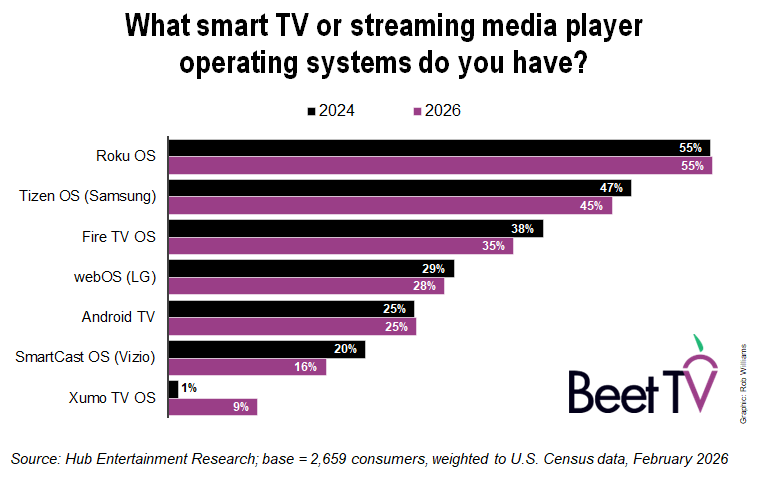
Smart TV streaming OS

“As we approach the ’26, ’27 upfront season, we are ready to transact with three different currency providers,” he said, naming Comscore, VideoAmp and Nielsen like a man listing acceptable dinner options rather than sworn rivals.

That flexibility is not just a technical upgrade. It is a philosophical one.

“This optionality is critically important,” Porter said. “We need a competitive marketplace in the currency space.”

Translation: when measurement companies have to compete, they tend to try harder, which is a refreshing concept in any industry that has historically relied on inertia as a business model.

StreamX tries to solve fragmentation without therapy

If fragmentation has been advertising’s favorite complaint for the past decade, StreamX is Warner Bros. Discovery’s attempt to stop talking about it and actually do something.

“The appetite is very, very strong,” Porter said of advertiser interest in unified planning.

The pitch is simple. Instead of chasing audiences across linear, streaming and digital like a confused tourist, StreamX pulls them into a single plan.

“StreamX finds viewers across linear, streaming, digital, and brings them all together into a single unified plan,” Porter said.

And in case anyone needed proof that this is more than a tidy PowerPoint, Porter pointed to actual revenue. A campaign in the travel sector drove $10 million in incremental sales. Not impressions. Not engagement. Sales.

Clean rooms: less magic, more common sense

Clean rooms may not sound glamorous, but Porter insists they are quietly rewriting how advertisers think about data collaboration.

“That report certainly did change the conversation,” he said, referring to research showing a threefold increase in targetable IDs.

The reason is not mystical. It is logistical.

“It isn’t magical,” Porter said. “Just reducing the handoffs means better match rates, more targetable IDs.”

In other words, fewer middlemen, fewer data hops and fewer chances for your audience to disappear somewhere between platforms. A shockingly effective strategy.

AI is coming for your planning cycle

While premium video still dominates the present, Porter is already looking at what comes next. And it involves AI gently dismantling some of the industry’s favorite habits.

“Agentic AI is gonna start to chip away at the legacy industry operating norms,” he said.

Those norms include some familiar friends: gross rating points, age and gender demos, quarterly planning cycles.

Instead of optimizing for those proxies, Porter suggests the industry may finally focus on what advertising was supposed to do all along.

“We’re gonna get to the heart of really what advertising is meant to do, which is drive business performance,” he said.

The upfront, but with fewer illusions

Taken together, Porter’s comments paint a picture of an upfront market that looks less like a ritual and more like a functioning marketplace. Multiple currencies, unified planning, better data collaboration and AI-driven execution all point in the same direction.

For media buyers, this may require letting go of a few comforting metrics. For sellers, it means proving outcomes instead of promising reach.

For everyone else, it means accepting that the future of advertising may be less about what can be measured easily and more about what actually works.

And if that sounds obvious, well, that may be the most radical shift of all.

IAS’s Lisa Utzschneider: Total TV brings linear transparency to CTV

MIAMI — IAS launched Total TV to address advertiser reluctance to shift linear television budgets toward connected TV due to transparency gaps, providing show-level and channel-level verification through integrations with Amazon Prime, Paramount, Disney, and NBCUniversal.

“If you ask brands, why won’t you shift more linear TV dollars over into CTV? They often say it’s because I want the same transparency I get in linear TV. I want to know by channel, by show,” Utzschneider said.

The solution enables CTV platforms to offer linear-like transparency that brands demand before reallocating traditional television investments toward streaming environments.

IAS Agent provides real-time analytics

Beyond AI-powered classification technology that drives most IAS products, the company deployed IAS Agent as customer-facing tool for real-time analytics and performance monitoring of media quality solution effectiveness.

“IAS Agent is a tool that we provide to our customers where they can go and see real time analytics, performance, how our media quality solutions are driving greater ROI,” Utzschneider said. “The tool is live. It’s accessible to brands today.”

This represents practical AI application rather than theoretical capability, putting agentic functionality directly in customer hands for immediate business value.

Multimedia classification creates differentiation

IAS’s competitive advantage stems from sophisticated multimedia classification technology that analyzes video, image, audio, and text content in real-time across open web, demand-side platforms, and social platforms with AI-fueled accuracy.

“We are able to classify real time video, image, audio and text. It is fueled by AI and the accuracy rates we’re seeing at the speed that we’re seeing and maintaining the cost, it’s off the charts,” Utzschneider said.

The technology evolution continues through large language model integration that enhances classification capabilities for brand safety and suitability verification across diverse content formats.

“The brands are really leaning into our classification capabilities,” Utzschneider said, adding,” and we can’t wait to share how our models continue to evolve and how we continue to leverage LLMs.”

Is Measurement the Missing Link for Pharma Brands Embracing CTV?

MIAMI — For years, pharmaceutical advertisers watched from the sidelines as other industries rushed into connected television. The hesitation was understandable: older patient populations still glued to linear TV, murky measurement capabilities, and the ever-present specter of healthcare privacy regulations made CTV feel like a gamble rather than an opportunity.

But that calculus may be shifting. As measurement tools mature and publishers become more willing participants in the addressable ecosystem, pharma brands are discovering they can definitively connect ad exposures to prescription outcomes – something that could unlock CTV budgets across the industry.

“You don’t get better data, you don’t get better targeting, you don’t get better strategies without measurement being there to be able to speak to it, be able to prove it,” said Faryn Brown, VP of addressable at KINESSO, in this video interview with Beet.TV at POSSIBLE 2026.

Why pharma dragged its feet on streaming

The pharmaceutical industry’s cautious approach to CTV wasn’t simply resistance to change. Brown pointed to structural factors that kept linear television in the media mix longer than other categories.

“A lot of the therapeutic areas do have a patient population that is a bit older, a little bit less likely to be cord cutters, and so slower adoption there,” she said. “So there is still a need for linear TV.”

Until recently, advertisers couldn’t draw a clean line between streaming ad exposure and downstream behavior – say, a patient filling a prescription or a healthcare professional changing their prescribing habits. That uncertainty made it difficult to justify shifting budgets away from the known quantity of broadcast television, even as audiences fragmented across streaming platforms.

Clean rooms become the compliance cornerstone

Threading the needle between personalization and privacy requires pharmaceutical advertisers to build their audience strategies on solid regulatory ground from the start. Brown emphasized that compliant audience segments must be constructed before they ever reach demand-side platforms for activation.

“Working with partners like Acxiom to make sure that we’re building these safe and compliant audience segments so that we are then able to reach the right patients and the right HCPs with that personalized message in a safe and compliant way,” she explained.

The identity challenge remains thornier on the direct-to-consumer side than for healthcare professional targeting, where the Medical Professional Identifier provides a clearer path. Brown acknowledged there’s no single identifier that solves the problem entirely. Instead, KINESSO focuses on helping clients build their own first-party data assets – encouraging patients and HCPs to opt into information through advocacy groups, support programs, and other value exchanges that create sustainable, privacy-compliant audience foundations.

Rare disease demands premium placement

Kinesso offers platforms and tools to optimize the marketing lifecycle, from planning and strategy to activation and measurement.

Brown pushed back against the notion that rare disease brands should avoid streaming environments simply because their target audience might number in the thousands.

“Something like rare disease, for example, when you might have a patient population of 8,000 people, that doesn’t mean that they’re not on CTV,” she said. “For something like rare disease, it’s even more important that we’re reaching them in these premium environments.”

The context matters as much as the reach. When a rare disease patient encounters a brand message while watching programming they value highly, they’re more likely to hold that advertiser in similar regard. Broader therapeutic categories like diabetes can afford a different approach – CTV becomes one touchpoint in a longer journey rather than a singular moment of connection.

Brands Should Stop Chasing Clicks, Start Booking Memories: United’s Mary Rachelle Stumpf

As Cannes Lions approaches, where every brand suddenly discovers it has a “bold new storytelling vision,” Mary Rachelle Stumpf, director of sales at Kinective Media by United Airlines, is offering a slightly inconvenient truth for the industry. The scroll is overrated, and your banner ad isn’t making memories.

“What excites me most about ‘traveler media’ is that we are at the center of the attention economy,” Stumpf, pointing to United Airlines’ global reach of more than 181 million travelers annually.

In other words, while most media plans are fighting for a fraction of a second between doomscrolls, Stumpf is talking about hours of relatively strong attention. Hours. The kind of time most advertisers have only dreamed of, usually while staring at a declining click-through rate.

From impressions to actual human moments

Stumpf says travel creates a rare psychological window where consumers are not just present, but open. Relaxed, curious, maybe even willing to watch something longer than six seconds without skipping.

“When you think about the psychology of a traveler, the opportunity to feed passions and create lasting memories exists in a way that just doesn’t exist through traditional media,” she said in this interview with Beet.TV editorial director Lisa Granatstein.

Compare that with a chaotic stadium or a crowded feed, where attention is fragmented and fleeting. Or as the industry politely calls it, “highly dynamic engagement environments,” which is a generous way of saying no one is paying attention.

Traveler media, by contrast, offers what Stumpf describes as “seven to 10 hours with customers to tell stories that resonate far beyond a billboard or an impression.”

Seven to ten hours. Somewhere, a programmatic trader just fainted.

Winning the order before landing

The pitch here is not just about attention, but timing. Stumpf makes the case that travel is a sequential journey, which means brands can align messaging with specific moments and mindsets.

“The travel journey is sequential,” she said, explaining how messaging can be tailored based on where someone is going and why.

That means a beach-bound traveler might see content about a culinary event in the Bahamas, while a business traveler heading to Chicago might engage with enterprise tech content mid-flight. Not exactly the same as blasting the same ad to everyone and hoping for the best.

The goal is to influence decisions before they happen. As Stumpf put it, travel media allows brands to “win the order in flight at 30,000 feet so that brands and customers don’t have to fight for it on the ground.”

Translation: convince them before they walk into the stadium where your competitors are flagging sponsorship logos and billboards.

Premium environments, not pixel clutter

Another selling point is the environment itself. Airports, lounges and in-flight experiences are positioned as uncluttered, premium spaces where brands can show up without competing against a thousand other messages.

According to Stumpf, this translates into measurable results.

“We’ve seen several fantastic examples of driving brand lift upwards of 30% higher than traditional media through travel environments,” she said.

That’s the kind of stat that makes a media buyer sit up straight, or at least stop pretending to understand their last attribution report.

Scale, precision and the elusive trifecta

Of course, no Cannes-bound conversation is complete without addressing scale versus precision. Stumpf’s answer is that traveler media offers both, thanks to data tied to destinations and intent.

The approach, she said, creates a “trifecta of value” by improving customer experience, driving business outcomes and building strategic partnerships.

It is a neat package. Solve a traveler’s need, help a brand sell something and make the airline ecosystem more valuable in the process. Everyone wins, at least in theory.

Cannes takeaway

Stumpf’s final argument is simple and conveniently aligned with every Cannes deck you are about to see. The brands that win will be the ones that combine time, attention and purchasing power with big ideas.

“The brands I feel that will win in 2026 through traveler media are the ones that harness that magic recipe of time, attention, and purchasing power,” she said.

Which sounds obvious, until you remember most campaigns are still optimized for clicks that no one remembers five seconds later.

So as the industry heads to Cannes to celebrate creativity, innovation and rosé-fueled optimism, Stumpf’s message lands with a bit of advice. Stop chasing impressions like they are rare collectibles. Start showing up where people actually have the time to care.

Preferably at 30,000 feet, where your ad might finally get the attention it has been begging for.

Smartly’s Laura Desmond: Marketers Need ‘New Creative System’ for AI’s Volume Explosion

MIAMI — Artificial intelligence’s tsunami of creative production is expected to dwarf the internet’s already overwhelming content saturation. That’s going to force marketers to build entirely new management systems for thousand-fold increases in versioning and variation.

“TikTok ushered in a big change to creative volume and velocity, where many of our marketers were saying, ‘I need to increase by a hundred X the amount of creative versioning and variation I have,’” Laura Desmond, CEO of Smartly, told Beet.TV contributor David Kaplan at POSSIBLE. “Marketers are now going to need to be ready for AI unleashing more affordable, more available creative, and factors of now a thousand or even 10,000 in terms of the type of creative diversity and variation that people want to see to engage.”

This exponential leap beyond current social media requirements demands fundamental operational transformation alongside workforce development for AI-ready teams.

Amazon CTV partnership enables performance scaling

Smartly’s Amazon connected TV partnership emerged from industry conference discussions about unlocking personalized creative at scale, combining campaign management tools with intelligent creative optimization and real-time audience data integration.

“We really believe we can take everything we know how to drive return on ad spend and ROI to the CTV environment by connecting all of our campaign management tools with our intelligent creative tools,” Desmond said.

The collaboration aims to bring performance marketing capabilities that brand marketers need for business growth through enhanced creative personalization rather than traditional CTV branding approaches.

INCRMNTAL acquisition addresses measurement evolution

Smartly’s acquisition of INCRMNTAL, which closed in early May 2026, is viewed as a response to measurement currency shifts as mixed media modeling becomes outdated and media mix attribution loses reliability due to algorithm-based optimization and cookie changes.

“The problems with [media mix modeling] is that they are a look back currency and it takes a while to get a true read of what’s happening. The problems with [multi-touch attribution] are that MTA data is getting less and less reliable,” Desmond said.

Real-time INCRMNTAL data married with Smartly’s activation and creative optimization provides immediate insights about purchase drivers and mid-to-lower funnel performance in AI-driven campaigns.

OpenAI partnership positions for contextual evolution

As OpenAI’s first creative ad tech partner, Smartly enables brands to reach consumers spending time with ChatGPT through more contextual, relevant search experiences that demand sophisticated creative responses.

“Our marketers need to reach people where they are, and we know that ChatGPT is something that consumers are spending time with and will increasingly spend time with,” Desmond said.

The partnership enables building and collaboration during AI’s early development phase while exploring creative relevance possibilities in contextual search environments.

Workforce transformation becomes imperative

Beyond creative volume scaling, the shift requires systematic training programs that help digital-native teams become AI-ready through structured learning approaches similar to traditional-to-digital workforce transitions.

Desmond draws from personal experience transitioning from traditional media to digital expertise, viewing AI as the next evolutionary learning opportunity for marketing professionals.

“CMOs and marketers are going to need to embrace new approaches to training, to development, and really helping their teams become AI ready,” Desmond said. “It is such a big game changer.”

Your TV Ads Start on the Home Screen, Whether You Like It or Not: Teads CEO David Kostman

MIAMI — At the Possible conference, where every conversation eventually becomes about “attention” and someone is definitely trying to reinvent television before lunch, David Kostman, CEO of Teads, offered a simple reminder: your ad campaign now begins before anyone presses play.

Kostman pointed to the growing importance of connected TV home screens, those few indecisive seconds when viewers stare at tiles and pretend they have control over their evening.

“When we open the TV and we spend a few seconds or minutes thinking which tile do we click on, that’s a time where… a video ad has a tremendous impact on attention,” he said in this interview with Beet.TV.

In other words, the moment of existential scrolling is no longer dead time. It is inventory.

Partnerships and premium placements

Teads has leaned heavily into that moment through partnerships with device makers like LG and Samsung, turning the home screen into what Kostman framed as prime real estate for brands.

“It gives access to advertisers to what we believe is one of the best places to drive attention outcome, which is the home screen placement,” he said.

The pitch is straightforward. Start with a high-impact placement where users are actually looking, then follow them into video and beyond, ideally without losing them to snacks or group chats. Kostman added that these placements are tightly controlled.

“They will only allow the most premium advertisers of the world to be there,” he said, reinforcing that not every brand gets to hang out next to Netflix and YouTube like it owns the place.

Creative meets reality

Of course, there is a catch. The creative has to work everywhere, including formats that were not designed with your carefully crafted 16:9 masterpiece in mind. Kostman acknowledged that these are “non-standard placements,” which is a polite way of saying your ad might need to survive being resized, reformatted and judged in under three seconds.

Still, he said the payoff is worth it. Teads claims stronger brand recall and awareness from these placements, largely because viewers are not yet buried in content and still capable of noticing things.

Self-serve, but make it premium

Kostman also made a case for bringing all this inventory into a single platform, Teads Ad Manager, which he described as a kind of control center for agencies trying to manage campaigns across multiple device ecosystems without losing their sanity.

“It’s very critical,” he said of accessibility and self-serve tools, adding that agencies can launch campaigns across multiple OEMs from one place, which he framed as a “tremendous advantage” for efficiency.

The underlying tension remains familiar. Make it easy enough to scale but not so easy that premium inventory turns into a clearance rack.

Attention is the new currency

If there was one word that hovered over the conversation like a KPI-shaped cloud, it was attention. Kostman positioned it as both a metric and a philosophy.

“For us, attention is the best measure that will basically be a leading indicator in terms of the outcomes that you can drive,” he said.

He went a step further, suggesting that the future is not just measuring attention but predicting it. The idea is to allocate budgets based on where attention is likely to happen, not just where it already did. It is a neat concept, especially in an industry that has spent decades reacting to results after the money is gone.

Brandformance, because of course

Kostman also leaned into the industry’s favorite hybrid term, “brandformance,” arguing that branding and performance are no longer separate lanes but part of the same system.

“If you can on the same platform allocate your campaign based on the results, and allocate your budgets between branding and performance… it makes it so much easier to use and ability to scale,” he said.

Translation: the funnel is now a circle, and everyone is expected to pretend that was always the plan.

The takeaway

Kostman’s message was less about a single product and more about a shift in where campaigns begin. The home screen is no longer a waiting room. It is the opening act, the billboard and the first impression all rolled into one.

And if advertisers are not thinking about that moment yet, they might want to start. The viewer already has.

Why Time Is the Most Democratic Asset – and Brands Should Treat It That Way

MIAMI — The digital economy has spent two decades pulling consumer attention away from the physical world. Should brands with brick-and-mortar presence refocus on the time people actually spend inside their stores?

“If you think even your own experience, you visit a new place, whether is a restaurant or a store, when you have a good experience, you will talk about it,” said Guglielmino, CEO of Cuebiq, in this video interview with Beet.TV. “And there’s nothing more powerful than that in marketing.”

The argument cuts against an industry that has long been obsessed with digital signals, click-through rates, and last-touch attribution. Guglielmino’s case is that the physical visit – and what happens during it – remains an undervalued signal in the measurement stack.

The identity graph problem

Connecting a television ad exposure to a real-world store visit sounds straightforward in theory. In practice, it requires a chain of identity resolution that still has weak links. Guglielmino acknowledged the progress being made.

“At the core, the reliability of the system is the reliability of the identity graph that are really operating as the connecting tissues between a screen, a household, and their individuals and all the conversion that these individuals are making,” he said.

The challenge is one of extrapolation. Streaming platforms know who is logged in, but that logged-in universe represents only a fraction of total viewing traffic. Location data, similarly, captures only a sample of real-world movement. “You only see a sample of the population and then you have to extrapolate for all the rest,” Guglielmino said. “We still need to figure out how to properly extrapolate, but I think that by working with the highest quality data, cutting middlemen, and understanding how the sources work, you set up a data strategy for more success.”

The identity graph challenge is not unique to Cuebiq. The deprecation of third-party cookies, shifting privacy regulations, and fragmented data environments have made cross-channel attribution a persistent headache across the industry. Location intelligence, Guglielmino suggested, can help fill some of those gaps – particularly in anchoring household identity and digitizing out-of-home touchpoints – but it is not a wholesale fix.

Credit versus incrementality

Too many companies, Guglielmino argued, are focused on claiming credit for conversions rather than demonstrating incremental impact. “Everyone will be good in assigning themselves an organic visit or an organic action,” he said, “but what it really matters for the marketer is, is there a change in the behavior of the consumer?”

That framing has real consequences for how measurement vendors are selected and trusted. Guglielmino was pointed in his skepticism of media companies that bundle measurement with their own inventory sales. “What I really do not recommend is to work with media companies that are selling you the media and giving you the measurement tools because it’s not going to be agnostic,” he said. “It’s biased by design. The lion’s share of money is on the media, it’s not on the measurement.”

Cuebiq is a provider of location intelligence and consumer insights, specializing in analyzing real-world, offline behavior using anonymized, consented location data. It enables brands and marketers to track footfall attribution, measure the ROI of marketing campaigns, and target audiences based on their physical movements.

In March, Cuebiq announced a partnership with Affinity Solutions, combining Cuebiq’s location intelligence with transaction data to give brands a more complete view of how marketing activity translates into real consumer behavior – an attempt to link mid-funnel location signals with bottom-funnel purchase outcomes.

Roundel’s Jenny Holleran: Efficiency or Growth? Retail Media Network’s Precision Plus AI Tool Promises Both

Most discussions of artificial intelligence in advertising and media circles still largely revolve around how to use the technology to generate actual growth, as opposed to achieving some level of efficiency. Target’s Roundel believes it can do both with its Precision Plus program. Billed as Roundel’s AI-based performance engine, Roundel uses it to optimize audience targeting across its 130 million guests, delivering significant performance improvements through real-time signal analysis rather than traditional channel-driven approaches.

“We are seeing a huge increase in conversion or click-through rates. We are seeing a 50% decrease in CPMs from an awareness standpoint and increase in ROAS just by utilizing our Precision Plus tool to have those optimizations in real time through AI,” Jenny Holleran, vp, for Roundel, told Beet.TV contributor David Kaplan.

The $2 billion network has evolved from five employees in 2007 to solution-based brand partnerships that span awareness, consideration, and conversion rather than platform-specific executions.

Signal diversity beyond transactions

Roundel analyzes transaction data, behavioral patterns, digital engagement, and in-store interactions to create comprehensive audience understanding that extends beyond purchase history alone.

“The most obvious are transaction signals. So understanding what is someone buying. Then actually thinking about behavioral signals. So where are they buying?” Holleran said. “Then how they’re engaging. So are they interacting with social? Are they interacting through search? How are they starting that digital journey? How are they engaging in store?”

This multi-signal approach provides the foundation for precision media that delivers appropriate messaging at optimal timing to relevant consumers.

Incrementality requires multiple metrics

Moving beyond impression-based measurement toward incrementality involves match market testing and synthetic controls, though brands must evaluate overall growth objectives rather than isolated metrics to avoid short-sighted decisions.

“You can’t always look at one metric or you’re going to be very shortsighted,” Holleran said. “How are you looking at your overall brand growth objectives and not looking at a moment in time, but really looking at that long-term impact.”

Roundel focuses on new-to-brand acquisition and long-term customer value development through incremental measurement approaches.

Full-funnel approach remains relevant

Commerce media evolution toward primary brand growth driver operates through comprehensive funnel strategies that acknowledge continued consumer shopping, discovery, and conversion patterns despite non-linear progression.

“Understanding the funnel isn’t dead. I know that is a hot topic that has been debated for years, but the guests, they still shop. They still want to discover,” Holleran said. “We still have to reach out to them through awareness and we’re still trying to talk to them through conversion.”

Mutual growth between brands and retailers creates aligned incentives for sustained development across different business stages, from startup brands beginning their journey to established companies seeking expansion opportunities.

“When brands win, we win at the retailer. So there is that mutual growth that we’re all looking for,” Holleran said.

CTV Democratizes Big-Screen Moments for Niche Healthcare Brands, DeepIntent CEO Says

MIAMI BEACH, Fla. — The pharmaceutical industry has long dominated television advertising with blockbuster drugs and massive budgets. But connected TV is rewriting those rules, potentially giving smaller, precision medicine brands access to premium inventory they could never previously afford.

It’s a change in how healthcare marketers can reach specific patient populations during high-impact viewing moments. A niche oncology drug, for instance, might now find its audience during the Olympics – something previously unthinkable for brands without nine-figure ad budgets.

“Being able to have a small brand that maybe doesn’t necessarily have the budget that a large, big brand does, we’re now actually able to somewhat democratize that inventory and allow these small brands that still have highly important patient populations to connect with those brands in those important moments,” said Chris Paquette, founder and CEO of DeepIntent, in this video interview with Beet.TV at POSSIBLE 2026.

Healthcare programmatic requires different thinking

Generalist demand-side platforms have served marketers well across most industries, but healthcare presents challenges that require specialized solutions.

“You’re not marketing to just one audience, you’re not marketing to the consumer,” Paquette said. “You’re actually marketing to both the patient and the provider.”

This dual-audience dynamic means platforms need intelligence capable of promoting interactions between patients and healthcare providers rather than simply driving awareness or conversions. The programmatic healthcare advertising market reflects this complexity, with industry analysts projecting continued double-digit growth as marketers seek more sophisticated targeting capabilities.

Privacy requires ground-up engineering

DeepIntent is a specialized, privacy-safe healthcare advertising technology platform designed for pharmaceutical brands, providers, and agencies to plan, activate, and measure digital campaigns.

Healthcare data carries regulatory weight that consumer packaged goods or automotive brands never face. HIPAA compliance isn’t optional, and the shifting landscape of state privacy laws adds further complexity to an already challenging environment.

Paquette Said DeepIntent approached this challenge by rebuilding its data infrastructure from first principles rather than retrofitting existing technology. “We had to completely re-engineer and rethink how we bring data into the programmatic ecosystem,” Paquette said.

“We built effectively an identity graph underneath the hood that was privacy-safe, HIPAA-compliant built-in,” he said. “From that foundation, we then built up our applications like our planning capabilities, our audience building capabilities, our DSP activation, optimization capabilities.” The company recently launched Helix, a healthcare marketing cloud designed to provide HIPAA-compliant data infrastructure for advanced marketing solutions.

Audience-based buying gains momentum

Pharma marketers have deep expertise in linear television, but CTV offers something broadcast never could: genuine personalization at scale.

“CTV has long been kind of a transformation opportunity as a way to personalize that big screen experience,” Paquette said. “Pharma marketers are now waking up to the opportunity to really lean into audience-based buying.”

Free ad-supported streaming television has emerged as a particularly strong growth channel. “New channel types like FAST has been on the rise, especially on our platform,” Paquette said. “We’re finding new ways to bring these what were fragmented type experiences, unify them onto our platform, make it easier for our clients to access those audiences when they need to.”

Evan Hovorka Pitches Albertsons as Retail Media Powerhouse

MIAMI BEACH, FL – Retail media was once the cute little side project of digital advertising, quietly selling sponsored cereal placements and hoping nobody asked too many questions about attribution. Now it has become one of the industry’s loudest growth engines.

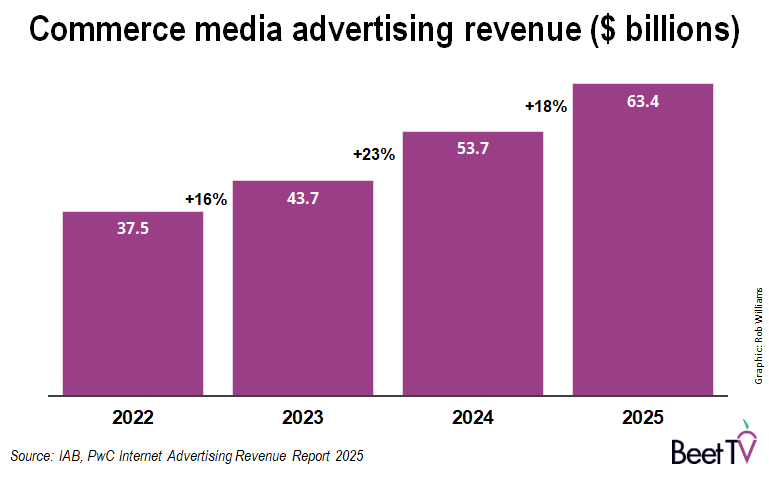
U.S. commerce media advertising rose 18% to $64.3 billion in 2025, according to IAB data, outpacing the 13.9% growth rate for the broader internet advertising market. In other words, retail media is no longer sitting at the kids’ table. It is now pricing the menu.

Commerce media advertising revenue

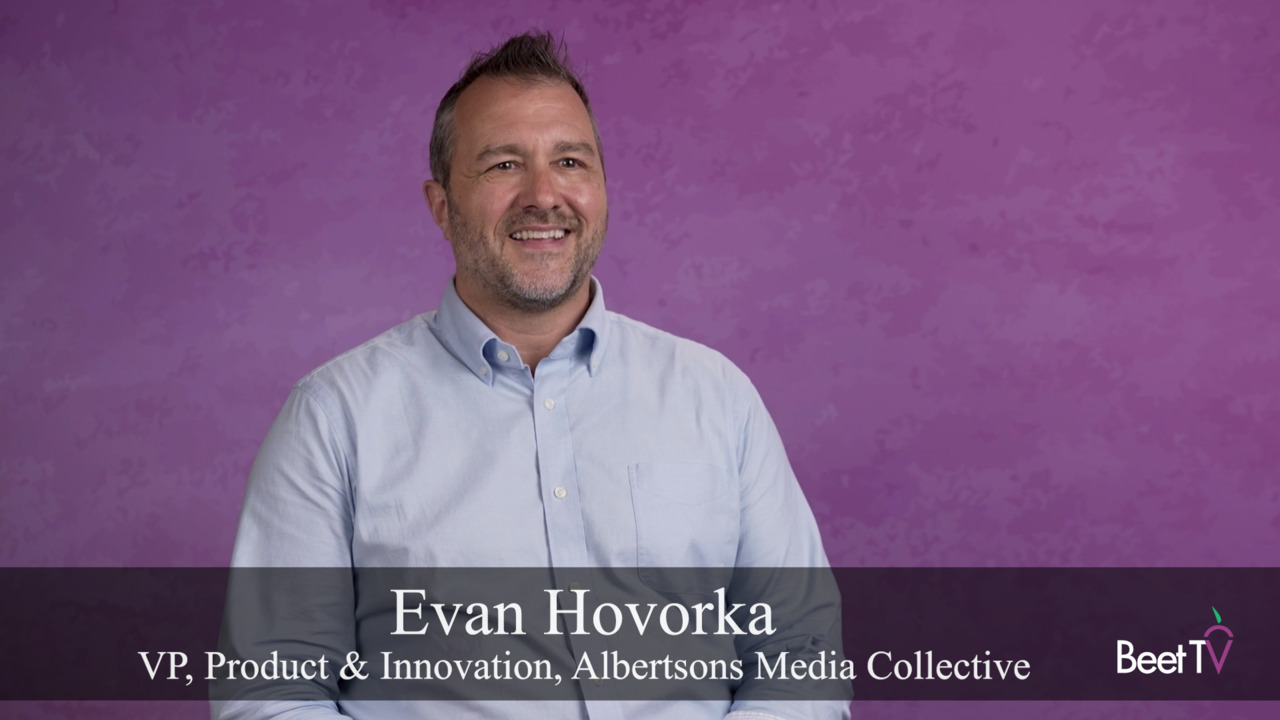
At the Possible conference in Miami Beach, Evan Hovorka, vice president of product and innovation at Albertsons Media Collective, laid out how the grocery giant’s media arm plans to capture more of that momentum by pushing its shopper data into the places marketers already spend money.

Albertsons enters the YouTube era

Hovorka said Albertsons had just launched a new capability that brings its audience data to YouTube and Google’s DV360 platform, debuting the offering with Keurig Dr Pepper.

“So Monday was an exciting announcement,” Hovorka said to Beet.TV contributor David Kaplan. “We, for the first time, brought the Albertsons audience to a very popular streaming video platform, YouTube.”

The idea is simple enough to make ad tech veterans suspicious. Brands and agencies can buy media through familiar platforms while using Albertsons’ first-party shopper data to target known audiences.

“It allows them to basically buy on known high fidelity first party audiences,” Hovorka said, adding that agencies can execute campaigns directly “with the intelligence of first party retail media data.”

Go where the fish are

Asked why YouTube matters, Hovorka offered a line that should probably be embroidered on a pillow in every revenue department.

“When you’re monetizing assets in any industry, you need to go where the fish are.”

He noted YouTube’s massive consumer reach makes it an obvious venue for audience monetization. If consumers are there, marketers are there. If marketers are there, someone will eventually create three dashboards and a measurement framework.

Managed service is nice, but self-serve pays faster

Retail media networks often began as managed-service businesses, where brands hand over budgets and hope the reporting arrives before the quarter ends. Hovorka said the next phase requires more flexibility.

“Putting self-serve into the popular platforms where people are buying media today is a great way to do that,” he said.

He said the model keeps Albertsons data secure while putting tools directly into the hands of media practitioners already working inside those systems. Translation: fewer extra steps, fewer frantic onboarding calls and fewer people pretending they love another standalone portal.

Grocery’s secret weapon: people keep eating

Hovorka also argued grocery retailers bring a unique edge to commerce media because consumers shop frequently and tie many purchases to loyalty programs.

“Our shoppers are in our stores two plus times a week,” he said.

That repeat behavior gives Albertsons a steady stream of signals. Because many transactions connect to loyalty IDs across stores and digital channels, Hovorka said the company has “the highest fidelity ID graph in the game.”

He added, “We only use deterministic data,” a phrase guaranteed to make probabilistic targeting nervous.

The next step: close the loop, then keep closing it

Looking ahead, Hovorka said Albertsons wants to extend beyond audiences into measurement, item feeds, pricing, promotions and dynamic content.

“We start to completely close the loop on what that brand may want to do with their agency dollars,” he said.

That is the promise now driving commerce media’s rapid ascent: not just ads near transactions, but ads tied to outcomes. Also charts. Many, many charts.

Your TV Ads Might be Playing to an Empty Room: Viant CEO Tim Vanderhook

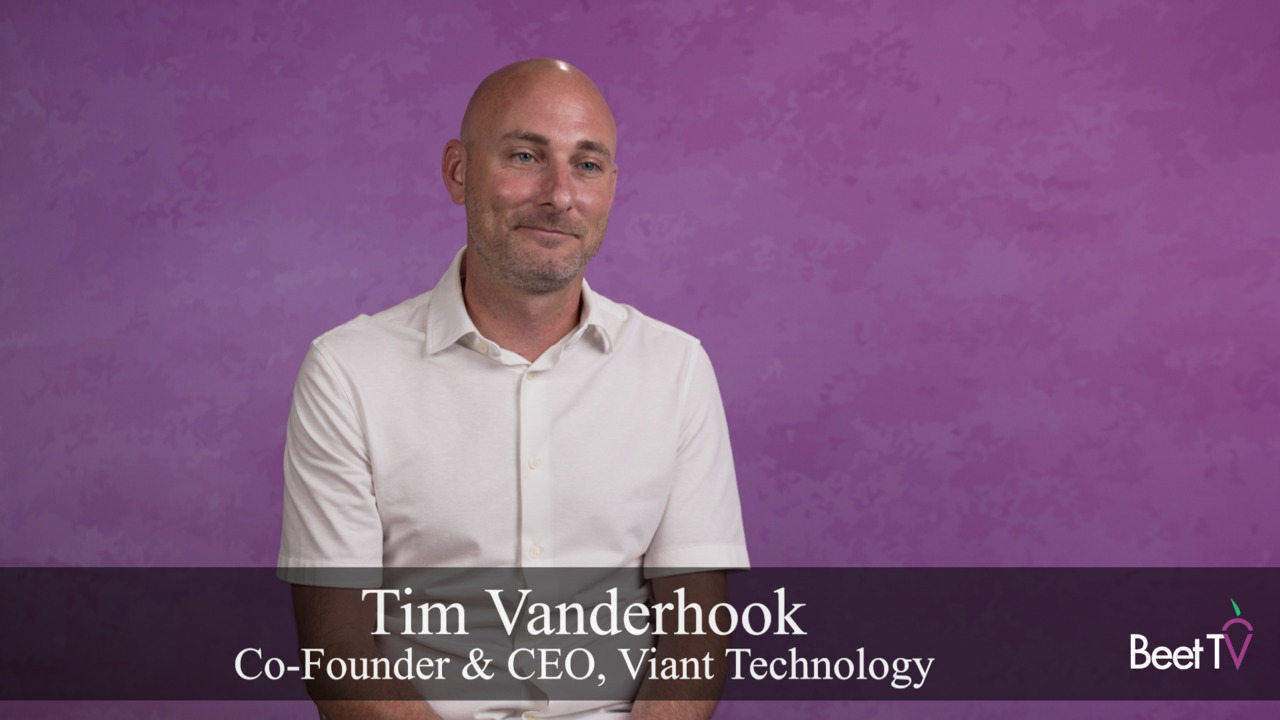
MIAMI BEACH, Fla. — At the Possible conference, where optimism flows as freely as rosé and every panel promises to reinvent advertising by Tuesday, Tim Vanderhook, co-founder and chief executive of Viant Technology, delivered a reality check. Some of your TV ads aren’t just underperforming. They are performing to absolutely no one.

“We see 20 to 30% of the ad impressions, no one’s actually in the room,” Vanderhook said, casually detonating a statistic that should make every media buyer reconsider their life choices.

This revelation comes courtesy of TVision Insights, which Viant acquired and integrated into its demand-side platform. The system doesn’t just confirm that an ad aired. It checks if a human being was present and, more uncomfortably, whether that human was looking at the TV or doomscrolling instead.

The deal combines TVision’s attention data with Viant’s existing identity and content layers. The result is a system that aims to measure performance across linear TV, connected TV and even the walled gardens, without relying on each platform to grade its own homework. It also introduces an “attention-adjusted CPM,” which prices inventory based on real human engagement rather than the comforting fiction of served impressions.

From eyeballs to actual eyes

Vanderhook framed the combination of TVision’s person-level attention data and Iris TV’s content-level signals as a turning point. Or, less grandly, a long-overdue upgrade from educated guessing to something resembling reality.

“To have all these signals integrated into a DSP is where it starts to change planning, buying and measurement,” he said in an interview with Beet.TV contributor David Kaplan.

The pitch is simple. If an ad runs during high-attention, co-viewed content, it should cost more. If it runs while viewers are in the kitchen or arguing with their phones, maybe not so much.

“If the attention is really high and the co-viewing is really high, that content owner is gonna see higher CPMs,” Vanderhook explained, adding that the inverse is also true.

In other words, not all impressions are created equal. Some are premium. Some are basically wallpaper.

CTV finally tries to prove it works

Connected TV has spent years promising performance, often delivering very nice charts about reach. Vanderhook argues Viant’s identity infrastructure changes that equation.

“One of the great advantages of CTV is addressability,” he said.

With household-level IDs, advertisers can target specific audiences and, crucially, measure outcomes in a way linear TV never could. The example he offered was telling. If data shows golfers are more likely to engage with a product, campaigns can focus on that audience across CTV.

It sounds obvious. It also sounds like something the industry has been circling for a decade.

AI runs the bids, humans keep the anxiety

No Possible discussion would be complete without an AI segment, and Vanderhook did not disappoint. He described a spectrum of adoption that ranges from “we trust the machine” to “legal would like a word.”

“AI bidding has the highest adoption, over 90% customer adoption,” he said, noting that machines are better at adjusting prices in real time than humans who insist on sleeping.

Planning, however, is another story. Adoption sits closer to 30%, largely because media plans still span multiple channels that AI does not fully wrangle yet. And fully autonomous campaigns remain more aspiration than reality.

“That final piece of letting AI run the whole campaign… we have the least amount of adoption there, and it’s really a question of trust,” Vanderhook said.

Translation: marketers love automation until it spends their budget in creative ways.

Winners will have something you don’t

On consolidation, Vanderhook offered a blunt assessment that cut through the usual industry jargon.

“What do you have that’s exclusively unique to you?” he said, describing the defining question for the next generation of ad tech.

The answer, he argued, is either exclusive data or exclusive inventory. The walled gardens already have both. Independent players, including Viant, are racing to secure the former through acquisitions like TVision and Iris.

Still, Vanderhook suggested the next frontier might not be data at all. It might be something older and less programmable.

“At a certain point… we need to go back to the foundational principles of advertising,” he said, pointing to creative as the next area ripe for reinvention.

Yes, after all the algorithms, identifiers, and attention metrics, the industry may rediscover that ads need to persuade people.

Revolutionary.

Grocery TV’s Marlow Nickell: Non-Endemic Brands Find In-Store Media ‘A Lot Easier’ Than CPG

NEW YORK — Financial services, telecom, and insurance companies are outpacing traditional consumer packaged goods advertisers in adopting in-store media because they face fewer structural budget and agency relationship challenges when funding new advertising formats.

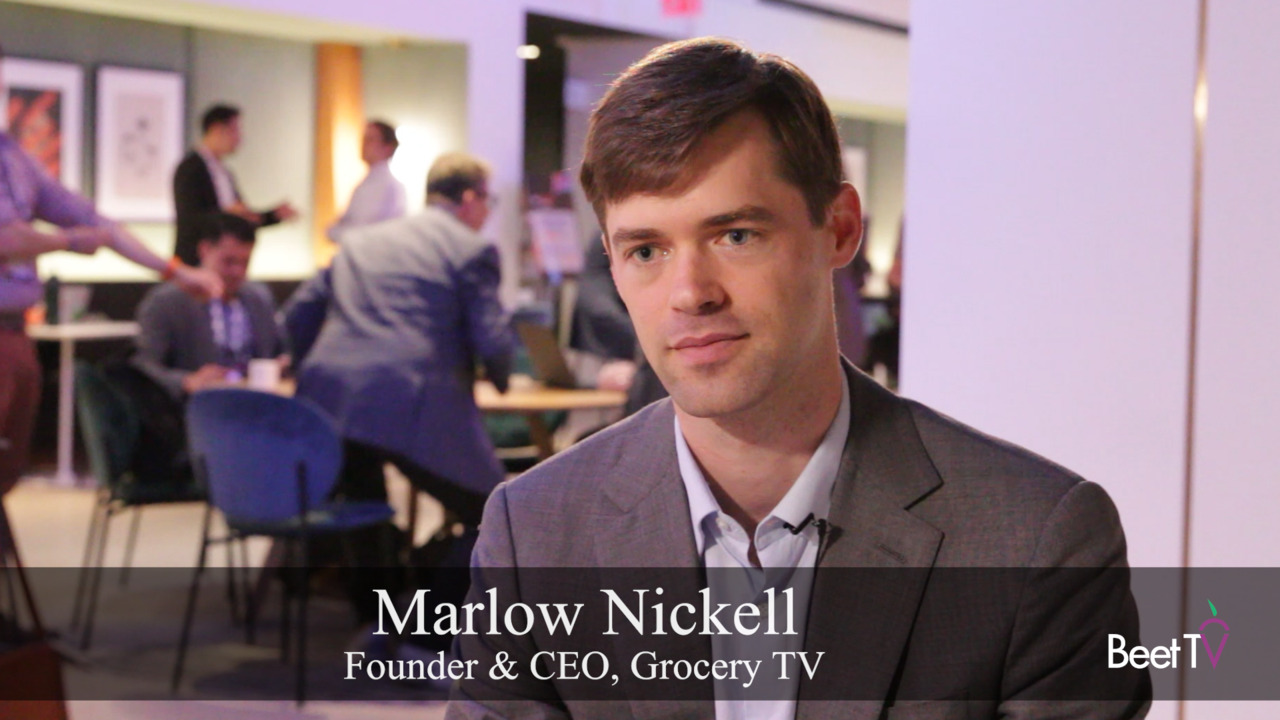
“The irony of it is that it’s been a lot easier for non-endemic brands to lean into the space than the endemic brands,” Marlow Nickell, founder, CEO at Grocery TV, told Beet.TV editorial director Lisa Granatstein at the IAB Connected Commerce Summit. “It’s very counterintuitive because the obvious customer would be an endemic brand that wants to drive sales in store, but they have a lot of structural challenges from a budget standpoint and from the agency relationships to actually fund the in-store programs.”

Non-endemic advertisers view in-store audiences as valuable incremental reach that extends beyond online capabilities, while CPG brands struggle with internal coordination despite eventually becoming the top category.

Small retailers lead innovation adoption

National retailers face organizational complexity that slows in-store media implementation compared to smaller regional players who can move more quickly through decision-making processes.

“You think about the organizations they have and how complex they are, how many people have a say in it. And it’s really tough,” Nickell said. “For in-store, you’ve got your customer teams, the store teams, you’ve got IT, you’ve got the merchants. Everybody’s got a say in what’s going to happen in the store.”

The format started with retailers operating one to 50 stores before expanding upward, with major regional grocers now operating in-store media networks while national retailers conduct pilot programs.

Measurement focuses on fundamentals

Brands prioritize campaign-level return on ad spend, incremental return on ad spend, reach, and brand awareness metrics rather than pursuing direct addressability approaches that work for online environments but don’t translate to physical stores.

“Really when you talk to brands, they don’t even really ask for that kind of stuff. Really what they want to know is at a campaign level, what’s my ROAS, what’s my iROAS, what’s my reach?” Nickell said.

Proven measurement approaches include third-party verification and closed-loop methodologies using matched market analysis where similar customer stores are held out to measure campaign lift versus control groups.

Scale and performance fundamentals established

Grocery TV partners with over 120 retailers to reach approximately one-third of Americans—about 100 million people weekly—during significant grocery purchasing moments that represent major household expenses.

“The scale’s there, the quality is there. It’s really good inventory. It’s purpose built for it. It’s respecting the customer experience, but it’s also really impactful,” Nickell said.

Consistent sales lift and incremental performance often exceeds other media channels, though success requires contextually relevant creative rather than repurposed television advertisements.

Experimentation promotes practical value

Early adopters who invested in experimentation one to two years ago are now scaling programs after learning optimization approaches, while newcomers must address agency ownership questions and budget allocation challenges.

“You can’t just port over a TV ad and put it in the store. It’s got to be really contextually relevant and make sense to really see the performance you’re going to want to see,” Nickell said. “The brands that really leaned in a year or two ago and did that experimentation, they’re now really starting to ramp up this year because they kind of know how to do it.”

Commerce Media Wants the Whole Purchase Funnel: Pacvue’s Michael Foulkes

NEW YORK – Commerce media is no longer content to sit quietly beside sponsored search listings and wait for last-click credit. The category is expanding fast, grabbing budget, attention and probably several internal org charts.

U.S. commerce media advertising grew 18% to $64.3 billion in 2025, according to IAB data, outpacing the 13.9% gain for the broader internet advertising marketplace. That is an impressive number and also a polite warning to anyone still calling this a niche tactic.

At the IAB Connected Commerce Summit, Michael Foulkes, head of customer success, retail media, at Pacvue, told Beet.TV editorial director Lisa Granatstein that the next phase of shopper media is all about convergence. Lisa, to her credit, asked the questions many marketers ask privately between coffee refills and budget meetings.

Social and commerce are now roommates

Foulkes said the old model treated social media as brand advertising while retail media handled conversion. That tidy separation is fading quickly.

“The next phase of shopper media that we’re seeing is that there’s a real convergence of social and commerce,” he said.

Commerce media advertising revenue

Platforms such as TikTok now compress discovery, consideration and purchase into one experience.

“It’s happening in one place, and that funnel is getting smaller,” Foulkes said.

In short, the consumer journey has been downsized for efficiency reasons.

Creator content now has to pay rent

Influencer marketing once enjoyed a comfortable life as an awareness play full of vibes, reach and suspicious engagement spikes. Foulkes said that era is ending.

“They’re thinking about creators with the exact same set of KPIs,” he said, noting advertisers now expect creator campaigns to hit return on ad spend goals much like traditional retail media buys.

He added that brands are increasingly shifting toward micro and midsized creators because marketers can optimize across multiple partners to reach more specific goals. Translation: fewer celebrity invoices, more spreadsheets.

Sponsored ads are no longer the hero of every story

Foulkes said better measurement tools and clean room technology are helping brands understand how upper-funnel media contributes to actual sales.

“In the past, we used to see sponsored ads as the hero,” he said.

Now marketers can better map the path to purchase and identify “true incrementality in these channels,” giving them more confidence to invest higher up the funnel. A moving moment for anyone who has spent years begging finance teams to believe branding matters.

AI helps you shop and helps Pacvue optimize

Artificial intelligence, naturally, entered the conversation because no conference panel can legally avoid it.

Foulkes said AI is already influencing product discovery as consumers ask tools for recommendations before buying.

“I just purchased the product the other day after consulting what’s the best product for me within this category, like on ChatGPT,” he said.

He also pointed to optimization, saying Pacvue is investing in tools that help improve retail media performance using machine learning models powered by AI. Even the ad bids now have career ambitions.

His advice: break silos before they breed

Asked how brands should scale commerce media, Foulkes urged closer coordination between brand media teams and retail media teams.

“Making sure that everybody’s working and marching to the beat of the same drum,” he said.

He also said brands should scrutinize their tech stacks and ensure measurement systems are strong enough to justify bigger upper-funnel investments.

That may be the least glamorous advice at any summit, but it is usually the most expensive to ignore.