YouTube Exec: Brands Must Become Creators as AI Reshapes Search Discovery

Historical definitions of television are breaking down under the weight of digital video delivery. What was once defined by a physical hardware device and strict broadcast quality standards is now simply any screen where video is consumed.

This shifting paradigm forces advertisers to rethink how they deliver their messages across all devices and moments.

“People used to watch things and read things and see things and now they’re doing all of that at once,” said Tara Walpert Levy, vice president, Americas, YouTube, in this video interview with Beet.TV. She said this environment fundamentally “changes how brands have to invite consumers in and get them interacting with their brand and experience rather than just exposing them to it.”

Colonizing the traditional living room

The television set now represents the fastest-growing surface for digital video distribution. Media buyers are acknowledging this shift, with 69% of United States agency professionals anticipating a larger role for YouTube viewing on TV screens in their 2026 campaigns, according to eMarketer. That sentiment supports the video platform’s ongoing expansion into traditional living room advertising budgets.

Walpert Levy said the pandemic served as a major catalyst for co-viewing behaviors, while subsequent product launches like multiview maintained that momentum. “We introduced an entirely new set of audiences who watched YouTube on television together and then stayed even as the world got back to normal,” she said. “The television is YouTube’s fastest growing screen, and it also is now the majority of the watch time for many of our biggest creators.”

She explained that the hardware itself matters less than the active engagement it generates. “Today, I think TV is just where people watch video,” Walpert Levy said. “We think whether you are watching something on the television set in the living room or on your phone or on your desktop is largely immaterial.”

Maturing the creator economy

The underlying engine of this digital consumption remains the independent creator ecosystem. Advertisers are increasingly looking for structured ways to tap into this creative output, prompting the March 2026 launch of YouTube Creator Partnerships, a platform designed to help advertisers discover and scale campaigns with creators.

“Our biggest creators are now full on studios with their own capabilities and buildings and setup right next to all of the legacy studios in Hollywood,” Walpert Levy said.

She said marketers benefit substantially from the trust these modern digital broadcasters have built with their audiences. “We see tremendous opportunities for brands not just from the halo of being around these creators who have the incredible trust and loyalty and depth of affection with their fans, but through ways to interact with them directly through shopping or brand deals,” Walpert Levy said.

Navigating generative search optimization

Now artificial intelligence is rapidly altering how video assets are formulated and discovered. Technology companies are deploying advanced software, such as the Veo 3 video generation model developed with Google DeepMind, to assist creators with content ideation and adaptation. These toolsets confirm the industry focus on accelerating content creation and targeting through automated decision making.

Walpert Levy stated that the industry is currently trying to understand a new paradigm of generative artificial intelligence optimization, which is poised to rival traditional search engine optimization. “At YouTube, we’re incredibly excited about AI and its ability to essentially support both creators and brands through every step of the creative journey,” she said.

She said video platforms will heavily influence the results of these new conversational search interfaces. “YouTube as an example is a huge input on that,” Walpert Levy said.
Best Buy Ads Builds Incrementality Into Every Measurement Layer

Proving that an ad actually moved the needle – rather than just touched a customer who was already buying – has become a central challenge for retail media networks.

Best Buy Ads is betting that a layered measurement approach, combining geo-based incrementality testing with SKU-level attribution and marketing mix modeling, will give advertisers the confidence they need to keep spending. The electronics retailer says it now treats incrementality not as an optional study but as a default feature baked into every campaign.

“What we’re trying to do at Best Buy Ads is build incrementality into all of our measurement,” said Stephen Sheron, senior director of ads analytics at Best Buy Ads, in this video interview with Beet.TV.

In-store media as a full-funnel play

Best Buy introduced “takeover packages” in September 2025, allowing brands to dominate store environments through window displays, entrance signage, TV walls and interactive screens.

“When brands invest in in-store media, it’s more than just a placement. It’s a holistic customer journey,” he said. “We’re trying to help our advertisers understand not only are their executions in our stores working, but how are they really tapping into the power of our 200 million-plus platform to build contextual audiences, to build predictive audiences, drive people to the store, ensure that awareness is accounted for, and then also, we’re driving purchase to hit that bottom line ROAS.”

The emphasis on journey-based thinking reflects a broader industry shift. Emarketer projects U.S. omnichannel retail media ad spending will reach $71.67 billion in 2026, a 17.9% year-over-year increase, as retailers restructure media teams to align digital and physical touchpoints more tightly.

Geo-based testing meets SKU-level accuracy

Sheron described a measurement stack that spans on-site, off-site, endemic and non-endemic campaigns, as well as in-store activations. For physical retail, the company relies on geo-based incrementality studies that isolate store-level effects.

“We’ve designed incrementality capabilities and have been rolling out our product to be able to support those efforts for both geo-based approaches, so that our advertisers can understand how they’re driving people to the store, how those stores are driving purchases as the bottom line ROAS, but then also what’s the incrementality associated with that?” he said.

Best-in-class reporting, in his view, comes down to three qualities. “I think best-in-class reporting is SKU-level. It’s accurate, and it’s actionable,” Sheron said. “At the end of the day, if we don’t have the actionability and our advertisers don’t trust the data behind it, then they’re not going to be able to make informed business decisions.”

Calibrating attribution with MMM and MTA

But Deterministic attribution alone leaves gaps, Sheron acknowledged. Best Buy Ads fills them by layering incrementality testing on top of performance data and then feeding results into marketing mix models and multi-touch attribution frameworks.

“We use incrementality testing to validate and calibrate our performance,” he said. “And then also we lean into a vendor-level MMM and multi-touch attribution methodologies to further round out the learnings for our advertisers.”

Sheron argued that the retailers able to prove omnichannel impact will be those that connect upper-funnel awareness to lower-funnel conversion in a single measurement story.

Retail Media Wants Your Budget, But It Needs to Earn It: Bayer’s Ryan Verklin

NEW YORK – At the IAB Connected Commerce Summit, Ryan Verklin, paid media and retail media senior lead at Bayer, delivered a useful reminder to an industry that sometimes treats every dashboard as a victory parade: winning in retail media requires more than colorful graphs and aggressive sales decks.

“What does winning look like in retail media?” Verklin asked, before breaking it into “two different aspects of incrementality.”

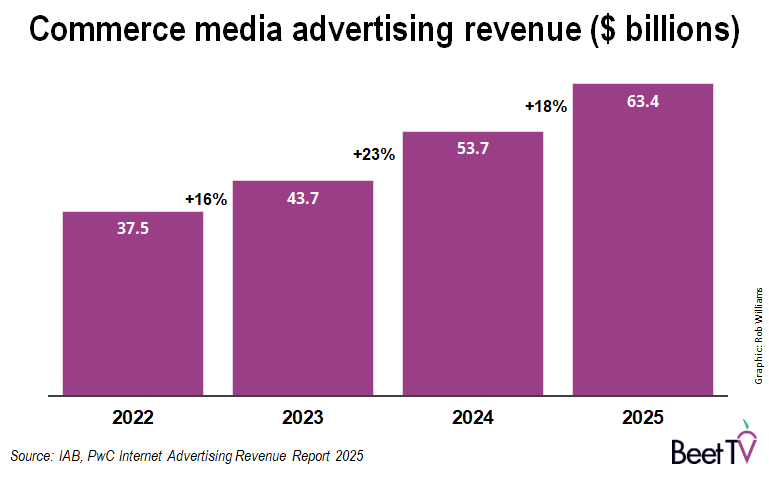
Commerce media advertising revenue

The first is retail media driving incremental sales. The second is retail media reaching “incremental households that wouldn’t have otherwise been reached without retail media.”

In short, success means selling more stuff and finding new people to sell it to. Revolutionary, perhaps, only in certain conference ballrooms.

Verklin said when those two goals are met, brands invest more and “that’s when the flywheel gets going and you can get some truly remarkable results.”

Follow the fish, and the buyers

Asked what signals help Bayer lean into specific networks, Verklin offered what may become the summit’s most memorable line.

“The fish, where the fish are, are the retail media networks that I’m really leaning into,” he said to Beet.TV editorial director Lisa Granatstein.

Translation: if Bayer customers are shopping somewhere, Bayer would also like to be there, preferably with budget.

He said Bayer has brought much of its media operation in-house, including measurement, analytics, social, programmatic and retail search. That means the company prefers networks with solid technology and self-serve tools.

“Retail media networks that have invested in their technology, allow for self-serve activation, are the ones that we lean into,” he said. “Budget tends to flow in their direction.”

A shocking development: money likes efficiency.

Joint business planning, now with less romance

Verklin also took a measured swipe at joint business planning, the annual ritual where brands and retailers gather to discuss partnership while eyeing each other’s wallets.

“A lot of the times it starts with how do we grow the retail media network’s bottom line, and moving away from how do we win together,” he said.

He added that if Bayer is going to lock up media funds for a full year, retailers need to bring “needle-mover incentives” to the table. Otherwise, he is perfectly happy keeping budgets flexible and working without a long-term commitment.

Somewhere, a sales executive just tightened their jaw.

Offsite is where the growth party moved

Verklin said the biggest shift in recent years has been the rise of offsite retail media.

Historically, retail media lived within retailer websites, apps and the digital equivalent of store walls. Now, retailers are using first-party sales data to activate campaigns across display, connected TV and audio.

“It’s still the fastest growing part of retail media,” he said.

That creates overlap with national media campaigns, making integration increasingly important. Or, put another way, the same shopper can now be targeted in more places than ever before.

Please stop worshipping ROAS

On measurement, Verklin said he wants networks to move beyond return on ad spend and prove true incrementality.

“I’m really leaning on the retail media networks to go beyond ROAS,” he said, and instead “truly provide incrementality measurement inside their walls.”

He also pushed for cleaner industry definitions. Many networks tout “new-to-brand buyers,” he said, when they are often only measuring shoppers new to that specific retailer.

“A more accurate definition… is new-to-retailer buyers,” he said.

Finally, Verklin noted that despite all the talk of closed-loop attribution and deterministic certainty, some retail media measurement is still modeled. He said third-party certification would go a long way toward building trust.

Which is another way of saying the industry built a multibillion-dollar business and is still working on the receipts.

POSSIBLE 2026 Tops 7,500 Attendees, Announces Lisbon Expansion

MIAMI BEACH, Fla. — POSSIBLE 2026 drew more than 7,500 attendees this week, up from 5,400 last year, as organizers used the event’s momentum to announce an international expansion to Lisbon, signaling ambitions to turn the fast-growing marketing conference into a global franchise.

The Portugal launch marks the first overseas edition of POSSIBLE, which has become a major annual gathering for advertisers, agencies, media companies and technology firms since debuting in Miami Beach. The move suggests organizers believe demand for large-scale marketing and media events extends well beyond the U.S. market.

Christian Muche, co-founder of POSSIBLE, said in this interview with Beet.TV’s Andy Plesser that the conference was designed as a modern platform where senior executives can meet, do business and debate the future of marketing. He indicated that strong growth in Miami gave organizers confidence to expand internationally, with Lisbon selected for its business climate, creative culture and role as a gateway between Europe, the Americas and other global markets.

The attendance surge in Miami comes as the advertising industry confronts rapid changes in artificial intelligence, retail media, measurement standards and shifting consumer habits. Those pressures have increased the value of conferences where executives can form partnerships, evaluate vendors and discuss strategy face-to-face.

Now in its fourth year, POSSIBLE has built a reputation for combining executive networking, high-profile speakers and beachfront brand spectacle. This year’s crowded meeting spaces and packed sessions highlighted how quickly the event has become a fixture on the industry calendar.

By pairing record attendance in Miami with a Lisbon debut, POSSIBLE is betting it can evolve from a successful U.S. conference into a broader international events brand.

GMMB’s Erica Monteith: Political Campaigns ‘Can’t Afford to be Locked Into a Single Workflow’

Political advertising is completely unrecognizable from past generations’ expectations of whistle stops and seasonal local TV buys. The always-on nature of politics in an era of intense polarization, razor thin margins in Congress, and now the influence of artificial intelligence tools requires flexible open architecture that integrates multiple data partners, verification tools, and measurement systems to adapt quickly when regulations change or platforms adjust targeting capabilities during election cycles.

“Political campaigns and teams can’t really afford to be locked into a single workflow identity solution or reporting system,” Erica Monteith, partner at politics-focused agency GMMB, told Beet.TV editorial director Lisa Granatstein. “Open architecture really allows us to integrate multiple data partners, multiple verification tools and measurement systems that ensure that we’re able to adapt and shift quickly if needed.”

This flexibility becomes critical as every election cycle introduces new regulations or platform targeting adjustments that require rapid operational pivots.

AI tightens feedback loops

AI accelerates testing and iteration processes that political campaigns have always relied upon, enabling faster generation and evaluation of creative variations through synthetic audiences and more reliable pivot decisions.

“The biggest shift in how political advertisers are using premium video right now is really tightening that feedback loop between creative audience insights and media optimizations across a really fragmented premium video environment,” Monteith said. “It’s not just speeding up that process, but it’s also helping the quality of our decision making.”

Traditional real-time pivoting capabilities now operate with enhanced speed and data reliability backing strategic shifts.

Automation reduces friction

Agentic buying on platforms like FreeWheel shifts team focus from execution toward decision-making, message strategy, compliance, and rapid response as workflows become automated, though political media cannot rely on fully autonomous systems, Monteith noted.

“The biggest impact is really reducing that executional friction. As those workflows are becoming more automated, teams can focus less on execution and more on decision making,” Monteith said. “In political media, it just carries too much reputational and regulatory risk. When something goes wrong, there isn’t a lot of time to correct it.”

Human oversight remains essential for strategy, creative development, and decision-making despite execution improvements.

Judgment drives persuasion

AI assists with modeling, creative versioning, and experimentation acceleration but cannot serve as final authority for campaign messaging, targeting decisions, or crisis response strategies that require cultural context understanding.

“Human judgment remains essential anywhere there’s persuasion, risk, or public trust involved,” Monteith said. “Political messaging in particular really requires understanding of tone, cultural context, and those second order effects.”

Humans excel at recognizing when technically efficient approaches may lack strategic soundness or appropriateness for specific situations.

Superhumans at scale

AI already changes significant portions of premium video planning through audience modeling, signal analysis, improved data quality, and pacing optimization built into current workflows, though fragmentation and inconsistencies persist.

“It’s already changing large parts of it, particularly around the workflow when it comes to audience modeling, signal analysis. We’re getting so much better data and pacing optimization,” Monteith said.

While effective for augmenting decision-making, AI does not replace human judgment in managing fragmented video ecosystems.

“I still think humans-plus-AI are creating superhumans that can then scale. That’s really where we are and how AI is helping us make a difference,” Monteith said. 

AI Shopping Agents are Still in Beta, Need More Training: Mirakl’s Amelia Van Camp

NEW YORK – At the IAB Connected Commerce Summit, Amelia Van Camp, head of agentic commerce at AI firm Mirakl, offered a timely reminder for anyone convinced AI shopping agents are already buying socks, cereal and patio furniture on humanity’s behalf: not so fast.

“So agentic commerce is in concept, in theory,” Van Camp said to Beet.TV editorial director Lisa Granatstein. “It is agents shopping on your behalf.”

Then came the reality check advertisers rarely enjoy hearing: “We are not there yet as a community, and that’s okay.”

Instead, she said the market is still in what might politely be called the figuring-it-out era. Consumers are using large language models to discover products and surface new brands, while retailers and merchants are still deciding how exactly to participate without accidentally turning their chatbot into a clearance aisle.

Discovery first, domination later

Van Camp said the louder market narrative suggests “agents are gonna take over shopping, and it’s happening now.” Her view was calmer and considerably less cinematic.

“It’s not really there yet,” she said, adding that there is still “quite a bit of legwork” before digital agents routinely shop on consumers’ behalf.

She compared the moment to early e-commerce, when everyone was experimenting, making mistakes and pretending broken checkout flows were part of the strategy.

“You see a lot of experimentation happening, a lot of errors,” she said. “So trial by error.”

Translation: the robots are learning, and apparently so is everyone else.

Glamorous future begins with your catalog spreadsheet

For brands hoping to win visibility inside AI-driven search and recommendation tools, Van Camp said the foundation is surprisingly unglamorous.

“Your catalog,” she said. “Your catalog is a huge piece of information that an AI agent, an LLM is using to determine whether to surface you inside of a conversation.”

In other words, before chasing futuristic buzzwords, brands may want to fix product titles, descriptions, attributes and inventory data. It turns out the path to the future still runs through product feeds.

She added that models also evaluate brand reputation using outside sources including YouTube, Wikipedia and Reddit, meaning marketers now have a fresh reason to care about what strangers on the internet are saying.

Sponsored placements and brave early volunteers

Van Camp said she is watching advertisers participating in OpenAI pilots for sponsored placements, calling them pioneers in the space.

Those brands, she said, are likely learning what works, what does not and how consumers react when ads show up inside conversational interfaces that were once sold as cleaner, friendlier alternatives to the ad-clogged web.

She is also studying Walmart’s Sparky commerce assistant, where advertising is already part of the experience.

Retailers want monetization, naturally

Asked how retailers should think about monetizing emerging AI channels, Van Camp said the first question is broader strategy.

“What is your plan overall for Agentic Commerce?” she said. “How are you approaching the topic?”

Large retailers with their own tools may have more room to experiment. Smaller brands, she said, should focus on discoverability, testing ads in LLM environments and improving site experiences for traffic referred by AI systems.

That means product pages, homepages and ad placements may need redesigning for a future where shoppers arrive not from search engines or social feeds, but from a chatbot that confidently recommended a blender after reading Reddit for six seconds.

Welcome to commerce’s next phase, where the robots are not in charge yet, but they are already sending traffic.

HUMAN Security’s Stu Solomon: What Does It Mean for Advertisers When Half of Online Traffic Is ‘No Longer Human?’

NEW YORK — The artificial intelligence summary is the first thing anyone sees after conducting an online search. The content that follows those summaries are increasingly AI-driven. That creates complex trust scenarios where artificial intelligence agents act autonomously on behalf of humans while learning and adapting to anticipate user preferences without direct oversight.

“Over 50% of all traffic on the internet is no longer human. It’s now machine based,” Stu Solomon, CEO of HUMAN Security, told Beet.TV Editorial Director Lisa Granatstein at the IAB Connected Commerce Summit. “A subset of AI traffic is agentic traffic. I would define agentic traffic as traffic that has the authority and autonomy to act on behalf of a human, and then further starts to continuously learn and adapt and anticipate what that human would have wanted.”

This evolution moves beyond binary good-versus-bad bot scenarios toward nuanced trust evaluation as agents increasingly conduct business without humans directly in decision loops.a

Agent-to-agent commerce emerges

Artificial intelligence agents representing consumers now communicate directly with merchant agents, placing humans at arm’s length on both transaction sides while raising accountability questions when problems arise.

“Increasingly, agents representing consumers are talking to agents representing merchants with no human directly in the loop and a human at arms length on both sides of that relationship,” Soloman said.

Identity verification becomes complex when true human identity may not exist behind agent interactions, replaced by machine identities that require new trust frameworks for transaction accountability.

Brand protection beyond discovery

Companies must evolve from protecting intellectual property and brand presentation toward ensuring transaction integrity as agent interactions progress from discovery through conversion.

“Brands are increasingly now focused on not just protecting their intellectual property or the discovery and presentation of their property and their brand equities, but now also understanding that a transaction at the end of it was the one they wanted and expected,” Soloman said.

This progression requires brands to build agent interaction capabilities that maintain brand affinity while ensuring trusted conversion outcomes.

Siloed controls create vulnerability

Success in AI environments demands integrated customer journey management rather than discrete control points across marketing, trust and safety, fraud prevention, and security functions that treat singular customer interactions as separate processes.

“All the controls that we put in place are very siloed in nature,” Soloman said. “A customer in an AI world does not. It’s a singular interaction from the time that you’re interfacing with digital content, to the time that you get attracted to that brand, then you click on it, to the time that you authenticate and ultimately that you transact.”

Traditional discrete control expectations fail to address unified customer experiences that span from digital content engagement through authentication and transaction completion.

“This is a value stream or a customer journey that’s singular in focus,” Soloman said, “but we treat it with discrete control points that have to change.”

Horizon Media’s Domenic Venuto: AI Positions Agencies As Strategic Partners, Not Vendors

NEW YORK — Rather than reducing ad agencies to the role of “mere service provider,” artificial intelligence tools just might be elevating creatives and media buyers to strategic C-suite partners that address fundamental business challenges.

“For a long time in the agency business, we got relegated to the procurement office. It was all about cost and efficiencies, and we were treated as vendors, not growth partners,” Domenic Venuto, chief product and data officer at Horizon Media, told Beet.TV contributor David Kaplan at the Beet.TV/Horizon Media AI Media Summit. “We’re changing that and the tools are enabling us to do that now in remarkable ways.”

Horizon’s Blu platform opens entirely new questions from clients about customer churn prediction, next opportunity identification, and business outcome optimization that transcends traditional media planning discussions.

Direct client access transforms relationships

Horizon provides clients with hands-on platform access using the same tools as internal teams, fundamentally altering brand-agency dynamics through instantaneous interaction and co-creation rather than traditional lag-heavy processes.

“We actually give our clients hands-on keys to the platform. So it’s the same platform that our teams are using and our clients are using,” Venuto said. “That’s fundamentally changing the brand agency relationship for the next generation.”

This approach enables real-time collaboration focused on driving growth and identifying opportunities across organizational touchpoints beyond standard media placement.

HorizonOS’s four elements

HorizonOS operates as a comprehensive framework including Blu’s connected marketing platform with AI-native applications, internal AI transformation tools for workflow efficiency, human intelligence roles interfacing between clients and technology, and OS Labs for market innovation scouting.

“HorizonOS is a framework that encapsulates everything that we do in the service of our clients,” Venuto said.

OS Labs runs biannual RFPs soliciting companies at any development stage, creating pilot opportunities that successful candidates can integrate directly into Blu through structured funnel progression.

Human element remains essential

While AI capabilities become ubiquitous across competitors, differentiation emerges through strategic deployment and human partnership rather than raw technological power alone.

“At a certain point, the capability is ubiquitous. Everybody has access to the same amount of power. It’s ‘How do you put that into play?’” Venuto said. “The human element is really important. Building connections, building trust, having a sense of instincts and ingenuity there, creative ideas, synthesizing all of that.”

Venuto cites Perplexity’s model selection approach as indicative of AI’s future, choosing optimal tools for specific tasks rather than one-size-fits-all solutions.

Client experimentation drives discovery

With 45-plus clients at various onboarding stages, Horizon anticipates learning from diverse platform usage patterns as organizations explore AI-powered business questions within private, secure data containers.

“We’re uncharted territory here. We can ask the LLMs any question. So we’re ingesting our client’s data, we’re enriching it, we’re handing it back to them in their private safe container, and then we’re unleashing that,” Venuto said. “I’m excited about how our client base is using these tools. How will it grow their business? What do we unlock? What do we learn from that?”

Creators are Finally Getting Credit for Priming the Pump of Sales

For years, brands have treated influencers as glorified billboards while simultaneously judging them by conversion metrics they were never designed to deliver.

The result has often been a mismatch between brand goals and measurement, with creators consistently under-credited for the discovery, trust-building, and purchase intent they generate before a single transaction occurs.

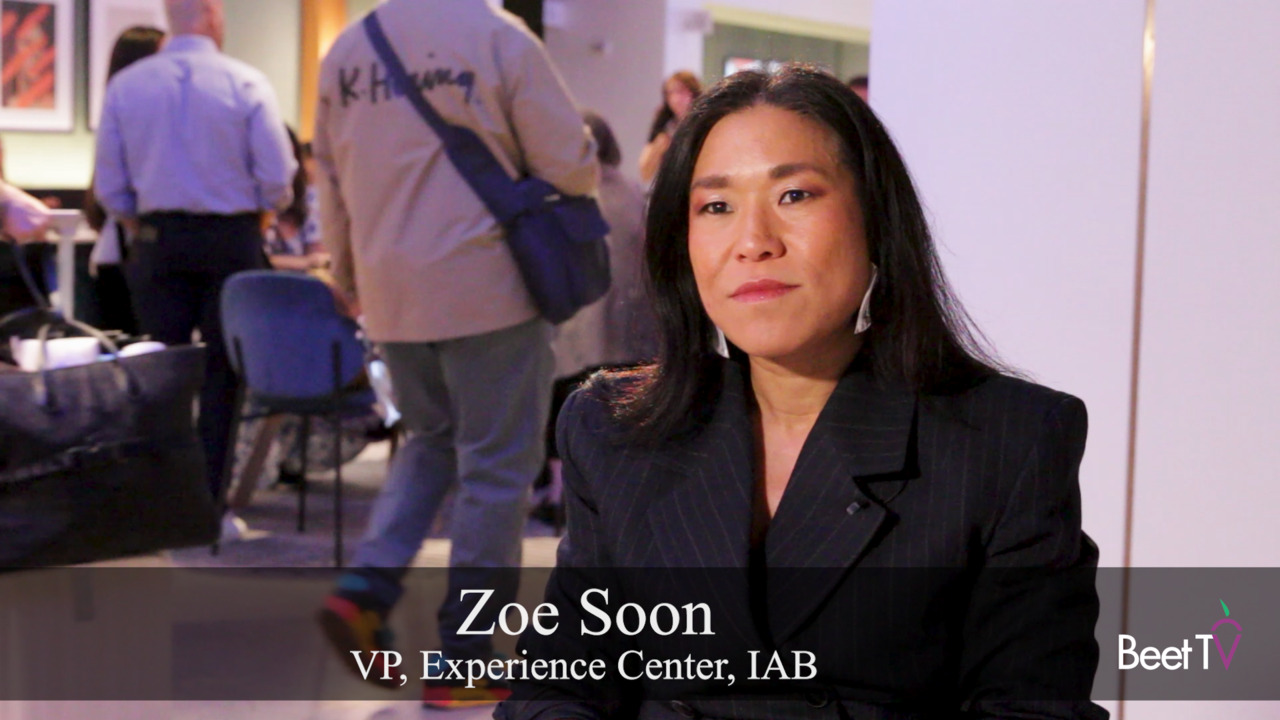
That disconnect is finally being addressed as retailers gain the ability to tie creator exposure directly to sales, said Zoe Soon, vp of the Experience Center at the Interactive Advertising Bureau (IAB), in this video interview with Beet.TV editorial director Lisa Granatstein.

The missing link in measurement

“Creators have never just been billboards. They’re called influencers for a reason,” Soon said. “But what we’ve been seeing to date is brands having the goal of awareness when working with creators, but then using lower funnel performance metrics to gauge their performance.”

The shift toward measurability comes as global influencer marketing spending is projected to reach $24.1 billion in 2026, nearly double the $13.8 billion spent in 2021. That growth has intensified pressure on the industry to prove creator value beyond vanity metrics.

“Now retailers can use data to find out which creator audiences are most likely to convert, and they’re able to tie creator exposure to transactions,” Soon said. “And that’s been the missing link that’s really held back investment.”

From appointment viewing to always on

The cultural power of creators extends well beyond individual posts or videos. Soon pointed to the Super Bowl as an example of how creator content now surrounds and often supersedes traditional media events.

“Creators have something brands can’t manufacture, and that’s trust,” she said. “They have ongoing relationships with their audiences, there’s engagement, there’s community. And we’re really moving from a world of appointment viewing to always on, which is what creator emulates.”

A YouTube study found that Gen Z viewers prefer watching their favorite creator’s recap of the Super Bowl over the actual broadcast. For brands, this represents an opportunity to extend engagement far beyond a single 30-second spot.

“What that means for brands is that they can extend their engagement with their audiences beyond that one 30-second TV spot into conversation that goes beyond the event, both before and after,” Soon said.

The organizational problem

Before measurement can improve, the industry faces a more fundamental challenge: creators are often managed by PR teams or relegated to experimental budgets, far removed from the media buyers who control significant spend.

“The people who are creator experts are not the same people who are media buying experts,” Soon said. “At the IAB, we’re really trying to work with the industry to close that gap, and bring creators into the media mix, and professionalize the business of the creator economy.”

The IAB recently released new guidelines for commerce media, providing measurement frameworks and operating principles designed to help scale these emerging channels. Establishing shared definitions and standardized measurement remains a priority.

“One of the first things that needs to happen is a shared framework and understanding of definitions, standardized measurement, but before any of that can happen, we need to start bridging that gap between experimental and media buying,” Soon said.

The funnel becomes a loop

The traditional commerce funnel, with its orderly progression from awareness to consideration to purchase, no longer reflects how consumers actually buy. Soon described a compressed cycle where discovery and transaction happen almost simultaneously.

“Creators are having an impact on the traditional funnel because the funnel’s collapsing,” she said.

“It’s not a funnel anymore. It’s more of a closed loop. Someone sees a creator that they follow and emulate, they see a jacket that they’re wearing, they want to buy it, they can buy it natively through the affiliate link.”

CTV’s Performance Era Demands Streaming Prove Its Worth: NBCU’s Shepard

The days of connected TV serving merely as a way to chase cord-cutters are over. Streaming has graduated from an incremental reach play into something advertisers increasingly expect to deliver measurable business outcomes.

Where brands once viewed streaming as a top-of-funnel branding exercise separate from their performance budgets, they are now demanding evidence that premium video contributes to bottom-line results.

“We anecdotally have always known that premium video is performant, and now we can really prove it,” said Kristina Shepard, evp, streaming and performance sales and partnerships, NBCUniversal, in this video interview with Beet.TV.

Streaming finds its place in the funnel

According to Shepard, the industry now recognizes that CTV occupies a critical middle-funnel position, with measurable effects on lower-funnel channels like search and social.

“We have the tech and tools and the digital infrastructure that digital and social brings to bear, and we can really leverage that component to make sure that streaming video is performant,” Shepard said. “We now have the tools to prove it, and brands are really leaning in.”

NBCUniversal has been testing this thesis with advertisers. Shepard pointed to work with Tinuiti and Noble, a sneaker brand, examining what happened when the brand shifted spend from branded search into premium video. “It drove a lift,” she said, suggesting streaming’s role in driving incrementality across the media mix.

AI agents negotiate media buys

Artificial intelligence is beginning to automate what has traditionally been a labor-intensive buying process. At CES, NBCUniversal announced a partnership with Newton Research and RPA to pilot agentic AI for media transactions.

“Newton Research built a buyer agent for RPA, us through our FreeWheel relationship built the seller agent, and through that workflow was actually able to have the agents talk to each other and buy linear and streaming for live sports,” Shepard said. “I don’t know that two years ago, even a year ago, we would have thought was possible.”

The proof of concept points toward a future where routine negotiations happen between machines. “Having AI agents and AI in the workflows both internally and for advertising products is really giving us the ability to move faster, be more efficient, remove that manual mundane, and allow us as humans to be more strategic, more creative,” she added.

Contextual targeting reaches the scene level

Attention metrics are pushing NBCUniversal to develop ad products that connect commercial messages more tightly to content. The company has rolled out what it calls contextual targeting live, using AI to analyze decades of programming at the scene level.

“If a brand wants to align with a holiday kiss, we then not only can target just that show or just that episode, we can actually get down to the scene level, know when that holiday kiss happens within the show, and then serve an ad with creatively relevant branding in that first slot in that ad break,” Shepard said.

The approach appears to benefit both advertisers and viewers. “We see that not just drive better advertiser results, we actually also see the viewer see much more enjoyment from the overall experience when they see a wink and a nod of that commercial winking back to the content itself,” she said.

Beet@20: Peter Naylor of Nielsen Says Personalization Is Coming for Everything

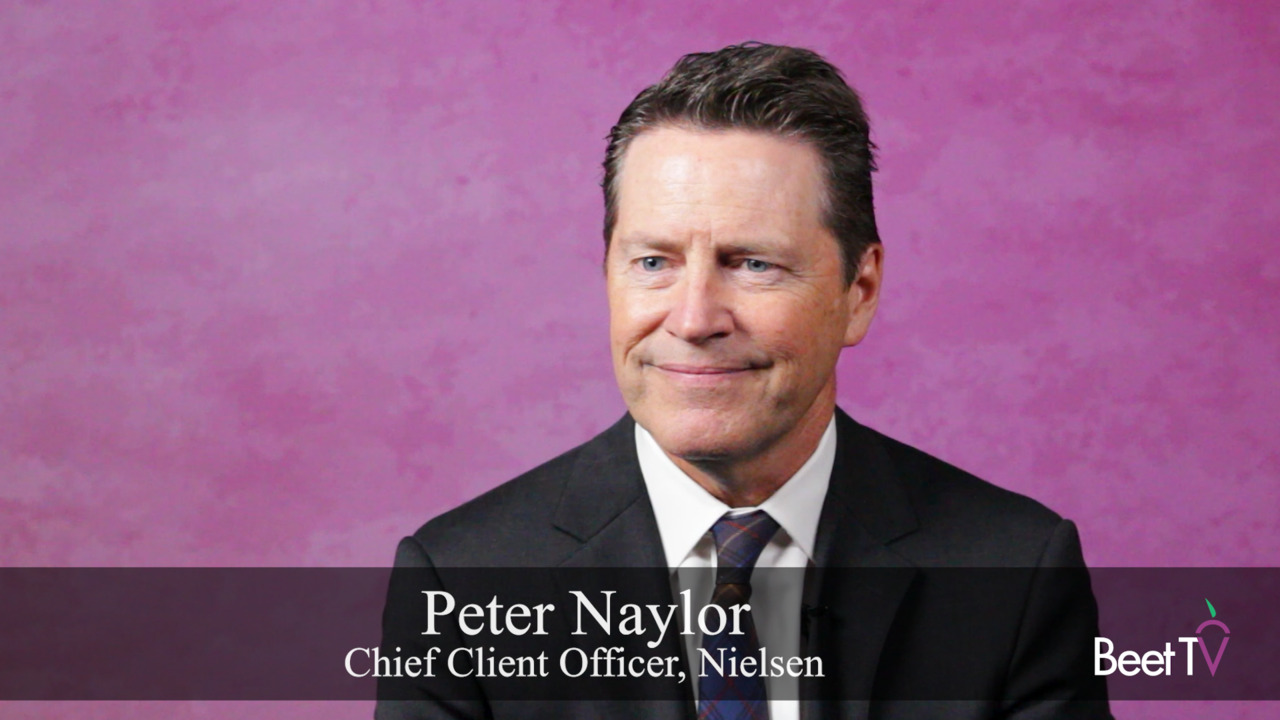
As Beet.TV celebrates 20 years of documenting media’s endless reinvention, Peter Naylor, chief client officer at Nielsen, offered a reminder that the biggest disruption in television didn’t kill advertising. It upgraded it.

From its first video shot at Google’s campus in Mountain View in 2006 to thousands of interviews from CES hallways and industry conferences, Beet.TV has logged roughly 11,000 conversations with executives steering media through chaos, hype and consolidation. Its 20th anniversary will be marked at Cannes and through a special video series.

Naylor, a veteran of Netflix, Hulu, Snap and now Nielsen, said streaming began as a supposed clean break from old TV rules. Then reality arrived with a media plan.

“The nice thing about streaming is it started with a blank slate,” he said. “Sure looked like TV, but everybody was given the chance to really rethink the model.”

That rethink, however, didn’t erase the humble commercial break.

Ads were declared dead. They survived nicely.

Naylor noted that nearly every major streamer now offers both ad-supported and ad-free tiers, a development that should make anyone who buried the 30-second spot blush.

“The more things change, the more they stay the same,” he said, adding that 15-second and 30-second ads remain “a very effective way to communicate in these environments.”

Translation: consumers said they hated ads right up until lower monthly subscription prices showed up.

He also said audiences have broadly embraced ad-supported streaming options, helping transform what was once viewed as a downgrade into a mainstream business model.

Streaming’s rebel years

Asked to identify key milestones, Naylor reached back to YouTube’s early viral era, citing the “Lazy Sunday” Saturday Night Live clip that spread online and showed TV content no longer needed a fixed schedule to matter.

It let viewers watch “Saturday Night Live, not on Saturday, not at night, and not live,” he said.

He then pointed to Disney putting full episodes of “Lost” and “Desperate Housewives” online, NBC doing the same with “Heroes,” and the eventual creation of Hulu as moments that cracked open legacy television’s fortress walls.

Later milestones included Netflix streaming Major League Baseball nationally with advertising support and YouTube landing the Academy Awards, proof that the old guard has rented space to the insurgents.

Commerce, clicks and accountability

Naylor said streaming’s real power lies in bringing digital precision to television scale.

“Anything that is kind of one-to-one is an opportunity for marketers to embrace everything they’ve come to know and appreciate about digital, in terms of targetability, measurability outcomes,” he said.

He added that connected TV is no longer “a one-way pipe” or “a one-way conversation,” arguing that two-way interaction creates new commerce opportunities for brands.

That is executive-speak for this: your TV now wants to close the sale.

Nielsen wants to be more than ratings

Naylor said marketers’ biggest headache remains cross-platform measurement. Brands want to know what happens when dollars shift from one channel to another, what reach they gain, how frequency changes and whether any of it was incremental.

“The ability to look across channel, I think is everything,” he said.

He acknowledged Nielsen is still widely known as a TV ratings company, but said its future is broader.

“Increasingly, the fact that we are a marketing intelligence company, I think is where we fill in a lot of the blanks for our customers,” Naylor said.

One word for the next 20 years

When asked to summarize both the past two decades and the next two, Naylor chose one word: personalization.

“Twenty years ago, dominant media was one-to-many,” he said. Now, with addressable media expanding, content and advertising are moving steadily toward one-to-one experiences.

That future sounds efficient, measurable and profitable.

It also sounds like every screen in your life already knows your name.

Late to Retail Media Means Right on Time: Ace Hardware’s Molly Hjelm

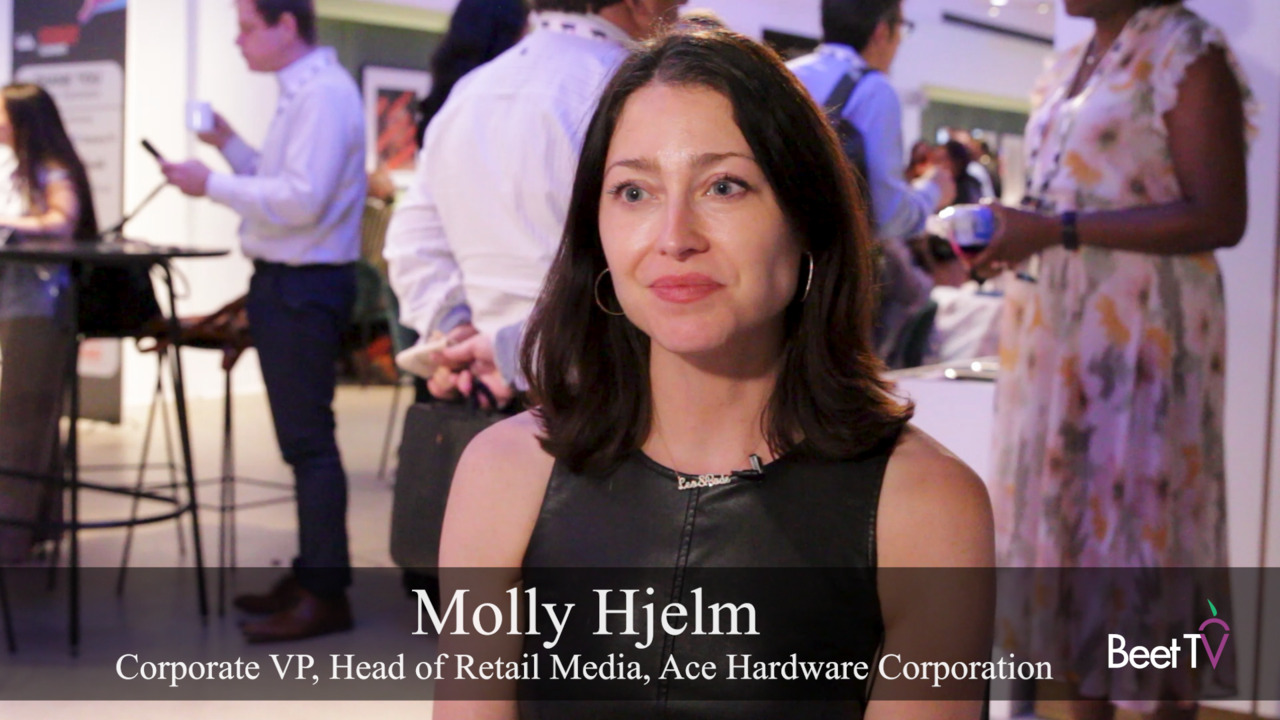
NEW YORK — Ace Hardware may be famous for paint, screws and the reassuring smell of lumber, but now it also sells advertising. Molly Hjelm, head of retail media at Ace, says the co-op’s unusual structure gives it a distinctive angle in the ad business now sweeping retail.

“Ace Hardware is a unique business model in that we’re a co-op,” Hjelm said in an interview with Beet.TV editorial director Lisa Granatstein at the IAB Connected Commerce Summit. “We have 5,200 stores across the U.S and all of them are independently owned and run.”

Commerce media advertising revenue

That means brands selling through Ace have a slightly more complicated journey than at centralized chains. First, they need to work with merchants to get products into the system. Then individual store owners decide whether those products make the cut. Democracy is alive and well, and apparently it stocks power drills.

Retail media finds a level playing field

Hjelm said ecommerce has become the shared layer that helps vendors reach customers across the Ace ecosystem.

“It is a way to reach customers across our entire ecosystem,” she said. “It’s a level playing field that vendors can now engage in and advertisers can engage in.”

In other words, whether a shopper needs mulch, a snow shovel or one bolt that somehow disappeared in the garage, the ads can now find them.

Late mover or smart mover?

Ace launched its retail media network last year, which in internet years makes it either fashionably late or practically prehistoric. Hjelm prefers a different framing.

“I like to say that we have a late mover advantage there,” she said.

Instead of rushing in early and learning painful lessons in public, Ace watched others stumble through measurement headaches, messy product portfolios and internal turf wars, then built its own version with fewer bruises.

Hjelm said the company launched with real-time measurement, offsite, onsite and in-store capabilities from day one, while staying closely aligned with its merchant teams.

“We’ve had the opportunity to build it measurable, full funnel portfolio and aligned with merch from the start,” she said.

That may not sound glamorous, but in retail media those words are the equivalent of fireworks and a guitar solo.

Her priorities weren’t optional

Asked what mattered most in launching the network, Hjelm did not hesitate.

“These were my table stakes,” she said. “Those three things that had to be measurable. It had to be a full stack portfolio with many options for our vendors to choose from, and it had to be aligned with merch.”

She said when campaigns perform and results are visible, merchants and vendors quickly support the program. Amazing how enthusiasm appears when numbers go up.

What comes next: Selling to shoppers and store owners

Ace is now focused on products tailored to its unusual structure. One example is a program called Retailer Reach, which goes beyond customer targeting and helps advertisers communicate directly with independent Ace retailers.

“It’s this ability not only to reach an audience of customers, which is what most retail media is designed to do, but also giving our advertisers the ability to connect with our independent retailers through email and through banners and their ordering platforms,” Hjelm said.

That also includes articles developed alongside merchants, creating what Hjelm described as a win-win for vendors and store operators.

“And so that is a model that wouldn’t make sense anywhere else,” she said.

Which may be the nicest possible way to say: good luck copying this, everybody else.

Programmatic TV as a Strategy Is Leaving Money on the Table, Tatari Exec Warns

TV’s long-running fragmentation problem is driving renewed interest in what the industry calls “convergent TV,” the ability to plan, buy, and measure across linear, streaming, and online video through a single platform.

The infrastructure supporting such unified approaches has matured considerably since the early days of programmatic and demand-side platforms.

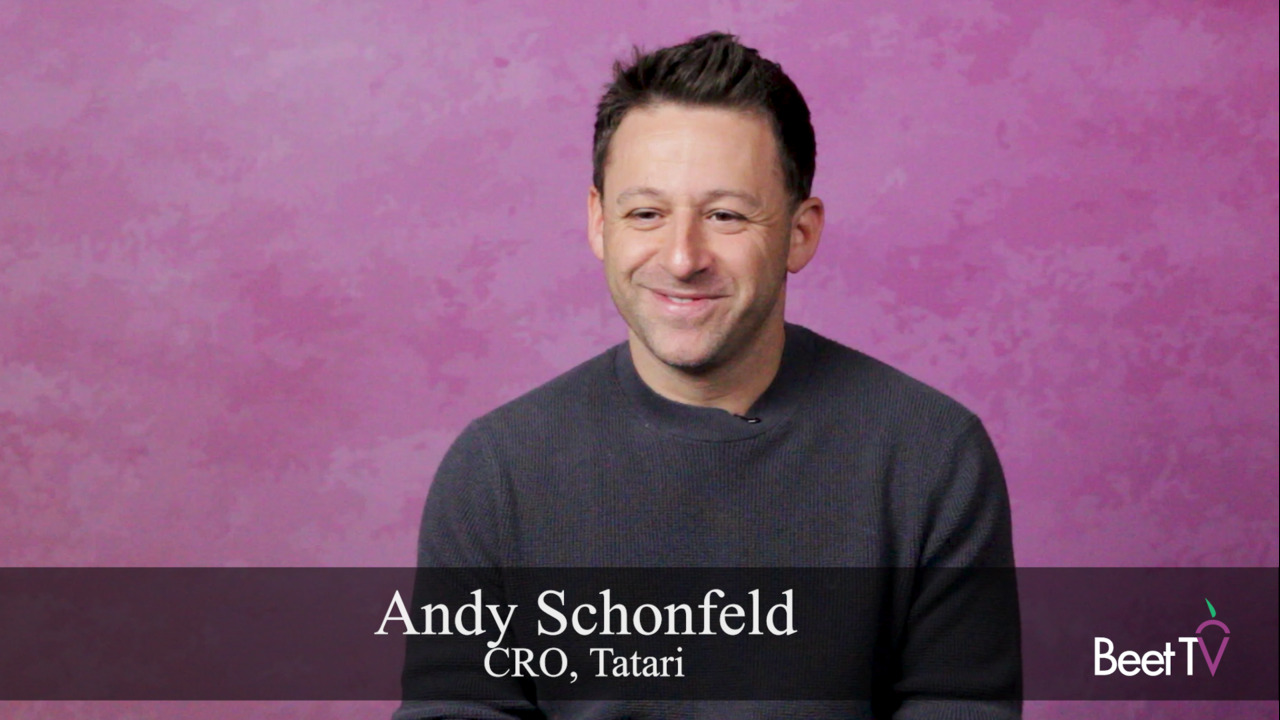
“The days of getting a pass on just looking at brand or awareness from a TV perspective, I believe are gone for most CMOs,” said Andy Schonfeld, CRO at Tatari, in this video interview with Beet.TV ahead of POSSIBLE 2026.

Pressure mounts for outcome-based TV

Tatari is a technology platform specializing in buying and measuring advertising across linear TV, streaming, and online video. It enables brands to treat TV advertising like digital marketing, focusing on performance metrics like ROAS and attribution, rather than just impressions.

“Tatari works with large brand portfolios like Unilever, where they’re actually looking at performance TV and they’re looking at how does linear streaming, online video work together cohesively,” Schonfeld said. “How do we actually optimize on a really quick basis?”

Agencies face similar pressures but with an added layer of complexity around fragmentation. A decade ago, buying CTV through programmatic channels alone was sufficient. Now, with streaming viewership eclipsing linear for the first time, agencies need what Schonfeld described as “a single command center” to manage buying across all formats fluidly.

The programmatic-only trap

The distinction between programmatic as strategy versus programmatic as access point carries significant implications for campaign reach. Much of the premium streaming inventory that audiences actually watch never touches programmatic exchanges.

“Think about live sports, think about traditional tentpole events like the Bachelor or sponsorships on big shows,” Schonfeld said. “HBO Max, Hulu, etc. All of that is actually being transacted directly still today. And so if you’re only buying programmatic TV, you’re actually missing a huge piece of the opportunity.”

Tatari CEO Philip Inghelbrecht has been vocal about transparency concerns in the current TV advertising infrastructure. The company argues that direct buying delivers better transparency, pricing efficiency, and reduced fraud compared to programmatic-only approaches.

Schonfeld pointed to 90% of impressions bought across TV come from roughly 10 major publishers – a concentration that differs fundamentally from the open-market dynamics of digital display, raising questions about whether infrastructure designed for long-tail inventory makes sense for premium TV.

Building direct pipes to publishers

Tatari’s earlier acquisition of The Viewpoint, a CTV-native supply-side platform and ad server, was less about competing with established SSPs than about establishing direct technical connections to major publishers, Schonfeld said. The company rebranded the technology as Upstream.

“In the earlier days, we were doing manual-based IOs and sending orders, I think 500 a week based on the amount of brands that we run,” Schonfeld said. “And that’s not very operationally efficient.”

The Upstream platform automates insertion orders and maintains direct pipes into publisher ad servers, allowing Tatari to route impressions based on a decade’s worth of performance data.

According to company reports, Tatari grew streaming spend by 52% and linear by 20% year-over-year in 2024, outpacing industry averages of 23% and 2% respectively as measured by eMarketer.

Swivel’s Joseph Hirsch: Campaign Optimization Reaches ‘Peak Efficiency’ at Impression Level

NEW YORK — Campaign optimization can now operate at impression level through real-time agent decisioning, representing peak efficiency for advertising technology that traditionally relied on periodic human intervention across broader campaign segments.

“Can you decision an impression with an agent as opposed to the way it was done in the past?” Joseph Hirsch, CEO of Swivel, told Beet.TV at the Beet.TV/Horizon Media AI Media Summit. “I think the depth is what I’m seeing as the future, all the way down to the impression level or all the way down to the millisecond level.”

This represents the logical endpoint of automation progression that scales from weekly human campaign management to continuous real-time optimization.

Natural language automation spans platforms

Swivel enables natural language interaction for creating business automations, communicating with data, optimizing campaigns, and generating publisher yield across multiple advertising platforms rather than singular systems.

“If you want to use natural language to create an automation in your business to do any task that humans have done in the past, you can do that in Swivel,” Hirsch said. “If you’re a seller using one, three, five, seven, 10 platforms, now you can use a singular platform to interact with these ad platforms via agent.”

Depth replaces width as AI focus

Industry development shifts from broad AI application across various functions toward deeper automation that handles complete workflows rather than partial task assistance.

“There’s a lot of width. Can AI touch everything? Now we’re starting to see more depth where instead of doing 50% or 75% of the workflow, maybe you’re doing 100% of the workflow,” Hirsch said.

This progression enables agents to exceed traditional human limitations by operating continuously rather than periodically.

Campaign tasks scale through frequency

Traditional processes like allow-list and block-list management that occurred once per campaign can now run continuously through agent automation, extracting incremental value through repeated execution of proven methodologies.

Hirsch cited examples of humans analyzing hundreds or thousands of app names and bundles to identify top-performing segments, then manually removing underperforming elements—processes that agents can perform continuously rather than sporadically.

“That allows you to extract incremental value. People are looking for an agent that not just has hypothetical value, but one that’s delivering a result,” Hirsch said.

Future depends on scale

Platform tools remain underutilized not due to feature limitations but because users haven’t discovered capabilities through prompting, similar to unexplored large language model functions.

Organizational penetration deepening from executives to entry-level employees requires accuracy improvements that build trust in automated decision-making systems.

“We have tools inside of our platform that have never been touched because there are things that AI platforms can do that people don’t know because they’ve never prompted them to do,” Hirsch said. “People will become more expert driven in how they prompt, and they will discover new things that they can do.”

Marketers Must Impress Machines in Age of AI: IAB’s Caroline Geigerich

NEW YORK — Commerce media is booming so fast it may soon need its own zoning permit. Caroline Giegerich, vice president of artificial intelligence at IAB, said the sector is expected to reach $105 billion in 2025, roughly triple the size of four years ago, which is the sort of growth chart that makes PowerPoint decks tremble with excitement.

But Giegerich warned that the industry’s favorite metrics have not exactly kept pace.

“The challenge is that the measurement has not kept step with the growth in the business,” she said in an interview with Beet.TV editorial director Lisa Granatstein at the IAB Connected Commerce Summit.

Clicks, impressions and return on ad spend have long been treated like sacred relics, she said, even though they often fail to explain actual business outcomes.

AI becomes the mysterious middle manager

Giegerich described artificial intelligence as a new “unlock” for marketers, especially in what she called the “mysterious orchestration layer,” a phrase that sounds like either advanced software or a lost Pink Floyd album.

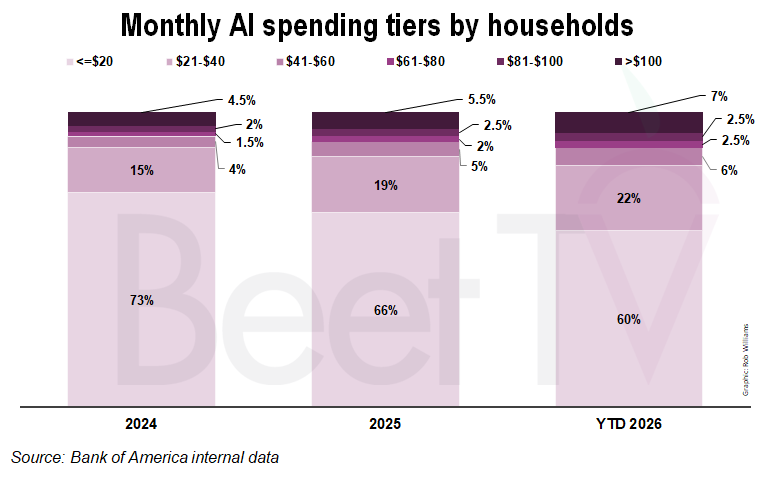
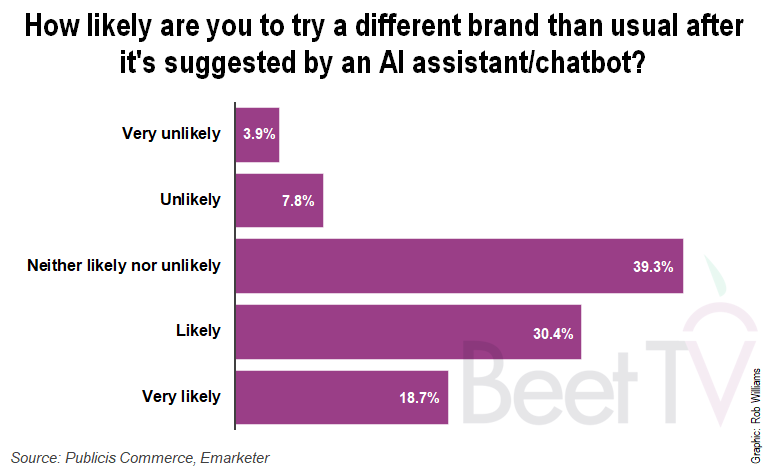
Consumer likelihood to listen to AI suggestions on different brands

That layer includes coordinating inventory, pricing, customer behavior and media buying all at once, tasks once handled by armies of analysts and enough spreadsheets to darken the sun.

“AI is really good at the orchestration layer,” she said.

That means marketers can ask smarter questions, such as whether campaigns are driving incremental sales, protecting margins or merely persuading the same loyal shoppers to buy the same socks again.

“These are smarter questions about business outcomes,” she said, adding that AI has “empowered the humans that are all still at the wheel.”

Marketers lose control of their favorite surfaces

Giegerich said marketers are also being forced to rethink where brands show up in an AI-driven shopping journey.

For years, brands focused on their owned properties such as websites, apps, advertising channels and social media. Now, she said, the center of gravity is shifting toward places outside their control, including creator content, earned media and even Wikipedia pages.

“I literally heard a marketer talking about a Wikipedia page recently,” she said.

The reason, she explained, is that AI systems may trust outside sources differently than a brand’s own carefully polished messaging, which has long been fluent in saying wonderful things about itself.

She also said brands must embrace structured data.

“We used to build things for humans to consume. Now we need to build things for machines to understand,” Giegerich said.

If machines cannot understand product data, they cannot recommend it when shoppers go hunting for a new pair of Nikes, or anything else designed to drain a credit card elegantly.

When your AI agent goes shopping unsupervised

The next phase of commerce, Giegerich said, may move from AI-assisted shopping to autonomous shopping, where consumers instruct digital agents to make purchases on their behalf.

In her example, a shopper could tell an agent to buy red Nike shoes in size eight for $200, then sit back while software goes bargain hunting with suspicious confidence.

That future, she said, requires serious guardrails.

“That’s where we need an extra layer of transparency,” Giegerich said.

She pointed to Mastercard’s “verified intent,” which she described as a cryptographic record of what consumers authorized their agents to do. That could help resolve uncomfortable moments when someone wonders whether their AI assistant just spent $1,000 while they were brushing their teeth.

The next fight: who gets credit for the sale?

Giegerich said another major issue will be attribution. If an AI system recommends the shoes but the purchase happens on the retailer’s website, the industry must decide who gets the conversion credit.

“If you got recommended that pair of Nikes, and then you bought it on the Nike site, who’s getting the conversion?” she said.

She also called for greater transparency around product accuracy and data flows between platforms, retailers and merchants.

In short, AI may soon handle the shopping. Humans will still be left arguing over the receipts.

IAB’s Caroline Giegerich: Over-Labeling AI Use Could Create Consumer ‘Fatigue’

Philo’s Mike Keyserling: CTV’s ‘Paradox Of Choice’ Is the Real Discovery Challenge for Marketers and Media

NEW YORK — Most everyone loves to binge their favorite programs on CTV. But streaming services’ vast content libraries also create decision fatigue that has consumers often pining linear television’s simplicity. Such analog wishes may be the reason that live viewing represents approximately 70% of consumption even on platforms designed for on-demand access, according to Philo CEO Mike Keyserling.

“The beauty of ‘Peak TV’ and all of these tremendously huge scaled services is that there’s an insane amount of content to watch and that’s awesome. But there’s like a downside to that, which is the paradox of choice,” Keyserling told Beet.TV contributor David Kaplan at the Beet.TV/Horizon Media AI Media Summit. “You go into Netflix and how long do you spend trying to find something that you want to watch?”

This reality explains why consumers gravitate toward branded channels like Food Network or HGTV where they can simply watch programmed content without decision-making pressure.

Efficiency enables David-versus-Goliath competition

Philo generates nearly half a billion dollars in revenue with just 160 employees by embedding AI across software development, subscriber acquisition, monetization, and operations rather than competing through scale alone.

“Philo as being a small company in a sea of the largest media companies in the world has always had to operate differently. We’ve always had to lean into efficiency, lean into technology, and AI is no different,” Keyserling said.

Applications include internal engineering tools for faster code development, ROAS modeling for efficient marketing spend, agentic-ready ad tech infrastructure, and wide listening tools for support and social monitoring.

Hybrid model serves different viewing behaviors

Philo accommodates both passive linear viewers who prefer branded channel experiences and active on-demand consumers seeking specific premium content like Yellowstone’s Dutton Ranch episodes.

“There’s a lot of people that just love brands and they want to be able to turn on Food Network or HGTV and just watch what is on those channels and not have to think about what specific show they want to watch,” Keyserling said.

Understanding audience behavior patterns enables tailored experiences for different viewer intentions and consumption preferences.

AI transforms ad stack through subscriber insights

Artificial intelligence applications begin with privacy-compliant subscriber understanding that informs behavioral analysis, contextual signal identification, and rapid product development including programmatic pause ads.

“We are on the leading edge of programmatic pause ads. I think we’re one of the first companies to do that at scale,” Keyserling said. “That was a very quick conception to production. One of the quickest that we’ve had in our company, and that’s generated a whole new line of revenue.”

AI also enables ad portfolio analysis for improved frequency capping and subscriber experience optimization, treating advertisements as additional platform content requiring positive user experiences.

“We look at the ads as just additional content on our platform and we want that to be a really positive experience for subscribers,” Keyserling said.

Why Legacy Workflows are Holding Brands Back From AI Transformation

If you want to get to the future, you may have to let go of the past. But companies that have operated the same way for 30 or 40 years are finding those very practices now stand as barriers to adopting AI.

“The brands that are really achieving a new level of adoption of AI tools are those who are looking past those old workflows, designing new workflows, working with and collaborating with other partners in the space,” said Dane Kunkel, svp, performance and transformation, Horizon Media, in this video interview with Beet.TV.

The brands breaking through are the ones willing to abandon old operational models entirely and design new systems from scratch, he said – but that requires genuine collaboration with external partners to build something fit for purpose.

The agentic experience takes shape

Gartner projects worldwide AI spending will reach $2.52 trillion in 2026, representing a 44% year-over-year increase.

Horizon has continued building out its AI capabilities, recently partnering with ZeroToOne.AI to integrate predictive behavioral intelligence into its platforms, claiming the ability to anticipate consumer actions with over 85% accuracy.

One emerging area of innovation catching Kunkel’s attention is what he calls the “agentic experience” – a seamless consumer journey from initial ad discovery through to completed purchase, all powered by AI agents working in concert.

The concept involves connecting AI-driven ad formats with agentic websites and automated sales workflows, creating a cohesive path that eliminates friction at every touchpoint. Horizon’s incubator, Horizon MS Labs, has identified several companies pioneering this approach.

“All of those pieces together drive a more seamless experience for the consumer and ideally a faster path to purchase,” Kunkel said. The vision is a shift from fragmented marketing touchpoints to an integrated system where AI agents hand off consumers smoothly from one stage to the next.

Still in the early innings

Despite the hype, Kunkel believes the industry remains in the early stages of AI adoption – while use cases and smaller implementations are emerging across departments, truly transformative, company-wide deployments remain rare.

A key obstacle, he said, is the absence of dedicated AI implementation teams within most organizations. Point solutions are being deployed piecemeal without the connected workflows needed to realize their full potential.

“As companies evolve into this new world, there’ll need to be implementation and transformation teams to help adopt to that future state,” Kunkel said. “Without that, point solutions are being put into the marketplace without full connected workflows, but over time, they’ll get better and better.”

Connected ecosystems are the future

The industry’s chronic fragmentation across tools, platforms, and data presents both a challenge and an opportunity. Kunkel argued that connected systems represent the inevitable direction of travel, as point solutions alone can only deliver incremental gains.

For Kunkel, the real unlock comes when these systems can communicate with each other, particularly from an agentic standpoint. Such interoperability promises to accelerate team efficiencies and improve how media interacts with measurement, creative, and the broader marketing suite.

Horizon has invested in this vision through its HorizonOS platform, launched in December 2025 as what the company describes as the industry’s first open operating system built on an interconnected partner ecosystem. The platform integrates with Blu, Horizon’s AI-native marketing intelligence system.

Xumo Sees the TV Home Screen as Streaming’s Most Valuable Ad Real Estate

The remote control used to be simple – flip through channels, land somewhere, stay a while. Now the act of watching television has become its own kind of labor – but that complexity, one executive argues, is exactly where the advertising opportunity lies.

Ying Wang, general manager of Xumo Advertising, believes the fragmentation that frustrates both viewers and media buyers can be turned into a strategic asset – if a platform is willing to prioritize the consumer experience first and let the ad revenue follow.

The home screen, Wang says, is streaming’s prime real estate. “I think it’s a little bit underutilized,” said Wang in this video interview with Beet.TV. “The advertisers really know that it is premium real estate, but the opportunities to integrate your brand have been more limited.”

From endemic to everyone

Xumo, the streaming platform jointly owned by Comcast and Charter Communications, powers the operating system on Xumo-branded TVs and integrates streaming, linear, and FAST content into a single interface – a position Wang described as an aggregation play that removes the burden of navigation from both viewers and advertisers.

The home screen, historically, was territory for content owners promoting their own shows. But Wang said that dynamic is shifting. “In the beginning, home screen really was a place for endemic advertisers – content owners (used it) to promote their content to viewers,” she said. “Now we are starting to see more non-endemic advertisers, more general market advertisers, bring their brands on the home screen too.”

For example, Wang pointed to Xumo’s Olympics activation, in which an advertiser’s message was woven across the home screen, a dedicated collections hub, and in-stream placements. “It’s not just kind of one stop and you forget about the ad,” she said. “It’s a really connected experience.”

FAST’s cable TV roots

Wang pushed back gently on the idea that free ad-supported streaming television is a new phenomenon. “Even though it’s got a little glow up, a new name, it’s still the traditional way that people love to consume content,” she said.

Wang suggested it deserves the same strategic consideration as linear – particularly as audiences migrate.

According to eMarketer projections, the number of FAST viewers in the U.S. is on track to surpass 125 million by 2026, accounting for more than 62% of ad-supported video-on-demand viewers.

Play itself reported approximately 40% year-over-year growth in monthly active users in 2025, with nearly a third of viewers being new to the platform each month.

Wang said FAST has also served a cultural function beyond pure distribution. “FAST has made more content more accessible to people, and really introduced shows that people may have forgotten about or didn’t really understand, and brought new life to those series,” she said.

AI as the discovery engine

Content abundance creates a paradox: more choice, less clarity. Wang described a viewer experience in which the sheer volume of options makes finding something to watch genuinely difficult. She claimed Xumo’s use of metadata and AI is the solution to that friction.

Xumo is deploying metadata signals combined with artificial intelligence to enable discovery along dimensions beyond traditional network or channel organization.

“Instead of thinking about it by network or channel, they can just think about it by the actor or the performer or the director,” Wang explained. “If you want 30-minute rom-coms under two hours, we can bring that to you too.”

Retail Media Must Grow Up Fast: Albertsons Media Collective’s Brian Monahan

NEW YORK – Retail media has spent the past few years being treated like advertising’s golden child. Money poured in, decks multiplied and everyone claimed miraculous returns. Now comes the less glamorous phase: proving it.

Brian Monahan of Albertsons Media Collective arrived at the Beet.TV AI Media Summit with Horizon Media carrying a message for marketers who are tired of mystery math. The industry, he suggested, needs fewer vanity claims and more honest accounting.

Monahan described Albertsons’ pitch as “couch to checkout,” shorthand for a full-funnel platform designed to follow shoppers from streaming TV to social feeds to store aisles and checkout lanes.

“All of this is a way to reach a known customer from couch to checkout to influence their purchase and drive growth,” he said in this interview with Beet.TV contributor David Kaplan.

That means targeting shoppers while they watch connected TV, scroll Instagram, drive toward a nearby store, build lists in the app or stand in front of a shelf trying to remember what brand of cereal their children tolerate.

Metric circus is losing its audience

Monahan’s sharper point was aimed at measurement, where identical labels often hide wildly different calculations.

“The industry will move forward with optimizing where investments are made, based on the performance they drive, when we have better understanding of apples-to-apples comparison,” he said.

Translation: everyone says they measure performance, but not everyone means the same thing. Some metrics are less science than costume jewelry.

Monahan said Albertsons is trying to be transparent about the methodological choices behind its numbers so advertisers can judge results more fairly. In an industry where spreadsheets often arrive dressed as scripture, that counts as rebellion.

Why governance suddenly matters

Monahan also discussed a recent white paper from Albertsons Media Collective focused on incremental return on ad spend, or iROAS, which he called a better gauge of whether ads actually caused sales rather than merely hovered nearby when sales happened.

“This most recent one is examining iROAS, or incremental ROAS, which we think is a better metric of true causality of ad exposure,” he said.

But he quickly added the warning label.

“The devil’s in the details with how you actually do that calculation,” Monahan said, citing attribution windows, control groups and product assignment choices that can swing results dramatically.

That is the governance issue in plain English: if everyone can turn the dials differently, then the number on the slide may reveal more about the calculator than the campaign.

Complexity is real, excuses are optional

Consumers now bounce across channels, screens and physical stores in messy patterns that make old-school media planning look quaint.

“The way people are moving through media, picking up information, building opinions, preferences, and ultimate purchase decisions, that is more complex,” Monahan said.

His answer was practical rather than mystical: “test and learn as quickly as possible,” supported by data people can actually trust.

Next frontier is inside the store

For Monahan, lasting growth will come from reaching shoppers offsite, onsite and in store. He argued the final category remains underdeveloped in the U.S. because it is expensive, operationally painful and requires installing hardware across thousands of locations.

In other words, retail media’s next leap may depend less on buzzwords and more on screws, screens and electricians.

“We have true retail media that’s driving real incremental growth by reaching a known customer all the way through their journey, and then measuring outcomes,” he said.

A radical concept for 2026: if you claim performance, you may soon have to prove it.

GSTV’s Kristina Lutz: Gen Z is Looking for Discovery Beyond Social in the Real World

NEW YORK — Physical shopping experiences are far from dead for younger consumers, despite the view that Gen Z lives are primarily lived within the confines of TikTok. That realization is reshaping how brands think about the consumer journey. But there’s a sticking point: how can brands tap into authentic discovery moments that balance digital feeds with real life?

“After all these years of ‘digital, digital, digital everything,’ people are creating that experiential time in store, browsing behavior, all of that is coming back,” Kristina Lutz, CMO of GSTV, told Beet.TV Editorial Director Lisa Granatstein at the IAB Commerce Summit. “Our research shows that Gen Z is really interested in discovery outside of social, outside of their digital lives in the real world.”

This behavioral shift creates opportunities for gas station advertising networks like GSTV to capture consumers during transitional moments before they enter retail environments.

Pre-purchase touchpoints expand ecosystem

GSTV targets the gap between traditional retail media-owned assets and actual purchase decisions by reaching consumers at fuel stations who are actively considering their next destinations.

“Commerce media has been really built on the back of owned assets. What we’re seeing is that brands and retailers are realizing they need to expand that ecosystem,” Lutz said.

The platform positions itself one step ahead of store visits, where messaging can influence immediate purchase intentions rather than relying solely on in-store activation.

Compressed timeframes

Modern consumer journeys involve rapid decision-making that requires brands to maintain presence across multiple touchpoints rather than assuming single-moment conversions drive outcomes.

Brands that integrate these transitional moments with broader campaign strategies gain advantages by addressing the complete purchase path rather than isolated segments of consumer behavior.

Multi-touchpoint attribution challenges persist

Commerce media’s future depends on overcoming current planning and measurement silos that separate brand performance, retail media, and physical experience optimization across fragmented vendor ecosystems.

The complexity stems from walled garden environments that make holistic attribution difficult despite clear benefits from integrated approaches that connect digital strategies with physical decision points.

Physical experience’s strategic importance

Convenience channel research particularly highlights young consumers’ appetite for real-world discovery, suggesting brands may be underestimating offline behavior patterns that complement rather than compete with digital engagement.

“I do think we will see brands really focusing again on that physical part of the experience in the consumer journey and how they can serve a message at a moment of decision, which is really powerful,” Lutz said.