


Marketers Must Impress Machines in Age of AI: IAB’s Caroline Geigerich
NEW YORK — Commerce media is booming so fast it may soon need its own zoning permit. Caroline Giegerich, vice president of artificial intelligence at IAB, said the sector is expected to reach $105 billion in 2025, roughly triple the size of four years ago, which is the sort of growth chart that makes PowerPoint decks tremble with excitement.
But Giegerich warned that the industry’s favorite metrics have not exactly kept pace.
“The challenge is that the measurement has not kept step with the growth in the business,” she said in an interview with Beet.TV editorial director Lisa Granatstein at the IAB Connected Commerce Summit.
Clicks, impressions and return on ad spend have long been treated like sacred relics, she said, even though they often fail to explain actual business outcomes.
AI becomes the mysterious middle manager
Giegerich described artificial intelligence as a new “unlock” for marketers, especially in what she called the “mysterious orchestration layer,” a phrase that sounds like either advanced software or a lost Pink Floyd album.
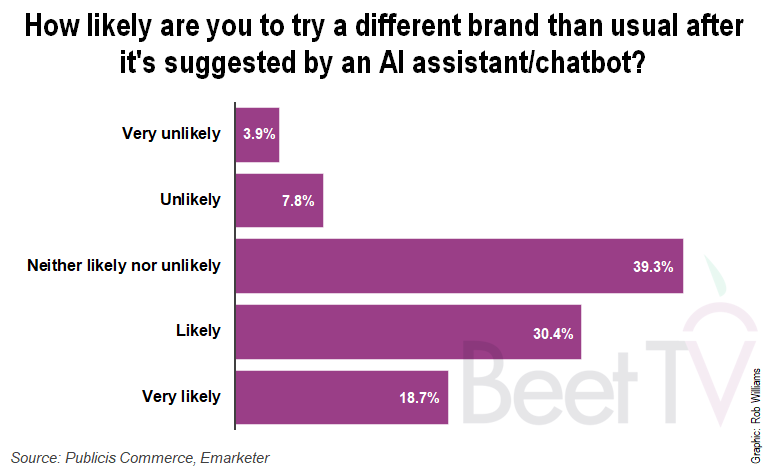
That layer includes coordinating inventory, pricing, customer behavior and media buying all at once, tasks once handled by armies of analysts and enough spreadsheets to darken the sun.
“AI is really good at the orchestration layer,” she said.
That means marketers can ask smarter questions, such as whether campaigns are driving incremental sales, protecting margins or merely persuading the same loyal shoppers to buy the same socks again.
“These are smarter questions about business outcomes,” she said, adding that AI has “empowered the humans that are all still at the wheel.”
Marketers lose control of their favorite surfaces
Giegerich said marketers are also being forced to rethink where brands show up in an AI-driven shopping journey.
For years, brands focused on their owned properties such as websites, apps, advertising channels and social media. Now, she said, the center of gravity is shifting toward places outside their control, including creator content, earned media and even Wikipedia pages.
“I literally heard a marketer talking about a Wikipedia page recently,” she said.
The reason, she explained, is that AI systems may trust outside sources differently than a brand’s own carefully polished messaging, which has long been fluent in saying wonderful things about itself.
She also said brands must embrace structured data.
“We used to build things for humans to consume. Now we need to build things for machines to understand,” Giegerich said.
If machines cannot understand product data, they cannot recommend it when shoppers go hunting for a new pair of Nikes, or anything else designed to drain a credit card elegantly.
When your AI agent goes shopping unsupervised
The next phase of commerce, Giegerich said, may move from AI-assisted shopping to autonomous shopping, where consumers instruct digital agents to make purchases on their behalf.
In her example, a shopper could tell an agent to buy red Nike shoes in size eight for $200, then sit back while software goes bargain hunting with suspicious confidence.
That future, she said, requires serious guardrails.
“That’s where we need an extra layer of transparency,” Giegerich said.
She pointed to Mastercard’s “verified intent,” which she described as a cryptographic record of what consumers authorized their agents to do. That could help resolve uncomfortable moments when someone wonders whether their AI assistant just spent $1,000 while they were brushing their teeth.
The next fight: who gets credit for the sale?
Giegerich said another major issue will be attribution. If an AI system recommends the shoes but the purchase happens on the retailer’s website, the industry must decide who gets the conversion credit.
“If you got recommended that pair of Nikes, and then you bought it on the Nike site, who’s getting the conversion?” she said.
She also called for greater transparency around product accuracy and data flows between platforms, retailers and merchants.
In short, AI may soon handle the shopping. Humans will still be left arguing over the receipts.
IAB’s Caroline Giegerich: Over-Labeling AI Use Could Create Consumer ‘Fatigue’
You’re watching coverage from IAB Connected Commerce Summit 2026. For more videos from this series, please visit this page.





NEW YORK — Commerce media is booming so fast it may soon need its own zoning permit. Caroline Giegerich, vice president of artificial intelligence at IAB, said the sector is expected to reach $105 billion in 2025, roughly triple the size of four years ago, which is the sort of growth chart that makes PowerPoint decks tremble with excitement.
But Giegerich warned that the industry’s favorite metrics have not exactly kept pace.
“The challenge is that the measurement has not kept step with the growth in the business,” she said in an interview with Beet.TV editorial director Lisa Granatstein at the IAB Connected Commerce Summit.
Clicks, impressions and return on ad spend have long been treated like sacred relics, she said, even though they often fail to explain actual business outcomes.
AI becomes the mysterious middle manager
Giegerich described artificial intelligence as a new “unlock” for marketers, especially in what she called the “mysterious orchestration layer,” a phrase that sounds like either advanced software or a lost Pink Floyd album.
That layer includes coordinating inventory, pricing, customer behavior and media buying all at once, tasks once handled by armies of analysts and enough spreadsheets to darken the sun.
“AI is really good at the orchestration layer,” she said.
That means marketers can ask smarter questions, such as whether campaigns are driving incremental sales, protecting margins or merely persuading the same loyal shoppers to buy the same socks again.
“These are smarter questions about business outcomes,” she said, adding that AI has “empowered the humans that are all still at the wheel.”
Marketers lose control of their favorite surfaces
Giegerich said marketers are also being forced to rethink where brands show up in an AI-driven shopping journey.
For years, brands focused on their owned properties such as websites, apps, advertising channels and social media. Now, she said, the center of gravity is shifting toward places outside their control, including creator content, earned media and even Wikipedia pages.
“I literally heard a marketer talking about a Wikipedia page recently,” she said.
The reason, she explained, is that AI systems may trust outside sources differently than a brand’s own carefully polished messaging, which has long been fluent in saying wonderful things about itself.
She also said brands must embrace structured data.
“We used to build things for humans to consume. Now we need to build things for machines to understand,” Giegerich said.
If machines cannot understand product data, they cannot recommend it when shoppers go hunting for a new pair of Nikes, or anything else designed to drain a credit card elegantly.
When your AI agent goes shopping unsupervised
The next phase of commerce, Giegerich said, may move from AI-assisted shopping to autonomous shopping, where consumers instruct digital agents to make purchases on their behalf.
In her example, a shopper could tell an agent to buy red Nike shoes in size eight for $200, then sit back while software goes bargain hunting with suspicious confidence.
That future, she said, requires serious guardrails.
“That’s where we need an extra layer of transparency,” Giegerich said.
She pointed to Mastercard’s “verified intent,” which she described as a cryptographic record of what consumers authorized their agents to do. That could help resolve uncomfortable moments when someone wonders whether their AI assistant just spent $1,000 while they were brushing their teeth.
The next fight: who gets credit for the sale?
Giegerich said another major issue will be attribution. If an AI system recommends the shoes but the purchase happens on the retailer’s website, the industry must decide who gets the conversion credit.
“If you got recommended that pair of Nikes, and then you bought it on the Nike site, who’s getting the conversion?” she said.
She also called for greater transparency around product accuracy and data flows between platforms, retailers and merchants.
In short, AI may soon handle the shopping. Humans will still be left arguing over the receipts.
IAB’s Caroline Giegerich: Over-Labeling AI Use Could Create Consumer ‘Fatigue’
You’re watching coverage from IAB Connected Commerce Summit 2026. For more videos from this series, please visit this page.

Series Videos