We Want Your TV Ad to Ring Up at the Checkout: Christine Foster of Kroger Precision Marketing

CANNES, France – For years, marketers have treated brand building and sales activation like divorced parents awkwardly sharing custody of the media budget. Christine Foster, group vice president of Kroger Precision Marketing, says it’s time for family counseling.

Speaking with Beet.TV contributor David Kaplan at the Cannes Lions International Festival of Creativity, Foster argued that advances in retail media measurement are dissolving the old boundaries between awareness campaigns and sales performance. Instead of asking whether a campaign belongs at the top or bottom of the funnel, marketers can now follow shoppers throughout their buying journey and see what actually lands in the grocery cart.

Commerce media

“SKU-level reporting is such an important next step in how we think about video overall,” Foster said. “Historically, video has been great for awareness but really hard to tie to retail impact or retail sales.” She added that connecting product-level sales directly to video campaigns creates “a brave new world for us, which is super exciting.”

Stop arguing about the funnel

Foster said omnichannel activation is helping marketers stitch together campaigns that once operated as separate disciplines.

“You know, these don’t have to be opposing forces,” she said. “These are actually individual tactics that should string together in a way that drives the ultimate performance.”

Rather than thinking in terms of upper, middle and lower funnel strategies, she said brands should focus on reaching shoppers wherever they happen to be.

“It isn’t just about upper funnel or mid funnel or lower funnel anymore,” Foster said. “It’s about really finding the consumer wherever they are in their journey and driving the greatest impact for that specific touchpoint.”

In other words, the funnel may not be dead. It’s simply getting a much better GPS.

Loyalty cards become marketing detectives

The backbone of Kroger Precision Marketing’s measurement strategy is purchase data tied to its loyalty program.

“95% of our sales are connected to a loyalty card,” Foster said.

That gives brands a verified view of what consumers actually buy after seeing advertising across streaming, display and other channels.

“That data is verified, and it tells us a lot about human behavior,” Foster said. “We have loyalty purchase signals that are really going to help measure true impact across the entire funnel.”

For marketers who’ve spent years squinting at attribution models like they were blurry security camera footage, verified purchase data offers a welcome reality check.

Insights that don’t gather dust

Foster also highlighted Stratum, Kroger Precision Marketing’s insights platform, which combines purchase data with activation tools.

The goal, she said, is to eliminate the familiar corporate ritual where fascinating consumer insights are admired in PowerPoint and then quietly forgotten.

“The purchase-based signals that we have really allow a brand to take insights all the way through to activation,” Foster said. “That’s a connectivity that we’ve really not had in this industry previously.”

She said brands can use the platform to translate sales data into business decisions and then carry those decisions directly into marketing execution.

“We’re really at a time and place that we’ve never been before,” Foster said. “It’s an opportunity for brands to really truly take an insight all the way through to activation.”

The cash register gets the final vote

Asked what all this means for campaign performance, Foster returned to a familiar theme: outcomes matter more than media labels.

“At the end of the day, it comes down to outcomes,” she said.

With SKU-level reporting and a unified view of campaign performance, brands can monitor results across channels and adjust campaigns while they’re still running instead of waiting for a postmortem.

“Brands are able to really follow performance throughout the entire channel ecosystem and drive it together to make optimizations in real time that have a better performance outcome,” Foster said.

It’s not quite the end of the age-old debate between branding and performance marketing. But if Foster gets her way, both sides may soon discover they’ve been shopping in the same aisle all along.

For KPM and Roku, Brand Storytelling Is the New Checkout Aisle
Out-of-Home Is the Last Scaled Reach Medium Standing, Says Clear Channel CMO

CANNES, France — Out-of-home advertising remains the only truly scaled reach medium available to marketers, according to one industry executive.

The difference now is that billboards and transit advertising have evolved far beyond simple static displays. Data capabilities allow marketers to plan, measure and optimize campaigns with the same precision they expect from digital channels.

“Instead of talking about displays or inventory or signs, we’re talking about audiences and outcomes,” said Dan Levi, CMO of Clear Channel Outdoor, in this video interview with Beet.TV.

New York footprint expands through transit deals

Clear Channel has significantly expanded its presence in the New York market through contracts with the Port Authority of New York and New Jersey and the Metropolitan Transit Authority. The Port Authority deal covers all four New York area airports, while the MTA contract includes more than 300 billboards on above-ground property throughout the city.

Both contracts have created opportunities to modernize aging infrastructure. Passengers flying through LaGuardia Airport have experienced the transformation firsthand, with digital signage improving both the passenger experience and the advertising environment.

“New York is a very, very challenging market when it comes to building billboards or converting them to digital,” Levi said. “Lots of regulation, lots of red tape. But through our contract with the MTA, it gives us the ability to bring more digital media.” The company’s existing digital network already reaches one in three New York City residents monthly.

Measurement platform proves real business outcomes

The company launched its RADAR measurement platform nine years ago, which Levi described as a game changer for customer engagement. The platform was built to help marketers understand physical-world movement and behaviors, then connect those patterns to out-of-home advertising exposure.

Initial capabilities focused on straightforward metrics like proving that billboard exposure led to store visits. The platform has since expanded to measure impact on web visitation, app downloads, video viewing across linear and connected television, and pharmaceutical advertising returns.

“I literally came over here from a meeting with a client who came in thinking that billboards were a nice to have medium,” Levi said. “Came away from it with a follow up to do a deep dive with his data analytics team to talk about ways that we can help better inform their model.”

Industry-wide measurement continues to advance

The out-of-home industry has seen broader measurement improvements through organizations like Geopath, the OAAA and Ipsos. However, Levi cautioned against framing this as entering a “new era,” preferring to describe it as continued improvement along a continuum of change.

The data and analytics advances have helped connect out-of-home to digital and performance media in ways previously impossible. According to eMarketer, OOH revenues reached a record $9.46 billion in 2025, with digital out-of-home accounting for 36.3% of total revenues and growing 10.5% year-over-year.

“I think of everything that we’ve done with data and data analytics is helped us connect out of home to digital and performance media in a way that you haven’t been able to in the past,” Levi said.

Community impact becomes part of the value proposition

Clear Channel recently launched an initiative called Clear Channel Impact, designed to help brands direct a portion of their advertising investment toward community causes. The program recognizes that most brands maintain CSR budgets or support non-profits, and creates a structured way to incorporate that into media partnerships.

Under the program, advertisers receive full media value for their investment while Clear Channel repurposes a portion toward community impact. This can take several forms, from direct funding of non-profits to production of social media content or on-the-ground activation.

“The idea is it gets us to working with brands in ways that we can deliver not only measurable, positive business outcomes, but actually give back to our community in a way that works for the brands and works for the people that they’re trying to reach,” Levi said.

Posted in Uncategorized

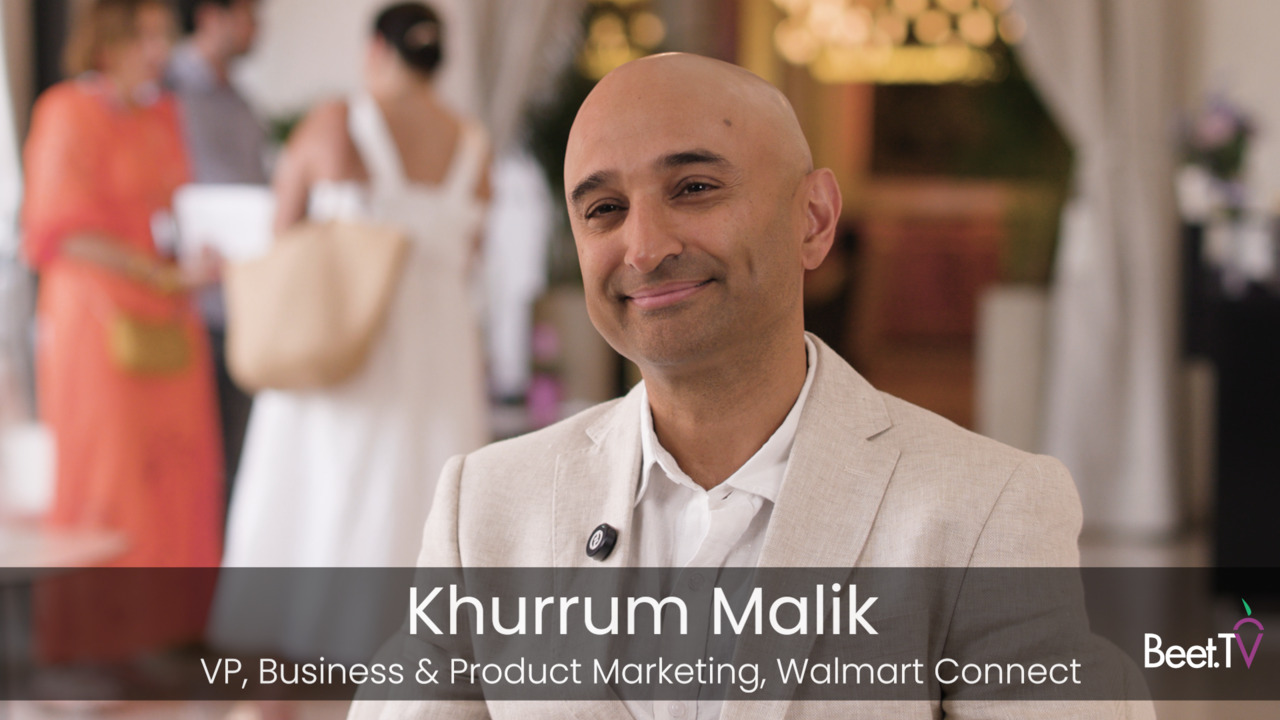
Walmart Connect’s Khurrum Malik: Branded Content Series Drives 37% Sales Lift for Participating Brands

CANNES, France — Integrated commerce programs combining branded content, connected television, in-store marketing, and search are generating measurable sales impact that points toward a broader industry shift from one-time performance captures toward durable brand growth.

“One of the big trends we’re seeing here at Cannes is creativity powering commerce more and more,” Khurrum Malik, vp of business & product marketing at Walmart Connect, told Beet.TV Editorial Director Lisa Granatstein at Cannes Lions. “If you’re an advertiser and you come to Walmart, you now have the opportunity to do branded content, distribute that on our Vizio televisions, invest in search and display and invest in store marketing.”

Walmart’s Patio and Garden “Backyard Escapes” branded content series — distributed across CTV, website, and stores — demonstrated this integrated approach’s potential, generating a 37% sales increase for participating brands.

The omnichannel opportunity

Walmart’s scale creates unique visibility into consumer behavior across 4,600 stores and digital touchpoints, with customers moving fluidly between CTV discovery, online search, and in-store purchase in patterns that require advertisers to maintain presence across every touchpoint.

“We see 150 million customers every week engage with us online and in store. We see customers walking across the omnichannel footprint we have looking to discover new brands and of course purchase,” Malik said.

Delivery infrastructure now reaches 95% of the United States within three hours, adding convenience as a third behavioral dimension alongside omnichannel shopping and digital discovery.

Magnite and Yahoo DSP partnerships expand CTV reach

New programmatic partnerships enable advertisers to purchase Vizio inventory through established buying platforms, reducing operational complexity while expanding access to Walmart’s connected television audiences.

“One of the partnerships we just announced was with Magnite and Yahoo DSP. Now through Magnite and Yahoo DSP, you can buy Vizio inventory and reach those audiences through CTV,” Malik said.

This expansion provides advertisers more efficient pathways to connect with omnichannel customers across preferred buying workflows rather than requiring dedicated direct relationships.

Incremental ROAS raises measurement bar

Walmart Connect’s measurement framework addresses advertiser demands beyond standard return on ad spend, launching incremental ROAS for search in January to demonstrate investment impact beyond baseline sales performance.

“Advertisers are not just asking for sales. They want incremental sales. We provide measurement that provides both of those answers, but also return on ad spend and incremental return on ad spend,” Malik said. “That’s a really high bar and we’re open to that high bar and we want to hold ourselves to that high bar.”

Driving durable growth

CMO demand for sustained brand development rather than isolated performance campaigns drives Walmart Connect’s evolution toward combined brand-building and lower-funnel capture strategies that create lasting consumer relationships.

“What we hear from CMOs, their agencies, is to help us build durable growth. Can you build my brand over time so people trust me? And can I have repeat purchases?” Malik said. “We believe all of media is going to align on lifetime value over time, which is brand and performance together.”

IAS’s Srishti Gupta: Media Quality has Shifted ‘From Protection to Growth’

CANNES, France — As AI-generated content floods digital environments, the case for media quality investment has fundamentally changed — moving from defensive brand protection toward measurable performance improvement that drives sales lift, brand awareness, and working media efficiency.

“Media quality has fundamentally changed from being about protection to really being about growth,” Srishti Gupta, chief product officer at Integral Ad Science, told Beet.TV contributor David Kaplan at Cannes Lions. “When consumers see an ad in the right environment, they actually engage with it, they lean in, and that leads to higher outcomes.”

With more than 50% of content now estimated to be AI-generated, brands face unprecedented pressure to ensure their advertising appears alongside appropriate content — creating both challenge and opportunity for media quality technology.

Performance data makes the case

Higher quality media environments generate significant performance improvements, with IAS data showing 35% increases in working media effectiveness, 40% sales lift for consumer packaged goods clients optimizing toward attention metrics, and 30% brand awareness gains for automotive advertisers targeting viewability.

“Just as an example, recently we saw with a CPG client that when they optimized towards higher attention media, they actually saw a 40% increase in sales lift,” Gupta said.

Pre-bid signal integration creates flywheel effects where quality improvements continuously reinforce campaign performance across subsequent media investments.

AI classification operates at unprecedented scale

IAS processes 140 years’ worth of video content daily through multimedia classification models that analyze sentiment, emotion, and cross-language nuance within user-generated and social environments.

“We are able to really build multimedia classification models at tremendous AI scale,” Gupta said. “Our models are not only able to classify it at scale, but then we are also able to go and be extremely nuanced. We can look at sentiment. We can look at emotion. We can look at nuances between languages.”

Fifteen years of model training data enables custom brand-specific classification that tailors quality parameters to individual advertiser requirements rather than generic industry standards.

Total TV bridges buy-sell transparency gap

IAS’s Total TV initiative addresses historical disconnects between publisher and advertiser quality definitions by creating shared visibility layers that align buy-side and sell-side standards across streaming environments.

“We have not only the buy side leaning in, but we also have the sell side leaning in. We have several publishers, for example, Disney and NBCU and Amazon Prime leaning in and sharing signals with us so that brands can be confident on what genres and what programs their ad dollars are appearing against,” Gupta said.

Quality Connect extends this transparency approach by giving publishers visibility into specific brand safety and suitability preferences that were previously invisible to the sell side.

“Brands have very specific preferences around brand safety and suitability, but publishers usually do not have visibility into that. That is where Quality Connect comes in to provide that visibility to both sides so that both sides win,” Gupta said.

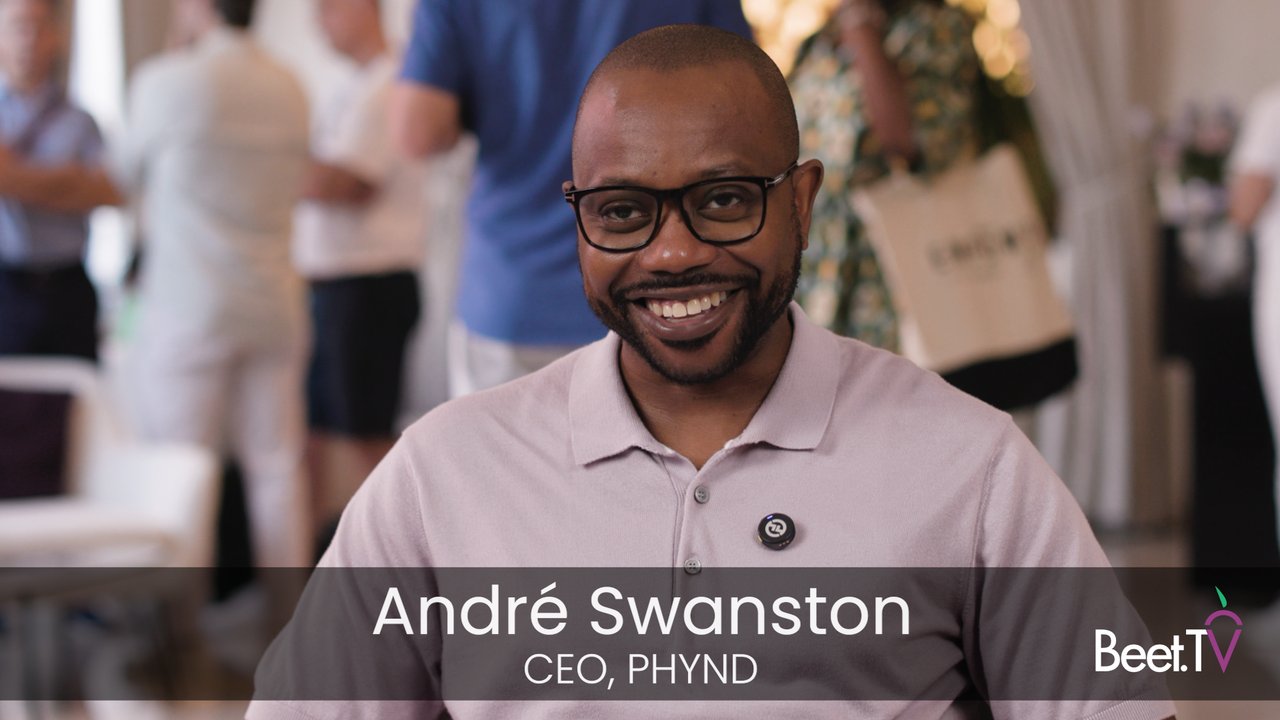
Interactive TV Is Ready to Press Start: Phynd CEO André Swanston

CANNES, France – Television has spent decades asking viewers to sit down, stay quiet and watch whatever happened to be on. André Swanston, chief executive of cloud gaming platform Phynd, thinks that era is ending. The next battle for brands, he says, won’t be fought over another streaming series. It’ll be fought over who gets the controller.

Speaking with Beet.TV editorial director Lisa Granatstein at the Cannes Lions International Festival of Creativity, Swanston said advertisers are beginning to realize that television is shifting from a passive medium into an interactive one, creating new ways to connect with consumers.

“I think what’s exciting for brands right now is that television is becoming interactive and more engaged and that presents new opportunities for brands to engage with consumers,” Swanston said.

Connected TV déjà vu

Swanston has seen this movie before.

Before founding Phynd, he built connected TV advertising company Tru Optik, helping advertisers navigate an emerging medium that many initially dismissed as experimental.

A decade ago, marketers questioned whether connected TV could be measured, targeted or scaled. Today, it’s one of advertising’s dominant channels. Swanston believes cloud gaming faces many of the same misconceptions.

“We helped solve for the industry, and now everybody views it as probably the most dominant platform and far and away the biggest opportunity to engage consumers,” he said.

His strategy at Phynd centers on three goals: convincing advertisers that gaming content is premium, making the technology easy to buy through familiar advertising infrastructure and educating brands about gaming’s unusually high levels of attention.

That premium lineup includes recognizable franchises such as Smurfs Kart, Who Wants to Be a Millionaire?, Garfield Party, Agatha Christie Mysteries and Inspector Gadget.

Goodbye console tax

Swanston believes cloud gaming’s biggest advantage isn’t simply better technology. It’s eliminating expensive hardware.

He noted that only about one-third of television households worldwide own a gaming console, limiting advertisers’ reach. By delivering games directly through smart TVs, Phynd aims to make premium gaming available without requiring consumers to buy consoles, expensive games or additional subscriptions.

“Whether it’s seeing an ad, whether it’s giving you a reward or sponsored experience, we’re helping you access this game for free,” Swanston said.

For marketers, that creates access to hundreds of millions of smart TV households that might never have purchased dedicated gaming hardware.

Don’t ruin the vibe

If there’s one thing brands should avoid, Swanston joked, it’s becoming the marketing equivalent of someone talking through the boss battle.

Phynd’s approach is to keep advertising outside gameplay rather than interrupting it.

“What you don’t want is for a brand to be considered intrusive or ruining the vibe,” Swanston said with a laugh, borrowing the phrase from his son.

Instead, the platform focuses on pre-roll advertising before gameplay begins along with sponsored rewards, discounts or virtual items earned during play.

“What we really have focused on is how does the brand enhance the experience,” he said.

Swanston argues that approach increases engagement while making brands feel like contributors rather than unwanted guests barging into the game.

Building toward a bigger launch

Phynd recently launched on Samsung smart TVs and plans to expand to LG and Amazon Fire TV. Swanston said the company has already seen millions of downloads, along with longer play sessions and higher engagement than expected, though he did not disclose specific figures.

For now, the company is intentionally limiting commercial activity while collecting data and refining its artificial intelligence-powered FAME, or Phynd Agentic Monetization Engine.

“We’re really excited in Q4 to start opening up more abilities for brands to engage with our users,” Swanston said.

If television’s next chapter really does involve game controllers instead of remote controls, advertisers may soon discover that the most valuable screen in the living room isn’t asking viewers to binge another crime drama. It’s asking them whether they’d like to press “Start.”

AI Agents Need Human Conductors to Navigate Connected TV and Commerce Media

Autonomous software programs are moving from theoretical concepts to active participants in the programmatic advertising supply chain – and that’s forcing the media marketplace to rethink things.

While the backend infrastructure to support these sophisticated tasks is accelerating, the transition requires a delicate balance between computational efficiency and traditional human oversight.

The macro trends of agentic artificial intelligence and the underlying infrastructure are pushing the industry faster and further than it knows how to run, said Mike Dupree, svp, demand, Magnite, in this video interview with Beet.TV.

Orchestrating the new automated workflow

Market forecasts indicate a massive capital influx to support this shift across the broader economy. Worldwide spending on artificial intelligence is projected to reach $2.59 trillion in 2026, marking a 47% annual increase largely driven by infrastructure investments, according to a Gartner forecast.

Dupree said the advertising sector has seen the concept of agentic software evolve rapidly, noting that in six short months, the market has gone from conception to actual tangible activation.

“We see a broad spectrum of readiness from both our supply and sell side partners and our buy side partners in terms of how people are approaching agentic,” Dupree said. “But we do know it is actively reframing and reshaping how we think, plan, buy, optimize, measure, report.”

“We want flexibility to bring whatever technology or choice you have to the table, which is why Magnite launched our orchestration layer right around Cannes,” Dupree said.

Maintaining human oversight in an automated ecosystem

Despite this automation, Dupree said maintaining a human element in the loop remains an essential part of the equation. “You still need somebody with context,” Dupree said.

“You still need somebody with taste, and you still need somebody with risk management potentially to look after and oversee this agentic activation layer.”

“AI may know how to play all the instruments, but you still need a conductor and that conductor needs to know when to start, when to stop, when to pause and let things breathe, and then when to compose,” Dupree said. “That is certainly the job of all of us as we continue to embrace this technology and apply it to our day-to-day.”

Merging high-intent commerce with big screens

Beyond artificial intelligence, though, Dupree said the convergence of retail data and connected television is creating a new dynamic for advertisers. He said marrying the storytelling canvas of television with high-intent commerce signals allows marketers to cut through legacy targeting methods and drive measurable outcomes.

“If you’re an apparel company, instead of just spraying and praying, you can now target and measure your ability to reach high-intent shoppers and see what that did in terms of offline or online sales afterwards,” Dupree said. “It is incredibly powerful and something that’s always been reserved for more native digital that is now being applied to the most important canvas of all, which is the big screen.”

To prove the efficacy of these campaigns, Dupree said the sell-side platform is pushing toward outcome-based measurement focused on identity resolution. “You can’t measure anything that you don’t have the signal on,” Dupree said. “We’ve built a conversion API which can be bespoke to pretty much any conversion event offline or online depending on what the customer’s needs are.”

Posted in Uncategorized

TV Ads Should Sell Stuff, Not Just Win Awards: Amazon’s Jeremy Helfand

CANNES, France – At Cannes Lions, where executives can usually survive an entire panel by saying “AI,” “creativity” and “consumer connection” in various combinations, Jeremy Helfand arrived with a more practical ambition. The vice president of Prime Video advertising at Amazon wants streaming television to do something radical: help brands actually sell things.

Speaking with Beet.TV contributor David Kaplan, Helfand outlined Amazon’s vision for Prime Video as both an entertainment destination and an advertising machine powered by what he described as “trillions of signals.” The message was clear. Streaming TV is no longer content to be television with a Wi-Fi password. It wants to become a shopping cart too.

Streaming TV discovers it can count

Helfand argued that Prime Video’s advantage comes from its ability to combine premium entertainment with data-driven advertising.

“Prime Video is focused on being a first-stop entertainment destination for both customers and for brands,” he said. He added that the platform’s ability to leverage “trillions of signals to deliver a more relevant experience” helps create advertising that works for viewers as well as marketers.

That phrase, “trillions of signals,” is the sort of number that makes media buyers either very excited or slightly concerned that their refrigerator is now participating in audience measurement.

AI’s job is making more ads and making them cheaper

Asked the mandatory Cannes question about artificial intelligence, Helfand delivered a refreshingly practical answer.

Rather than portraying AI as a digital messiah, he described it as a tool that can help brands create more advertising variations and improve relevance. AI can “democratize creative” by helping advertisers produce campaigns that are “more effective as well as more varied,” he said.

The benefits extend beyond creative development. Helfand also pointed to behind-the-scenes improvements in ad delivery, optimization and inventory management. In other words, AI is not just writing marketing copy. It’s helping make the plumbing work better too.

The remote control becomes a checkout button

For decades, television’s primary contribution to commerce was convincing viewers to buy something later. Streaming wants to shorten that process considerably.

“The expectation for streaming TV should be that it’s a full funnel advertising medium,” Helfand said. He argued that advertisers should be able to achieve “whatever objective” they have, whether brand awareness, conversion or performance goals.

Prime Video’s interactive ad units allow viewers to complete purchases with “a single click of the remote,” turning the traditional couch-to-store journey into something closer to couch-to-couch commerce.

The television remote has spent decades helping people avoid advertising. Amazon would now like it to help complete transactions.

From product placement to social media victory laps

Helfand described what he called a “continuum” of brand integration opportunities, ranging from direct placements inside content to broader sponsorship and co-branded marketing campaigns.

One example involved Prime Video’s “Off Campus” series and hydration brand Liquid I.V. According to Helfand, the campaign combined in-show integration, co-branded advertising featuring the show’s characters and social media amplification. The result was what he called Liquid I.V.’s “most effective social marketing campaign ever.”

Cannes attendees may find comfort in learning that product placement has evolved from a soda can sitting on a kitchen counter into a multi-platform marketing ecosystem supported by social content, branded storytelling and enough measurement dashboards to power a small utility company.

Television for the little guys

Perhaps Helfand’s most notable point concerned accessibility. He argued that streaming television is becoming available to advertisers far beyond the traditional roster of national brands with giant media budgets.

“Whether you’re a large national brand or you’re a small, medium sized business local advertiser,” Prime Video can provide access to streaming television advertising, he said. AI-driven creative tools and improved targeting capabilities are helping lower barriers to entry.

“The idea that we can democratize television for any type of advertiser is a fantastic opportunity,” Helfand said.

That may be one of the more significant shifts underway in media. For generations, television advertising was a club with a very expensive cover charge. Amazon’s pitch is that the velvet rope is coming down, though naturally there will still be plenty of opportunities to buy something once you get inside.

Posted in Uncategorized

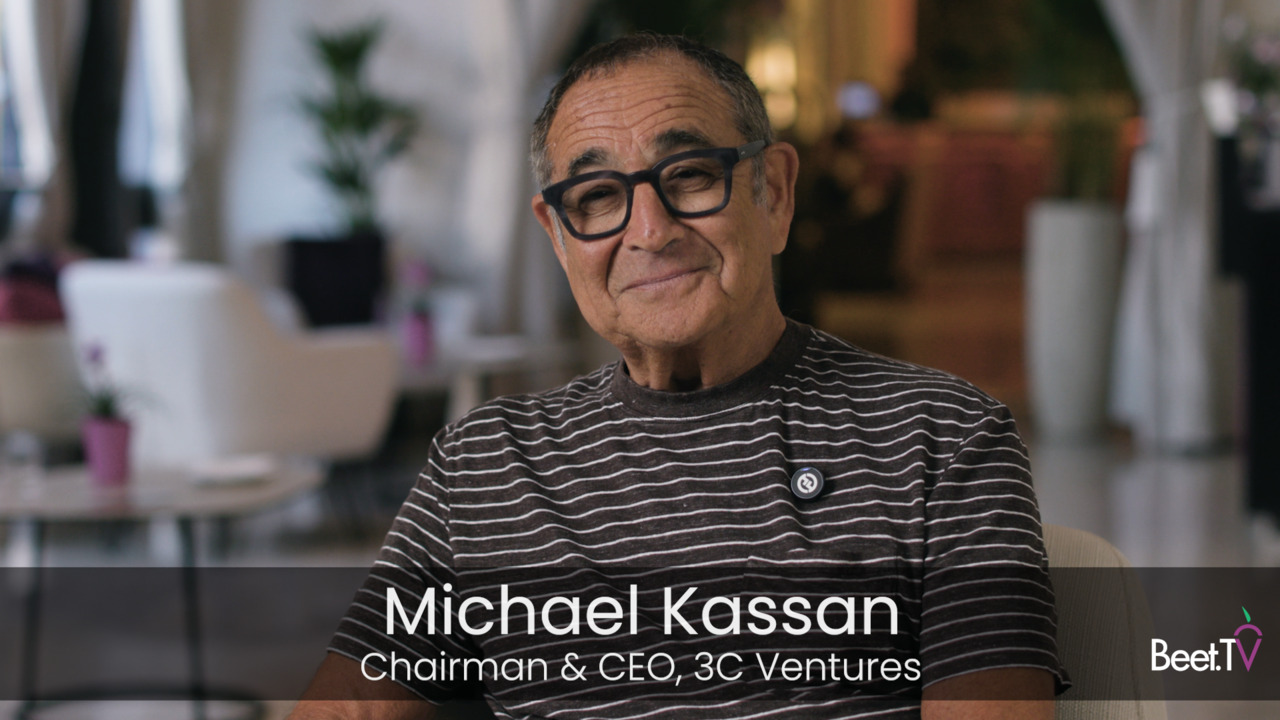
3C Ventures’ Michael Kassan: AI Ranks Among ‘Three Most Important Technological Advances’ In 50-Year Career

CANNES, France — Artificial intelligence represents a generational shift comparable to mobile telephony and the internet, driving a veteran industry executive off the sidelines and into a consultancy built to help companies navigate marketing’s most transformational moment.

“Over the arc of my career, which has been 50 years since I finished graduate school, the three most important technological advances would be the introduction of mobile telephony, the PC and the internet era and AI,” Michael Kassan, CEO of 3C Ventures, told Beet.TV at Cannes Lions. “For me personally, I couldn’t be on the sidelines during this one.”

This conviction shaped 3C Ventures’ rapid scaling around practical experience combined with deep consultative capability — a deliberate mix of major consulting firm talent that Kassan says elevates the work product for clients navigating complex marketing decisions.

Cannes evolved from creativity fest to industry hub

Kassan traces Cannes Lions’ transformation from a creative awards festival into a comprehensive industry gathering across 26 years of personal involvement, crediting client arrival as the pivotal moment that drew the entire ecosystem.

“About 26 years ago, I accidentally showed up at the Cannes Lions because I was on vacation in the region. And I saw what is still at the core of this event, a festival of creativity,” Kassan said. “The progression was Cannes for the creatives. I showed up and said, ‘Wait, you should be here from the media side of the business.’ Then the digital players showed up and then Jim Stengel made the decision at Procter & Gamble to show up. And once the clients came, then everybody came.”

This year’s edition reflects that evolution through sheer volume — more people, topics, beaches, conferences, and speaking opportunities than ever before.

Efficiency defines Cannes value proposition

Five days of concentrated relationship building and business development across the entire marketing ecosystem creates unmatched efficiency that justifies the event’s growing complexity and scale.

“There’s a proliferation of opportunity here. The efficiency that one gets spending five days in one place and being able to cover all the ground you can, I’ve always believed efficiency matters,” Kassan said. “There’s no place more efficient if you do it right.”

Consultative model meets navigation demand

3C Ventures fills a gap at the intersection of marketing, media, advertising, entertainment, sports, and technology — the same navigational role Kassan pursued throughout his career, now amplified by AI transformation demands.

“There was a need for a navigational order at the intersection of marketing, media, advertising, entertainment, sports and technology,” Kassan said. “That opportunity right now in the wake of what is arguably the most transformational moment I’ve ever experienced — I have more people at 3C that are former McKinsey, Bain, BCG than I do in my previous company. Maybe that says something about how I’m looking at it.”

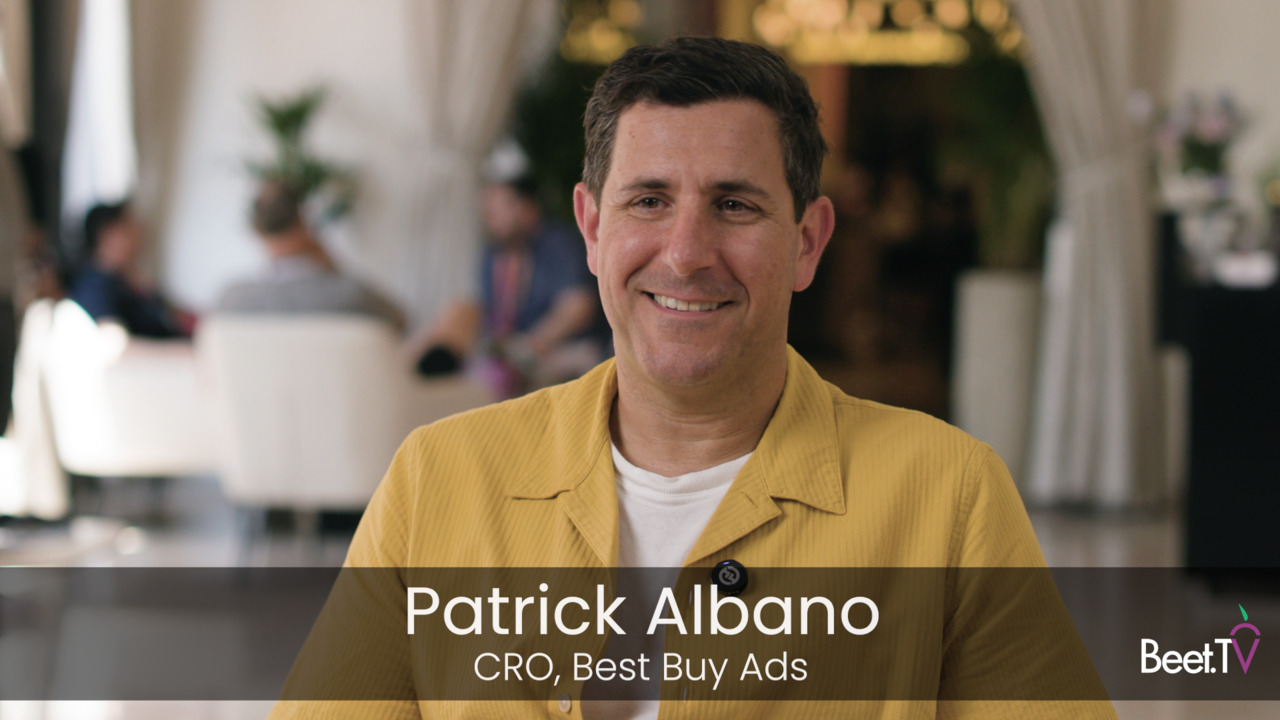
Best Buy Ads’ Patrick Albano: AI Search is Collapsing the Discovery-to-Purchase Funnel

CANNES, France — Consumers increasingly bypass traditional product research across multiple websites, moving directly from AI-powered search engines to retail purchase decisions — a behavioral shift that compresses the marketing funnel while delivering higher-intent buyers to retailers.

“There used to be this process of searching for a product, researching it on different websites, and then coming to a retailer to buy. That’s all collapsed now,” Patrick Albano, chief revenue officer of Best Buy Ads, told Beet.TV contributor David Kaplan at Cannes Lions. “People are going through AI search engines, they’re discovering and researching product and then coming right to the retailer. They’re coming with true intent. They understand the products they want and they’re purchasing.”

This compression creates new marketing imperatives where brands must establish awareness within LLM environments before activating mid and lower-funnel strategies directly at retail.

Physical stores anchor AI product education

Best Buy deploys its thousand-store footprint and in-store employee expertise to help consumers navigate AI product purchases, supplementing human interaction with dedicated partner spaces and original video content.

“One of the biggest values Best Buy has is our thousand stores across the US and what we call blue shirts, which are our employees in store that help people navigate product purchases,” Albano said.

Recent initiatives include Meta Labs in-store experience centers, staff AI training programs, and the company’s AI Vat video content series — all addressing a consumer upgrade cycle as new AI-embedded devices enter the market.

Predictive audiences identify purchase intent signals

Three distinct consumer electronics purchase motivations — broken product replacement, planned upgrades, and discretionary self-treats — require fundamentally different marketing approaches despite identical purchase outcomes.

“By using more predictive audiences and media planning capabilities, you can actually understand which journey a consumer is on and give them the right ad, the right brand experience and actually help them through their purchase journey,” Albano said.

Expanding predictive audience targeting capabilities enables Best Buy Ads to match creative and messaging strategies to specific consumer intent states rather than treating all potential buyers identically.

Human credibility becomes competitive advantage

As consumers grow more sophisticated about AI limitations and authenticity questions, brands with genuine human expertise embedded in their purchase journeys gain trust advantages that purely digital experiences cannot replicate.

“People are starting to get to the point where they understand how to use LLMs and AI, but also are starting to question how authentic it is,” Albano said. “Consumers either coming in store to ask questions or purchasing online and then picking up in store — that human interaction at some point in the purchase journey actually is a really helpful thing.”

Natural language interfaces will eventually reshape the entire internet, making the distinction between human and computer-generated advice increasingly consequential for consumer trust.

“Understanding what advice is coming from a consumer from a computer versus a person is going to be critically important and we have an authentic voice in that,” Albano said.

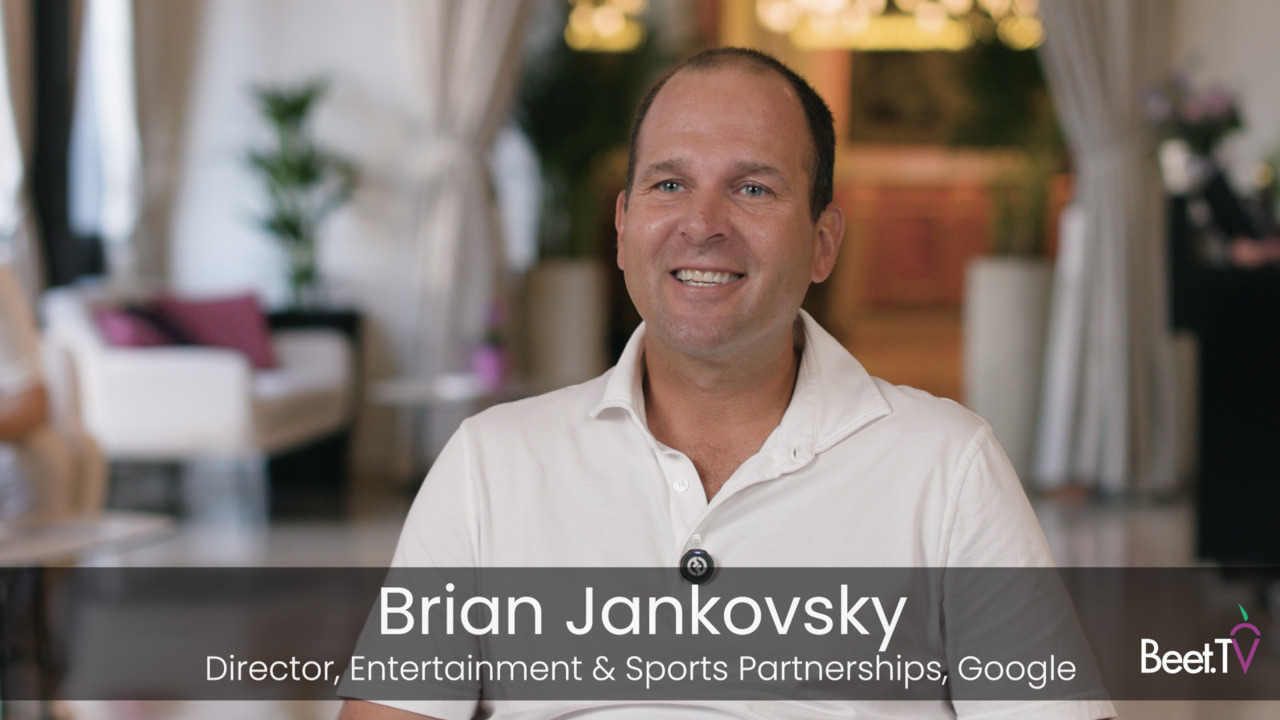
Streaming Ads Need Less One-Size-Fits-All, More Infrastructure: Google’s Brian Jankovsky

CANNES, France — For years, adtech companies pitched the idea of a single platform that could do everything. Brian Jankovsky, director of entertainment and sports partnerships at Google, says media companies would rather build their own castles than rent a room in someone else’s.

Speaking with Beet.TV dditorial director Lisa Granatstein at the Cannes Lions International Festival of Creativity, Jankovsky said the defining word for Google’s publisher strategy today is “flexibility.”

“We’ve had to adapt a lot to support our publishers’ businesses over the last few years,” he said.

The reason is simple. Large media companies increasingly want control over pieces of their technology infrastructure rather than outsourcing everything to a single vendor.

“You can’t be a one-size-fits-all solution anymore,” Jankovsky said.

Some publishers want Google to handle only specific functions, such as ad serving or server-side ad insertion. Others still prefer a fully managed approach. Google’s job, he suggested, is to stop insisting it has to be the entire kitchen and become comfortable supplying a few appliances.

“We can plug in as a pipe. We can plug in as a service side ad stitching component. We can be an ad server,” he said.

Sports remain ultimate stress test

If ad technology had an equivalent of running a marathon while juggling chainsaws, it would probably be live sports.

Jankovsky pointed to live events as the clearest example of where infrastructure matters most. Viewers watching a championship match are generally not interested in staring at loading screens, frozen streams or the digital equivalent of a shrug.

“The expectation for the consumer is a beautiful experience between content and ads, no slate,” he said.

To deliver that experience, he argued, platforms need massive global infrastructure capable of serving personalized advertising to huge audiences simultaneously.

According to Jankovsky, research conducted with Boston Consulting Group found that 77% of media partners said they needed the ability to support at least 250,000 concurrent personalized streams. Google’s systems are already operating at far larger scale.

“We’re doing a million a day,” he said. “We’re three times the capacity of where the industry is.”

Cricket delivers big numbers

When asked for a real-world example, Jankovsky did not reach for the Super Bowl or the Olympics. Instead, he pointed to cricket.

Google helped support streaming during the Cricket World Cup in Asia, a tournament that attracts audiences large enough to make even the biggest Western sporting events glance nervously over their shoulders.

“We did over 11 million one-to-one streams concurrently,” Jankovsky said. “We did it effortlessly.”

In the world of streaming infrastructure, 11 million concurrent personalized streams is the sort of figure that causes engineers to either celebrate or immediately look for something stronger than coffee.

Bringing small businesses to TV

While much of the streaming advertising business focuses on major brands, Google sees opportunity in helping small and medium-sized businesses buy television advertising for the first time.

Jankovsky said the company is leveraging the advertiser base it built through Search and YouTube to introduce new demand to streaming publishers.

“A lot of these advertisers are first-time buyers of TV,” he said.

According to Jankovsky, Google brought more than 2,000 new advertisers to partner platforms last year. Many began with YouTube campaigns before expanding into streaming television inventory.

The strategy effectively turns local businesses and emerging brands into potential streaming advertisers, giving publishers access to a broader pool of buyers while helping smaller companies reach larger audiences.

Gemini takes on creative approval pile

If streaming advertising has one universal challenge, it is the growing mountain of creative assets that publishers must review, approve and manage.

Jankovsky said Google has rebuilt its creative review tools using Gemini AI to help automate that process.

“We rebuilt our creative tools on Google Gemini,” he said.

The system can scan thousands of ads almost instantly and compare them against publisher guidelines. Human reviewers still make the final call on questionable submissions, but the platform learns from those decisions over time.

“We’re able to scan thousands of creatives instantaneously,” Jankovsky said.

The goal is to reduce the manual workload without taking publishers completely out of the loop. At least for now, there is still a human somewhere deciding whether an ad belongs on screen, which may come as reassuring news to anyone who has ever seen an internet advertisement and wondered how it got approved in the first place.

For Google, the larger objective is clear: give publishers more control over technology choices, help them attract new advertisers and use AI to manage growing complexity. In an industry that once promised a single solution for everything, Jankovsky’s message was refreshingly less grandiose. Sometimes the future of advertising is not about owning the whole stack. Sometimes it is about being a very reliable pipe.

Streaming Ads are Growing Up, Getting Smarter and Learning to Shop: Amazon’s Jenny Burke

CANNES, France – At Cannes Lions, where every conversation eventually circles back to AI, measurement or someone insisting they have solved television, Amazon Ads arrived with a simpler proposition: Why settle for one advertising platform when you can have an entire shopping mall attached to your streaming service?

That was the message from Jenny Burke, director of worldwide video strategy and go-to-market at Amazon Ads, during an interview with Beet.TV editorial director Lisa Granatstein. Burke described Prime Video not as a standalone streaming platform but as the centerpiece of Amazon’s sprawling media ecosystem, where shopping, entertainment and advertising increasingly blend into a single consumer experience.

Prime Video as the center of the universe

For advertisers trying to navigate an increasingly fragmented streaming landscape, Burke argued that Prime Video’s biggest advantage is that it sits inside a much larger machine.

“What that enables is a full-funnel marketing capability from brand awareness to consideration to conversion,” Burke said. “Prime Video sits at the center of all of that to really meet all of those objectives.”

In Amazon’s view, advertisers are not simply buying access to a television audience. They are buying into a network that includes Fire TV, Twitch, Wondery and Amazon’s retail business. It is a pitch that essentially says viewers can watch a show, click an ad and buy a product without ever leaving the couch. Exercise remains optional.

Burke said Amazon works backward from advertisers’ goals and uses its content portfolio, audience insights and measurement tools to match brands with programming that feels natural rather than forced.

Product placement gets a college education

One example is Amazon’s upcoming adaptation of “Off Campus,” a young adult series that has become the centerpiece of a broad partnership with hydration brand Liquid I.V.

“We’ve integrated Liquid IV into not only the storyline, but we have some a 30 second spot with the talent,” Burke said. “We have social activations, licensing product, and that just shows the scale of what can be done with Amazon.”

The goal is to move beyond traditional sponsorships and create deeper partnerships around specific titles. According to Burke, brands are finding success when they become involved early in the content creation process.

“We’re finding that having big ownership of certain titles is working,” she said. “So that means really partnering early on to create content together.”

In other words, the days of simply slapping a logo onto a streaming series may be fading. Advertisers increasingly want to become part of the story itself, preferably without viewers reaching for the fast-forward button.

The remote control becomes a shopping cart

Amazon is also betting heavily on interactive advertising formats that encourage viewers to do more than just watch.

Burke highlighted interactive video ads that allow viewers to learn more or purchase products with a click of the remote. She also pointed to “Next Step Ads,” a format designed to appear naturally as viewers move from one episode to the next during binge-watching sessions.

“We’re finding interactive video ads, one click of the remote to learn more or to actually purchase on Amazon is working,” Burke said.

The concept is simple enough: If audiences are already spending entire weekends consuming television, Amazon would like to make shopping another subplot.

Solving streaming’s fragmentation problem

Burke acknowledged that streaming continues to become more fragmented as new services emerge and viewers spread their attention across countless platforms.

“What we’re finding is that there’s even more fragmentation than before,” she said. “There are so many streamers out there.”

Amazon’s answer is its demand-side platform, which allows advertisers to buy inventory across both Amazon-owned properties and competing streaming services through a single platform. Burke said the approach offers frequency management, audience targeting and operational simplicity for marketers increasingly overwhelmed by complexity.

Perhaps the boldest claim involved Amazon’s data advantage.

“We like to say we know we’re not guessing who we’re serving ads to, we truly know,” Burke said.

That confidence comes from what Amazon calls its authenticated graph, which uses deterministic customer signals derived from its direct relationships with consumers. Burke said those capabilities allow Amazon and its partners to reach roughly 90% of U.S. households with known audience information rather than probabilistic estimates.

Agentic advertising is coming

Looking ahead, Burke pointed to three major investment areas: content, measurement and artificial intelligence.

Prime Video with ads recently expanded into four additional countries and now operates in 20 markets, according to Burke. Amazon also continues to invest heavily in original programming, particularly content aimed at younger audiences.

But the most Cannes-worthy buzzword was impossible to avoid.

“What’s next is the use of agentic capabilities to drive ease of buying,” Burke said.

That effort includes broader use of AI-powered tools, including Alexa+, which Burke described as part of Amazon’s larger AI strategy. The vision is to simplify advertising workflows while improving measurement and campaign performance.

For marketers, the future apparently involves AI agents buying ads, viewers buying products and streaming platforms buying more content. The only party not buying something may be the consumer, who just wanted to watch one episode and somehow ended up purchasing electrolyte packets at 1 a.m.

Posted in Uncategorized

PayPal Ads Bets on Transaction Data to Solve Commerce Media’s Measurement Problem

CANNES, France — While ad spending in commerce media is projected to reach $100 billion by 2026, according to Emarketer, proving true return on investment across multiple merchants remains elusive for many advertisers.

PayPal believes its position straddling 400 million users and 30 million merchants gives it an unusual vantage point. The company’s advertising arm, launched in May 2026, claims it can show advertisers what happens after a campaign runs – not just on one retailer’s site, but across the entire merchant landscape.

“We can show after someone was exposed to a CTV campaign, what happened at any merchant,” said Mark Grether, svp and gm of PayPal Ads, in this video interview with Beet.TV at Cannes Lions 2026. “That’s why we can provide a much richer, closed-loop attribution.”

Deterministic data versus proxies

The measurement challenge in commerce media stems partly from fragmented identity solutions. Most retail media networks can only track conversions on their own properties, leaving advertisers to guess at the broader impact of their campaigns.

Grether argued that PayPal’s payment infrastructure solves this fundamental problem. “We truly know who you are because we’re leveraging the payment rails,” he said. “And that is actually key from a measurement and incrementality perspective, because we can do it based on deterministic data as opposed to just proxies or look-alike modeling.”

The company combines transaction data from PayPal, Venmo peer-to-peer payments, and Honey browser activity to build its advertising offering.

Positioning as partner, not competitor

Rather than competing directly with retail media networks, PayPal Ads is pitching itself as connecting with existing merchant advertising operations. The company has struck partnerships with retailers including Best Buy and Sephora to extend their capabilities.

“We see us more as an amplifier, as an enabler, as opposed to a competitor,” Grether said. “It could be from an insights perspective, it could be from a measurement perspective, it could be from a media perspective.”

This approach addresses what Grether described as the two most fundamental questions for advertisers: “What is my market share across all the merchants? What can I do to actually increase my market share? And then secondly, where should I deploy my spending across these merchants? Where do I get the most incremental return?”

AI reshaping the customer journey

Artificial intelligence is transforming how consumers discover products, according to Grether, with implications for where advertisers need to show up. He pointed to PayPal’s data showing a shift in shopping behavior away from traditional search.

“Consumers are no longer starting their customer journey on search. They start in LLMs,” he said. “Eventually, they go to merchants and make the transactions, but they quite often actually skipped the search step in between.”

To address this shift, PayPal has developed what it calls storefront ads – shoppable units that bring a merchant’s store to consumers wherever they are browsing. “It might be on the open web, it might be in LLMs,” Grether explained. “And that gives the merchants the reach that they otherwise would eventually miss out.”

Checkout Is the New Click: Fluent’s PJ Triboletti on Why the POS Screen Is Commerce Media’s Next Frontier

CANNES, France – What’s the most valuable moment in retail? Increasingly, some think it’s the split second after they’ve decided to buy something and are standing at the register.

That’s why some in commerce media are making the argument for embedding media directly into the point-of-sale experience, tied to loyalty data and capable of tracking a consumer from impression through to conversion.

“The checkout is the next frontier of commerce media because it’s something that the consumer is engaging with and has already made a decision on what they are going to buy,” said PJ Triboletti, SVP of revenue at Fluent, in a video interview with Beet.TV at the Beet.TV Leadership Sessions at Cannes Lions 2026.

Bringing the digital funnel in-store

The measurement problem has long haunted in-store media. Traditional retail screens generate impressions, but connecting those impressions to actual purchases has required stitching together foot traffic data, sales velocity figures, and a series of educated guesses. It’s a far cry from the clean, attributable loop that digital advertising has spent two decades perfecting.

Fluent is a commerce media solutions provider connecting top-tier brands with highly engaged consumers. Leveraging exclusive ad inventory, robust first-party data, privacy-first infrastructure, and proprietary machine learning, Fluent unlocks additional revenue streams for partners and empowers advertisers to acquire their most valuable customers at scale.

Triboletti argued that the checkout screen changes that calculus entirely. “You’re bringing the online experience of traditional measurement from impression to click to conversion, full funnel on a screen inside of a physical retail environment for the first time ever,” he said. The mechanism he described allows consumers to opt in to receive an offer via email or SMS at the moment of transaction, carrying that offer with them after they leave the store.

“The powerful piece here from a measurement perspective is one, you’re getting brand visibility for a consumer who’s in a purchase mindset and has actually just completed a transaction,” Triboletti said. “And then you can follow them and be in their inbox or be in their SMS on their phone when they are ready to convert for that offer.”

The hardware payback argument

Is it worth upgrading old sale terminals? The old pin-pad terminals, Triboletti noted, resemble “a Texas Instrument calculator at checkout” and are long overdue for replacement. But beyond aesthetics, he argued the software layer on modernized hardware should be doing considerably more than processing transactions.

“The software behind it needs to be really engaging for the consumer, opting into the loyalty program, driving higher authentication of every single customer transaction, which is really powerful data for the retailer,” he said. The revenue generated from commerce media on those screens, he suggested, could dramatically compress the payback window on the hardware investment itself.

“Based on the size of each store and how many transactions they’re doing annually, you’re looking at an accelerated payback window of that capex to be from five to 10 years to under six months,” Triboletti said. “CFOs and all of the retailers will love this opportunity to really let the monetization be that accelerant from a payback for the investment of that hardware.” It’s a pitch designed to move the conversation from the marketing department straight to the finance suite.

Trust before dollars

Projection for global retail media ad spending are pointing toward $100 billion by 2026, according to eMarketer estimates, as retailers increasingly seek to monetize first-party data across every touchpoint in the customer journey.

Fluent’s own trajectory tracks that growth. At Cannes, the company used its time on the Beet.TV stage to announce a new commerce media partnership with CVS — deepening its footprint inside traditional retail, even as it pushes past it. A recent deal with Wyndham Hotels & Resorts extends that same model into hospitality and travel, proof that the post-transaction moment travels well beyond the checkout aisle.

But Triboletti was measured about the preconditions for that growth to materialize at the checkout. Before ad dollars flow reliably, he said, the ecosystem needs to earn something harder to manufacture than reach or scale. “It has to be trust. You have to get the trust from the retailer, you have to get the trust from the consumer, and that you’re showing them the right offer that they opt in,” he said.

“If we don’t deliver the personalization and the trust that the users will engage or the customers will engage, that has to happen first for this to really be a true success,” he said.

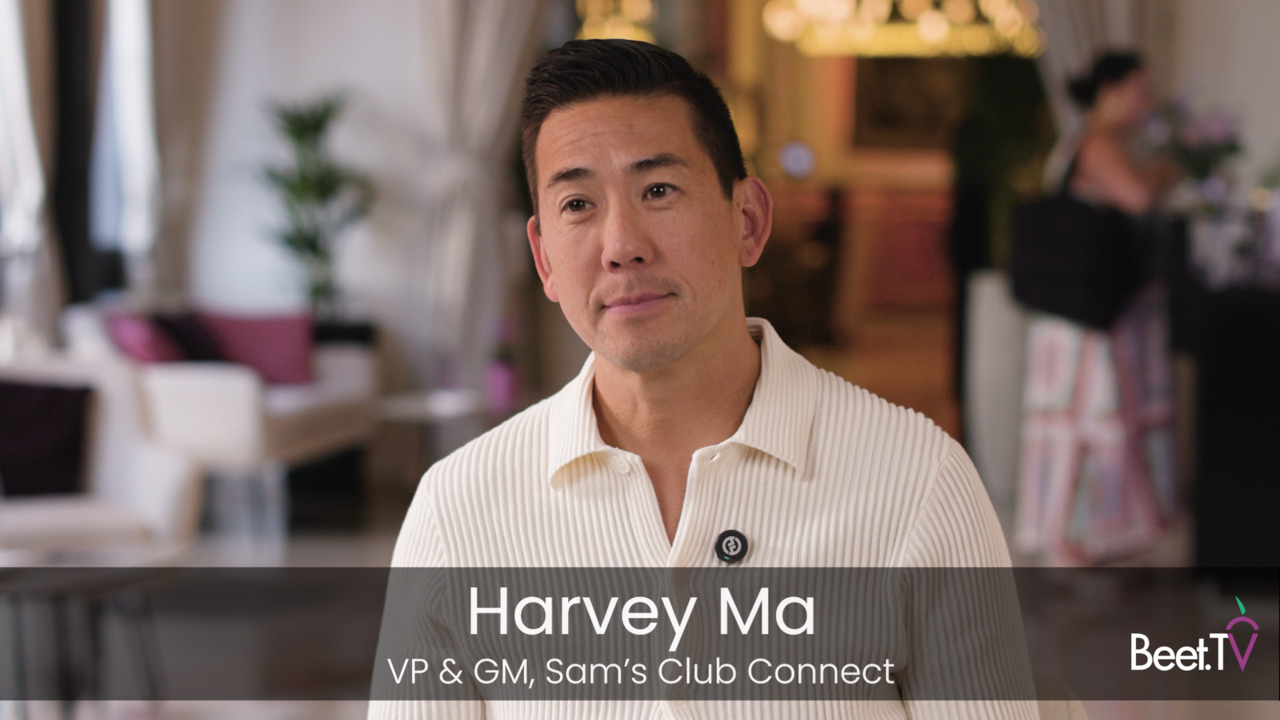
Why Membership Changes Retail Media: Sam’s Club Connect’s Harvey Ma

CANNES, France — Retail media companies spend a lot of time talking about transactions. Harvey Ma would rather talk about relationships.

The vice president and general manager of Sam’s Club Connect used his appearance at the Cannes Lions International Festival of Creativity to explain why Sam’s Club’s retail media business recently rebranded from Sam’s Club MAP to Sam’s Club Connect. The change, he said, reflects a broader ambition than simply selling ads next to shopping carts.

“Connect really unifies that whole experience and that whole journey together,” Ma told Beet.TV Editorial Director Lisa Granatstein. “Connecting members with valuable experiences, and we call them breakthrough experiences, that provide clear proof of measurement.”

The name change also signals something bigger inside Walmart’s growing advertising empire. According to Ma, the company is building what he described as a global advertising ecosystem designed to simplify things for advertisers, technology partners and consumers alike.

“It’ll be easier for tech suppliers, it’ll be easier for advertisers, it’ll be better for our members and customers to have a unified ads experience,” he said, adding that Walmart aims to become “a mega power in the ads industry.”

Not many executives arrive at Cannes and casually announce aspirations for mega-power status. Then again, not many companies have parking lots large enough to qualify for regional airports.

Why membership changes everything

Unlike traditional retailers, Sam’s Club starts with a paying relationship. Members hand over money before they ever fill a shopping cart, creating what Ma described as a fundamentally different dynamic.

“Membership is everything,” he said.

That distinction matters because retail media has traditionally focused on transactions. Sam’s Club believes its membership model gives it a longer and richer view of consumer behavior.

“A member is paying us for the privilege to shop at a Sam’s Club,” Ma said. “What that means is that the obligation back to create that breakthrough experience is absolutely profound for us.”

The result is a data set that follows members across products, services and shopping journeys over time. For advertisers, that means fewer snapshots and more movies.

From soccer player to soccer mom

Retail media executives love talking about customer journeys. Ma offered one of the more memorable examples heard on the Croisette this year.

“We know when you’re a soccer player and you’ve transitioned to a soccer mom,” he said.

Behind the joke lies a serious point about longitudinal measurement. Sam’s Club says it can track how consumer behavior evolves over time because membership creates a persistent identity.

In perhaps the interview’s most colorful illustration of deterministic data, Ma added: “You could come into our clubs, you could transact with a jar full of pennies, and we still know exactly who you are.”

Privacy advocates may have just spilled their rosé. Advertisers probably nodded enthusiastically.

According to Ma, that ability to connect transactions to a known member over time allows marketers to measure performance far beyond a single campaign.

Taking the club to the race track

Retail media networks have spent years expanding beyond search ads and sponsored product listings. Sam’s Club wants to push even further into experiential marketing.

Ma pointed to the company’s “Race to the Club” initiative, which includes sponsorship of Andretti Global’s No. 27 Honda IndyCar driven by Kyle Kirkwood.

When people ask why a warehouse club is sponsoring a race car, Ma says they’re asking the wrong question.

“It’s less about the sponsorship, it’s less about the race car, it’s more about bringing Sam’s Club to the track,” he said.

The idea is to let consumers experience products in real-world settings rather than simply seeing digital ads. Need a portable air compressor? Why not test one next to an IndyCar driver?

The approach extends to parking lot activations, music festivals and other events that place the Sam’s Club brand far beyond the walls of its warehouses.

The next retail media battleground

Looking ahead, Ma believes the winners in retail media will separate themselves in three ways: audience quality, experiential engagement and proof of performance.

The first is having a high-quality audience with what he called “one-to-one fidelity” and deterministic measurement. The second is creating sensory experiences that go beyond clicks and impressions.

“It’s not just search and display, but the taste, the touch, the emotion, the smell that you feel when you’re shopping,” he said.

The final differentiator is proving that advertising actually works. In an industry where every presentation deck seems legally required to contain the words transparency, incrementality and lifetime value, Ma argued that the real challenge is confidence.

“How do you know, deterministically and confidently, that that is actually happening?” he asked.

It is a question that continues to haunt retail media executives from Cannes to Bentonville. Sam’s Club Connect is betting that if advertisers can answer it, they’ll keep coming back. Membership, after all, has its privileges.

Posted in Uncategorized

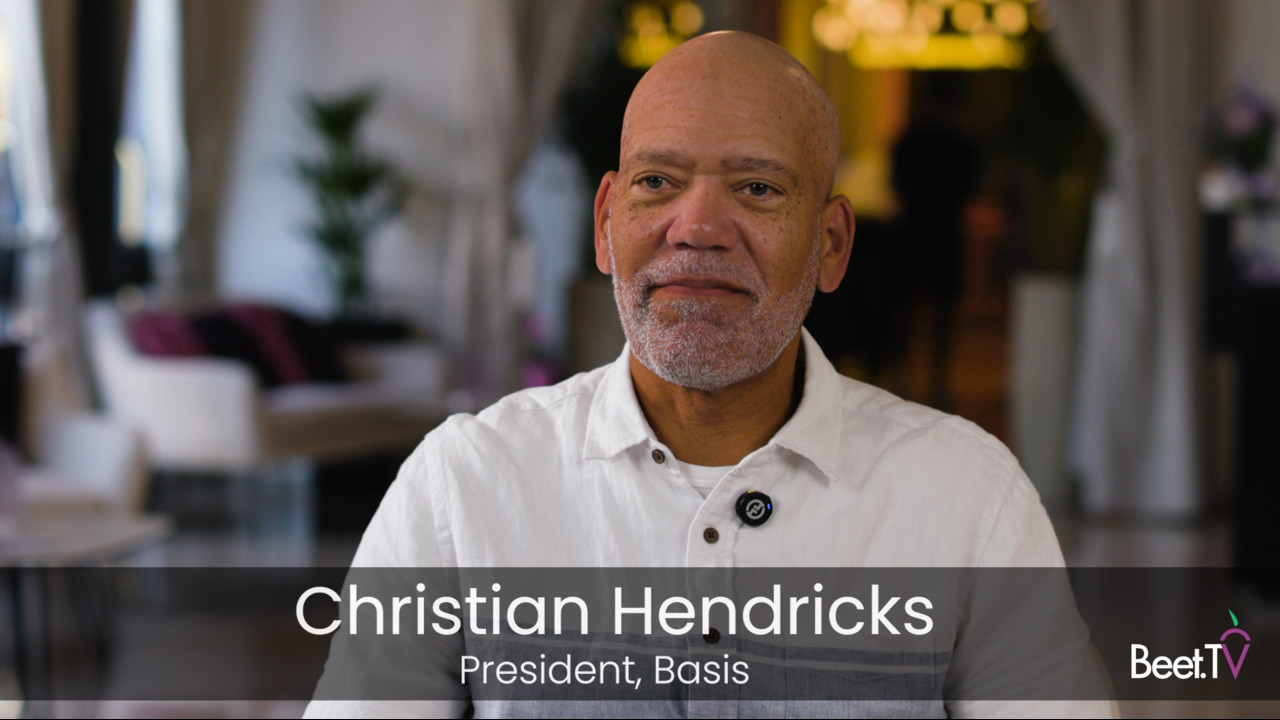
Ad-Tech’s ‘Cookie Licking’ Problem is Starving Quality Content, Says Basis President

CANNES, France – Every dollar spent on digital advertising goes on a journey before it reaches the publisher. Along the way, it gets smaller – much smaller.

In fact, the advertising supply chain has become so bloated with intermediaries that roughly 60% of ad spend never makes it to content creators, according to Christian Hendricks, president of Basis. He describes the phenomenon with a vivid analogy: everyone in the chain wants to “take a lick of the cookie” before passing it along.

“That’s an enormous tax,” Hendricks said in a video interview with Beet.TV at Cannes Lions 2026. “And if you want quality content, the ecosystem itself has to own up and say, we are part of the problem and we need to fix this if we want to have quality content because ultimately those two equations need to balance.”

The economics of quality journalism

As newsrooms close and media outlets struggle to sustain operations, the connection between ad tech friction and the decline of journalism becomes awkward.

Hendricks said the issue is fundamentally about access to information. Publishers face limited options for monetization – advertising, paywalls, or some combination of both. For those who believe content should remain freely accessible to all readers regardless of their ability to pay, advertising remains essential, he said.

“You want to inform people not based on simply on those who can pay for it, you want to inform all the people,” Hendricks said. “So advertising is a very important piece of this ecosystem.”

Where the money disappears

Basis Technologies, formerly known as Centro, offers an all-in-one advertising automation and intelligence platform.

  • The Basis DSP is the programmatic engine of the platform.
  • Basis also includes a system to manage non-programmatic, direct-to-publisher ad buys.
  • Launched as a core component of the platform, Compass is an agentic AI-powered media planning tool.
  • The platform also offers operational “back-office” software and a cross-channel analytics dashboard.

The inefficiencies Hendricks described begin earlier than most realize, he said – planning processes consume excessive time, and every touchpoint in the ad-tech stack extracts value from the transaction.

But he pointed to the reluctance of industry players to acknowledge their role in the problem. “They don’t want to own up to the fact that 60% gets wasted on that friction before it gets to the publisher, right, to the content creator,” he said.

From initial campaign planning through ad networks and delivery systems, each step adds latency and cost. According to recent IAB forecasts, US ad spending will grow 9.5% in 2026, driven partly by AI integration in performance marketing – suggesting the market is actively seeking solutions to these efficiency problems.

A virtuous cycle awaits

The efficiency gains from streamlined operations create a choice for advertisers and agencies. They can pocket the savings or reinvest them in the content ecosystem that makes advertising valuable in the first place.

Hendricks advocates for the latter approach, suggesting it creates mutual benefit. Advertisers and agencies fundamentally want quality content – it’s the entire basis of their business model.

“If you can make it more efficient and the publisher gets instead of getting 40 cents on the dollar, the publisher gets 80 cents on the dollar, and they on the other side of the bargain with them is you’re going to invest that in more quality content, it’s a virtuous cycle,” he said.

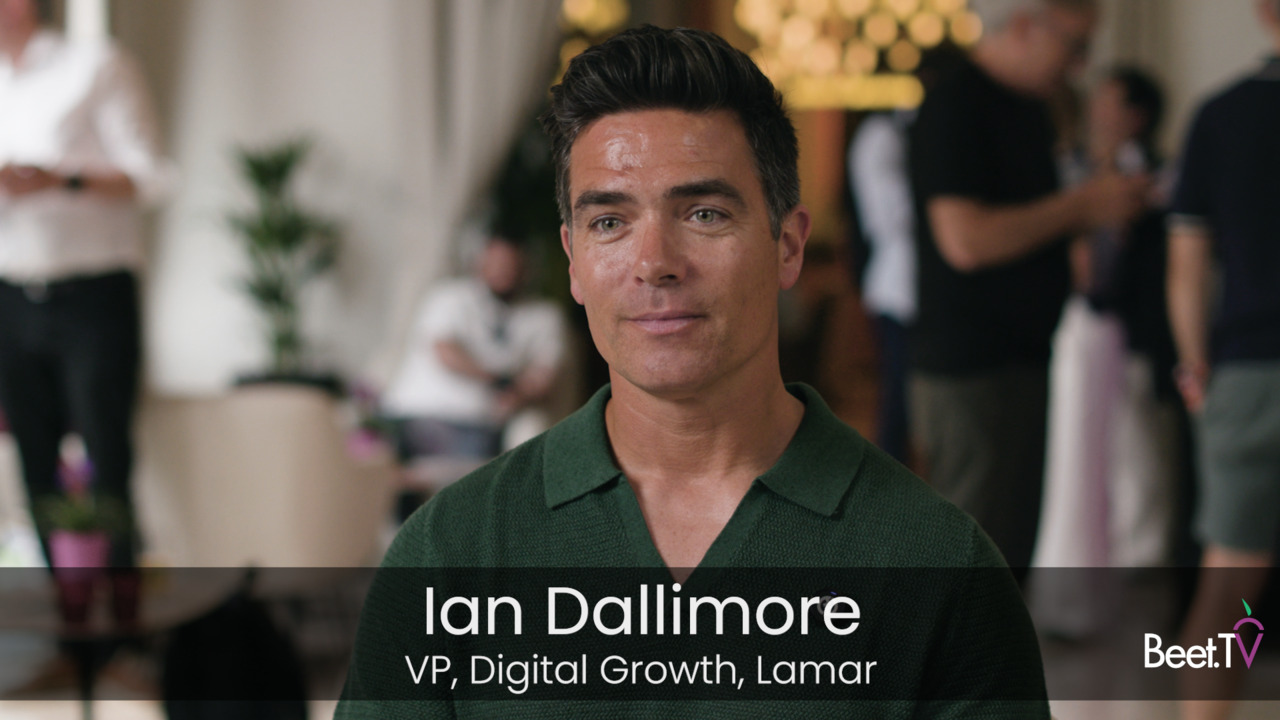
Lamar’s Ian Dallimore: OOH Is the ‘Anti-Algorithm’ That Unites Consumers Around Brands

CANNES, France — While digital advertising serves increasingly personalized content to fragmented individual audiences, out-of-home advertising creates shared brand experiences that bring consumers together — a distinction that grows more valuable as digital fatigue accelerates.

“If you and I are sitting here having a conversation, if we were to open our mobile device, the ads that were served would look significantly different. But out of home, it’s a powerful presence. It’s something you visually see and we collectively as consumers all get to be a part of that brand,” Ian Dallimore, vp of Digital Growth & gm of Programmatic at Lamar, told Beet.TV contributor David Kaplan at Cannes Lions. “Most importantly, then go on to social, to CTV to learn more about that story that they see on their journey.”

This communal quality positions out-of-home as a complement to digital campaigns rather than a competitor, creating curiosity that drives consumers deeper into brand storytelling across streaming and search environments.

Physical presence counters digital exhaustion

Consumer exhaustion with scrolling and streaming creates openings for physical brand presence that earns attention through environmental integration rather than algorithmic targeting.

“There’s this notion of digital fatigue. We live in a scroll, we live in streaming platforms that exist out there, but the one thing that’s really started to emerge more and more is the power of out-of-home and the power of being in that environment and being a physical presence,” Dallimore said.

Community integration during sporting events and daily consumer journeys enables brands to appear organically in ways digital channels cannot replicate.

Real-time creative capitalizes on cultural moments

Programmatic out-of-home enables brands to respond instantly to cultural moments through dynamic creative deployment, with FIFA World Cup and New York Knicks victories demonstrating how timely market presence amplifies brand relevance.

“The moment the Knicks won, go live all throughout New York and go live. Same thing with FIFA World Cup. As different teams play, those brands should morph and change what that creative message is based on the countries, the way that the country views a brand,” Dallimore said.

This real-time flexibility represents programmatic out-of-home’s most powerful standalone capability beyond its complementary digital role.

OOH and CTV complete brand storytelling

Out-of-home and connected TV combine to create complete narrative arcs that move consumers from initial awareness through detailed product understanding toward active search and purchase consideration.

“You’ll have a Defender and you’ll have this beautiful creative of a Defender climbing a mountain and it just says Defender on it. And then next thing you know, you’re watching Hulu and there’s a streaming ad and it tells the story on how that Defender has rock climbing capabilities,” Dallimore said. “And then that consumer will then go on a search or an LLM to learn even deeper about it.”

Data-driven retargeting connects out-of-home exposed audiences to subsequent CTV campaigns, creating measurable cross-channel journey continuity.

Programmatic OOH misconceptions

Brands purchasing programmatic out-of-home without strategic screen selection risk appearing in irrelevant environments, mirroring online advertising’s brand safety challenges where inventory quality varies significantly across the ecosystem.

“In the programmatic ecosystem, if you’re not cautious and you’re not strategically thinking about what you’re buying, you could be buying screens that are completely irrelevant to your brand,” Dallimore said. “Understanding what specific medium you’re buying — very parallel to the online universe. It takes a second step and more education, but it’s still the simplicity of buying through a platform.”

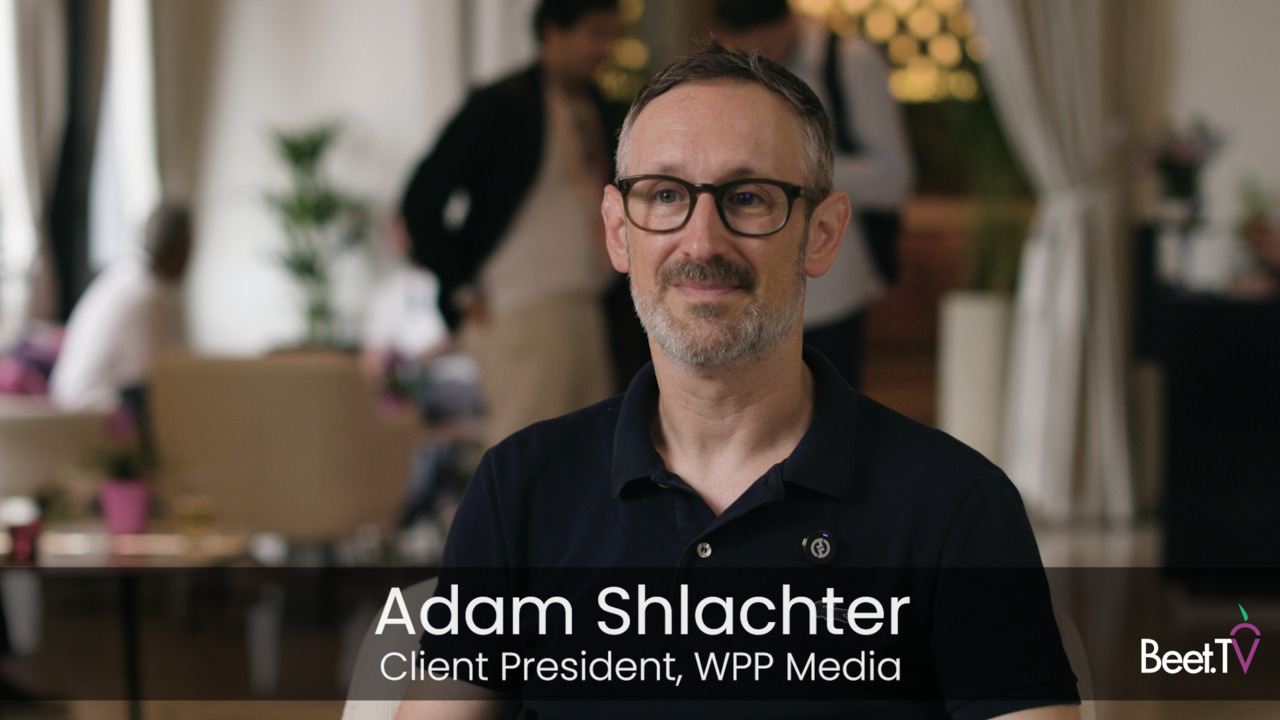
WPP Media’s Adam Shlachter: At Cannes, Creators have Gone From ‘Rough and Raw’ to ‘Primetime Programming’

CANNES, France — Creator content has evolved from unpolished user-generated material into sophisticated prime-time programming, transforming how brands approach storytelling partnerships. Still, brands and agencies are still figuring out how best to connect creators and audiences. Naturally, it was a frequent topic at this year’s Cannes Lions.

“The creators that we grew up with that felt very organic and independent, very rough and raw have become very refined and very sophisticated and very savvy and advanced as producers, as directors, as talent themselves, as just incredible storytellers,” Adam Shlachter, client president at WPP Media, told Beet.TV contributor David Kaplan at Cannes Lions. “More and more we’re seeing brands want to lean into that space and want to learn more about that space and want to be a part of that space even with their own voice.”

This creator maturation coincides with private equity and investment community convergence at Cannes, signaling where significant bets are being placed across AI, creator economy, and sports and entertainment sectors.

AI expectations versus long-term reality

While artificial intelligence dominates Cannes conversations, near-term expectations outpace current capabilities even as long-term implications remain underappreciated by the industry.

“I think that the expectation of it today is overhyped. The long-term implications of it I think are probably underhyped,” Shlachter said. “As we start to think about what the impact is from everything from strategy development to planning to using agents and buying and optimization process, we’re getting there and we’re experimenting rapidly.”

As Shlacthter tells it, WPP’s open systems approach enables modular end-to-end integration across data sources, inventory, audience insights, and market opportunities.

Agency role expands beyond media buying

Client proximity drives agency value beyond media efficiency toward comprehensive marketing orchestration that addresses business challenges through data, systems, and infrastructure improvements.

“Their challenge is often not just how they could buy media better or smarter, faster, or cheaper, but it’s how they can orchestrate all their marketing better, how they can get to market faster, how they can get to insights faster,” Shlachter said.

Intelligence underpins all opportunity identification, as theoretical possibilities without data-driven foundations fail to generate sustained business growth and client outcomes.

Media surfaces expand across every environment

Connected world opportunities extend beyond screen interconnection toward storytelling, community building, and engagement across every physical and digital surface available to capture consumer attention.

“Media is everything and it’s everywhere. Everything is a surface to deliver a message, to capture someone’s attention, to create an engagement, to capitalize on the moment,” Shlachter said.

Investment community presence at Cannes reflects recognition of emerging opportunities across AI development, creator economy growth, and sports and entertainment expansion.

Automating ordinary elevates extraordinary

Competitive differentiation requires strategic focus prioritization rather than simultaneous pursuit of every emerging opportunity, using automation to free human talent for meaningful, high-impact work.

“If we could automate more of the ordinary and elevate more of the extraordinary using AI and technology and data, we can get to the work that’s really going to be meaningful and that’s really going to matter and really make a difference,” Shlachter said. “If we’re aligned there, then we’re going to do great work.”

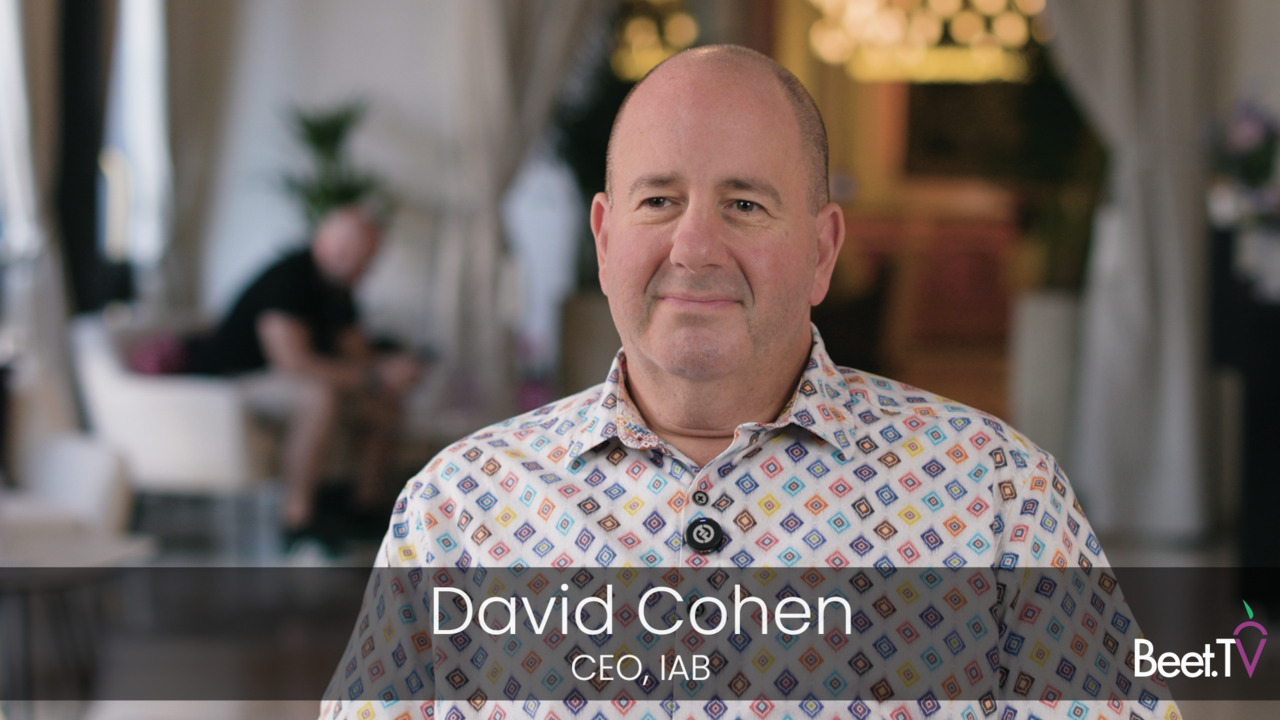
IAB’s David Cohen: AI Is Doing to the Internet What the Internet Did to Traditional Media

CANNES, France — Three decades after digital advertising disrupted traditional media, artificial intelligence is triggering an equally fundamental rethinking of measurement frameworks, supply chain architecture, and the role agents play in mediating brand-consumer relationships.

“If you think back to the beginning of the industry 30 years ago, the internet disrupted traditional media back then and now we’re going through this kind of same thing happening with AI disrupting the internet,” David Cohen, CEO of the IAB, told Beet.TV contributor David Kaplan at Cannes Lions. “We’re wrestling with rethinking lots of the things that we’ve built over the past three decades, rethinking the role that agents and bots play in intermediating the relationship between brands and consumers.”

This disruption arrives alongside economic uncertainty that is compressing planning cycles and threatening long-term brand investment — challenges the industry must navigate simultaneously, Cohen noted.

Standards lag innovation

AI guardrail development follows historical patterns established during early internet standardization, with the industry beginning to address transparency, disclosure, and LLM advertising formats on an accelerated timeline compared to previous cycles.

“If you think back to the early days of the standard ad package, that was about 2002, 2003, and the internet advertising world really took off in 1996. So it was seven or eight years before we came up with a set of standards because standardization and innovation don’t always work together,” Cohen said. “We’re going through the same thing again in a much more accelerated timeline.”

Economic uncertainty compresses planning cycles

Pandemic-era agility lessons now shape how brands respond to current uncertainty, shifting investment decisions closer to execution moments and reducing appetite for long-term brand building despite its strategic value.

“The days of annual planning — we’d do the upfront, we’d get in the market — I’m not sure that that’s entirely gone, but I think it’s much more in the moment, closer to the moment of execution,” Cohen said. “If things are not working in the immediate term, you kind of move on. There’s not a lot of appetite for what we call long-term brand building, which I think is a shame.”

Permanent complexity

Media fragmentation will continue expanding despite industry consolidation efforts, requiring better management tools rather than simplification strategies that ignore structural market realities.

“Fragmentation has been around this business for a very, very long time. I think it’s going to continue to explode,” Cohen said. “We’re now using technology and data to make our jobs as planners and strategists much more efficient and effective.”

Industry resilience defines Cannes moment

Despite consumer confidence challenges and geopolitical uncertainty, the advertising industry’s builder mentality generates optimism that transcends current headwinds.

“If you look out on the Croisette, you see an industry that is resilient, that is resourceful, that is optimistic. The world is a pretty challenging place on lots and lots of fronts. Consumer confidence in the US is at an all time low. And yet we are still an industry of builders,” Cohen said. “I get a great deal of confidence and I get a great deal of energy from that.”

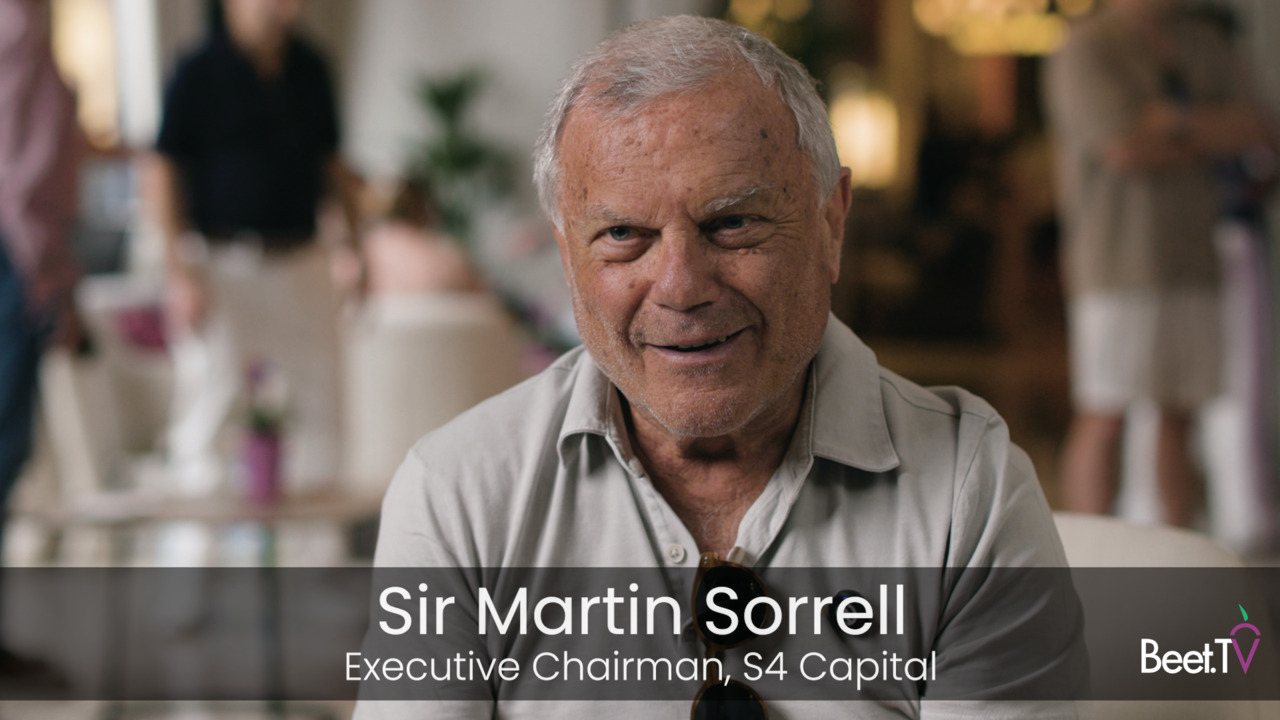
Cannes Is Talking About the Wrong Thing, Says Sir Martin Sorrell

CANNES, France — The advertising industry has gathered on the Croisette once again, debating creativity and whether AI will crush it. Sir Martin Sorrell thinks that’s a distraction from the real story.

At Cannes Lions 2026, the S4 Capital executive chairman argued that the festival’s creative anxiety is misplaced – and that the more urgent disruption is happening not in the studio but in the trading desk. Meanwhile, the holding companies are, in his view, too rattled by AI’s threat to their legacy revenue streams to think clearly about what comes next.

“The industry is going in the wrong direction here at Cannes,” said Sir Martin Sorrell, executive chairman of S4 Capital, in this video interview with Beet.TV. “The focus is on creative, and that is wrong. What it has to be is on media.”

The creativity debate misses the point

Sorrell acknowledged that AI-driven visualization and copywriting are compressing the time and cost of making ads – and that this is genuinely unsettling for the holding companies. He estimated that creative revenues represent roughly 40% of WPP’s total, around 25% for Publicis, and similar proportions for Omnicom and IPG. That exposure explains the defensiveness.

But he argued that the human factor will ultimately provide the differentiator that machines cannot replicate. He cited James Quincy, the Coca-Cola chief executive, who raised the concern on a Yale CEO call with professor Jeff Sonnenfeld that personalization at scale risks making all advertising look the same. “How do you differentiate Coca-Cola advertising?” Sorrell asked. “The answer is through the human factor. That’s where you’re going to get the lift.”

Research from Harvard Business School, where Sorrell said he has been collaborating with professor Karim Lakhani, points toward a two-tier professional services model: more senior strategists and creatives commanding higher pay, with a large automated layer beneath them handling production at scale. “We’re going to have two levels,” he said, summarizing the hypothesis. “More strategists, not maybe fewer strategists, more highly paid, creatives, same – and then a transformational layer underneath it where you automate at huge scale.”

Transparency reignited

The sharper edge of Sorrell’s argument concerned media trading and transparency – a wound in the industry that, he suggested, has been reopened. He pointed to the recent public dispute between Publicis and The Trade Desk over take rates as an “own goal” for the holding company, arguing it drew attention back to proprietary trading margins that agencies do not disclose to clients.

“Publicis says you’re a $100 million client, we’ll spend $10 million on proprietary trading – you won’t know the price at which we’ve had the inventory,” he said. The Trade Desk’s OpenSecura program, he noted, is designed to surface exactly those margins. The episode, in his telling, echoes the 2016 reckoning triggered by media auditor Jon Mandel’s K2 report and the 4A’s transparency crisis. “This has reignited the focus on proprietary trading, take rates – reignited the transparency issue.”

He invoked Irwin Gotlieb, former GroupM chairman, who once quipped that agencies were “transparently untransparent.” Sorrell’s conclusion: “We now have to be transparently transparent.” He described S4 Capital’s Monks unit as operating on a straightforward fee model in which all media spend flows to the client – with limited exceptions in markets like Brazil and Japan, where structural peculiarities apply.

IAS CEO Lisa Utzschneider Steps Down; Lidiane Jones Named Successor

Integral Ad Science has appointed Lidiane Jones as CEO, succeeding Lisa Utzschneider who led the company for more than seven years, initiating a leadership transition that reflects how generative AI is intensifying demand for trusted independent measurement across digital advertising.

Speaking with Beet.TV founder Andy Plesser at POSSIBLE in May, Utzschneider outlined the strategic priorities that now pass to her successor. 

She pointed to connected TV as a critical growth driver, noting IAS’s Total TV initiative — integrations with Amazon Prime, Disney, NBCUniversal, and Paramount — as enabling linear-like transparency that encourages brands to shift traditional TV budgets toward streaming. 

 Utzschneider also highlighted IAS’s classification technology as a key competitive differentiator, describing how the company uses large language models to classify video, image, audio, and text in real time across dozens of African languages without translation into English as an intermediate step.

Handing over the mandate

Those capabilities now frame the mandate Jones inherits.

Jones, whose background spans leadership posts at Microsoft, Salesforce, Slack, and Bumble, says her priority is acceleration rather than strategic reinvention. “Our goal is to become a very critical part of the trust infrastructure of this AI era,” Jones told Axios, which first reported the appointment. “IAS has the right technology, the right people and the right customer base for us to go do that.”

Utzschneider, who took IAS public in 2021 before its $1.9 billion acquisition by Novacap in September 2025, will remain as special advisor to the board through year-end. 

She told Axios the decision was both personal and professional. “It just felt like the right moment in time for IAS, now as a private company, to step down and hand the reins over to a phenomenal tech leader like Lidiane Jones.”

Technology foundation drew new CEO

Jones says she was drawn to IAS after evaluating its capabilities firsthand, according to Axios’s report. “When Lisa reached out to me, she started with, ‘Take a look at our tech.’ I was hooked. I was amazed at the level of sophistication, quality and depth of the technology and the opportunity.”

That technology depth was central to Utzschneider’s recruitment pitch. Rather than positioning IAS as an ad tech vendor, she describes it as a “deep tech” company whose competitive advantage comes from engineering talent, according to Axios.

The appointment was confirmed in a press release issued by IAS this morning.

Utzschneider championed AI and CTV expansion

The leadership transition arrives as large language models and AI answer engines create new measurement challenges for advertisers, with IAS intending to innovate “wherever” brands choose to advertise, Utzschneider told Axios.

Utzschneider had been building toward this moment. Speaking with Beet.TV at POSSIBLE  earlier this year, she detailed IAS’s multimedia classification technology as a key competitive differentiator. 

“We are able to classify real time video, image, audio and text. It is fueled by AI and the accuracy rates we’re seeing at the speed that we’re seeing and maintaining the cost, it’s off the charts,” Utzschneider said.

Utzschneider also introduced IAS’s Total TV initiative at POSSIBLE, addressing advertiser reluctance to shift linear budgets toward connected TV. “If you ask brands, why won’t you shift more linear TV dollars over into CTV? They often say it’s because I want the same transparency I get in linear TV. I want to know by channel, by show,” she told Beet.TV.

Private company structure enables faster moves

Jones inherits a business that can move more aggressively as a private company, investing in internal development and potential acquisitions without public market constraints, according to the Axios report.

The appointment reflects IAS’s broader strategic vision articulated in the company’s press release outlining the executive change: “As AI transforms how media is planned, bought, measured, and optimized, advertisers increasingly need trusted intelligence to make real-time decisions.”

Jones’s background spanning product, technology, and AI across enterprise and consumer software positions IAS to build on its media quality leadership while pursuing its next growth phase, according to the company.

“Leading IAS has been one of the greatest privileges of my career,” Utzschneider said in a statement. “With Lidiane at the helm, I could not be more excited about the future of IAS.”