
Why High Ratings Don’t Mean High Attention: TVision’s Bid to Rewire Ad Buying

CANNES, France — You probably know those crackling fireplace videos on YouTube. The CPM is dirt cheap, the reach is massive, and absolutely nobody is watching most of the year. It’s the perfect illustration of advertising’s oldest problem: buying eyeballs that aren’t actually looking.

That disconnect between reach and impact is exactly what attention measurement firm TVision has spent 11 years trying to solve. The company captures second-by-second, eyes-on-screen data to help brands understand not just whether an ad was served, but whether anyone was actually paying attention when it appeared.

“Brands want impact. The reason why they’ve been buying reach is that was the best proxy,” said Yan Liu, CEO, TVision, in this video interview with Beet.TV. “But … what you need is the impact, and impact comes from attentive audience.”

The granularity gap

The advertising industry has long measured attention at the platform level – Instagram versus TikTok, for instance. But Liu argues that approach is fundamentally inadequate for the programmatic era, where decisions happen impression by impression.

TVision’s second-by-second measurement enables something that has eluded the industry for decades: separating the impact of creative from the impact of media placement. “The media guy always blame creative and creative guy always blame media,” Liu said. “But we believe there’s a happy medium.”

“Once you understand both, then you can understand what’s the best context to really drive the best attention for the creative or vice versa,” he added. “That’s really the beauty of the granular data second by second level to tell a story between the media and creative.”

Viant acquisition changes the game

For most of its existence, TVision operated as a data-only company. That changed in May 2026 when Viant Technology completed its acquisition of TVision Insights, integrating attention measurement directly into Viant’s AI-powered programmatic platform.

The combination addresses what Liu described as a limitation of TVision’s previous approach. “For a long time, TVision we had amazing data. But the way to use the data, I think was a bit more basic,” he said. “We came up with the planner, we came up with the pre-bid solution, basically saying, ‘Hey, just don’t bid on those apps.'”

Now, Liu said, the company is building what he believes is “the most advanced, modern AI solution in the marketplace” – one that combines attention signals with other data to score every impression in real time. “Is Peacock better than WBD? It’s not a simple solution,” he noted. The acquisition also brought IRIS ID, another Viant acquisition that enables activation at the show level or even scene by scene.

The ratings-attention disconnect

Perhaps the most curious finding from TVision’s data: outside the top 1% of programming like the Super Bowl, there is no correlation between ratings and attention. The assumption that high-rated content automatically commands viewer focus simply doesn’t hold up under measurement.

“Many sports games, people assume, ‘Oh, that’s high ratings must be high attention,'” Liu said. “Nobody can pay attention for four hours straight to a baseball game near the end. People got to take a break. We have to get some drink, go to the bathroom.”

The fragmentation of the media landscape makes this insight increasingly relevant. Liu pointed to the explosion of content choices: roughly 1,200 FAST channels, close to 1,000 new professionally produced shows launching annually, plus the vast ocean of YouTube.

“It’s beyond what any human can imagine,” he said. “High ratings usually equals to high CPM, but does it equal to high attention? I don’t think so. That’s why you need data to unpack that.”
1440’s Tim Huelskamp: AI Content Explosion Creates Greater Demand for Human Curation, not Less

CANNES, France — This summer, artificial intelligence generated more content than humans for the first time — a milestone that most media companies view as a threat but that 1440’s CEO sees as a significant business opportunity.

“The Cambrian explosion of AI content is going to lead to more slop and then more demand for where’s the best content, what’s worthy of my time, have humans help me find what I should actually spend my time on,” Tim Huelskamp, co-founder & CEO of 1440, told Beet.TV contributor David Kaplan at Cannes Lions. “The brands that can help readers find the trustworthy content that’s worthy of their time win and readers will spend more time with them.”

This conviction shapes 1440’s curation-first model, which relies on passionate human editors to surface the most valuable content across health, science, business, sports, and culture rather than competing with AI-generated content creation.

Discovery, not content shortage, is the issue

The internet’s fundamental challenge has never been insufficient quality content — it has been connecting curious readers to outstanding material that already exists but remains effectively invisible.

“The problem isn’t that there’s no great content; the problem is no one can find the great content,” Huelskamp said. “MIT has incredible content from some of the best scientists in the world where you can learn about CRISPR in 30 seconds, in 60 minutes, in hours. It is so world-class, but no one can find it.”

When asked about the company’s profile as a “new model media company,” Huelskamp said 1440 positions itself as connective tissue between curious readers and the internet’s best knowledge, functioning as a platform that brings both sides together rather than generating original content.

Human editors surface knowledge serendipity

1440’s editorial model deploys passionate subject matter experts to navigate content rabbit holes, identifying fascinating nuggets that readers wouldn’t have known to seek out themselves — what the company calls knowledge serendipity.

“Imagine a really curious human that loves a topic, learning and going down all these rabbit holes, sifting through all the junk. Every once in a while there’s something so fascinating that blows their mind. Those nuggets are gold,” Huelskamp said.

As Huelskamp describes it, the company’s “1440 Topics” product combines Reddit-like community signals, Pinterest-like visual discovery, and Wikipedia-like depth through human curation and reader engagement layers.

Direct reader relationships allow platform independence

Media companies that rely on Facebook referrals, SEO, or algorithmic traffic face existential vulnerability as AI answer engines increasingly intercept that traffic, making direct reader relationships a critical strategic asset, Huelskamp said.

“I think they need to lean into trust and build direct relationships with the customer. AI is now basically doing answer engines and cutting traffic further. How do you build a direct relationship with a customer so you don’t have to worry about that?” Huelskamp said. “That’s how we set up our business really early on and it’s been a huge strategic advantage for us.”

Two types of knowledge define AI’s limits

In Huelskamp’s view, AI excels at answering direct questions but cannot replicate the human judgment required for knowledge discovery — the experience of learning something fascinating that a reader didn’t know they wanted to know.

“There are two types of knowledge. There’s ‘I have a question, give me an answer’ — AI is incredible at that. But the other side is knowledge discovery and knowledge serendipity. That taste and that judgment is the best way to do that,” Huelskamp said. “It’s the same reason if we’re in Cannes for the first time, you want to talk to a local who knows the situation. That’s the same thing at scale with all knowledge.”

Albertsons and P&G Reboot the Soap Opera for the Retail Media Age

CANNES, France — The company that invented the soap opera is now modernizing it for vertical video and grocery store screens.

Procter & Gamble has partnered with Albertsons Media Collective to launch “Rico’s Tacos,” an episodic branded entertainment series that debuted at Cannes Lions 2026. The 20-episode comedy follows a multigenerational Southern California family running a taco stand, with product integrations for P&G brands like Bounty and Head & Shoulders woven into storylines about grocery shopping occasions.

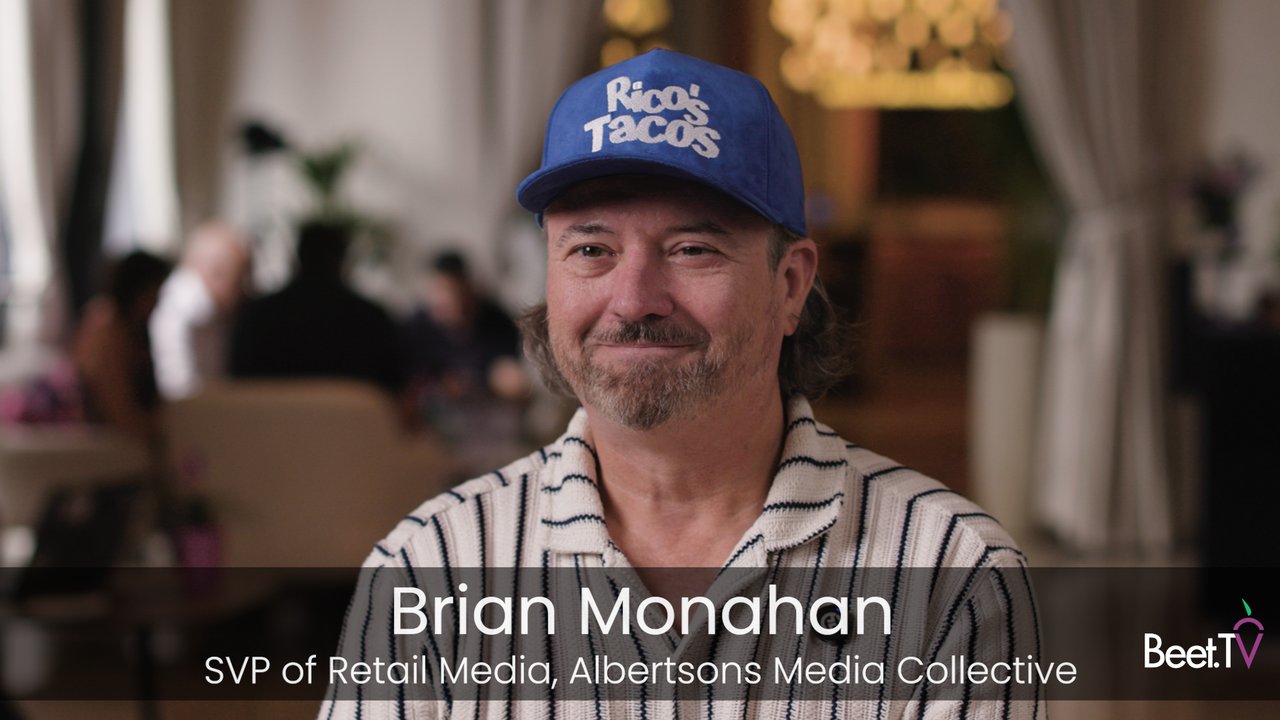
The project represents a deliberate attempt to expand retail media beyond “item and price bottom of the funnel advertising,” said Brian Monahan, SVP of Albertsons Media Collective, in a video interview with Beet.TV.

From shopper data to creative brief

The series originated not in a writers’ room but in a data meeting. Albertsons and P&G pooled their respective consumer and shopper insights to identify growth audiences and relevant use cases before developing any creative concepts.

“What manifested as the Rico’s Tacos show started in data,” Monahan said. “That led us to the idea of reaching a growth audience, that led us to the type of brands to bring into the project, that led us to the type of use cases to demonstrate in it. And that led to the creative brief which manifested in the creative container.”

Albertsons has developed a taxonomy of 25 different reasons why people go grocery shopping, from weekly shops to forgotten ingredients to rewarding treats. These occasions are embedded directly into the show’s storylines. One episode features a Taco Tuesday crisis when the family runs out of avocados; another shows the abuela treating herself to shampoo.

Measuring entertainment like advertising

The retailer plans to evaluate the series using the same incrementality methodology it applies to standard advertising. With 90% of Albertsons transactions authenticated via its loyalty program, the company can link exposure to purchases and measure lift.

“We’ll know if it drives sales the same way we know if any of the ads we present drive sales,” Monahan said. “We know what our customers buy, and we know what they were exposed to. So we’ll do that link, we’ll do our typical incremental test and control methodology to understand incremental lift.”

The in-store component will be particularly instructive. Albertsons is rolling out a smart screen network, launched in partnership with STRATACACHE, where snippets of the show will play with closed captions and QR codes. The company recently introduced in-store incrementality measurement specifically to prove causal impact of such campaigns.

Retail media’s entertainment future

The initiative arrives as U.S. omnichannel retail media is projected to generate $71.67 billion in 2026, according to eMarketer. Retailers are increasingly restructuring their media operations to integrate more closely with core business functions.

Monahan positioned Rico’s Tacos as an addition to existing retail media tactics rather than a replacement. “This is not the end all be all of how to drive growth through retail media,” he said. “This is an and. This sits on top of all the sponsored product ads and all the other ways that we can do item and price advertising.”

The response at Cannes suggested appetite for similar experiments. “We’ve had a lot of great conversations here at Cannes this week with other brands saying like, wow, I never thought of retail that way,” Monahan said.

Posted in Uncategorized

Havas Market’s Molly Hop: In Agentic Commerce, Only One Product Wins. Retailers Aren’t Ready

CANNES, France — Search used to surface the top results through infinity. Agentic commerce surfaces one. And most retailers have not yet built the product content infrastructure needed to be that winner.

“Consumers’ expectations are that what is discoverable is the best product for them. But I don’t think retailers have figured out how to allow the products to necessarily have the right content to meet that consumer expectation,” Molly Hop, managing partner, North America at Havas Market, told Beet.TV contributor David Kaplan at Cannes Lions. “It’s a confusing world for retailers right now that they’re trying to figure out.”

This winner-take-all dynamic makes product discoverability the defining retail challenge of the agentic era, requiring brands to think differently about how they present themselves within AI-driven discovery environments.

Seamless path to purchase is paramount

Agentic commerce integration into consumers’ daily lives raises experience expectations beyond current retail capabilities, requiring natural, non-intrusive discovery followed by frictionless purchase pathways.

“Agentic becomes more natural in the consumer’s lives. Their expectation is even more so that the experience is clean, that it’s personalized and that they’re getting what they want,” Hop said. “Think about how you naturally show yourself in terms of being the right discoverable solution and then a really seamless path to purchase for them within that environment.”

Consumer expectations, rather than technology capabilities, will ultimately dictate what successful agentic commerce implementations look like.

Generational divide shapes AI adoption

Experienced professionals approach AI content creation cautiously as a supplement to existing work, while younger generations increasingly use it as a replacement — a divergence that will define industry norms over the next two years.

“People 20-, 30 years into their career are being much more cautious when it comes to how to create content, how to use it to supplement what you’re doing. Younger generations who are adapting quicker are using it almost as a replacement and they’re removing that human element,” Hop said.

This tension between augmentation and replacement remains unresolved, with the right balance between human and agentic contribution still emerging across the industry.

AI picks cultural moments where brands need to appear

DeBeers’ approach to AI-assisted brand stewardship illustrates how technology can expand opportunity identification while human creativity remains essential for authentic brand expression at those moments.

“Where AI is helping is that it’s helping us understand more moments that we can be relevant to people, culturally relevant to people. But once AI has helped them identify those moments, that’s where they really still need to be their authentic brand when they’re showing up,” Hop said.

AI serves as an opportunity scanner while human brand judgment determines how to respond — a division of labor that preserves creative authenticity within scaled content environments.

Personalization speed brings comfort and concern 

Rapid AI personalization generates both consumer comfort and unease, as the speed at which AI tools learn individual preferences normalizes deeper reliance on automated recommendations.

“How surprisingly quick any of the AI partners that I’m using, how personalized they get so quickly, and then how comfortable I am really assuming that they know what I need and what I want,” Hop said. “I think that’s where the success is. And also the scariness of it.”

AI Isn’t Replacing Marketing Basics, It’s Making Them Matter More: LiveRamp’s Ted Flanagan

CANNES, France — AI may be moving at warp speed but Ted Flanagan, vice president of customer success and solution engineering at LiveRamp, thinks marketers should resist the urge to chase every shiny new model. Instead, they should do something far less glamorous: make sure their data isn’t a dumpster fire.

Speaking with Beet.TV contributor David Kaplan at the Cannes Lions International Festival of Creativity, Flanagan argued that AI’s biggest contribution may be reminding marketers that the fundamentals never went away. The interview is part of a Beet.TV video series produced in collaboration with the New York Stock Exchange.

“I think the influx of AI into the industry is really putting an emphasis back on the fundamentals,” Flanagan said. “With so much changing so rapidly, what is important for all of us in marketing and advertising is just focus on quality inputs and quality outputs.”

It’s hardly the sort of futuristic vision that gets venture capitalists reaching for their checkbooks. But as companies rush to bolt AI onto nearly everything with a login screen, Flanagan’s message was refreshingly old school. If the data going in is questionable, the dazzling charts coming out probably deserve a healthy dose of skepticism too.

Quality beats quantity

Asked by Kaplan how brands should evaluate an expanding universe of AI vendors, platforms and data partners, Flanagan said marketers shouldn’t confuse having more options with making better decisions.

“It still comes down to… quality over quantity,” he said.

He urged companies to examine where a partner’s data comes from and whether it reflects “an authentic relationship with the consumer.” As AI systems become increasingly opaque, understanding the lineage and provenance of data becomes even more valuable.

In other words, before trusting an AI model that promises marketing enlightenment, it might be worth asking whether it learned from solid customer relationships or from the digital equivalent of a guy selling watches from the trunk of his car.

Experiment often, but don’t improvise

Flanagan also argued that AI should encourage more experimentation, not less. The catch is that experiments need discipline.

“The best forms of measurement are experimental by design,” he said. “That’s how we can really understand what is working and what’s not working.”

He said marketers should run as many experiments as possible while maintaining consistent design and rigorous implementation. Otherwise, organizations risk making decisions based on results they can’t fully trust.

The emphasis, he said, is less about finding one perfect AI model than building a repeatable system for testing what actually delivers results.

Humans still get a vote

For all the excitement surrounding autonomous AI, Flanagan doesn’t believe marketers should hand over the keys and head out for coffee.

“I think this is why we constantly hear about putting a human in the loop,” he said.

Human judgment remains essential for deciding whether AI-generated recommendations are accurate, appropriate and worthy of real marketing investment, he said. Brand safety, governance, privacy and security all become even more important as AI takes on larger roles across marketing workflows.

That may disappoint anyone hoping AI would eliminate meetings. Instead, it appears AI has simply created new reasons to schedule them.

Build a foundation instead of rebuilding everything

With AI capabilities evolving almost monthly, Kaplan asked how marketers can avoid rebuilding their technology stacks every year.

Flanagan’s answer was to invest below the surface instead of chasing every new feature.

He recommended maintaining governed, secure and interoperable data that can work across new applications while also investing in people who understand experimentation and can adapt as technology evolves.

“I think kind of the data foundation and then the people foundation are the two critical pieces that most of our customers are looking at,” Flanagan said. “That’s how we’re investing in our own business.”

His advice offers a useful reality check in an industry where every product launch claims to reinvent marketing. Sometimes the most valuable AI strategy isn’t buying another tool. It’s making sure the data, the people and the process underneath are strong enough that the next tool actually has something worthwhile to work with.

From Compliance to Competitive Edge: Lyft, Kroger, Intuit LiveRamp on Trust in Marketing

Internet Needs Fewer Algorithms, More Humans: 1440’s Michelle Denhart

CANNES, France — The internet has spent the better part of two decades convincing us that an algorithm knows us better than our spouse, our dog and possibly our therapist. Michelle Denhart has another idea.

The head of brand and content strategy at 1440 says the future of trusted media may actually look a lot more like the past, with humans deciding what’s worth reading instead of software optimized to keep your thumb scrolling until bedtime.

Speaking with Beet.TV contributor David Kaplan at the Cannes Lions International Festival of Creativity, Denhart outlined why 1440 has built its business around curation instead of feeding the world’s already overflowing content machine. The interview is part of a Beet.TV video series produced in collaboration with the New York Stock Exchange.

“1440 is built on curation,” Denhart said. “There is so much incredible content in the world, and our job at 1440 is to find and surface the best content out there.”

She didn’t stop there.

“The world does not need any more algorithmic content,” she said.

That’s a bold statement at Cannes, where AI was about as common as branded tote bags and discussions about “transforming creativity.”

Making readers smarter, not just busier

Denhart described 1440’s mission as delivering fact-driven news while also exposing readers to subjects they may never have searched for themselves.

“Our job is to deliver fact-driven news and knowledge to make you smarter about the world,” she said.

That includes major stories involving politics and world affairs but also fascinating topics that readers might otherwise miss.

“It’s information that you might not find elsewhere,” she said. “That’s fascinating, that’s interesting and just makes you a more interesting person.”

It’s a refreshing business proposition in an era when many digital platforms seem determined to answer questions nobody asked while recommending videos nobody intended to watch.

Rather than relying on engagement metrics alone, Denhart said the company stays close to readers by listening to feedback and even responding to emails.

The result, she said, is a relationship built around delivering value instead of simply capturing attention.

Not all content deserves your attention

Denhart acknowledged there’s no shortage of material competing for readers every day. The real challenge isn’t producing more of it.

“A lot of it’s great, but a lot of it’s not great,” she said.

That’s where curation earns its keep.

“Our role at 1440 is to shine a light on that content and be able to tell you, ‘Hey, this is gonna make you smarter. This is something that you might not find elsewhere.'”

Instead of trying to out-publish everyone else, Denhart argues that helping readers navigate the avalanche may be the more valuable service.

Think of it as having a well-read friend who quietly slides the good articles across the table instead of texting you 87 links before lunch.

Trust starts with facts

If curation is the product, trust is the brand.

Denhart said 1440 deliberately focuses on presenting factual information without editorial spin.

“We are very focused on providing fact-driven content,” she said.

Rather than creating original reporting for every story, the company highlights credible information already available and presents it in a straightforward way.

“We are very careful to provide content in a way that does not imply bias,” Denhart said. “It’s just the facts. It’s just delivered to you so that you can learn and you can move on with your day.”

That last part may be the most radical promise of all. Learn something useful, close the browser and continue living your life.

Less noise, more clarity

Denhart said the company’s approach also shapes its partnerships and broader role in media.

“We know that there’s so much content out there, and we don’t need to add to the noise,” she said. “We need to provide the clarity for that content.”

Instead of producing another wave of headlines destined to disappear into tomorrow’s feed, 1440 focuses on distilling existing reporting into information readers can quickly absorb.

In a media landscape overflowing with hot takes, algorithmic rabbit holes and enough content to occupy several lifetimes, Denhart’s pitch is surprisingly simple: maybe what people need isn’t another content factory. Maybe they just need someone to tell them what’s actually worth reading.

Viant’s Chris Vanderhook: Attention Metrics are Driving CTV Growth

CANNES, France — Connected TV advertising growth is accelerating beyond the simple linear-to-streaming shift as marketers who measure CTV’s true incremental sales impact redirect budgets from branded search, social, and display — a structural reallocation that is pushing Viant’s CTV growth above 40% annually for three consecutive years.

“Marketers who are measuring CTV’s impact are now growing CTV even more because they’re taking money away from branded search, social and display advertising and pushing that into CTV,” Chris Vanderhook, co-founder & COO of Viant, told Beet.TV editorial director Lisa Granatstein at Cannes Lions. “At Viant, CTV has been growing north of 40% for the last three years.”

This measurement-driven reallocation depends on proving incremental sales impact rather than attributing last-touch credit — a fundamental shift in how CTV justifies its place in the media mix.

TVision acquisition brings attention data to activation

Viant’s acquisition of TVision, the only US television panel competitor to Nielsen, provides camera-based attention measurement that tracks who is in the room, how many viewers are present, and whether they are actually watching content and advertising.

“TVision is a US television panel and it’s the only competitor to Nielsen. They have a camera that sits on top of their panelists television set and it measures who’s in the room and what’s the attention being paid to the content that they’re watching and then also the ads,” Vanderhook said.

This attention data enables activation across CTV, linear, and walled garden environments including YouTube and Prime Video through attention-adjusted CPMs that reflect actual viewer engagement rather than assumed exposure.

Marketers’ expectations

Attention metrics become strategically actionable when connected directly to sales outcomes, enabling marketers to move beyond acknowledging attention’s importance toward quantifying its precise business value.

“Marketers all know that attention matters, but they may not know how much. When you take attention and actually link it to sales, now they’re able to quantify how much it actually matters,” Vanderhook said.

From there, attention-adjusted CPM optimization enables more precise publisher evaluation across CTV environments based on demonstrated sales impact rather than delivery metrics alone.

Premium’s attention advantage

Attention measurement reveals clear quality hierarchies across television environments, with premium streaming services and live programming generating significantly higher engagement than long-tail video content.

“You see the premium apps, the big streamers, Disney, Paramount, NBC Peacock, they have very high attention scores. A lot of their programming is live, that does really well. And then you see kind of a longer tail where YouTube doesn’t really get as much attention as some of the premium streamers,” Vanderhook said.

Linear programming also demonstrates strong attention performance for quality content, reinforcing the case for measurement-driven investment decisions across both traditional and streaming television environments.

Incremental measurement wins CTV

Brands that move beyond last-touch attribution toward true incremental sales measurement will gain clearest understanding of CTV’s contribution to business growth rather than credit-claiming that obscures actual performance.

“Brands in CTV need to start measuring the true impact that CTV has on incremental sales,” Vanderhook said. “Everyone knows you can show a display ad right before someone’s going to buy and a display ad gets credit for it in last touch attribution. But in CTV, they need to measure the incremental sales impact, not just the same sales.”

Breaking Down Silos, Not Building New Tools: WPP Media’s Vision for AI-Enhanced Media

AMENIA, NY — What if the advertising industry’s obsession with shiny new capabilities may be missing the point entirely? While competitors race to stack more technology, one agency leader argues the real transformation lies in dismantling the organizational walls that prevent existing tools from working together.

Agentic AI promises to automate the drudgery that slows down execution – billing, trafficking, the grunt work nobody signed up for – while making planning “smarter and more intelligent.” But the technology itself won’t solve advertising’s fundamental coordination problem.

“I think it’s less about new capabilities. I think it is about the silos we’ve built across all the things that you’re talking about,” said Ritu Trivedi, client president at WPP Media, in this video interview with Beet.TV at Beet Retreat Berkshires.

The silo problem runs deeper than agencies

Trivedi pointed to specialty teams – not just on the agency side but within client organizations – as the culprits fragmenting the customer journey.

“On Amazon, I can see a format which might be sitting on CTV, but it’s a clickable opportunity for me to put something in my cart,” she said. “That to me is taking all of the things … and it’s bringing it all together.”

The question, she suggested, is how teams reorganize to match the speed at which these convergences are happening in the marketplace. A March 2026 survey by the Interactive Advertising Bureau found that 40% of U.S. ad buyers consider understanding agentic ad buying and campaign execution among their top concerns – that suggests anxiety about how autonomous AI agents will fit into existing workflows.

First-party data sits dormant across categories

The gap between collecting first-party data and actually using it remains stubbornly wide. Trivedi identified two distinct camps: clients with robust e-commerce and app data who aren’t thinking about marketing applications, and CPG companies that lack direct consumer relationships altogether.

“It doesn’t have to be all about just activation. It could also be about intelligence,” she said. “Learn a little bit more about who your lapsed users are, learn a little bit more about who your growth segments are. Let’s learn about if you did a sponsorship during soccer, did that really bring more soccer fans to you?”

She pointed to WPP’s acquisition of data collaboration platform InfoSum as a mechanism for working with publishers in privacy-safe ways. The goal is bringing client-side data together with publisher intelligence to fuel smarter planning – not just activation within walled gardens.

Business outcomes need better organization

The industry’s long-standing fixation on impressions and clicks as primary currencies has obscured what clients actually care about. Marketing mix models and return on investment analysis exist, Trivedi acknowledged, but they remain sporadic and siloed from other measurement streams.

“Business outcomes is also POS data, it’s also MMM data, it’s also your brand equity data, it’s all the things that the clients are measuring, but it’s sitting in silos,” she said. “And the campaign data that

Gartner projects worldwide AI spending will reach $2.59 trillion in 2026, a 47% year-over-year increase, with much of that investment flowing into infrastructure that could enable such unified measurement approaches.

Posted in Uncategorized

Why SharkNinja Is Betting on Creators Over AI-Generated Content

AMENIA, NY — The vacuum cleaner aisle used to start with a Google search. Now it begins with a TikTok video of someone’s favorite creator demonstrating how a cordless stick vac handles pet hair on hardwood floors.

@jessdoinglifee

The best thing I’ve ever bought!!! @SharkNinja @Shark Home UK @Shark Home thank you for making my life a lot easier!! 😍🙌 #sharkninja #vacmop #ninja #shark #fyp

♬ original sound – JessDoingLife✨💖

That change in the consumer journey has prompted SharkNinja to double down on creator partnerships while taking a deliberately cautious approach to AI-generated advertising content. The home appliance maker sees creator trust as an asset that artificial intelligence simply cannot replicate – at least not yet.

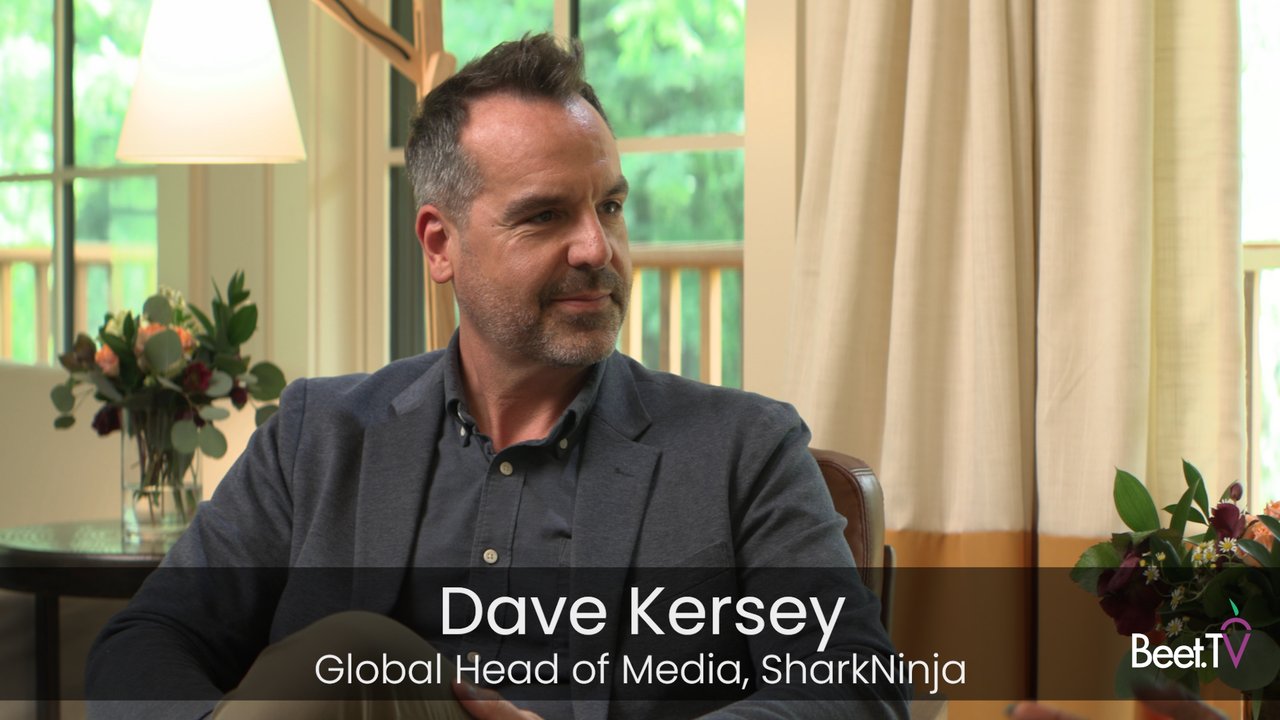
“There’s so much inherent trust in these creators from consumers that there isn’t a lot of need for search to say, ‘Does this product work for me?'” said Dave Kersey, global head of media at SharkNinja, in this video interview with Beet.TV. “Because they’re seeing it in real life from the creator’s point of view and the solutions that product’s solving for them.”

The search paradigm is crumbling

Consumer attention has migrated to mobile devices and social platforms, altering how people discover and evaluate products. While high-intent search signals remain valuable, SharkNinja is witnessing substantial success with what Kersey calls “creator-to-conversion” pathways.

Global influencer marketing spending is projected to reach $24.1 billion by 2026, up from $16.4 billion in 2022, according to Gartner research. Brands across categories are recognizing that creator recommendations often carry more weight than traditional advertising.

“Consumers see themselves in those situations much easier than researching it to say, ‘Does this work for me?'” Kersey said. “They need to see it in real life. So it’s changing the consumer behavior quite drastically.”

AI automation yes, AI content creation not so fast

SharkNinja’s approach to artificial intelligence distinguishes between operational efficiency and creative production. The company actively deploys AI for automation and optimization, using it to scale performing creator content and reach the right consumers in real time.

Content creation, however, remains largely human-driven. Kersey described ongoing “test and learns” with AI-generated creative but emphasized that creator-produced content continues to outperform alternatives. The company operates what he characterized as a “machine” that rapidly evolves content daily, pulling non-performing material and introducing fresh creative on a global scale.

“On the content creation, we’re doing some test and learns, but right now, our performance is coming from the creator’s point of view,” Kersey said. “So as long as that’s working, and we always are looking to refine it and optimize it, but this is where we’re seeing a lot of success. So until that changes, I’m not sure we would go all-in or even go further from an AI content creation perspective.”

Preparing for the agentic search era

The emergence of AI-powered search tools and social search functionality, though, is forcing SharkNinja to reconsider its content strategy timeline. Where social content traditionally has a brief shelf life – consumers constantly crave fresh material from their favorite creators – AI search engines may surface older content that remains relevant.

This shift requires thinking about content longevity in new ways. Material that works today must also work next week if brands want to appear in real-time AI search results. Kersey sees potential for AI to play a role in the mid-funnel, providing information and education to consumers who need additional trust and authority before making purchase decisions.

“I don’t think it has to be AI content,” Kersey said of material optimized for agentic search. “It can be any types of content. And ensuring that you’re in the right places that these platforms are sourcing information from, Reddit, YouTube, etc. That’s really where we’re spending a lot of our time, is how do we have a portfolio of content there that becomes search-optimized?”

@alliequist

vacuum of 2026… shark TRANSFORMER vacuum does it all, plus a whole new innovation for vacuums! #sharktransformervacuum #sharkpowerdetect #3in1vacuum

♬ original sound – allie🌼

Speed wins in the new landscape

SharkNinja has been expanding its product portfolio aggressively, launching items including the Shark PowerDetect Transformer vacuum system and the FlexStyle IonCurl multi-styler in recent months. Each launch represents another opportunity to leverage creator partnerships for authentic product demonstrations.

Kersey identified real-time decision-making as the critical differentiator for brands navigating this evolving landscape. The ability to respond quickly to performance data and consumer actions determines success, regardless of content type or audience composition.

“From a brand perspective, it’s our ability to make decisions in real-time,” Kersey said. “That’s where you win. And I think the idea of media or even the message, it really comes down to how quickly can you make decisions based on the actions happening.”

Posted in Uncategorized

CTV’s Fragmentation Problem Demands Industry Consistency: IAS’ Mathewson

CANNES, France — Connected TV was supposed to be the promised land for advertisers – the precision of digital married to the reach of television. Instead, it delivered a sprawling patchwork of publishers, apps, and devices, each speaking a slightly different measurement dialect.

The fragmentation plaguing CTV transparency is “a major challenge for our industry,” according to Mike Mathewson, vp of product marketing at IAS, who argues that the medium’s maturation now demands the kind of signal consistency that linear TV long took for granted.

With CTV ad spending in the United States projected to reach $38.83 billion in 2026, up from $21.16 billion in 2023 according to eMarketer, the stakes for getting measurement right have never been higher. “Now it’s time to really bring that transparency and, more importantly, consistency to how those signals are getting delivered,” Mathewson said in this video interview with Beet.TV at Cannes Lions 2026.

Going direct to cut the noise

The vehicle for Mathewson’s ambition is IAS Total TV, a suite of CTV solutions the company launched in April 2026, designed to give marketers aggregated data on show, genre, and rating transparency across major streaming platforms – all consolidated within the IAS Signal interface.

The architecture of Total TV is, by Mathewson’s account, deliberately upstream. Rather than intercepting signals mid-chain, IAS has structured the product around direct partnerships with major broadcasters and streaming platforms.

“We are working directly with these major broadcasters and apps – we’re talking about the Amazon Prime Videos, the Disneys, the Paramount Globals – and we’re working directly with them in partnership, which is unique to the way that some others in the industry are operating,” Mathewson said.

That proximity, he said, is what separates signal quality from signal noise: “It gives us a closeness to the inventory, so that way we are able to get access to that signal with higher fidelity and removing any of the unnecessary hops in the programmatic supply chain.”

By anchoring at the publisher level, IAS is betting that cleaner inputs will produce more actionable outputs for advertisers trying to understand where their money is actually going across an increasingly complex CTV landscape.

AI as the scale engine

AI-driven content classification has become a competitive differentiator among verification and measurement vendors, with the technology enabling real-time analysis of video content at a scale no human review team could match. Mathewson and IAS are involved in that.

“Media is getting generated at a faster clip than ever in the history of humanity,” Mathewson said, “and the way that we have purpose-built our technologies to be able to analyze and classify that media at that growing pace” is central to IAS’s approach.

“It’s really about how are we leveraging AI to be able to not only capture that signal, but also interpret it and understand it in a way that we can make it more actionable and provide marketers more easy-to-glean insights to be able to make better decisions.”

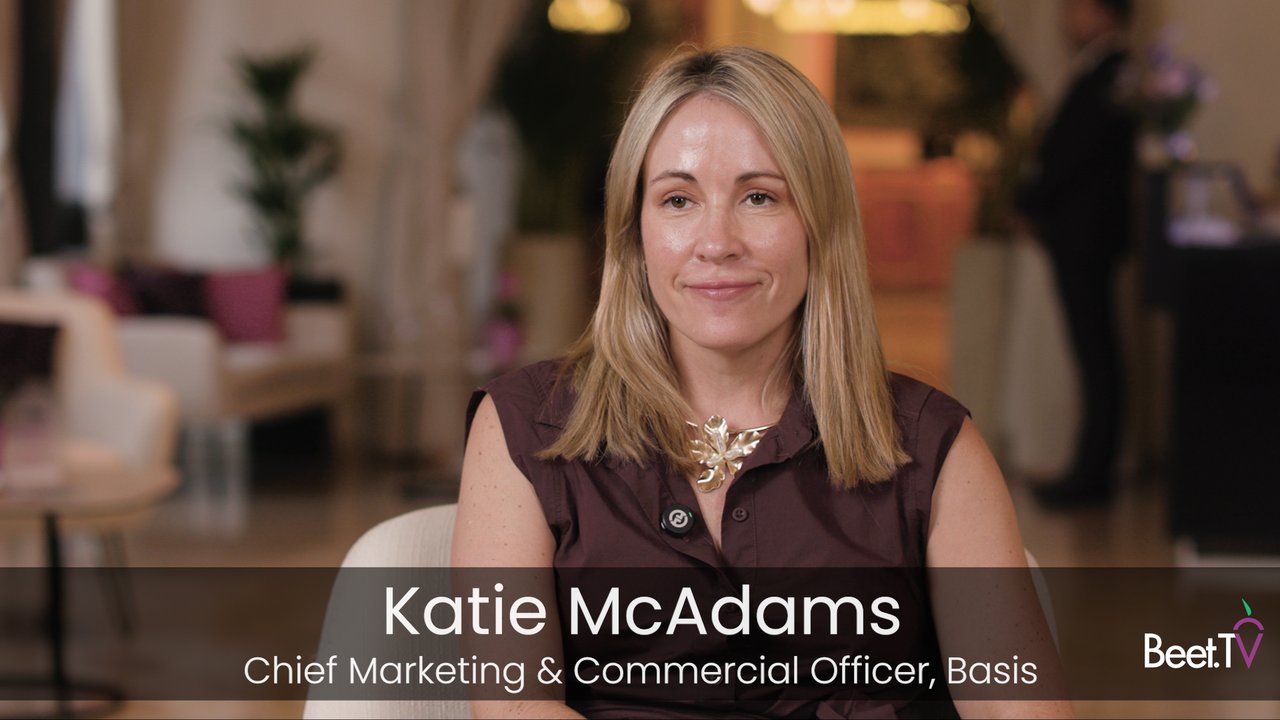
Basis’s Katie McAdams: AI’s Data Obsession Risks Emphasis on Short-Term Performance Versus Long-Term Growth

CANNES, France — Artificial intelligence’s appetite for data creates a natural gravitational pull toward performance marketing metrics, but brands that follow that pull risk sacrificing the long-game brand building that creates lasting competitive advantage.

“AI loves mass amounts of data, loves to crunch that data, come back with suggestions and recommendations. For that reason, it’s very tempting to say, I’m going to focus on what I would call more of the short-term performance metrics,” Katie McAdams, CMO and head of commercial enablement at Basis, told Beet.TV contributor David Kaplan at Cannes Lions. “The risk that that poses for brand building is that brand building is the long game. A new campaign in-market this month is going to take potentially up to three years for us to really build that brand visibility and brand recognition that we’re looking for.”

This tension shapes how brands must think about deploying AI — capturing its efficiency benefits without letting data abundance distort strategic priorities.

AI reveals hidden audience segments

Beyond generative content creation, AI’s most significant brand marketing opportunity lies in uncovering previously unknown audience segments and behavioral signals that enable more precise, meaningful targeting.

“The less obvious methods that we’re looking at are more around how we’re using AI to better understand who our audience is. Are there new segments of our audience that we didn’t actually know existed before?” McAdams said. “Now because of the data that we have access to, we’re able to actually have more intelligence about who those different segments might be, those emerging new customers that we didn’t realize we had before.”

Authenticity becomes competitive differentiator

As AI democratizes content creation, volume loses its strategic value while authenticity becomes the distinguishing factor that separates brands building genuine connections from those simply generating noise.

“Just because you can create more ads, more content doesn’t necessarily mean that you should. It’s more about quality over quantity,” McAdams said. “The brands who choose to lean into authenticity versus creating more content just because they can are the ones who are going to end up standing out in the long run.”

Meaningful experiences resist automation

CMOs must distinguish between processes that benefit from automation and human connection moments that technology cannot replicate, investing in events and experiences that create genuine community and learning opportunities.

“Automate the things that can be automated, but let’s focus on how we actually create meaningful connections and meaningful experiences,” McAdams said. “The brands who are going to focus on that, on connection, on creating meaningful experiences, are going to be the ones who stand out from the rest of the pack.”

Impact over noise defines long-term brand strength

Five years from now, brand strength will depend on the ability to create meaningful impact rather than maximum content output, as universal AI access eliminates production volume as a differentiating factor.

“There’s a difference between creating noise and creating impact. It’s less about let’s put out as much as we can because we now have the tools to do that and let’s focus on how we can actually do better with what we are putting out,” McAdams said. “Don’t create noise. There’s enough noise in this industry. How do I actually use tools to my advantage so that we can create things that are more meaningful and more impactful?”

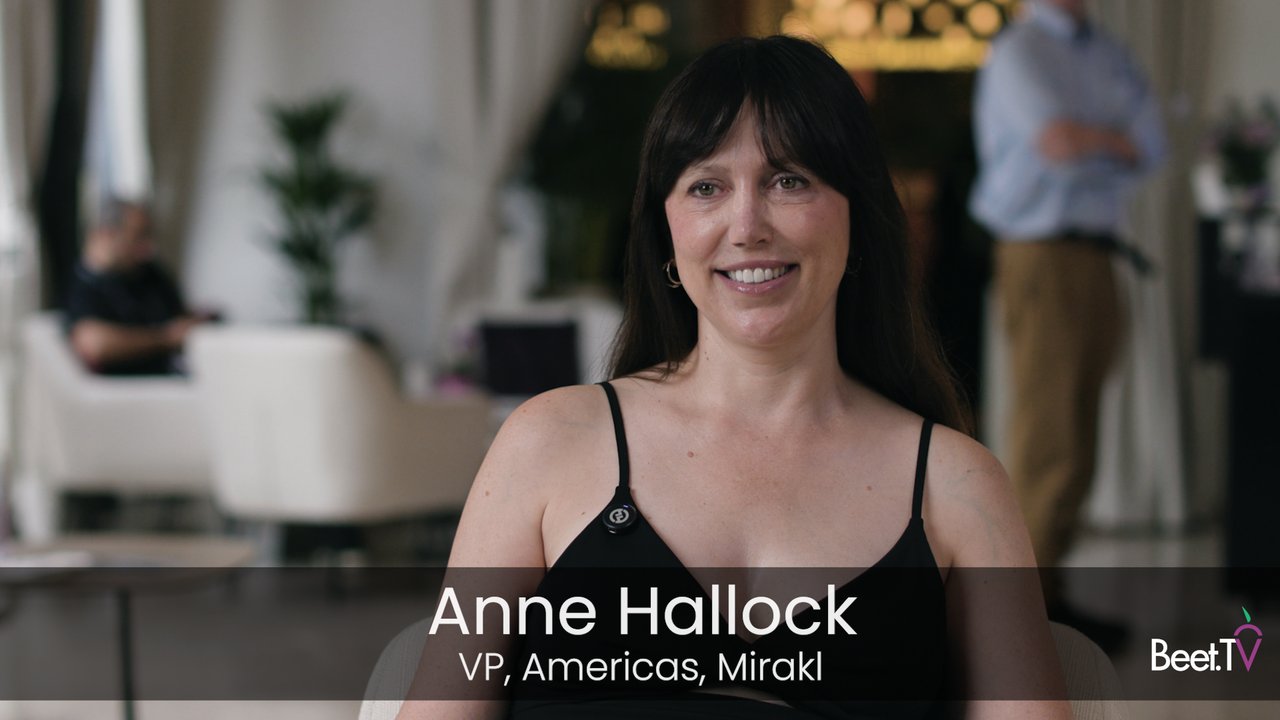
Retail Media’s Goal is Effortless Shopping, Not Just More Ad Inventory: Mirakl’s Hallock

CANNES, France — Shouldn’t the ideal shopping experience should feel effortless? That’s the vision driving the next phase of retail media, according to one industry executive who argues the channel’s true measure of success isn’t impressions or clicks but whether it actually drives purchases.

Commerce media has expanded far beyond a single touchpoint, now reaching shoppers across social platforms, in physical stores, and online. The challenge for retailers, though, is covering all those surface areas while understanding data across the entire value chain.

“The insight with retail media is that we are driving shoppers to prefer products and to convert, which means purchase,” said Anne Hallock, VP, Americas, Mirakl, in this video interview with Beet.TV at Cannes Lions 2026. “Really the goal here and the way that we measure success is, is it actually driving purchase.”

Closing the gap between wanting and buying

The retail media sector keeps on growing. U.S. retail media ad spending is projected to reach $61.15 billion by the end of 2026, accounting for 20.5% of total digital ad spending, according to eMarketer. That’s up from $41.37 billion just two years earlier.

Specializing in the space, Mirakl is an enterprise software company that provides SaaS technology enabling retailers and B2B businesses to build, operate, and scale their own online marketplaces.

For Hallock, the opportunity lies in surfacing relevant products to shoppers based on behavioral signals. When a retailer knows someone has visited a site multiple times, holds loyalty membership status, and is clearly browsing a particular category, they can present offers that accelerate the path to checkout, she said.

“When you’re reducing friction for the shopper, of course, you’re benefiting the retailer because they’re enjoying a sale, but the idea is that you have met an unmet need,” she said.

Breaking down organizational silos

Retailers like Lowe’s and Best Buy have accelerated their speed to market by dismantling internal barriers between departments. But, for many, the structural challenge, Hallock noted, stems from the sheer age of many retail organizations, some of which are 80 to 100 years old.

The emergence of the chief digital officer role has helped consolidate functions that previously operated in isolation. This leadership shift enables faster deployment of marketplace and advertising capabilities.

“When they’re on their public earnings announcements talking about how ads and marketplace are the flywheel that are really going to drive their business forward for the next five to 10 years, we’re incredibly proud to be a component part of that,” Hallock said.

Every website needs a media strategy

Not every retailer has launched a media network yet, but Hallock argued the economics make it inevitable. Any retailer operating a website has already paid to acquire that shopper traffic, she said, and retail media represents a way to recoup that investment.

Mirakl’s own retail media platform, Mirakl Ads, saw 258% year-over-year growth in ad spend during 2025, reaching $12.7 million. The company recently introduced AI-powered tools designed to help advertisers optimize campaigns through guided conversations.

“If you own a website now and in the future, it is incumbent upon you to pay yourself back for achieving those visits, but you do that by actually benefiting the shopper and letting them find what they were looking for to begin with,” Hallock said.

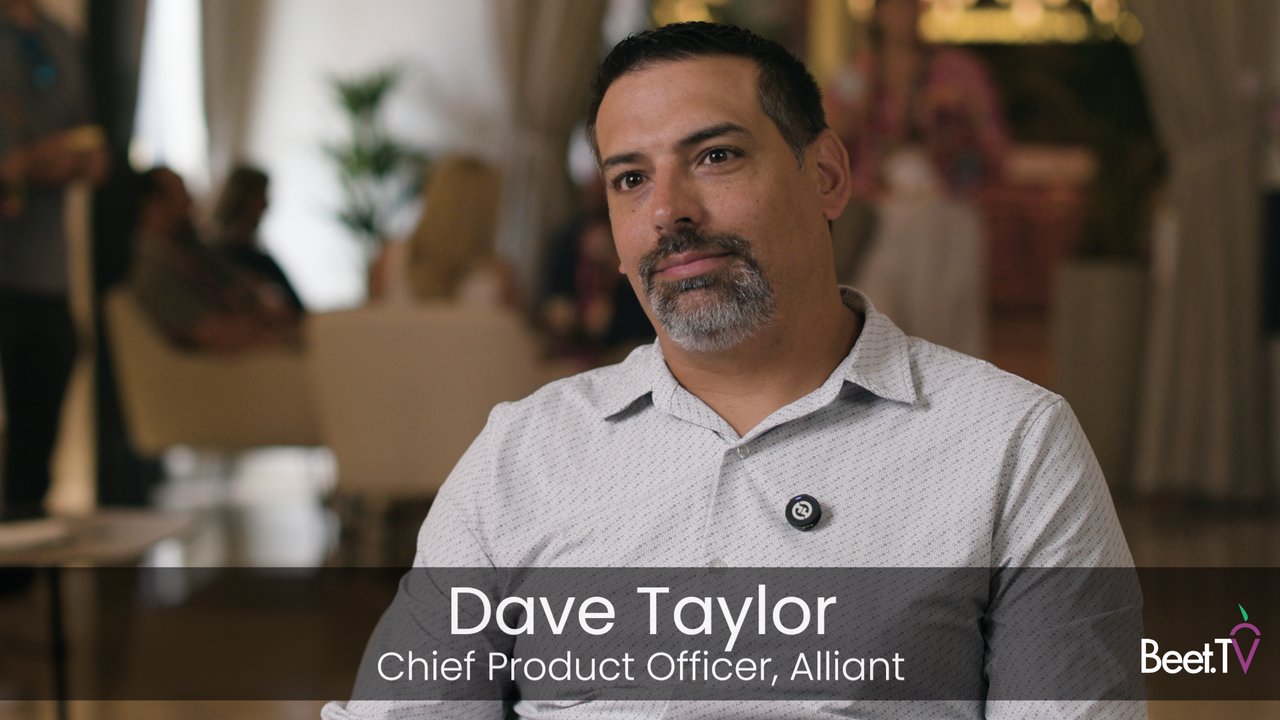
AI Is Only as Smart as the Data You Feed It: Alliant’s Dave Taylor

CANNES, France – Artificial intelligence may be the hottest guest at every advertising conference, but Dave Taylor isn’t ready to hand it the keys just because it showed up wearing a shiny new algorithm.

Speaking with Beet.TV contributor David Kaplan at the Cannes Lions International Festival of Creativity, the chief product officer at Alliant argued that AI’s biggest challenge isn’t a lack of hype. It’s a lack of high-quality data.

In other words, AI can cook dinner. But if you hand it spoiled ingredients, don’t blame the chef.

Bigger isn’t always better

Taylor said marketers shouldn’t confuse giant datasets with useful ones, especially as AI becomes more deeply embedded in campaign planning.

“Without the best data, the AI is kind of almost useless to a degree,” Taylor said. “Making sure that we hone in on the right data assets… is really paramount.”

Asked how marketers can distinguish quality data from data that simply looks impressive in a PowerPoint deck, Taylor offered a gentle reality check.

“Biggest isn’t always the best,” he said. Instead, marketers need a variety of data assets that provide predictive value rather than sheer volume.

“You don’t want to just have the scale,” Taylor said. “You want to have the predictive nature of the data.”

That’s welcome news for anyone who’s ever been handed a spreadsheet with 47 million rows and exactly zero useful insights.

No single data source wins the game

Taylor said Alliant’s approach combines predictive, probabilistic and contextual data because each serves a different purpose.

When building custom audiences, “the blend and the combination of many different data assets coming together is really what’s going to be powerful,” he said.

Predictive models help forecast future behavior. Historical data explains what already happened. Context adds another layer of relevance. Rather than declaring one methodology the winner, Taylor argued that marketers should match each data type to the objective of the campaign.

“There’s really just a combination of all of those together to help drive the outcome that you’re looking to achieve,” he said.

It’s less Avengers versus Justice League and more everybody reluctantly agreeing to work on the same group project.

Beyond audience segmentation

Custom audiences may now be standard practice across digital advertising, but Taylor believes the next frontier extends well beyond building better audience lists.

“AI… we know AI is here,” he said, while also pointing to the industry’s long-running quest for closed-loop measurement across channels including direct mail, digital and out-of-home.

What fascinates him most, however, isn’t another attribution model. It’s the next generation of consumers.

“I’m interested in… my son’s age,” Taylor said. “How are they going to consume content?”

He even floated a possibility that might surprise marketers who haven’t checked their mailbox lately.

“Is direct mail going to make a comeback?” Taylor asked. “Because it’s the new thing out there now.”

Advertising has officially entered the stage where physical mail is starting to sound innovative again. Somewhere, a catalog printer just smiled.

Privacy starts before the campaign does

Taylor also argued that privacy can’t be treated as a compliance exercise that happens after audiences have already been built.

“You want to make sure that you don’t just do the privacy at the end,” he said. Instead, marketers should build governance, permissions and privacy controls into every stage of the data pipeline.

For Taylor, that means ensuring companies have the proper technology and data controls from the moment consumer information enters the system through campaign activation and measurement.

The goal isn’t simply staying compliant. It’s creating a process that protects consumer data while still producing meaningful marketing outcomes.

As AI continues to reshape advertising, Taylor’s message was refreshingly unglamorous. Fancy algorithms are great. But if the underlying data is a mess, all you’ve built is a very expensive machine that gets the wrong answer faster.

Retail Media Knows What You Want Before Your Shopping Cart Does: Walmart Connect’s Brett Wein

CANNES, France – Retail media loves to brag about signals, identity and deterministic data. Brett Wein, vice president and head of food at Walmart Connect, has a simpler pitch: if someone buys groceries every week and starts lingering around mattress listings, that probably tells you something.

Speaking with Beet.TV contributor David Kaplan at the Cannes Lions International Festival of Creativity, Wein argued that Walmart Connect’s greatest advantage isn’t another advertising buzzword. It’s the fact that more than 150 million shoppers interact with Walmart’s stores, website and app every week, creating a mountain of purchase data that advertisers would happily trade their favorite attribution deck to access.

Shopping carts don’t lie

Wein said purchase behavior remains one of the strongest signals marketers can use, especially as older targeting methods continue to lose ground.

“Purchase-based signals are really, really powerful” compared with legacy approaches, he said, adding that deterministic data is “probably kind of like the fundamental value that we bring.”

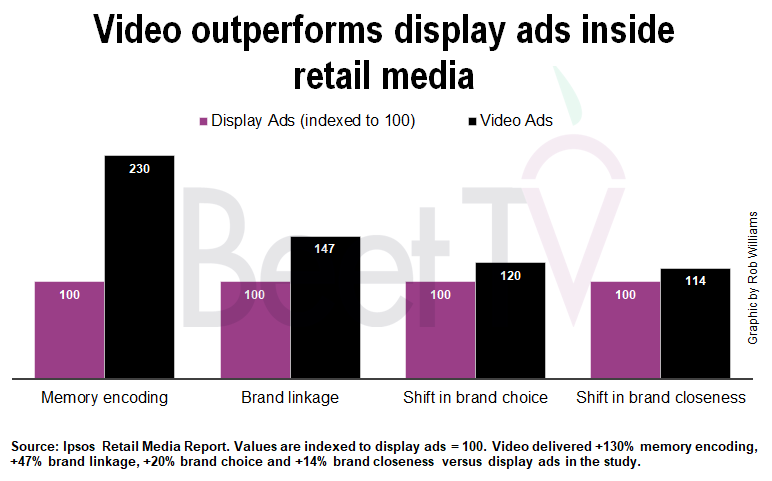
Video outperforms display ads in retail media

With millions of shoppers generating signals through stores, ecommerce and mobile apps, Walmart can identify everything from routine grocery trips to consumers researching a new television or mattress.

“We have over 150 million customers walking through our stores… every single week,” Wein said. “The buying behavior and the shopping behavior of those consumers is as powerful as you could possibly imagine” for predicting what customers may do next.

For marketers, that’s a refreshing alternative to trying to infer purchase intent from someone who accidentally clicked on an article about patio umbrellas three months ago.

Backyard marketing without the logo wallpaper

Wein also highlighted Walmart Connect’s “Backyard Escapes” campaign with VIZIO, which tried to avoid the classic marketing formula of attaching logos to content and calling it integration.

Instead, Walmart transformed four backyards in four markets with help from influencers and television personality Tan France, turning the seasonal campaign into an entertainment program that aired on VIZIO’s platform.

“We said, ‘How do we bring what we do in our stores to life to literally every customer imaginable?'” Wein said.

Rather than simply placing sponsor logos everywhere, brands became part of the makeover experience itself.

The approach appeared to resonate. Wein said roughly 2.7 million to 2.9 million viewers watched the program.

“People talk about integrated marketing programs,” he said. “This brought it to life in a way that nobody else could possibly do… except for somebody like Walmart and VIZIO.”

In advertising, that’s practically revolutionary. Nobody had to pretend a lawn chair “created authentic engagement” simply because its logo appeared in the corner of the screen.

Grocery today, mattress tomorrow

Wein said Walmart’s purchase signals aren’t limited to groceries or seasonal merchandise.

“It’s pretty extensive,” he said, noting that the same data can help marketers understand impulse purchases as well as products that consumers may research for months before buying.

“Those signals are valuable, whether it’s an impulse buy or something that you’re thinking about buying six months from now,” Wein said. “Our signals are extremely valuable.”

That broad view gives advertisers insight across both fast-moving consumer goods and higher consideration purchases, making retail media useful well beyond packaged goods brands.

CTV gets a shopping upgrade

As retail media expands into connected television, Wein believes Walmart’s ownership of VIZIO gives advertisers something traditional television has struggled to match: purchase-backed audience targeting at scale.

He said VIZIO, combined with Walmart’s Onn television brand that runs VIZIO’s operating system, is expected to reach roughly 25% to 30% of U.S. households by the end of the year.

That combination lets advertisers reduce wasted impressions by showing ads only to households that are actually likely to buy.

“It’s just bringing the magic of digital to life… in the CTV environment that’s never been done before,” Wein said.

For advertisers, the message was straightforward. Streaming television is becoming less about broadcasting to everyone and more about finding the households already halfway to the checkout lane. The shopping cart, it turns out, has become one of media’s most persuasive storytellers.

Accenture Song’s Rajat Agarwal: Agentic Commerce Promises ‘The Biggest Transformation’ In Two Decades

CANNES, France — Digital commerce has long been accepted but never truly loved, with 85% of consumers abandoning transactions after product selection due to friction-filled checkout experiences — a persistent failure that agentic commerce is uniquely positioned to address.

“If we look at the current system of digital commerce, it’s an accepted system. It’s not really loved,” Rajat Agarwal, senior managing director and global commerce practice lead at Accenture Song, told Beet.TV contributor David Kaplan at Cannes Lions. “Almost 85% of consumers actually abandon their transactions after they have made the selection because there are so many friction points in the entire cycle. The promise of agentic commerce is to really address many of these friction points.”

Simulation research across 50,000 synthetic consumers conducted with Accenture company Arwen found agentic commerce potential across all five major consumer mission types — from repeatable grocery purchases to complex travel decisions and B2B negotiations.

Two types of agents will emerge

Horizontal platforms including ChatGPT, Amazon, and Alexa will dominate search, browse, and checkout optimization while vertical agents built by brands and retailers provide deep category expertise and authentic brand experiences that generalist platforms cannot replicate.

“For a lot of our clients, which are brands and which are retailers, I think they have a real possibility of trying to provide authentic human experience, authentic brand experience, because they understand their category much better than anybody else,” Agarwal said.

This distinction creates a fundamental strategic choice for brands between becoming the choice of agent — showing up within dominant platforms — or becoming the agent of choice by building proprietary vertical commerce experiences.

Brands must learn to market to agents

Agents intermediating brand-consumer relationships require factual, confirmable product information rather than emotional messaging, as AI intermediaries evaluate claims through social sources and third-party references before making recommendations.

“There’s an agent in between the brands and the humans and the agents are not emotional. So you have to be much more factual. You have to ensure that whatever you are saying can be confirmed by agent through social sources, through other third party references,” Agarwal said.

This requirement demands significant investment in content systems and product information infrastructure to ensure agents accurately represent brand positioning to consumers.

Shopping should be inspirational, not just efficient

Agentic commerce’s true promise extends beyond transaction friction reduction toward replicating the best possible human retail experience — knowledgeable, unobtrusive guidance that creates genuine shopping delight.

“Agentic commerce is meeting the best salesperson you would ever encounter in a shop who would know exactly what you are looking for, is not very intrusive and really guides you to the exact purchase,” Agarwal said. “Shopping should not be boring and it should not just be making it more efficient. In a lot of cases we want it to be inspirational.”

Brands that treat agentic commerce as simply another channel miss its deeper potential for authentic, human-first consumer experiences that transform how people discover and purchase products.

“Brands should not feel that agentic commerce is just another channel. It’s the ability to provide a truly authentic, human first experience to their customers,” Agarwal said.

Experiential Media Networks Need Unified Buying to Scale, Says LiveRamp’s Stanichev

CANNES, France – The airport screen showing a tourism ad and the hotel room product sample from a CPG brand might feel like completely different advertising experiences. But, for the consumer walking through that journey, it’s one seamless moment of attention.

While platforms like Uber, DoorDash, and Connective have built substantial advertising businesses by bridging online and offline touchpoints, the traditional siloing of media budgets continues to hamper growth.

“The allocation of budget is what becomes challenging,” said Frederick Stanichev, VP of sales at LiveRamp, in a video interview with Beet.TV at Cannes Lions. Out-of-home screens in airports get purchased by out-of-home buyers, even when the entire connected experience is digital, he explained.

Brands should think in moments, not channels

The fragmentation extends beyond just buying structures. Experiential media networks span multiple verticals and formats – from ride-share apps to gaming platforms to hotel properties – creating complexity that doesn’t map neatly onto traditional agency structures.

Stanichev argued that brands need to reconceptualize their approach entirely. “When you think now about the engagement of the audiences, whether it’s actually an online or offline moment, both are actually converging into one single experience,” he said. “So there’s not necessarily a differentiation from a user standpoint.”

Rather than treating digital and physical touchpoints as separate line items, advertisers should view them as “a global moment of attention that they want to purchase,” Stanichev added. This shift in mindset could help unlock budgets currently trapped in channel-specific allocations.

Endemic advertisers paved the way

Despite the buying challenges, several experiential media networks have achieved meaningful scale by starting with partners already embedded in their ecosystems. Stanichev pointed to Uber and DoorDash as prime examples of platforms that built “amazing ad businesses” by first capitalizing on endemic advertisers.

“When we think about Uber or DoorDash, it’s all about the initial QSR retailers actually being leveraged through the delivery services,” he said. Similarly, Connective’s early growth came from tourism boards—advertisers with natural alignment to airport environments.

Gaming platforms like EA and Sony have followed a comparable playbook, nurturing relationships with endemic partners willing to invest for the long term. “I think this is the way to initiate the growth—really to capitalize on the endemic, initial corporation partners to invest and build for the long term together,” Stanichev said.

Data collaboration unlocks measurement

LiveRamp positions itself as a “neutral, interoperable platform” that helps clients connect data residing in different systems against a single customer ID. That unified view can then be activated across delivery platforms and measured through what Stanichev described as a “unified measurement framework.”

The company has been investing heavily in AI capabilities to automate campaign planning and optimization, and recently integrated NVIDIA infrastructure to accelerate model training within its clean room architecture.

But Stanichev emphasized that measurement in experiential media requires genuine partnership between networks and advertisers. “The transactional data does not necessarily sit with the media networks and will sit actually with the brand,” he explained.

AI Is Collapsing the Car-Buying Journey, Says GM’s Global Media Chief

AMENIA, NY — The number of touchpoints between a consumer first considering a new vehicle and actually purchasing one is shrinking.

For brands that have long relied on multiple opportunities to influence buyers throughout an extended decision-making process, a “collapse” means every remaining interaction carries significantly more weight.

“This is actually a collapse of the number of touch points that I have to influence a consumer,” said Shenan Reed, global chief media officer, General Motors, in this video interview with Beet.TV. “And that is really interesting to me because it means all of the touch points that I have before you get to the LLM become that much more important in the process.”

How AI reshapes the consideration phase

The shift is most pronounced in how consumers research vehicles, Reed said. Rather than navigating automaker websites organized around engine specifications most buyers don’t understand, shoppers are increasingly turning to AI tools to answer practical questions about seating capacity, towing capability, and safety ratings.

Reed described how AI tools allow consumers to build their own comparison charts across multiple brands, something that was previously difficult to accomplish. “You might have actually already started with a series of vehicles that you have in mind and you’re asking the AI to just build the comparison chart for you because it’s difficult to find places,” she said.

The pattern GM is observing shows consumers using AI for the research-heavy consideration phase, then returning to traditional search engines for the final steps. “We’re seeing really well over 60% of them turn back to the traditional search engines to know where there’s a dealer near me and what actual vehicles they have in stock,” Reed said.

Recent research from eMarketer supports that trend, finding that 44% of consumers are interested in using AI specifically to compare multiple vehicles.

Why brand building matters more than ever

The automotive purchase cycle operates on a timeline that separates discovery from consideration by months or even years. Whether a consumer’s lease is ending predictably or a tree falls on their car unexpectedly, they typically already have a mental shortlist of vehicles they would consider buying.

Reed emphasized the importance of being on that shortlist. “When that happens, you already have four vehicles in mind. There’s already four vehicles that you’re thinking of are the thing that are right for you, for your family, for your need state. And 70% of the time, you purchase one of those four,” she said.

This dynamic explains why upper-funnel brand advertising remains essential even as AI transforms the research process. “That’s why the brand media matters so much in the upper part of the funnel and in the conversation long before a consumer even gets to what I would call the modern search engine of an AI,” Reed said.

Optimizing for machines and humans alike

GM is adapting its digital strategy to ensure its content surfaces effectively in large language model responses. The approach draws on familiar search engine optimization principles but requires significantly more content production.

“What LLMs need that is a little bit different from the SEO engines of the past is they need a lot more content,” Reed said. “They can index things that the search engines have not been able to index in the past, and the more content we have and the richer that content is, the more likely it is to show up in the LLM when somebody’s researching something.”

The automaker is also partnering with platforms that perform well in AI results. “Reddit shows up incredibly well, YouTube shows up incredibly well. So how do you have strategies around those partners to make sure that you’ve got the right content, the right stories, that it’s authentic,” Reed said.

GM has been actively integrating AI into its own vehicles, recently announcing the integration of Google’s Gemini AI into millions of its cars to enhance in-vehicle interactions.

First Movers in Agentic Commerce may Build Lasting Advantages as LLMs Learn and Remember

CANNES, France – Unlike traditional search engines that simply indexed pages without memory, large language models learn from consumer interactions.

Some think that creates a case for brands to move into agentic commerce.

“If you’re a first mover and you’ve provided all your data and then they’re seeing the behavioral aspects of how consumers are engaging with the brand, they remember that,” said Diaz Nesamoney, founder and CEO of DaVinci Commerce, in this video interview with Beet.TV at Cannes Lions 2025.

More than instant checkout

DaVinci Commerce is an AI-powered commerce experience platform that helps brands manage product discovery and marketing campaigns across artificial intelligence shopping systems. Formerly known as Jivox, the platform features core tools like the DaVinci Agentic BrandStore and DaVinci Commerce Marketing.

The concept of agentic commerce has suffered from early misunderstandings about what it actually entails, according to Nesamoney. He said initial interpretations focused narrowly on autonomous purchasing or instant checkout functionality, both of which failed to gain traction.

“I don’t know about you, but I don’t want agents buying stuff for me by themselves,” Nesamoney said. “I want to be able to see, understand the product, colors, size and all of that.”

ChatGPT has pulled back on instant checkout features, validating the view that consumers want more than a quick transaction. So maybe the full consumer journey, from discovery through experience to purchase, represents the true opportunity in agentic commerce. Currently, more than 500 agentic storefronts exist on ChatGPT, with additional platforms emerging across other LLM environments.

The product description gap

But brands face a challenge in making their products understandable to AI agents, which cannot visually perceive products and rely entirely on data to make recommendations.

“Somebody might say, ‘I’m going camping this weekend, what should I be buying?'” Nesamoney explained. “Now, if you look at descriptions of camping equipment like tents and such, it doesn’t actually describe how you’d use it for camping.”

This disconnect requires brands to re-describe their entire product catalogs in ways that AI agents can interpret and match to natural consumer queries. The effort involved is substantial, but the alternative is invisibility in an increasingly important discovery channel.

High-consideration products face greatest stakes

The shift to agentic commerce will affect product categories unevenly, with complex purchases likely facing the most significant disruption. Routine commodity purchases like toilet paper require little consideration, but products where nuances matter substantially will see the greatest impact.

“Let’s say you’re buying a camera or a piece of clothing or something where the nuances between one and another could be pretty significant,” Nesamoney said.

“If you’re not able to describe your products really well and allow the consumer to understand it within that environment, you lose out.”


Manas Mittal of Uber Advertising Wants Your Ride to Make a Pit Stop for Coffee and Advertising

CANNES, France – The advertising industry has spent years chasing consumers from awareness to consideration to purchase. Uber Advertising has a different idea: Why not catch them while they’re literally on the way somewhere?

Speaking with Beet.TV at the Cannes Lions International Festival of Creativity, Manas Mittal, vice president of product management at Uber Advertising, made the case that Uber’s biggest competitive advantage isn’t just transportation. It’s knowing when millions of people are about to make decisions.

“So Uber sits in the moment of intent,” Mittal said. “We have a lot of valuable customer signals… and we’re very close to the purchase intent.”

In other words, your ride to the dentist might also become your introduction to a coffee shop, grocery store or other advertiser that just happens to be a minute from your destination. Because apparently your final destination was merely a suggestion.

A detour sponsored by caffeine

The company’s newest offering, Destination Offers, may be the most Uber-like ad product imaginable.

Instead of simply serving an ad, Uber can recommend an alternate drop-off location near the rider’s destination if it happens to be an advertiser’s storefront.

“We’re able to suggest alternative drop-off points that are close to the user’s original destination,” Mittal said to Beet.TV contributor David Kaplan. Those locations “represent advertiser locations.”

The idea is simple enough. Heading somewhere downtown? Uber might ask whether you’d rather be dropped at a nearby coffee chain and hand you a $2 coupon while it’s at it.

“That drives consideration but also conversion for the advertiser in a way that is very memorable,” Mittal said.

It’s one thing to tell marketers they can drive foot traffic. It’s another to literally steer the traffic there.

Chasing the holy grail

Uber isn’t shy about its ambitions for advertising.

Mittal described the business as “a large opportunity” supported by a growing audience. He noted that Uber’s membership program has reached 50 million engaged users, creating what he called “a wide open green space” for further investment.

Advertisers, meanwhile, aren’t asking for shinier banners or flashier creative. They want proof.

“They want better measurement,” Mittal said. “We want to collapse the funnel. That’s what the holy grail is.”

That means combining awareness, consideration, conversion and measurement into one experience rather than treating each as a separate campaign objective.

It’s an ambition that practically every retail media network, commerce platform and ad tech vendor now claims to share. Uber just happens to own the vehicle.

Turning soccer goals into shopping moments

Uber is also betting that real-world events create perfect opportunities for commerce.

Its Deal Drops product lets brands react to live moments, such as a World Cup goal, by serving timely promotions inside the Uber app.

“When a goal happens, you can show special content on the Uber app,” Mittal said. “That creates a memorable moment for the user.”

Meanwhile, Reorder Rewards encourages repeat purchases by nudging customers with offers shortly after previous orders.

Together, the products reflect a broader shift that interviewer David Kaplan summed up neatly: advertising is moving from awareness to action.

“Yeah, that’s exactly right,” Mittal said.

Why choose between media and commerce?

As Cannes conversations inevitably drifted toward the future of advertising, Kaplan asked whether tomorrow belongs to media or commerce.

Mittal declined to pick sides.

“I think it’s an ‘and’ question rather than an ‘or’ question,” he said, arguing that marketers increasingly want solutions spanning the entire customer journey while delivering clear attribution and reporting.

It’s a diplomatic answer, but also a practical one. For Uber, media and commerce are already sharing the same ride.

And if that ride happens to stop for an iced latte on the way, well, that’s apparently just another successful conversion.

Horizon Media’s Katie Comerford: Organizational Change Is the Main Barrier to AI Adoption

CANNES, France — Agencies and brands have access to sophisticated AI tools, but getting employees to incorporate them into daily workflows presents a harder challenge than any technology deployment — one that requires hands-on demonstration rather than simply granting access.

“There’s a hunger for discoverability. There’s a lot of curiosity. We’ve given our teams access to multiple different AI tools, but that step change to really making it a day-to-day component of what you’re doing — that’s the tricky part,” Katie Comerford, president, Horizon Commerce and Client Transformation at Horizon Media, told Beet.TV editorial director Lisa Granatstein at Cannes Lions. “You’ve got like 80% of the group that really needs a little bit more handholding.”

This organizational reality shapes how Horizon approaches AI adoption internally and with clients, emphasizing demonstration and hands-on experimentation over tool access alone.

Retail and national media budgets converge

Horizon helps clients consolidate historically separate retail and national media strategies into unified budget frameworks that drive growth across both channels rather than managing competing initiatives.

“What we’ve been trying to do is tell a consolidation story of not having two separate budgets and two separate initiatives, but really marrying it together,” Comerford said. “We can’t control where customers shop. So making sure that both sides of the house are elevating and driving client growth.”

This consolidation becomes critical as consumers move fluidly between retail and national media touchpoints without regard for internal budget structures.

Agentic commerce demands discoverability investment

Emerging agentic commerce platforms require brands to optimize content specifically for AI discovery engines that surface product recommendations, reviews, and purchase suggestions through conversational interfaces.

“For us, it’s really starting with discoverability. Making sure that we’re showing up in the discovery engines where they’re looking for reviews or where should I travel, what should I buy, what’s the best fan from a [product design/tech company] SharkNinja perspective,” Comerford said. “We’re optimizing the content that’s getting picked up by the agents and helping them come to the forefront.”

Speed and scale require creative guardrails

AI-powered content creation at scale demands strong creative briefs and quality controls to prevent brand messaging from losing resonance and authenticity across expanded content volumes.

“You still want to be meaningful. You can’t have AI slop everywhere. We do need the message to be resonating and we need to make sure it resonates with the right audience,” Comerford said. “We’re still looking at the data first, finding the right people, but we’re now doing it at a much broader scale and more effectively and more efficiently.”

Human judgment powers AI strategy

Despite AI’s expanding capabilities, human understanding of consumer psychology, cultural context, and macro-micro ecosystem shifts remain irreplaceable for strategic decision-making that technology cannot reliably predict.

“There’s still this element of strategy. There’s understanding what’s going on in our ecosystem from both macro and micro things shifting that humans are going to understand how a consumer thinks and how they feel and what’s impacting them,” Comerford said. “That’s not something that I think is predictable a lot of times in human behavior. Having that core — we’re all still customers, we’re all still consumers — that human element is still going to be very, very important.”