Adobe’s Ryan Fleisch: Agentic AI Strategy Is Only as Good as the Data Foundation Beneath It

CANNES, France — Brands rushing toward agentic AI implementations face a fundamental obstacle most haven’t solved: the quality and organization of the customer data those agents depend on to function effectively.

“The number one blocker of brands say they have to really implementing an agentic AI strategy is the data foundation because your agents are only going to be as good as the data that they’re operating off of,” Ryan Fleisch, head of Product Marketing, Real-Time CDP & Audience Manager at Adobe, told Beet.TV contributor David Kaplan at Cannes Lions. “If we can give the best in class tools for how you should manage your data, how you should manage your audiences, know that it’s going to be built off of the right foundation from your customers.”

This dependency elevates the customer data platform from technical infrastructure to strategic AI enabler, reshaping how brands think about data investment priorities.

CDP role evolves beyond data storage

Customer data platforms have shifted from IT-focused data repositories toward intelligent activation engines that connect customer journeys from acquisition through loyalty with real-time speed unavailable through traditional data warehouse approaches.

“Originally, it was marketed as a database to put all of your first party data. They were built primarily for IT and very technical personas,” Fleisch said. “The role of a CDP now has to be more around the intelligent activation of what I do with that data? How do I connect that across a full customer journey?”

This evolution addresses brands’ need for engagement workflows that operate at speeds analytical warehouses cannot match.

Data collaboration breaks third silo

Beyond channel and technology silos that marketers have long struggled with, a third collaboration silo persists between brands, publishers, and partners who cannot access shared audience intelligence in privacy-safe environments.

“One of the silos is still people [themselves],” Fleisch said. “We look at collaboration as really a way to break down that third silo and really expand a 360 view of your customer based on what you know about them and more into a 3D view.”

Clean room environments enable brands to activate audiences beyond first-party foundations through publisher partnerships, media network establishment, and broader data strategy expansion.

Real-time profiles enable in-moment personalization

CDP value emerges through unified customer profiles that enable same-page and next-page personalization, media suppression, and cross-system customer view synchronization without hours or days of latency affecting marketing relevance.

“If I don’t have the speed of data on a unified profile, sure, I can do omnichannel marketing, but I’m doing that off of hours, if not days of latency so I’m not marketing to the freshest view of that customer I have,” Fleisch said.

AI agents require CDP foundations

Adobe’s audience agents and AI workflows multiply CDP productivity while the platform simultaneously powers broader organizational AI strategies through properly managed data and audience tooling.

“How can my CDP power my AI strategy at large? Our research at Adobe has found that the number one blocker brands have to implementing an agentic AI strategy is the data foundation,” Fleisch said. “Whether it’s with Adobe or outside of that to execute your AI strategy, know that it’s going to be built off of the right foundation from your customers.”
Google Wants to Untangle Programmatic’s Spaghetti Bowl, Paul Gubbins Says

CANNES, France – For years, programmatic advertising has promised efficiency. It has also delivered a labyrinth of acronyms, middlemen, marketplaces and PowerPoint slides attempting to explain all of the above.

Google’s Paul Gubbins says advertisers have finally had enough.

Speaking with Beet.TV contributor David Kaplan at the Cannes Lions International Festival of Creativity, Gubbins, CTV sales lead for agency activation in EMEA exchange platforms at Google, described an industry increasingly focused on simplifying how ad dollars reach premium television inventory.

In other words, advertisers would like fewer treasure maps and more direct routes.

Agencies want fewer twists and turns

Gubbins said Google has long worked with brands, agencies and demand-side platforms to help advertisers reach audiences across screens and premium content. But in recent years, agencies have become increasingly concerned about navigating what he called a “very complex and fragmented programmatic supply ecosystem.”

That concern has fueled interest in supply path optimization, or SPO, the advertising industry’s ongoing quest to answer a deceptively simple question: Why take six connecting flights when a direct flight exists?

“We’ve had a lot of asks from the big holding cos and some of the independents” to help navigate the growing complexity of programmatic supply, Gubbins said.

Google’s answer is a collection of buy-side tools, including Buyer Direct, updated curation capabilities and programmatic marketplaces.

The goal is to help agencies get closer to publishers while removing some of the layers that have accumulated in programmatic over the years like geological sediment.

Buyer Direct aims to shorten the journey

One area where Google sees significant momentum is connected TV.

Gubbins said agencies and DSPs increasingly prefer transacting CTV inventory through direct deals and programmatic guaranteed arrangements rather than relying solely on the open marketplace.

That trend led Google to launch Buyer Direct, a product designed to combine traditional insertion-order relationships with programmatic controls.

“It enables brands and agencies for the very first time to buy directly from publishers ad server, i.e. Google Ad Manager,” Gubbins said.

The product is intended to address agencies’ supply path optimization goals while strengthening connections with major publishers.

For buyers accustomed to tracing their media spend through a maze of vendors, the pitch is straightforward: fewer detours, fewer mysteries and hopefully fewer meetings dedicated entirely to explaining where the ads actually ran.

CTV keeps opening its doors

Gubbins also expressed optimism about the continued growth of addressable television in Europe.

One reason is the gradual blending of traditional television buying and programmatic advertising.

“The continued convergence of traditional linear and programmatic advertising practices” is making television more accessible to new advertisers, he said.

That includes smaller businesses that historically lived in search and social media campaigns and may never have considered television inventory within reach.

At the same time, ad-supported streaming and FAST channels continue expanding available inventory.

According to Gubbins, that growing supply creates opportunities for smaller advertisers to appear on television screens without requiring the sort of budget that once demanded approval from an entire corporate finance department.

Home screens become advertising real estate

Another area attracting Gubbins’ attention is the rise of home-screen advertising on smart TVs.

While consumers may not always wake up hoping for more ad placements in their lives, Gubbins argued that these formats are proving effective because they appear when viewers are actively deciding what to watch.

“Personally, I think they’re fantastic,” he said. “They’re not intrusive, they’re highly engaging and they’re putting ads in front of people at a point in time when they’re receptive to messaging.”

That statement may inspire spirited debate among anyone who has spent fifteen minutes searching for a movie only to abandon the effort and rewatch The Office. Still, television manufacturers clearly see the home screen as valuable real estate.

AI becomes television’s recommendation concierge

Artificial intelligence also earned its obligatory Cannes mention, although Gubbins connected it to a practical use case.

He pointed to AI-powered recommendation engines that help viewers discover content more efficiently.

“Historically, people used to say, it takes us ages to figure out what we want to watch in streaming,” Gubbins said.

Today, he added, recommendation systems are doing “a fantastic job of putting the right content in front of the right person at the right time.”

That may be one of AI’s most universally appreciated applications. Few consumers object when technology saves them from scrolling through 8,000 viewing options before ultimately selecting the same sitcom they watched yesterday.

Outcome-based buying gains momentum

Google is also expanding tools designed around advertiser outcomes rather than simple inventory access.

Gubbins said agencies have increasingly requested packages optimized toward specific goals such as viewability and click-through rates.

Using AI, Google has developed offerings designed to align inventory selection with those desired outcomes.

“We’ve built packages that are optimized towards the outcomes of brands and agencies are now asking us for,” Gubbins said.

For an industry that once celebrated impressions as if every ad exposure were equally meaningful, the shift reflects a broader trend. Advertisers increasingly want proof that campaigns achieved something beyond successfully occupying pixels.

As Cannes conversations continue to revolve around AI, CTV and programmatic efficiency, Google’s message appears clear: less complexity, more control and fewer reasons for media buyers to need a flowchart before lunch.

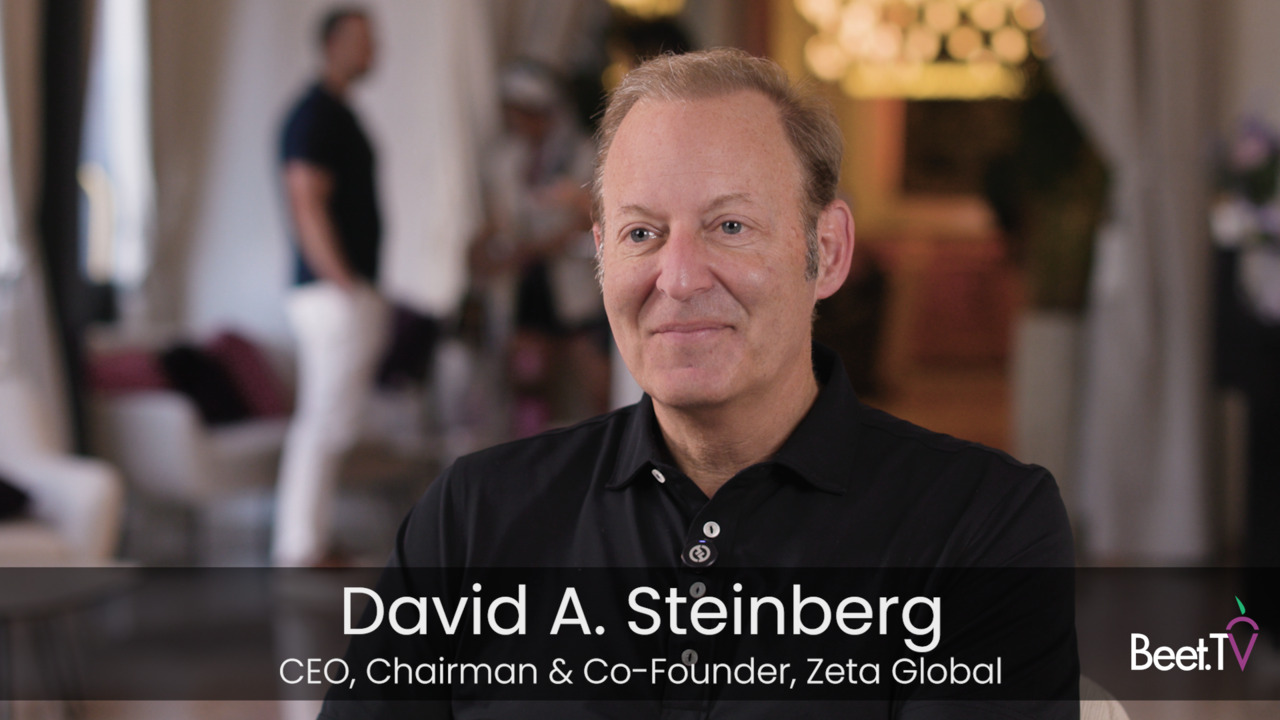
Zeta’s Athena Turns Marketers From Cessna Pilots Into Stealth Bomber Crews

CANNES, France — Most enterprise software sits largely unused. The average user taps into just 5% to 10% of the features in any platform they buy, according to David Steinberg – and that waste, he argues, is the real problem AI needs to solve in marketing.

That is the pitch behind Athena by Zeta, the agentic AI layer that Zeta Global has built on top of its marketing cloud. Rather than requiring users to find and configure the right features themselves, Athena accepts a business objective – say, two million new customers at 7% lower acquisition cost – and reconfigures the platform’s interface around that goal, then asks whether to activate. It is less a chatbot than a co-pilot for a plane most marketers didn’t know they were flying.

“We’ve turned out a stealth bomber and our clients know how to fly Cessnas,” said David Steinberg, CEO, chairman, and co-founder of Zeta Global, in this video interview with Beet.TV at Cannes Lions 2026.

Speed as a competitive weapon

Steinberg pointed to decision velocity as the core differentiator underpinning Zeta’s claimed returns. A Forrester study, he said, found that for every dollar spent through Zeta’s platform, clients see more than 600% return on marketing spend – a figure he attributed directly to the platform’s ability to make targeting decisions in a millisecond, compared to seven to 10 seconds for competing systems.

In programmatic advertising, where inventory is auctioned in fractions of a second, that latency gap is the difference between winning and losing the bid. Steinberg’s argument is that speed compounds: faster decisions mean better targeting, which means tighter feedback loops, which makes the algorithms smarter over time.

“Our attribution looks across every single component of the journey of that customer,” Steinberg said, “and we’re able to track them and create a true return on investment. Because we always have a feedback loop from our clients who became an end user or a customer, the algorithms are consistently getting smarter on who to target and where.”

From 600% to 1,000%

The 600%-plus return on marketing spend figure, Steinberg was careful to note, predates Athena’s rollout. Early adopters of the new agentic layer are already seeing returns “substantially higher” than that baseline, he said – pointing toward what he described as a publicly stated long-term goal of 1,000% return on marketing spend.

Whether those early numbers hold at scale remains to be seen, but Steinberg cited Zeta’s first-quarter 2026 results as evidence the trajectory is real: 50% year-over-year revenue growth, at what he described as a “pretty scaled business.” Zeta Global, which went public in 2021, has been building toward this moment for years, and the Athena expansion to agencies – announced ahead of Cannes Lions – signals an intent to push the technology beyond direct brand relationships.

“That’s coming because of that return on marketing spend,” Steinberg said of the growth figure.

Posted in Uncategorized

Restraint, Not Reach, will Define Advertising’s Next Turn: Chase Media Solutions

CANNES, France – Sure, artificial intelligence can deliver hyper-personalized messages at scale. But what if the real competitive advantage lies in knowing when to stay silent?

That idea is driving strategy at one of the newest entrants to the retail media arena, where the temptation to bombard consumers with offers has never been greater. The argument: showing fewer, more relevant messages builds the kind of trust that converts better than any targeting algorithm alone.

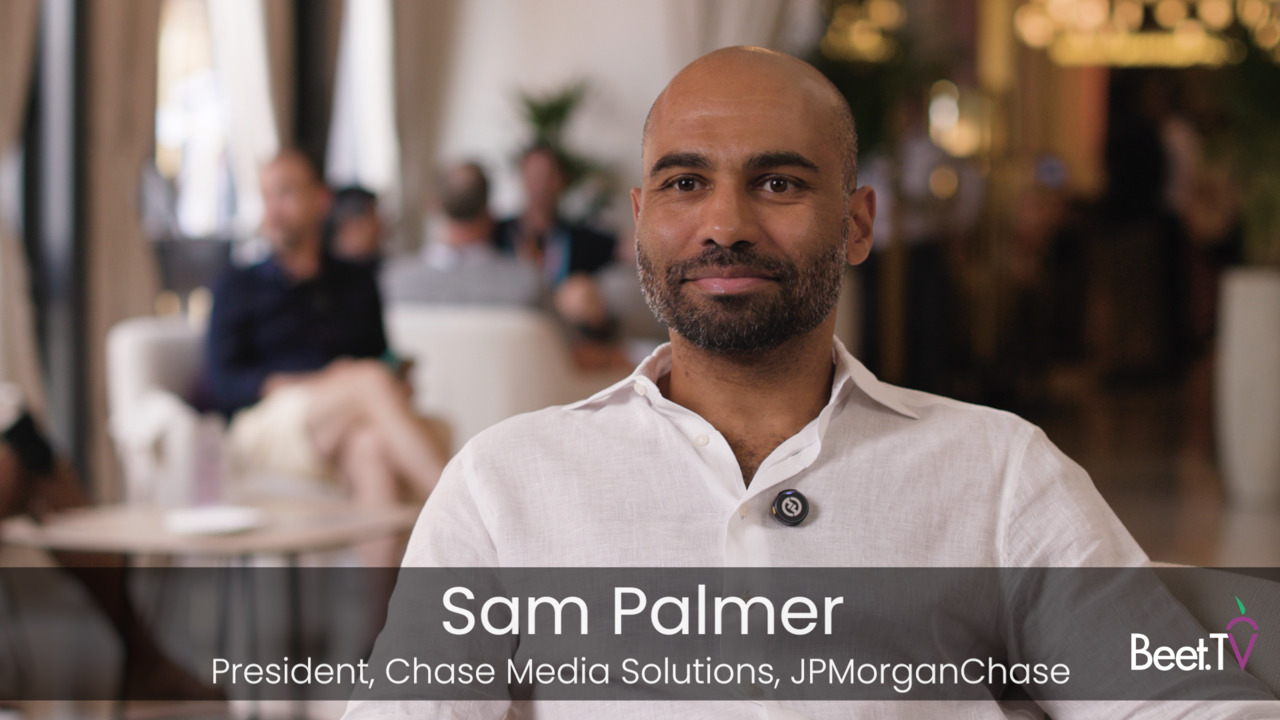
“My favorite word from this week at Cannes is ‘restraint’,” said Sam Palmer, president of Chase Media Solutions at JPMorgan Chase, in a video interview with Beet.TV. “Just because I can doesn’t mean that I should.”

From luxury cards to retail media

Palmer’s perspective was forged during his time leading JPMorgan’s Sapphire Reserve credit card, where cultural credibility meant partnering with artists like Es Devlin at Art Basel and booking Black Coffee – who became the world’s top DJ shortly after – for electronic music events. Those curated moments, he argued, sent signals that attracted consumers who recognized the brand understood them.

“When you stack them together, truthfully, start sending a signal and the brand itself starts attracting people who want to be part of it because they now understand that you’re culturally relevant to the specific groups,” Palmer said.

Now he is applying that same curatorial instinct to Chase Media Solutions, the bank’s retail media network, which leverages first-party transaction data from millions of Chase customers. The difference is scale: what was once manual curation for premium cardholders must now happen algorithmically across a vast consumer base.

Trust beats awareness

The retail media sector is booming. U.S. advertisers are projected to spend $71.09 billion on retail media in 2026, according to eMarketer, as brands chase the closed-loop measurement that first-party data provides.

Palmer positioned Chase Media Solutions’ value proposition squarely around that measurement capability, but framed it through the lens of trust rather than targeting prowess.

“Trust has become a bigger driver of choice than brand awareness because awareness is easy,” Palmer said. “You can buy reach nowadays anywhere. Customers feel that. What is much harder to do is to be able to delight the customer at the right moment where the customer responds with, ‘Wow, I actually needed that, thank you.'”

Respecting the moment of intent

“If you look at premium consumers, you think about hotels that actually deliver the best experience… (they) are not hotels that give you endless choice.”

That extends to how Chase approaches its mobile banking app, where users arrive primarily to check their finances, not to shop. Recognizing the right moment to introduce a commerce offer – and, crucially, when not to – is what Palmer called “the magic sauce.”

“As a consumer, when you come to the Chase mobile app, your primary goal is not always and not necessarily shopping,” he said. “Your primary goal is making sure that your money, your hard-earned money is okay. And we have to respect that because that’s what we build the trust with the consumer.”

Proving incrementality

For marketers, the network’s first-party transaction data purports to offer definitive proof that advertising drove sales that would not have happened otherwise.

“It’s not just about showing customers that have completed a transaction actually, but it’s about being able to prove that we found ones that wouldn’t have completed that transaction in the first place,” Palmer said.

That incrementality measurement addresses a persistent challenge in digital advertising, where attribution remains murky despite sophisticated tracking. Chase’s visibility into the full transaction lifecycle – from offer exposure to purchase completion – provides what Palmer said is “clear ROI” for marketing partners.

Brand Authenticity Still Beats Algorithmic Guesswork: Warner Bros. Discovery’s Laurie Shackell

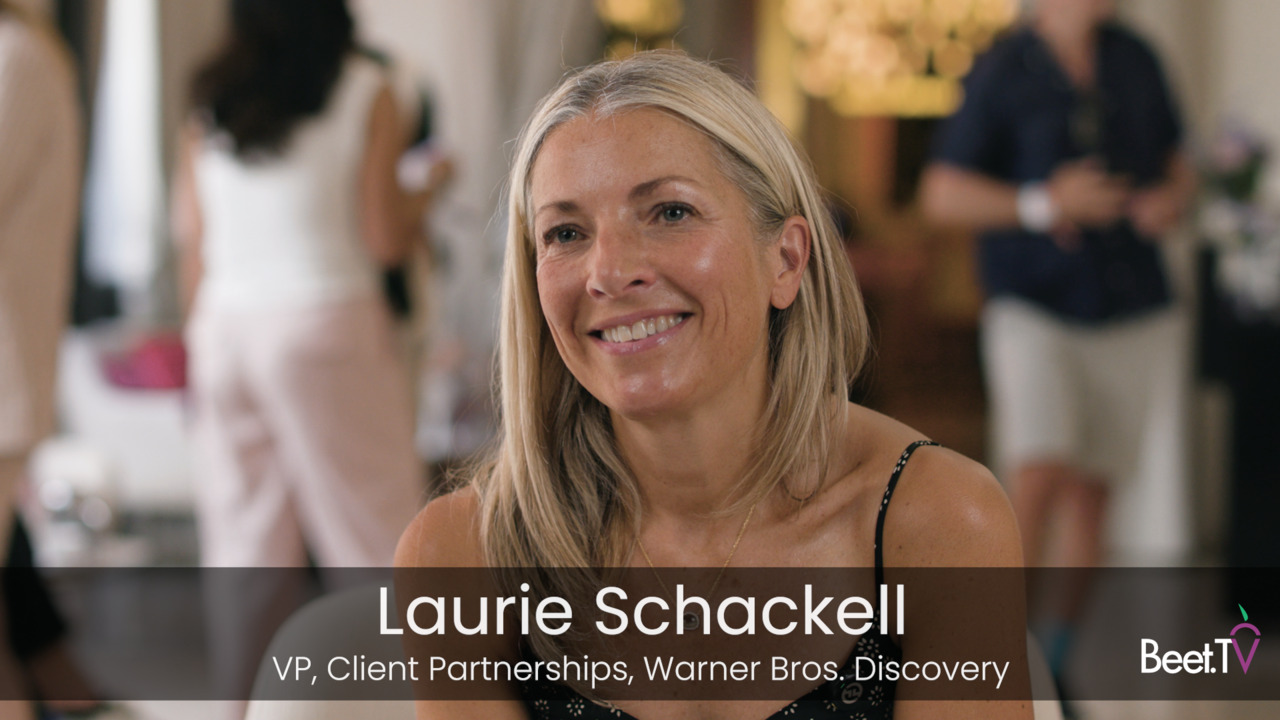
CANNES, France – At a time when media companies, advertisers and agencies are all trying to navigate a marketplace that seems to reinvent itself every quarter, Laurie Shackell has a surprisingly old-fashioned prescription: trust.

The vice president of client partnerships and brand solutions at Warner Bros. Discovery spent part of the Cannes Lions International Festival of Creativity explaining why successful partnerships often look less like media buying and more like relationship management. Sometimes they even resemble family therapy.

“Any partnership is built on trust,” Shackell said in an interview with Beet.TV Editorial Director Lisa Granatstein.

That may sound obvious. Then again, so does “communicate with your spouse,” yet entire industries exist because people struggle with it.

When the left hand doesn’t know what the right hand is sponsoring

Shackell described Warner Bros. Discovery’s approach as a “concierge” model, helping brands navigate not only the media giant’s sprawling organization but sometimes their own.

Large corporations, she noted, often have licensing teams, consumer products divisions and marketing groups pursuing related goals while communicating about as often as contestants on a reality show after elimination.

“Sometimes the left hand isn’t talking to the right hand,” Shackell said.

In those situations, Warner Bros. Discovery’s role extends beyond selling media opportunities. The company frequently helps clients connect internal dots, translating priorities across departments and smoothing out organizational friction.

The result is a partnership built on familiarity and consistency, which becomes increasingly valuable as companies confront rapid changes in media, technology and consumer behavior.

From sponsorship to joining the cast

One of Shackell’s recurring themes was the idea that brands should move beyond simply sponsoring content.

Instead, they should become part of it.

“We take it from sponsorship to participation,” she said.

That means finding intellectual property, or IP, that fits naturally with a brand’s identity rather than forcing an awkward connection that consumers immediately recognize as manufactured.

Audiences have become remarkably skilled at detecting inauthenticity. Social media has effectively turned everyone into a cultural fact-checker. If a partnership feels forced, viewers tend to spot it faster than a White Lotus guest spots a brewing disaster.

Shackell said the goal is to identify opportunities where brands can genuinely participate in a cultural conversation while building stories that continue beyond a single campaign.

Challenges of being a giant entertainment warehouse

Warner Bros. Discovery owns one of the industry’s largest collections of entertainment properties. That creates an interesting challenge.

When marketers think of the company, they may immediately picture HBO hits like The White Lotus. But Shackell said part of her team’s job is reminding clients just how much content sits inside the company’s portfolio.

“It’s reminding them, one, what’s in the portfolio,” she said.

In an age when every streaming service is producing new releases at a relentless pace, older franchises can sometimes get overshadowed. Yet those libraries remain powerful assets.

Fortunately, viewers have not stopped watching beloved shows simply because they first aired during a different presidential administration.

The data says people miss their TV friends

Shackell pointed to a striking audience insight: roughly 60% of streaming on Warner Bros. Discovery’s platforms comes from viewers revisiting older titles.

Think Friends. Think Gilmore Girls. Think comfort television.

Apparently many consumers have decided that amid economic uncertainty, geopolitical tension and an endless flood of notifications, spending time with familiar fictional characters feels like a perfectly reasonable life choice.

That insight led Warner Bros. Discovery to develop initiatives such as StoryBurst, which helps marketers build campaigns around beloved catalog content.

Examples include partnerships like “When Sally Met Hellmann’s” and a campaign that brought Gilmore Girls back into the spotlight for Walmart.

The lesson, according to Shackell, is that data should spark creativity rather than replace it.

“The insight is what launches the story,” she said.

Finding fan passion points

When asked how brands can connect with audiences in meaningful ways, Shackell returned to a simple principle: understand what people actually care about.

Warner Bros. Discovery’s portfolio spans entertainment, sports and news. Each attracts communities with distinct passions and interests.

“I think we identify the passion points of our audience,” Shackell said.

Once brands understand those passion points, they can create content that feels relevant instead of intrusive.

That sounds straightforward. Yet in a media industry that occasionally treats audience attention like something that can be purchased wholesale from a spreadsheet, it remains a useful reminder.

The technology may be getting more sophisticated. The targeting may be getting more precise. But Shackell’s message at Cannes was refreshingly human: know your audience, earn trust and tell stories people actually want to be part of.

Or, put another way, if 60% of viewers are voluntarily spending time with Ross Geller and Lorelai Gilmore, maybe the smartest strategy is not fighting nostalgia. It’s finding a way to join the conversation without making it weird.

A Bloomberg Terminal for Marketing?: Why One Veteran Thinks the Industry’s Fragmentation Problem Is Finally Solvable

Marketing fragmentation has been the industry’s dirty secret for decades. Campaigns scatter across dozens of channels, creative assets multiply without coordination, and CMOs are left squinting at disconnected dashboards trying to figure out what’s actually working. One veteran of the industry’s digital origins thinks he’s finally built the tool to fix it.

His take: show marketers everything their consumers are seeing, across every touchpoint, and match it to performance data in one place. Think of it as a Bloomberg terminal for marketing – a single interface that aggregates the chaos into something actionable.

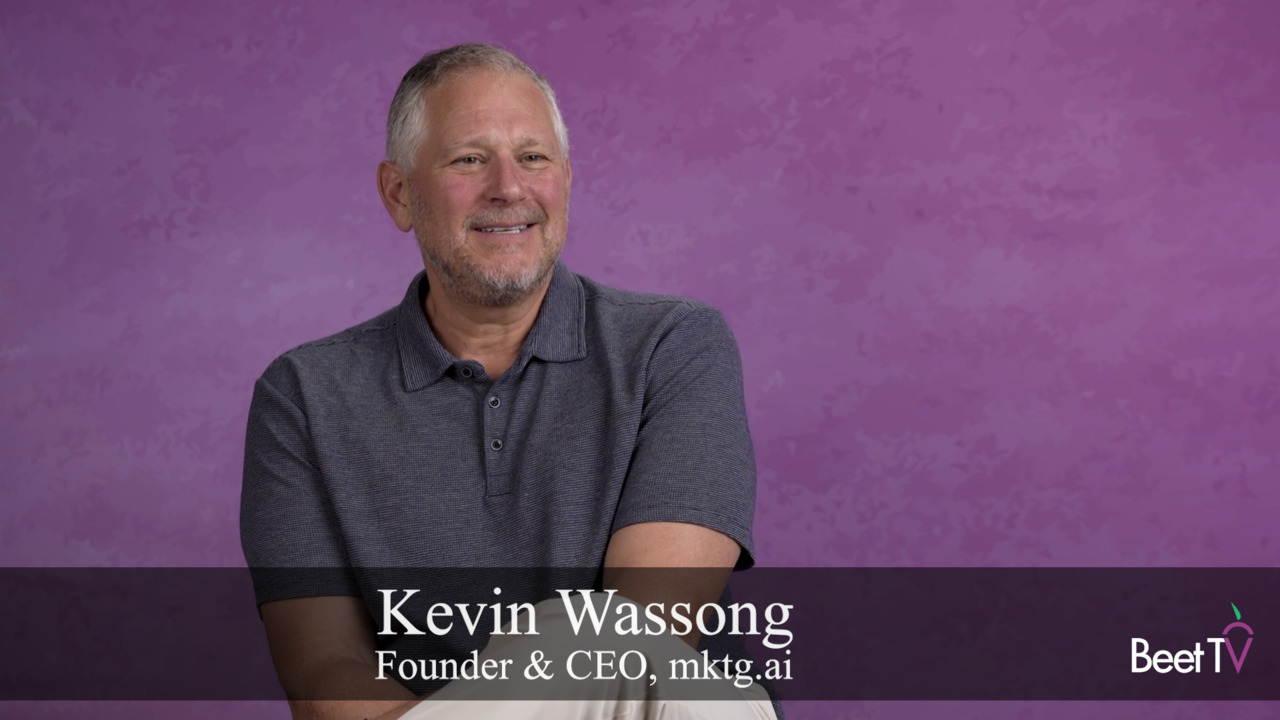
“I bought the domain mktg.ai in 2016 and tried to build it then. It just couldn’t be built,” said Kevin Wassong, founder and CEO of mktg.ai, in this video interview with Beet.TV. “And finally, we’ve built it over the last two years.”

A career-long problem, a two-year solution

Wassong’s credentials in digital marketing stretch back to the medium’s earliest commercial days. He founded the digital division of J. Walter Thompson in the 1990s, helping brands navigate the first wave of the internet. That experience, he suggested, gave him an unusually long view of how the industry’s structural problems compounded over time.

The platform mktg.ai has built is positioned as “creative-first,” meaning it surfaces what consumers are actually encountering in market before layering in performance analytics. The goal is to let marketers audit, archive, and analyze their activity in a unified environment rather than toggling between siloed tools. It’s a workflow argument as much as a technology one.

“The product’s really been in market for about a year now, and we’re moving fast,” Wassong said. The company sells primarily to CMOs, pitching the platform as a holistic view of marketing activity at the executive level.

The fragmentation problem CMOs can’t ignore

The timing may be favorable. Gartner’s 2026 CMO Spend Survey found that CMOs are now allocating an average of 15.3% of their marketing budgets to AI initiatives – yet only 30% of marketing organizations report having mature AI readiness capabilities. Investment is outpacing infrastructure, which is precisely the gap a platform like mktg.ai is designed to address.

Wassong pointed to a presentation by Greg Stewart at the Possible conference, where he was interviewed, as validation of the direction the industry is heading. “We’re now getting to that point where creative first, understanding what’s working across multiple channels is mission critical,” he said. The reference underscored his view that the industry’s consensus is shifting toward integrated, performance-linked creative intelligence.

Gartner also forecasts worldwide AI spending to reach $2.59 trillion in 2026, a 47% jump year-over-year, suggesting the macro environment is accelerating demand for exactly the kind of tooling Wassong is building.

Speed of decision-making as the real product

What Wassong kept returning to was velocity. The pitch is the ability to act on what you see, faster than the current fragmented stack allows. “They can make decisions faster,” he said of the CMOs using the platform, describing the ability to audit and analyze marketing activity as foundational to that speed.

That positions mktg.ai less as a reporting tool and more as a decision-support system, which is a meaningful distinction in a market crowded with dashboards.

Whether the Bloomberg terminal analogy holds up – Bloomberg’s power comes as much from its network effects and data exclusivity as its interface – remains the longer-term test for the platform.


Tomorrow’s Leaders will Connect People, AI and Ideas: Chief CEO Alison Moore

CANNES, France – By the middle of the Cannes Lions International Festival of Creativity, executives had settled into a familiar rhythm: praise AI, praise creativity, praise the Mediterranean and repeat as necessary.

Alison Moore happily checked the first box.

“If I didn’t say AI, there would be something wrong with me, right?” she joked in this interview with Tameka Kee for Beet.TV and the New York Stock Exchange.

But as the CEO of executive leadership network Chief, Moore wasn’t interested in delivering another sermon on artificial intelligence. Her real message was about leadership and why companies risk overlooking the human side of the AI revolution.

Across discussions about commerce, creativity and technology at Cannes Lions, Moore said another theme kept surfacing: “the concern for the humanity of it all.”

The real question isn’t whether AI will transform business. It already has. The challenge, she said, is whether companies will redesign their organizations and leadership models as quickly as they adopt the technology.

Speed is great, panic is overrated

Corporate executives have rarely been accused of moving too slowly when the latest technology arrives. Moore is urging something that almost feels rebellious in 2026: think first.

“We have to move at record’s pace,” she said. “It’s mind blowing, but can we have some contemplation and consideration first? I think the two can be had at the same time.”

Rather than blindly chasing speed, Moore wants leaders to rethink how AI fits into organizations, how people collaborate with intelligent agents and what uniquely human skills deserve protecting.

That conversation, she said, is finally beginning to happen.

The org chart is getting flatter

Chief works with thousands of senior women leaders, giving Moore a front row seat to how leadership is evolving.

Today’s workplace spans four generations, from baby boomers to Gen Z, while AI arrives as an entirely new kind of colleague. Instead of treating that as organizational chaos, Moore sees an opportunity.

Young employees often arrive with native AI skills. Veteran executives contribute experience, judgment and strategic thinking. Neither group can succeed without the other.

“The hierarchy is sort of collapsing,” Moore said. “They have to talk differently together. And the best organizations are going to be the ones that acknowledge that.”

Future executives, she suggested, may spend less time acting as command-and-control managers and more time connecting expertise across people, AI systems and business functions.

Women aren’t waiting for permission

Moore also pushed back on the narrative that women are cautiously standing on the AI sidelines.

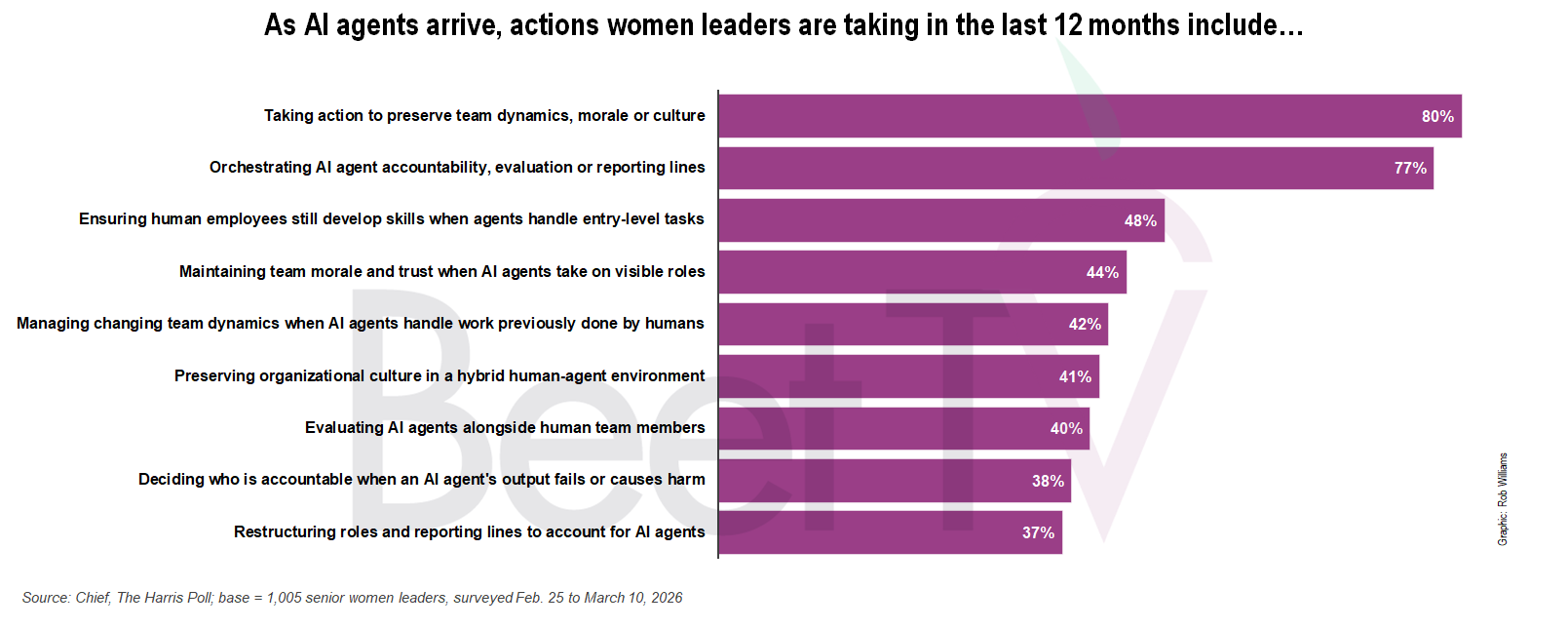
Research conducted by Chief with The Harris Poll found that 80% of senior women leaders already play an active role in AI strategy, governance or implementation inside their companies. They’re participating enthusiastically while also asking harder questions about long-term consequences.

Chief Harris Poll

According to Moore, many are concerned that organizations are prioritizing speed over thoughtful adoption.

Among their biggest worries is the erosion of critical thinking as employees become increasingly dependent on AI tools.

“I am going to be thinking about the human impact,” Moore said, describing the mindset she sees among many leaders. “Protecting critical thinking, protecting integrity, intelligence, all the things that are uniquely human.”

She describes the goal as balancing artificial intelligence with what she calls “HI,” or human intelligence.

Curiosity is becoming a leadership skill

Asked what women leaders should take home from Cannes, Moore’s advice was refreshingly direct.

“Gear up.”

She acknowledged that women have historically faced barriers to accessing emerging technologies, making it even more important to experiment with AI both professionally and personally.

Her prescription sounds less like a technology roadmap than a lifelong learning plan: stay curious, keep experimenting and repeatedly upskill and reskill.

“The mindset needs to change,” Moore said. “Agile, constant learner, skill, upskill, reskill, repeat.”

Optimism survives the hype cycle

For someone who spent much of the interview discussing disruption, Moore ended on an unexpectedly hopeful note.

She sees women inside Chief launching businesses, reinventing careers and embracing AI as a tool for building entirely new chapters rather than simply preserving old ones.

In a conference overflowing with predictions about machines replacing work, Moore offered a different vision.

Technology may reshape organizations, flatten hierarchies and automate countless tasks. Leadership, however, still depends on curiosity, judgment and the very human ability to connect people who think differently.

Those qualities remain refreshingly difficult to automate.

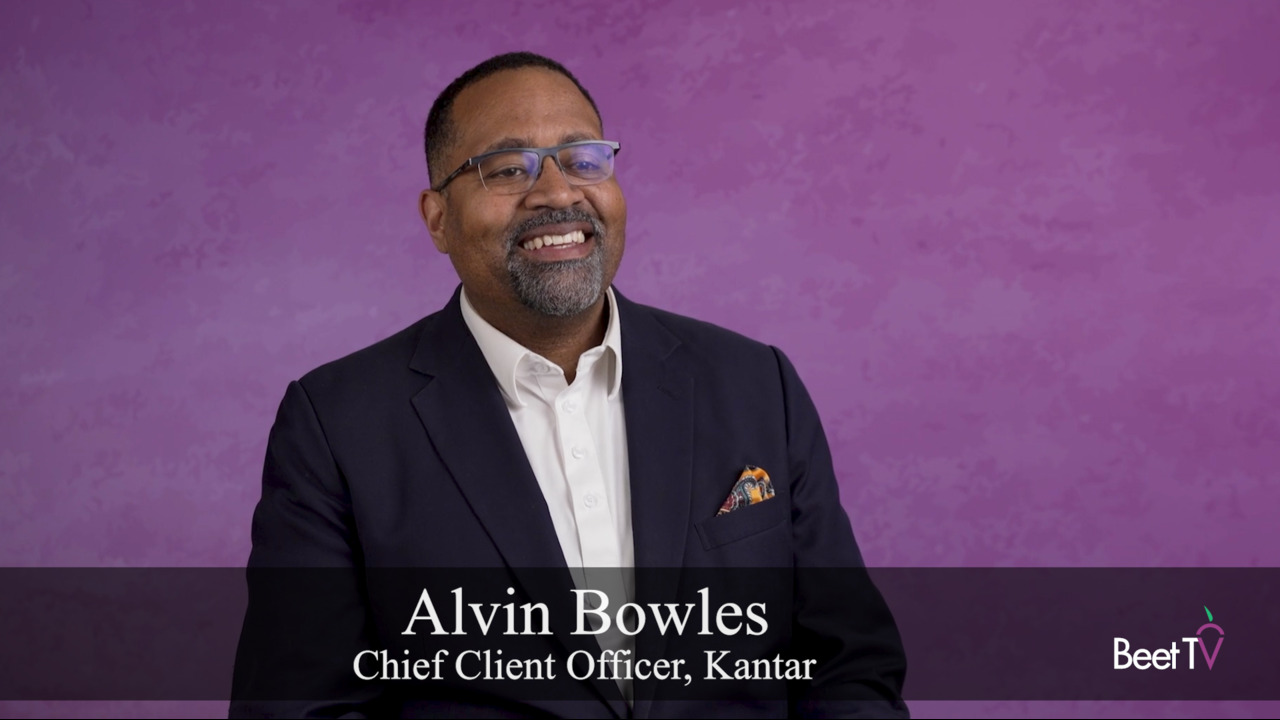
Presence Isn’t Impact: Kantar’s Bowles on Why CMOs Are Counting the Wrong Things

Stacking impressions across platforms might feel like progress. According to one senior research executive, it may actually be the problem.

In a media landscape where every platform promises reach and every dashboard overflows with metrics, the real crisis for brand marketers isn’t a shortage of inventory – it’s a confusion of signals.

CMOs are mistaking the accumulation of touchpoints for the delivery of outcomes, conflating how loudly a brand shows up with how meaningfully it lands, said Alvin Bowles, chief client officer at Kantar, in this video interview with Beet.TV.

Presence vs. impact

The fragmentation of media has created what Bowles described as an almost paradoxical trap: infinite choices leading to unfocused strategy. “Because there are infinite choices, individuals are often adding and stacking how many impressions you’re getting from platform to platform to platform and trying to aggregate what used to be just TRPs and GRPs with impressions, with likes and things of that nature,” he said, “as opposed to thinking about this in a very coordinated manner.”

The corrective, in Bowles’ view, is a shift from volume-based thinking to outcome-based planning. “It’s not just about how many people you reach – it’s are you reaching the right people at the right time with the right creative,” he said. That sounds intuitive, but the pull of raw numbers remains strong in boardrooms where campaign performance is still often reported in aggregate reach figures rather than conversion or brand equity metrics.

Kantar’s own research framework – what the company calls its MDS model, standing for meaningful, differentiated, and salient – underpins this argument. The firm’s BrandZ rankings, which track the world’s top 100 brands, apply this lens to assess whether campaigns are actually breaking through with target audiences or simply generating noise.

Creative fit for purpose

Bowles identified a second, related failure mode: repurposing creative across platforms without adapting it to each environment. “You can’t just actually make a spot or a brand campaign and then try to repurpose that, taking a 90 and cutting it to a 15 or cutting it to a 30,” he said. The medium, in his framing, is not simply a distribution channel – it’s a creative brief in itself.

“It’s almost like painting a picture, taking a blank canvas and then painting a picture and allowing that to have a continuity across all the platforms in which this creative may appear,” he said. The brand idea provides the through-line; the execution should be native to each surface.

He cited Heinz as an example of a brand that had done this well, taking a core brand truth – “it’s got to be Heinz” – and expressing it distinctively across TikTok, Snapchat, Facebook Reels, YouTube, and traditional media. “For a brand that is as well known as Heinz to be able to take that brand idea and embody that across a number of different campaigns, across a number of different platforms, really allowed it to come to life,” Bowles said.

Posted in Uncategorized

Cannes Lions Was Powered by Rosé, AI and Billion-Dollar Deals: LUMA Partners CEO Terry Kawaja

CANNES, FRANCE – If Cannes Lions is supposed to be the advertising industry’s annual celebration of creativity, this year’s festival added another attraction: investment bankers quietly checking their phones between yacht parties.

According to Terry Kawaja, founder and chief executive of LUMA Partners, dealmaking was impossible to ignore on the Croisette. The mergers, acquisitions and strategic investments piled up so quickly that Cannes began to resemble an outdoor version of a Wall Street conference with better weather and significantly more linen.

“Well, it’s inevitable,” Kawaja said when asked about the surge in activity.

Year of the Giant Checkbook

The buying spree started before Cannes even opened its doors.

In the months leading up to the festival, Publicis Groupe agreed to acquire LiveRamp for $2.2 billion. Fox followed with its planned $22 billion purchase of Roku. Then Cannes week arrived and apparently decided the pace was too slow.

“We had $2 billion deals announced,” Kawaja said.

Among the headline-grabbers was AppsFlyer’s sale of roughly $1 billion in secondary shares to investors including Moloco, Unity, Meta and Google. Walmart also announced plans to acquire performance TV platform Vibe for approximately $1.2 billion.

Taken together, the transactions turned what is usually a festival of marketing trends into a festival of term sheets.

“It very much took center stage at Cannes in 2026,” Kawaja said.

Why performance TV suddenly became everyone’s favorite toy

While the deals were different, Kawaja sees them as evidence of larger shifts transforming the advertising ecosystem.

“There are changes, acceleration of CTV,” he said.

The Vibe acquisition in particular reflects the growing obsession with measurable outcomes. As marketers increasingly demand proof that advertising actually works, performance TV has become one of the industry’s hottest sectors.

“You had basically a perfect storm that led to the extraordinary outcome,” Kawaja said.

That storm included rising demand for outcome-based advertising, the need to attract smaller advertisers traditionally spending inside the walled gardens and Walmart’s willingness to aggressively pursue a strategy it began building with its acquisition of Vizio several years ago.

Kawaja noted that Walmart brings scale, data and a long-term commitment to connected television. In other words, if you’re shopping for a fast-growing CTV asset, it helps to have one of the world’s largest retailers paying the bill.

Scarcity creates a bidding frenzy

Another factor helped push valuations skyward: there simply are not many companies like Vibe available for purchase.

“You had scarcity,” Kawaja said. “There’s just not that many platforms that if you wanted to pursue performance TV where you could go to acquire.”

That scarcity, combined with Vibe’s rapid growth and aggressive market positioning, created exactly the kind of competitive situation that tends to make investment bankers smile and buyers reach for larger calculators.

The result was what Kawaja called “the perfect storm,” producing both an “extraordinary outcome” and “a very, very high multiple.”

Valuation reality check

Not everyone, however, gets to enjoy Vibe-style valuations.

Kawaja pointed out that the acquisition price stands in sharp contrast to the more subdued environment facing many public ad tech companies.

The industry’s private-market winners are commanding eye-popping premiums while public valuations remain weighed down by investor skepticism and a tougher market environment.

“Everyone’s gonna be looking at that multiple,” Kawaja said.

And who can blame them? In an industry where every startup deck promises to revolutionize advertising with AI, automation or some combination of both, a billion-dollar exit still has a magical ability to focus attention.

For one week in Cannes, creativity may have remained the official theme. Unofficially, the hottest campaign on the beach appeared to be convincing someone to write a very large check.

Gen Z Wants to Be Part of the Journey, Not Just the Destination

CANNES, France — You know the old playbook of showing consumers product ads on white backgrounds and hoping for the best? Apparently, younger shoppers want immersion, personalization, and the thrill of discovery – not a sterile transaction.

With 80 billion monthly searches on its platform – half of which carry commercial intent – Pinterest finds itself at the center of that trend, where inspiration and purchase increasingly blur into a single experience.

“Gen Z, they want to be part of the discovery, meaning that they want it to be immersive, personalized, visual,” said Matt Madrigal, chief technology officer, Pinterest, in this video interview with Beet.TV at the Cannes Lions Festival of Creativity. “The marketers that will do well will recognize that so they can tell stories to Gen Z.”

The limitations of text-based search

Search has changed. While traditional search engines excel when users know exactly what they want, they struggle with the messy, exploratory nature of modern shopping journeys.

“You’re starting to see some of the limitations of text-based search,” Madrigal said. “Text search now is becoming much more conversational, you have longer queries. But with that, there’s no inspiration, there’s no discovery.”

Pinterest positions itself as the answer to that gap. According to Madrigal, more than 40% of Gen Z users come to Pinterest to search first, while 60% use the platform specifically for shopping. “It starts often times with Gen Z wanting to search with an image or an idea,” he said.

Building a taste graph

Central to Pinterest’s approach is what the company calls its “taste graph” – a massive data structure built from user interactions across 750 billion pins organized into 15 billion boards.

“The taste graph is all this incredible user interaction data that we have,” Madrigal explained. “All the associated visual searches, text searches allows us to really understand what a user’s taste or vibe or aesthetic is.”

The company recently unveiled several AI-powered tools to deepen this capability. At Cannes 2026, Pinterest announced its Business Assistant, an AI collaborator currently in closed beta, along with a new Pinterest Model Context Protocol that optimizes ad performance at the asset level rather than the ad level.

Ads as content

The traditional model of advertising as interruption is giving way to something more integrated. Madrigal argued that when ads are genuinely relevant, they function as content rather than disruption.

“We always view really relevant ads as great content,” he said. “When you have great content, it really resonates with our users. And so that delivers both a great engaging experience for our users and usually better outcomes for our advertisers.”

Pinterest’s proprietary recommendation models play a key role in this approach. “They’re 30% more accurate compared to recommendations you’ll see through other commercial models,” Madrigal claimed, explaining why the company builds its own foundational AI models rather than relying on third-party solutions.

Anticipating what users want next

The real ambition goes beyond simple personalization – showing users more of what they have already clicked on. Madrigal described a more sophisticated goal: anticipating desires before users consciously recognize them.

“Traditional personalization has been something where I click on this, therefore I like that,” he said. “What we’re trying to do is, as we try to anticipate what you want next, we do that in a way for users when they don’t even know they want it themselves.”

This capability relies on Pinterest’s logged-in user base of 631 million monthly active users, providing rich behavioral data that powers the platform’s recommendations. The company also recently launched an experimental app called Ask Pinterest, designed to explore conversational, visual-first shopping experiences.

Bad Streaming Ads Hurt Brands More Than Platforms, Omnicom Warns CMOs

CANNES, France — When viewers suffer through a poorly targeted or repetitive ad on a streaming service, they don’t blame Netflix or Disney. They blame the advertiser.

That is driving a wave of creative personalization deals between Omnicom Media Group and major streaming platforms, as the agency holding company races to solve what it sees as a “negative reach” problem plaguing connected TV.

The stakes are high. For the first time, CTV upfront ad spending is projected to surpass prime-time linear TV in 2026, with U.S. advertisers expected to commit $17.73 billion to streaming versus $16.98 billion for traditional prime time. Yet the creative experience on these platforms often lags behind the investment.

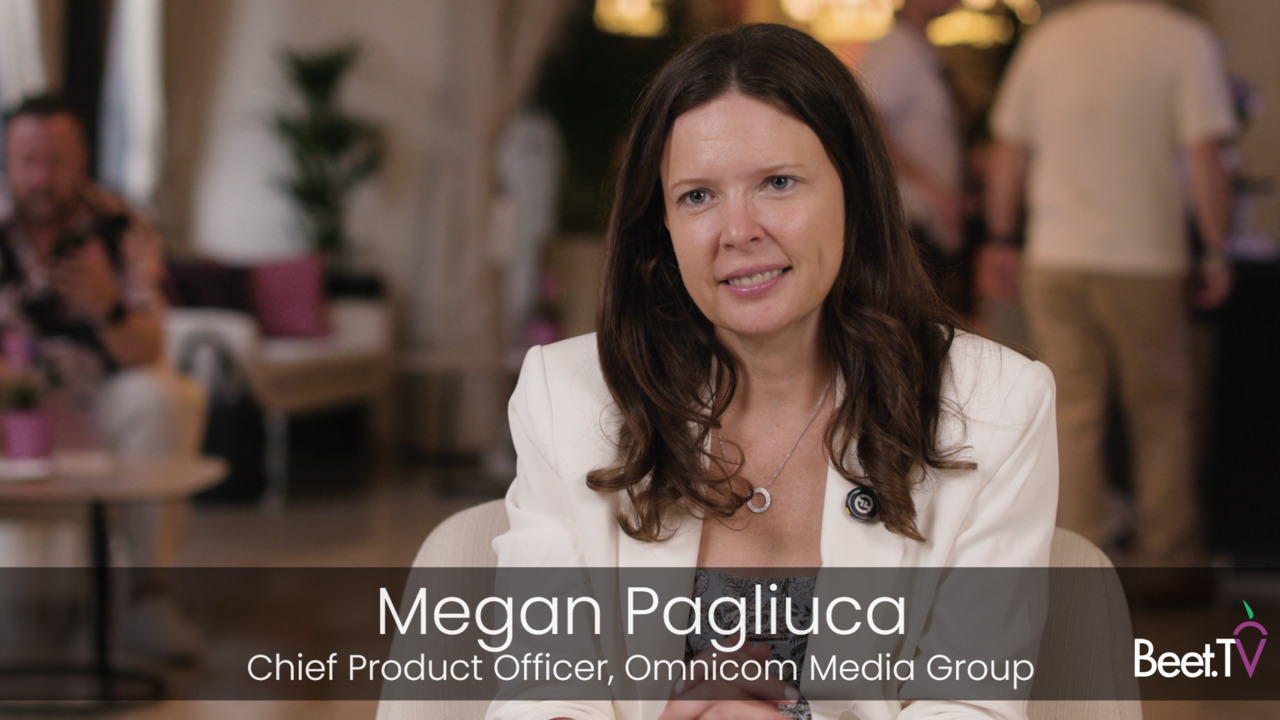
“If there’s a bad experience in streaming, consumers don’t blame the platform, they blame the brand,” said Megan Pagliuca, chief product officer at Omnicom Media Group, in this video interview with Beet.TV at Cannes Lions.

Netflix clean room unlocks viewing-based creative

Omnicom announced a string of partnerships with streaming giants this week, headlined by what Pagliuca described as the company’s first co-development project with Netflix.

“We actually can match Acxiom audiences to viewership within the Netflix clean room to really understand those audiences’ favorite shows and movies, and then personalize the creative experience aligned to those shows and movies,” Pagliuca said. The result, she explained, delivers ads that are “both contextually relevant to the platform and a much more personalized consumer experience.”

The Netflix deal represents a breakthrough after years of negotiation with the streamer, which only launched its ad-supported tier in late 2022. Pagliuca noted that Omnicom had been “trying to work on it for a couple of years, but they’re relatively new in the market.”

Disney, Paramount and NBCU get tailored approaches

Beyond Netflix, Omnicom struck creative personalization deals with Disney, Paramount, and NBCUniversal, each structured around the unique capabilities of the respective platforms. The Disney partnership builds on previous programmatic work, extending personalization into live sports and entertainment programming.

“Last year we worked with Disney on programmatic live. So it was the first time we could use programmatic signals for targeting in live,” Pagliuca said. “This year, we scaled that to the capability within creative personalization in live sports and live entertainment.”

Paramount’s deal targets the cultural moment around binge viewing. “Whenever they drop a new series, they often drop them in threes. We captured that unique unit, personalized it, and then built around that binge experience and that shared cultural moment,” Pagliuca explained. NBCUniversal’s collaboration goes deeper into content metadata, pulling episode and scene-level data from its clean room to inform creative decisions.

Cross-publisher measurement finally arrives

Perhaps the most significant technical advancement involves Acxiom’s multi-party clean room infrastructure, which enables measurement across streaming publishers for the first time. This capability addresses a longstanding frustration for marketers who have struggled to evaluate campaign performance holistically across fragmented streaming inventory.

“This is new and game-changing because you didn’t have that capability before this data collaboration infrastructure that Acxiom has taken to market,” Pagliuca said. The system also passes creative IDs through the measurement framework, giving Omnicom Production and creative partners visibility into performance at a granular level.

“You can see creative ID by audience, by frequency band, by outcome that can all inform creative personalization,” she added.

Global Ad Industry Hits $1.4 Trillion as Platforms Beyond Big Three Drive Growth

CANNES, France — The advertising industry has ballooned into a $1.4 trillion behemoth, powered by a broader coalition of global platforms that have proven surprisingly resilient against economic headwinds.

While Google, Meta, and Amazon continue to dominate headlines, a collective surge from platforms like Reddit, Snap, and Pinterest – players often overshadowed by their larger rivals – is now driving much of the industry’s expansion.

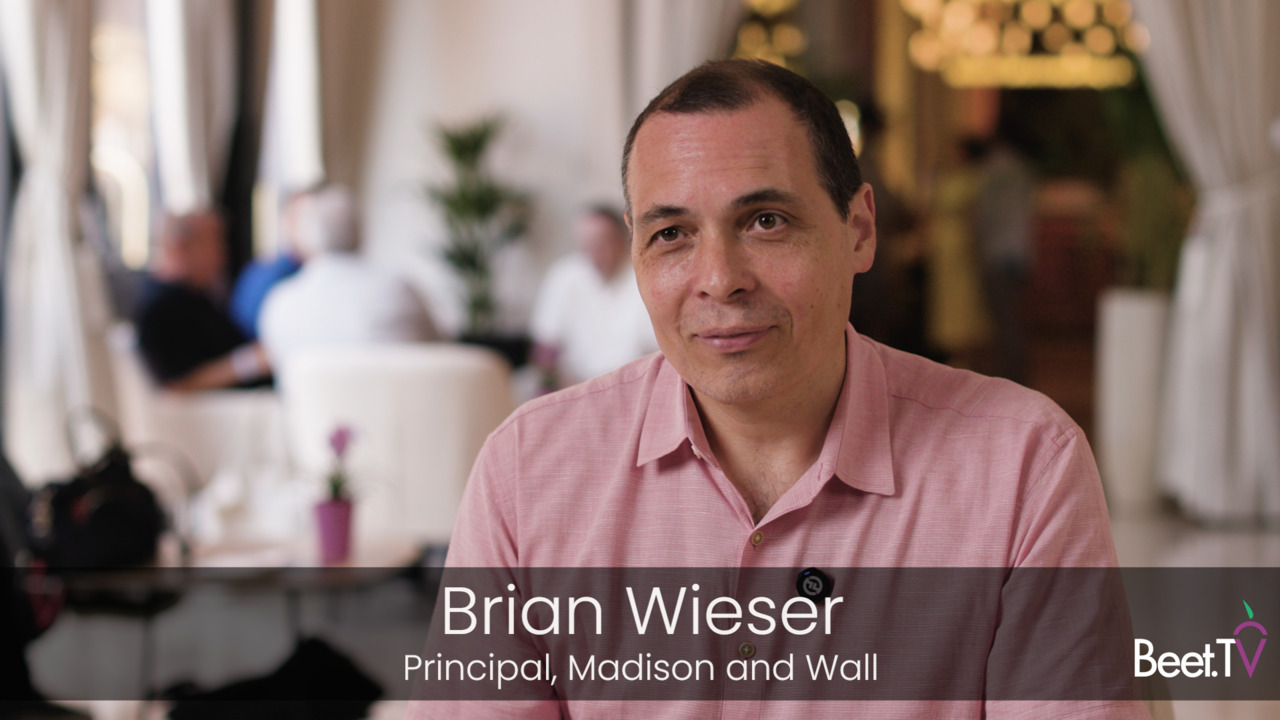
“This is way broader than just Google, Meta, and Amazon taking over the world,” said Brian Wieser, principal at Madison and Wall, in this video interview with Beet.TV at Cannes Lions. “It’s the global platforms… collectively, those are the players that are actually driving most of the growth for the industry.”

Short-term spending masks long-term concerns

Madison and Wall’s latest global advertising forecast projects 8% growth for the year, a figure that appears robust given persistent macroeconomic anxieties. The firm has now completed deep-dive analyses of 10 countries, with plans to expand to 50 by year’s end.

The resilience stems partly from a fundamental shift in how marketers allocate budgets. Rather than committing to long-term plans, advertisers increasingly tie spending to immediate consumer signals – a strategy that keeps dollars flowing as long as people keep buying.

“Advertisers are spending despite those problems, obviously, not because of them,” Wieser said. “Because advertisers are increasingly allocating resources on a very short-term basis, tying spend to the most immediate signals they have… as long as the economy continues to actually do okay, in aggregate, not everywhere, then there’s still a lot of growth.”

Deceleration is inevitable

The current double-digit growth rates, however, cannot persist. Wieser warned that the industry faces an unavoidable slowdown, regardless of whether broader economic fears materialize.

Social media and commerce media will continue posting aggressive numbers well into the teens globally. But the overall advertising market must eventually align with an economy growing at mid-single-digit levels, he said.

“I think that marketers are likely to decelerate their growth in spending because these levels are really not sustainable,” Wieser said. “Double-digit growth which we’ve seen in the first couple quarters of this year is just not a durable number… the overall advertising industry does have to decelerate, and that’s before we get to the real negative macroeconomic issues that go from being fears to reality.”

M&A signals platform integration push

Recent dealmaking reveals a broader strategic shift across the industry. The Roku-Fox News partnership, Walmart’s acquisition of streaming ad platform Vibe, and Publicis’s purchase of LiveRamp all point toward platforms seeking deeper integration across products and services.

This consolidation echoes the “set it and forget it” convenience that Google’s Performance Max and Meta’s Advantage Plus campaigns offer marketers. The common thread is end-to-end solutions that reduce friction for advertisers.

“What we’re seeing is a number of platforms trying to integrate way more deeply and cutting across a much broader array of products, solutions, and services,” Wieser said. “Not quite going back to the old day of the conglomerate, but much more of an end-to-end within a set of solutions is what we’re seeing.”

If You Have One Extra Dollar, Spend It on Creative, Says Kantar Americas CEO

CANNES. France — The marketing world loves to debate where the next dollar should go. Better data? Smarter media buying? More sophisticated measurement? For one industry leader, the answer is simple: invest in creative.

Up to 50% of marketing and media effectiveness stems from the content shown to customers, not the channels used to deliver it. It’s not all about data optimization and performance metrics, which have dominated marketing conversations in recent years.

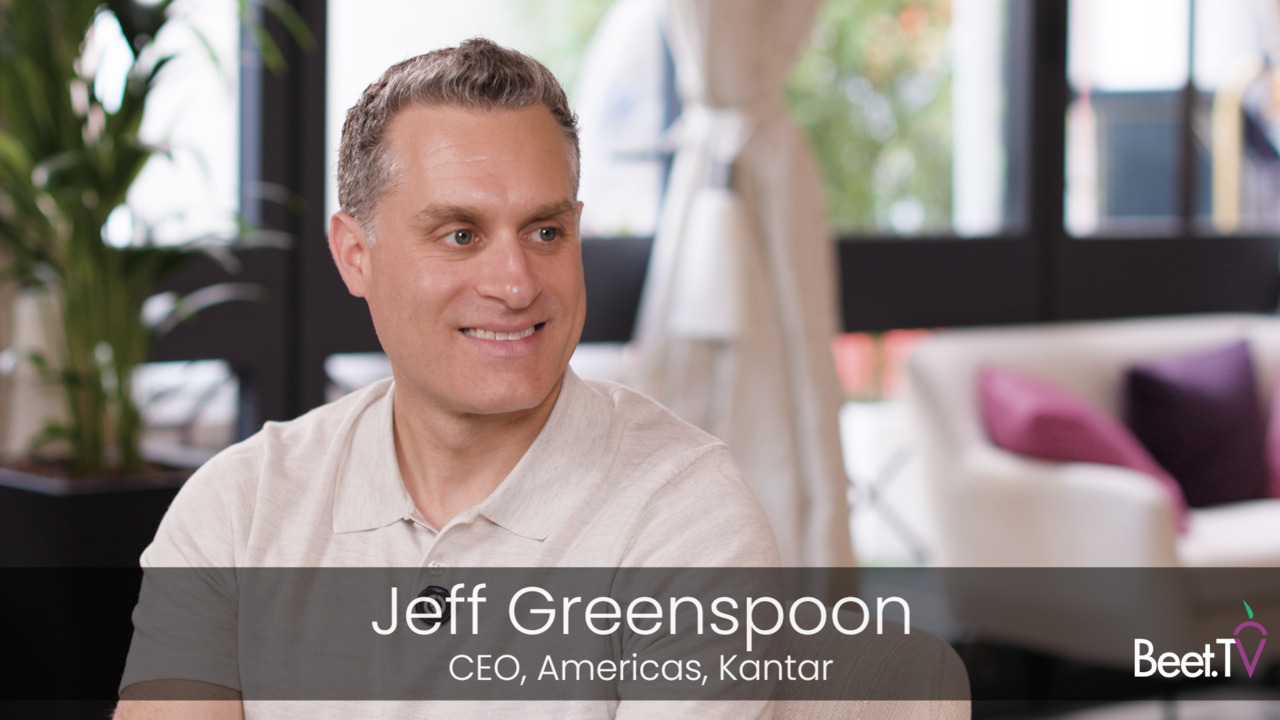
“If I had one extra dollar, I’d be putting it into creativity 10 out of 10 times,” said Jeff Greenspoon, CEO of Kantar Americas, in a video interview with Beet.TV at the Cannes Lions Festival of Creativity.

The measurement silo problem

Greenspoon, who joined Kantar a year ago after spending many years at advertising agencies, has observed a troubling pattern in how marketers approach measurement. While media fragmentation gets plenty of attention, measurement itself has splintered into disconnected silos.

“You’re measuring your brand over here and your creativity over here, your media impact over here, your experiences over here,” he said. “The best CMOs, the best marketers are looking at the signals that go across all of those different channels, going across all the different types of measurement that they do, and then starting to find both the correlations and the causations of the data so that they can make more informed decisions.”

The challenge, according to Greenspoon, lies not in collecting data but in connecting it. “Everyone has data. So, it’s (about) what do you do with it and how do you build decisions and strategies on top of that?” he said.

Meaningful, different, and salient

Kantar’s approach to breaking down these silos centers on its MDS framework, which measures whether brands are meaningful, different, and salient. The Marketing Accountability Standards Board recently certified this framework for its effectiveness in linking brand equity to financial performance.

Greenspoon explained the three components:

  • Meaning addresses whether a brand solves problems and resonates emotionally with customers
  • Difference captures whether a brand innovates and offers something competitors cannot match.
  • Salience measures whether customers think of a brand first when making purchase decisions.

“Difference really drives the ability to gain price performance and price share, earn more margin on your product,” Greenspoon said. The framework connects brand actions to brand value and ultimately to enterprise value, providing a through-line from creative decisions to stock price performance.

The case for brand investment

Kantar’s 2026 BrandZ report shows the top 100 most valuable brands grew approximately 504% over 21 years, compared to just 234% for average stock indices. The combined value of the BrandZ Global Top 100 has now reached a record $13.1 trillion.

Greenspoon argued that many brands have “over-rotated” toward performance marketing at the expense of building future demand. “If you don’t invest into the salience, you’re not going to have that predisposition later on,” he said.

The tension between brand building and performance marketing represents a false trade-off, according to Greenspoon. “It’s actually cheaper to get real performance results today if you’ve invested in the past to deliver those results,” he said. “And so they work together in a harmonious world.”

Sports Illustrated Heads to Hulu as Minute Media’s Rich Routman Seeks Expanded Playbook

CANNES, France – Plenty of media companies arrive at Cannes Lions talking about efficiency, scale and optimization. Rich Routman, president of Minute Media, showed up talking about Sports Illustrated covers, swimsuit models, World Cup soccer and why nobody wants coverage of Argentina’s national team written from a cubicle in Manhattan.

Speaking with Beet.TV contributor Tameka Kee at the Cannes Lions International Festival of Creativity, Routman described a strategy for Sports Illustrated that can be summed up as: keep the iconic parts, move them to wherever audiences happen to be hanging out this year.

Keeping old franchises young

For a publication that has been around long enough to remember when sports highlights arrived the next morning instead of the next six seconds, Sports Illustrated is focused on adapting its best-known franchises to new formats.

“It’s less about trying to sit in somebody else’s skin,” Routman said. “It’s more about taking those franchises to differentiating platforms.”

That means taking properties once associated with magazine pages and transforming them into experiences, digital products and entertainment programming. The famous cover, Faces in the Crowd and the Power List are still part of the formula. They’re just showing up in different places.

Routman called SI “a very resilient brand” and argued that its longevity comes from remaining focused on what made it successful in the first place while adjusting to changing consumer habits.

“If we just continue to focus on the things that we do really well, but adapt them to how people are consuming media now, I think that we have a business that’s going to be for a long time,” he said.

The swimsuit issue gets a streaming glow-up

Perhaps the most visible example is Sports Illustrated Swimsuit’s move to Hulu.

For decades, the franchise generated magazine covers, beach photos and annual debates among people who insisted they only bought the issue for the journalism. Now it is becoming television.

According to Routman, Hulu approached SI about turning the event into a streaming experience, giving viewers access to behind-the-scenes moments and content that previously existed only for attendees.

“Our team was like, not initially, there was not even a hesitation whatsoever,” Routman said. “This is gonna be awesome.”

The partnership expands the reach of the event while giving fans a closer look at the production. It also illustrates a broader reality in media: if something attracts attention, eventually a streaming service will ask whether it can become a show.

Why World Cup coverage starts outside the U.S.

Another ambitious project involved a 48-cover Sports Illustrated World Cup initiative.

Routman argued that authentic soccer coverage requires a perspective that many American publishers struggle to achieve.

“The best coverage in soccer is from international into the U.S.,” he said.

Rather than covering global soccer through an exclusively American lens, Sports Illustrated partnered with local creators in individual markets. The goal was to create content that resonated with both U.S. fans and supporters in countries where soccer functions as a national obsession rather than an occasional summer pastime.

“The flavor of the content that we were able to get from somebody who lives and breathes that team in that culture is far different than someone who’s doing it from a New York office,” Routman said.

It is a simple concept that sounds obvious until one remembers how often global sporting events are analyzed by people whose primary qualification is having recently discovered where Slovenia is located.

Advertisers want more than scale

Routman also suggested that publisher conversations with advertisers have evolved significantly.

Five years ago, he said, publishers spent much of their time discussing audience size and Comscore rankings. Today, those discussions focus more on audience interests, content franchises, talent and platforms.

“We don’t even talk about the size of our audience anymore,” he said.

Instead, Minute Media is concentrating on innovation, experimentation and launching new products. Some initiatives work, some do not, but Routman said standing still is not an option.

“The buy side also, it’s like, ‘Rich, I just saw you six months ago. What’s new? Do I really need to meet with you again?'”

It is perhaps the most Cannes answer imaginable. In an industry that treats novelty like an Olympic sport, showing up with the same PowerPoint twice may be the only truly unforgivable offense.

A brand fueled by ambition

Routman, who described Sports Illustrated as an aspirational brand throughout his career, said one of the publication’s greatest assets is the passion of the people working on it.

Many of the ideas now being developed have existed inside the organization for years, waiting for the right moment. The challenge, he said, is not generating concepts but deciding which ones to pursue first.

“The brand is very ambitious,” Routman said.

That ambition appears to be producing a steady stream of projects, from Hulu productions to global soccer coverage. For a media brand that has survived decades of industry upheaval, the strategy seems refreshingly straightforward: respect the legacy, experiment aggressively and never underestimate the power of a good franchise.

After all, if Sports Illustrated can turn a swimsuit issue into a streaming show and a World Cup into 48 covers, somebody is probably already pitching a reality series about the people arguing over next year’s cover selection.

Trusted Voices Win: CNBC’s Sullivan on Partnership and Why Premium News Still Matters

CANNES, France — At a festival overflowing with content creators, platform pitches, and AI hype, the case for old-fashioned journalistic credibility might seem like a hard sell. CNBC’s president doesn’t think so.

Speaking at the Cannes Lions Festival of Creativity, KC Sullivan argued that media fragmentation has paradoxically made trusted news brands more valuable to advertisers, not less. With audiences “flocking” to CNBC “at the moments that matter,” Sullivan said the network is posting its highest ratings in over five years – a data point that cuts against the broader narrative of linear news in decline.

“In a world where there’s more and more content, and content is commoditized, trusted content and trusted voices are really what separate,” said Sullivan, president of CNBC, in this video interview with Beet.TV at Cannes Lions.

Building through partnerships

Beyond the newsroom, Sullivan pointed to partnerships as a central pillar of CNBC’s growth strategy – a way to extend the network’s journalism into the physical and digital spaces where its audience already operates.

“Partnerships are a huge part of our growth strategy,” he said. “It allows us to get to audiences and put our content in the places that matter.

“One of the most important partnerships that we have is with the New York Stock Exchange. We do a number of hours of broadcasting from the floor of the New York Stock Exchange, which allows us to tell our story where the actual market is being made, which is incredibly important.

“But we also do a number of events from the New York Stock Exchange, and the New York Stock Exchange has been a great partner in helping us tell the stories that we’re trying to tell.

“We want to make sure that our best-in-class journalism is being exposed to as many folks as possible in the way that they want to consume it,” Sullivan said.

The access argument

Sullivan positioned CNBC’s core value proposition around two pillars: access and trust. The network’s ability to put brands alongside interviews with business leaders and policymakers, he argued, is something social platforms and creator content simply cannot replicate at the same level of credibility.

“It’s access to business leaders, politicians, the folks that matter to our audience,” Sullivan said. “Trusted content and trusted voices are really what separate.”

He was also careful to define what CNBC is not. The network, he said, makes a deliberate choice to anchor its editorial identity in business outcomes rather than partisan politics – a positioning that may resonate with advertisers increasingly wary of brand-safety risks on politically charged platforms. “It’s about policy, it’s about the win-loss of business. It’s not about politics, right or left,” he said.

Streaming Has Become a Social Network and Every Show Is an Event: Disney’s Dana McGraw

CANNES, France – Marketers have spent years trying to figure out how to keep consumers engaged. Disney Advertising’s Dana McGraw may have a simpler answer: give people something to obsess over together.

Speaking at the Cannes Lions International Festival of Creativity, McGraw, senior vice president of data and measurement science at Disney Advertising, said modern fandom has evolved far beyond simply watching a favorite show or team. Today it stretches across streaming, linear television, social platforms and enough post-game clips to keep Knicks fans busy until next season.

“Fandom is about connection,” McGraw said in this interview with Beet.TV contributor Tameka Kee. “We all want to belong somewhere, be connected to something.”

That desire to belong has become increasingly valuable for advertisers as audiences fragment across platforms. The good news for Disney is that its fans tend not to stop at a single obsession.

“If you have this propensity to be a fan and to be deeply engaged with us, you’re deeply engaged with us in a multitude of ways,” McGraw said.

For media planners, this is a pleasant way of saying that someone who watches ESPN might also stream Disney+, argue about Marvel movies online and spend an unhealthy amount of time discussing playoff basketball.

Sports still owns the moment

At a festival where artificial intelligence is often treated as the answer to every question, McGraw reminded attendees that live sports still possess a superpower algorithms cannot easily replicate.

“There is nothing like the power of live sports and live events,” she said.

The reason is attention. While viewers may treat many forms of content as background noise while scrolling through their phones, live events create a sense of urgency.

“The attention lasts longer. The connection is tighter,” McGraw said.

More importantly for advertisers, the value extends well beyond the final whistle. Fans relive highlights, share clips and continue conversations long after the event itself has ended.

“It’s the before, it’s the during, it’s the after,” McGraw said.

For brands, this creates something increasingly rare in modern media: a moment when audiences are not actively searching for the skip button.

The rise of eventized viewing

Disney’s latest Generation Stream research project is built around what the company calls “eventized viewing,” a concept that suggests viewers increasingly treat streaming content the way previous generations treated major television broadcasts.

People plan around shows. They gather with friends. They prepare food. They create rituals.

In other words, streaming has somehow reinvented appointment viewing after spending a decade convincing everyone appointment viewing was dead.

Fandom escapes the screen

McGraw said the company’s research across 11 markets found that audiences increasingly turn viewing into shared experiences, even when they’re physically alone.

“People see streaming now as kind of a social network,” she said.

That finding may delight streaming executives and mildly terrify social media companies.

According to McGraw, viewers often feel connected simply by knowing that thousands or millions of others are experiencing the same moment at the same time.

The phenomenon is expected to become even more pronounced as Disney heads into a packed calendar that includes the Super Bowl, College Football Playoff National Championship, Grammys, and Oscars.

For a company built around blockbuster events, it’s essentially Christmas every month.

Beyond impressions and into halos

If advertisers have one universal talent, it’s reducing complex human behavior into spreadsheets.

McGraw would like them to stop doing that.

Rather than measuring events through isolated impressions, Disney increasingly wants marketers to think about what she calls the “halo effect.”

“We want to think about everything as sort of, there’s a halo effect,” she said.

That means understanding not only what happened during a broadcast but how the surrounding content ecosystem influences brand outcomes.

“We want to think about it more for all of those events, and really, all of our content around them,” she said.

The approach reflects a broader shift in media measurement. As audiences move fluidly between television, streaming and social platforms, a single metric increasingly resembles a flashlight trying to illuminate a football stadium.

One audience, many screens

The convergence of linear television and streaming has been discussed at Cannes for so many years that it risks becoming a retirement hobby. McGraw argues the industry should stop treating the channels as separate entities altogether.

“You have to look at it holistically,” she said.

Success, she argued, depends on understanding unified audiences, incremental reach and the role each platform plays within a broader business objective.

“We have to think about unified audiences. We have to think about incrementality,” McGraw said.

It is a less glamorous message than declaring the death of television or the arrival of some revolutionary new platform.

But in Cannes, where every beach seems to be launching the future of media, the radical idea may simply be that consumers do not care which screen they’re watching.

They just want to feel connected while doing it.

Retail Media’s Next Test: Turning Siloed Data Into Shared Wins

Floor decals and shelf talkers don’t get much respect in the era of programmatic advertising. But they were retail media before anyone called it that – and understanding that lineage matters for grasping where the industry is headed next.

Retail media has traveled a long road from in-store signage to what are now, in some cases, barely distinguishable from full-scale media platforms. The networks built by Walmart and Target have grown sophisticated enough to compete for national brand budgets – but the sector still faces stubborn structural problems around measurement, identity, and data fragmentation that no amount of AI enthusiasm will paper over, according to one industry veteran.

“You’re seeing these retailers create truly transformative media networks with really, really sophisticated capabilities,” said Claire Wyatt, GM, BD and retail sector lead at The Trade Desk, in this video interview with Beet.TV. But she was equally candid about the gaps that remain.

From floor decals to full-stack platforms

Wyatt, who spent time at Albertsons earlier in her career, traced retail media’s origins back to physical stores – the branded end-caps, shelf talkers, and floor graphics that manufacturers paid for long before a pixel was ever served. The digital pivot came when e-commerce gave retailers a new inventory to monetize, and someone realized ad space on a product page was worth something.

She credited the team at Walmart’s Triad unit – the in-house group that managed supplier marketing programs – as “probably the pioneers of maybe what we would know of retail media today.” From that starting point, the category has ballooned. Global retail media ad spending is projected to reach $100 billion by 2027, up from an estimated $75 billion in 2025, according to eMarketer forecasts, as retailers increasingly package their first-party data alongside ad inventory.

Wyatt pointed to Walmart Connect and Target’s Roundel as benchmarks for what the category can become – networks that have built genuine media infrastructure, not just bolted an ad server onto a shopping site.

The measurement problem

For all the sector’s growth, Wyatt described measurement as a persistent frustration – one she has carried through most of her career. The core value proposition of retail media, she argued, is the retailer’s first-party data: both for audience targeting and for closing the loop between an ad impression and an actual purchase. The trouble is that the industry hasn’t agreed on what “closing the loop” actually means in practice.

“Despite the fact that retailers have access to all of this great data, there’s still such intense discussion in the industry about what do we do with that data and how does it actually drive outcomes,” she said. “Can we agree, and then can we agree across retailers if those outcomes are the same?”

The debate over incrementality versus return on ad spend cuts to the heart of it. Wyatt argued that basic ROAS figures, while useful as a rough business metric, don’t answer the more important question of whether advertising is actually moving the needle. “When you’re really thinking about is my media adding value, it needs to be an incremental ROAS number,” she said. Progress is being made, she acknowledged, but “not as fast as everybody would like.”

Garbage in, garbage out – even with AI

The question of what separates winning retail media networks from also-rans drew a pointed answer. Scale alone, Wyatt suggested, only gets the largest players so far – and for everyone else, a generic pitch about retailer brand equity isn’t enough.

“It’s not enough to say you should spend with me because I’m XYZ retailer,” she said. The networks pulling ahead are those that translate the actual differentiators of their retail business into their media product, creating coherent value on both sides.

On AI – which she noted was unavoidable at industry events, suggesting a “shot game” at conferences would leave attendees unable to walk out – Wyatt is pragmatic. “It’s very much garbage in, garbage out,” she said. “If you haven’t done the work to create a really solid data foundation, implementing any kind of AI efficiencies is going to be really, really hard.”

Posted in Uncategorized

Cannes Lions is Becoming a Festival of Culture, Creators & AI-Assisted Creativity: Festival Chairman Phil Thomas

CANNES, France – The Cannes Lions International Festival of Creativity has spent decades evolving from an advertising awards show into something closer to a temporary city-state for marketers, creators, platforms, consultants, athletes, musicians and anyone else with a budget for beachfront real estate.

According to Phil Thomas, executive chairman of event organizer Informa Festivals, the latest evolution is impossible to miss. Just look at the beaches. Thomas is chairman of the Festival. We spoke with him on Sunday on the eve of the week-long event.

From ad agencies to culture

“The most interesting” shift at this year’s festival, Thomas said, is how Cannes Lions increasingly reflects broader culture rather than just the advertising industry that created it.

“If you look at the history of the festival, it really began as an advertising festival,” Thomas said in this interview with Beet.TV contributor Pooja Midha. “The big installations were by the advertising agencies.”

That changed during the digital era, when technology platforms became the dominant presence on the Croisette. Now, another transition is underway.

“There’s the Sport Beach. There’s the Music Beach that Spotify put on. There’s a Creator’s Beach,” Thomas said. “This year, we’ve got twice as many creators, for instance, as we had last year.”

The result is a festival that increasingly mirrors the worlds brands are trying to reach.

“We’ve always wanted to try to have an event that did reflect culture,” Thomas said. “And I think the brands that are here and the partners that are here also want to get into culture.”

Thousands of marketers descend on Cannes

The festival continues to grow despite economic uncertainty, political tensions and persistent questions about whether anyone really needs another panel discussion featuring the phrase “future of marketing.”

Attendance this year is running at roughly 13,000 badge holders, according to Thomas, with thousands more unofficial attendees circulating between yachts, beach clubs and coffee meetings that somehow become acquisition talks.

One of the fastest-growing groups is brand marketers.

“There are thousands of CMOs here, thousands,” Thomas said.

Their objective is relatively straightforward. They’re looking for partners, technologies and ideas that can help drive business growth while also giving them ammunition for conversations with skeptical boards and finance departments.

“They’re trying to find partners who can help them grow their businesses,” Thomas said. “And they’re trying to find partners who they can use to persuade their boards to invest in marketing and creativity.”

The network effect of everyone showing up

Thomas attributes much of the festival’s continued expansion to a simple principle familiar to every social network, nightclub and high school cafeteria.

“If people feel everybody’s here, then everybody wants to be here,” he said.

The festival has worked to stay relevant by continuously adapting to industry priorities. This year that includes expanded forums for senior executives, including the return of the CEO Forum and the debut of the Global CMO Forum, both designed to connect creativity more directly with boardroom discussions around growth and capital allocation.

The event’s owner, Informa, has also contributed resources and expertise since acquiring Cannes Lions.

“It doesn’t really affect the festival other than in positive ways,” Thomas said. While Cannes Lions continues to operate independently, he said Informa’s global event management capabilities have strengthened operations and partnerships behind the scenes.

Humans still want to gather in person

For all the industry’s obsession with AI, automation and virtual experiences, Thomas believes recent years have reinforced a much older truth.

“I think the pandemic taught us something, and I think AI is teaching us the same lesson,” he said.

“Deep down after many millennia of development, the human beings are social animals.”

That desire for community helps explain why large-scale business events continue to thrive.

“People want to be together,” Thomas said. “People want to be with their own tribe.”

In other words, even in an era when an AI agent can summarize a keynote in seconds, many executives still prefer to discuss it over rosé while trying to remember where their next meeting is.

New award spotlights creative cultures

Among this year’s additions is the inaugural Creative Brand Lions award, which recognizes organizations that build systems and cultures capable of consistently producing outstanding creative work.

Rather than evaluating a single campaign, the award asks brands to demonstrate how creativity is embedded into their operations.

“What you’re trying to do is persuade the jury that you have created an environment, a culture, that allows creativity to flourish,” Thomas said.

The category arrives as brands play a larger role throughout Cannes Lions. According to festival data, 10% of all award submissions this year came directly from brands, up from 8% in 2025. Roughly 400 brands are participating across the festival.

The new award also reflects a broader industry question: Once executives accept that creativity can drive growth, how do they actually build organizations capable of delivering it repeatedly?

AI moves from experiment to creative partner

No Cannes Lions conversation would be complete without AI, and the festival’s awards data suggests the technology is rapidly becoming part of the creative process.

Two years ago, only 11% of award submissions reported using AI in some capacity. That figure climbed to 20% last year and has now reached 40%.

“That doesn’t mean the work was created by AI,” Thomas said. “But what it does mean is AI was a partner to the creative people, to make the thing happen.”

This year’s festival introduced AI Craft subcategories across several awards programs, recognizing work in which human creativity and artificial intelligence combine to produce results neither could achieve independently.

The emphasis remains on creative intent and craftsmanship rather than technology for its own sake.

Meanwhile, more than 300 jurors from around the world have gathered in Cannes to evaluate 20,050 award submissions from 92 countries. Festival organizers also implemented new Awards Integrity Standards designed to strengthen judging credibility and submission quality.

For a gathering founded around advertising, Cannes Lions now finds itself judging not only campaigns but cultures, communities and increasingly the relationship between humans and machines.

The beaches, it seems, are evolving right alongside the industry.

Editors’s Note:  This video was produced in partnershp with the New Y0rk Stock Exchange Live.

Posted in Uncategorized

CTV’s Future Is Shopping, Scale and a Little AI Magic: Vizio’s Adam Bergman

The biggest screen in the house has dominated advertising for generations. Now Vizio wants to turn that screen into something more: a storefront, a data platform and a gateway to measurable outcomes.

That is the vision Adam Bergman, group vice president of advertising and data sales at the consumer electronics company, is pursuing as the smart TV maker deepens its ties with Walmart and pushes further into connected TV advertising.

Speaking with Beet.TV contributor David Kaplan, Bergman said scale remains the starting point for any platform hoping to compete for major ad budgets.

“To win budgets at scale, you have to have scale,” Bergman said.

Vizio asserts it is well positioned to deliver that scale. Bergman noted that the company benefits from Walmart’s television sales strength and from deploying its operating system on Walmart’s Onn televisions. As a result, Vizio currently reaches between 20% and 30% of U.S. households and expects further growth as its footprint expands.

The company’s goal is ambitious. Bergman said Vizio is on pace to become the nation’s top-selling television operating system by early 2027.

Premium means whatever advertisers want it to mean

The advertising industry loves the word “premium” almost as much as it loves inventing new definitions for it.

Bergman acknowledged that premium inventory means different things to different marketers.

“Premium supply, to me is in the eye of the beholder,” he said.

Some advertisers focus on content quality and brand-safe environments. Others care more about reaching highly specific audiences based on viewing habits or purchase behavior.

Vizio can play both sides of that equation. Bergman pointed to WatchFree+, the company’s free streaming service, which he said is the most-used free ad-supported app on the platform and the third most-used app overall. At the same time, Vizio’s data capabilities allow marketers to target viewers based on a wide range of behavioral signals.

In other words, one advertiser wants prestige television. Another wants dog owners who buy organic treats and watch home renovation shows. Vizio would like to help both.

Outcomes era has arrived, but apparently it arrived years ago

Advertisers today talk constantly about outcomes. Reach is nice. Impressions are nice. Click-through rates look great in PowerPoint decks. But eventually someone in the room asks whether any products actually sold.

Bergman’s response is that Vizio has been operating in an outcomes-driven world for years.

“We’ve been living the outcomes era for quite some time,” he said.

A major reason is Inscape, Vizio’s television viewership data business. The platform has become an important source of measurement data across traditional and streaming television.

The company’s focus on outcomes extends across categories. Entertainment companies want subscribers and viewers. Movie studios want ticket sales. Retailers want purchases. Auto companies want shoppers to visit dealerships.

One recent example is a partnership with Fandango that helps movie studios connect streaming ad exposure with actual ticket purchases.

“We’re helping movie studios validate the connectivity of streaming ads, streaming placements to ticket purchases,” Bergman said.

That focus has evolved alongside the streaming marketplace. A few years ago advertisers wanted to understand how streaming added incremental reach beyond linear television. Today the challenge is understanding incremental reach across an increasingly crowded universe of premium streaming services.

Television wants to become a shopping mall

The television industry has spent decades training viewers to sit still. Now it wants them to shop.

Bergman said Vizio has long viewed television as a shopping experience, although historically consumers were shopping for content rather than products.

“We have always thought of the television screen as a shopping experience,” he said.

The Walmart relationship creates an opportunity to extend that concept into retail media. Instead of helping viewers find a movie or streaming subscription, television could eventually help drive purchases of products sitting on Walmart shelves.

Vizio is already experimenting with QR codes and exploring ways to connect television exposure with mobile commerce.

“What does add to cart look like?” Bergman asked.

That question increasingly sits at the center of the retail media industry’s ambitions. The dream is straightforward: inspire consumers on the television screen, guide them to their smartphones and ultimately send them to checkout before they become distracted by cat videos.

AI’s job is to help you find something worth watching

No advertising interview in 2026 would be complete without mentioning artificial intelligence. Fortunately, Bergman appears determined to keep at least some of the discussion grounded in reality.

On the consumer side, Vizio is focused on using AI to improve content discovery through natural-language interactions.

“How do we really think about natural language?” Bergman said while describing future voice-driven search capabilities.

The goal is simple. Instead of forcing viewers to navigate endless menus, AI could help them find a movie, show or actor more quickly.

“Our job is to get you to a great piece of content as quickly as possible,” he said.

Behind the scenes, Vizio is also using AI tools to help build audiences, accelerate reporting and enhance its Inscape measurement business.

The next frontier may be creative optimization. Bergman said the company is exploring how AI can help improve ad messaging and creative versioning, particularly on the smart TV home screen.

Business result still matters

For all the excitement surrounding AI, retail media and streaming innovation, Bergman ultimately returns to a surprisingly old-fashioned idea.

Advertising should help businesses achieve business goals.

“We want to ensure that your media is pushing towards a business goal,” he said.

That may sound obvious. Yet Bergman suggested the industry sometimes becomes overly focused on media metrics while losing sight of what advertisers actually want.

“Products wanna move off the shelf, cars have to come off the lot,” he said. “We wanna drive customers into a restaurant.”

In an industry increasingly crowded with dashboards, attribution models and acronyms that require their own glossary, that may be the simplest outcome of all.

Posted in Uncategorized

Hispanic Audiences Are Too Big to Ignore and Too Often Missed: TelevisaUnivision’s Cara Lewis

Marketers spend endless hours debating audience targeting, measurement and attribution. According to Cara Lewis, evp and U.S. head of agency at TelevisaUnivision, many of them may be missing half the room while doing it.

Speaking with Beet.TV contributor David Kaplan, Lewis argued that many third-party measurement providers significantly undercount Hispanic audiences, creating a blind spot that becomes harder to justify as the economic influence of Hispanic consumers continues to grow.

“Most of the measurement companies today, third-party companies are missing our audience by 50%,” Lewis said.

That isn’t a rounding error. It is the statistical equivalent of inviting 100 people to a party and only noticing 50 of them showed up.

Lewis said TelevisaUnivision is working to close that gap through first-party data and culturally relevant programming designed specifically for Hispanic audiences.

“We’re making sure that they understand the relevancy and the attention that we can drive for Hispanics because we understand them,” she said.

Sports aren’t just one night

While advertisers often fixate on tentpole events, Lewis wants brands to think bigger than a single championship game.

The company is preparing for the Spanish-language broadcast of the Super Bowl in 2027 while expanding relationships with Major League Baseball and Formula One. Those additions build on TelevisaUnivision’s longstanding strength in soccer.

“Sports are not just one night, it’s 52 weeks a year,” Lewis said.

That message arrives as media companies race to secure live sports rights that remain one of the few reliable ways to attract large audiences that actually watch commercials in real time rather than three days later while folding laundry.

Lewis said Hispanic viewers often seek out TelevisaUnivision first because of the trust the company has built through years of sports coverage.

“They trust us, so they come to us for that reach and relevance,” she said.

Building a Hispanic household map

If data is the favorite buzzword of advertising conferences, Lewis came armed with a new entry.

TelevisaUnivision has developed what it describes as the only U.S. Hispanic household graph, combining first-party signals and outside datasets to improve audience identification across Spanish-speaking and bilingual households.

The goal is to solve what Lewis sees as a persistent industry problem.

“We took signals and third-party data sets and built the only U.S. household Hispanic graph,” she said.

Lewis argued that combining the company’s identity graph with other data assets allows advertisers to reach Hispanic consumers more accurately than conventional targeting methods.

In an industry where every vendor claims to know exactly who is watching, buying and thinking about buying, Lewis’ pitch is that her company actually knows where Hispanic audiences live, watch and engage.

More than a translated commercial

One of the interview’s sharper observations centered on creative strategy.

Many brands, Lewis said, still treat Hispanic marketing as a translation exercise rather than a cultural one.

TelevisaUnivision’s Así Studios unit works with advertisers to adapt campaigns or create entirely new creative designed specifically for Hispanic audiences.

“We can basically take their English language creative and make it authentic, or we can create something that is authentic,” Lewis said.

The distinction matters because consumers generally know the difference between a campaign designed for them and one that was fed through a translation app five minutes before launch.

Lewis said the studio’s team understands the culture because its members live it every day.

“They live and breathe that brand,” she said of the team’s connection to Hispanic audiences.

A $4 trillion audience

Underlying Lewis’ argument is a simple economic reality.

She pointed to estimates that Hispanic consumers represent roughly $4 trillion in economic output, a figure she noted would rank among the world’s largest economies.

“They just moved up above Japan in terms of being the fourth globally recognized GDP,” Lewis said.

For advertisers, the takeaway is less about multicultural marketing as a niche category and more about recognizing a massive consumer segment that increasingly shapes mainstream culture, sports consumption and spending patterns.

Or, as Lewis effectively suggested, if brands want to reach Hispanic audiences authentically, relying on generic targeting and translated creative may be like trying to win a soccer match while staring at the wrong goal.

The audience is already there. The challenge is finally seeing it.

Posted in Uncategorized