

CTV’s Fragmentation Problem Demands Industry Consistency: IAS’ Mathewson
CANNES, France — Connected TV was supposed to be the promised land for advertisers – the precision of digital married to the reach of television. Instead, it delivered a sprawling patchwork of publishers, apps, and devices, each speaking a slightly different measurement dialect.
The fragmentation plaguing CTV transparency is “a major challenge for our industry,” according to Mike Mathewson, vp of product marketing at IAS, who argues that the medium’s maturation now demands the kind of signal consistency that linear TV long took for granted.
With CTV ad spending in the United States projected to reach $38.83 billion in 2026, up from $21.16 billion in 2023 according to eMarketer, the stakes for getting measurement right have never been higher. “Now it’s time to really bring that transparency and, more importantly, consistency to how those signals are getting delivered,” Mathewson said in this video interview with Beet.TV at Cannes Lions 2026.
Going direct to cut the noise
The vehicle for Mathewson’s ambition is IAS Total TV, a suite of CTV solutions the company launched in April 2026, designed to give marketers aggregated data on show, genre, and rating transparency across major streaming platforms – all consolidated within the IAS Signal interface.
The architecture of Total TV is, by Mathewson’s account, deliberately upstream. Rather than intercepting signals mid-chain, IAS has structured the product around direct partnerships with major broadcasters and streaming platforms.
“We are working directly with these major broadcasters and apps – we’re talking about the Amazon Prime Videos, the Disneys, the Paramount Globals – and we’re working directly with them in partnership, which is unique to the way that some others in the industry are operating,” Mathewson said.
That proximity, he said, is what separates signal quality from signal noise: “It gives us a closeness to the inventory, so that way we are able to get access to that signal with higher fidelity and removing any of the unnecessary hops in the programmatic supply chain.”
By anchoring at the publisher level, IAS is betting that cleaner inputs will produce more actionable outputs for advertisers trying to understand where their money is actually going across an increasingly complex CTV landscape.
AI as the scale engine
AI-driven content classification has become a competitive differentiator among verification and measurement vendors, with the technology enabling real-time analysis of video content at a scale no human review team could match. Mathewson and IAS are involved in that.
“Media is getting generated at a faster clip than ever in the history of humanity,” Mathewson said, “and the way that we have purpose-built our technologies to be able to analyze and classify that media at that growing pace” is central to IAS’s approach.
“It’s really about how are we leveraging AI to be able to not only capture that signal, but also interpret it and understand it in a way that we can make it more actionable and provide marketers more easy-to-glean insights to be able to make better decisions.”
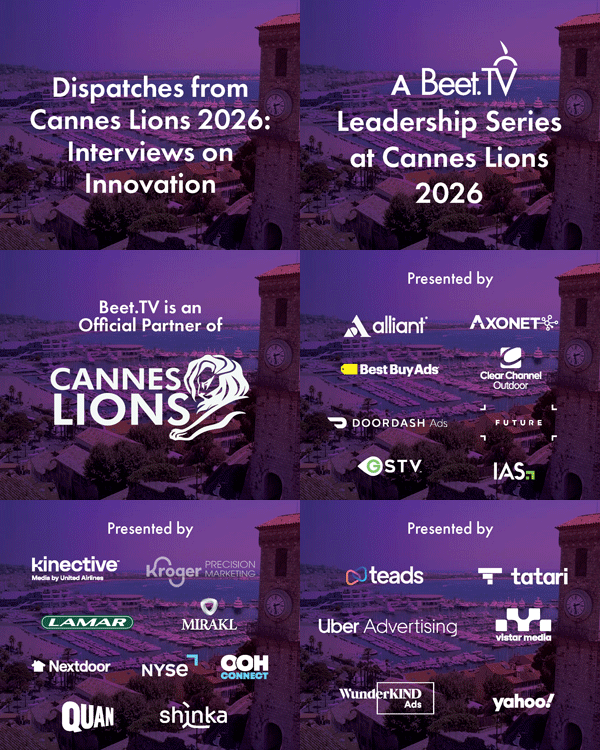
You’re watching “Dispatches from Cannes Lions 2026: Interviews on Innovation”, a Beet.TV Leadership Series at Cannes Lions 2026, presented by Alliant, Axonet, Clear Channel, DoorDash Ads, Future, GSTV, IAS, Kroger Precision Marketing, Lamar, Mirakl, Nextdoor, OOH Connect, Quan, Shinka, Teads, Tatari, Uber Advertising, Vistar Media, WunderKIND Ads, and Yahoo. For more videos from this series, visit this page. You can find all of our coverage from Cannes Lions 2026 here.
CANNES, France — Connected TV was supposed to be the promised land for advertisers – the precision of digital married to the reach of television. Instead, it delivered a sprawling patchwork of publishers, apps, and devices, each speaking a slightly different measurement dialect.
The fragmentation plaguing CTV transparency is “a major challenge for our industry,” according to Mike Mathewson, vp of product marketing at IAS, who argues that the medium’s maturation now demands the kind of signal consistency that linear TV long took for granted.
With CTV ad spending in the United States projected to reach $38.83 billion in 2026, up from $21.16 billion in 2023 according to eMarketer, the stakes for getting measurement right have never been higher. “Now it’s time to really bring that transparency and, more importantly, consistency to how those signals are getting delivered,” Mathewson said in this video interview with Beet.TV at Cannes Lions 2026.
Going direct to cut the noise
The vehicle for Mathewson’s ambition is IAS Total TV, a suite of CTV solutions the company launched in April 2026, designed to give marketers aggregated data on show, genre, and rating transparency across major streaming platforms – all consolidated within the IAS Signal interface.
The architecture of Total TV is, by Mathewson’s account, deliberately upstream. Rather than intercepting signals mid-chain, IAS has structured the product around direct partnerships with major broadcasters and streaming platforms.
“We are working directly with these major broadcasters and apps – we’re talking about the Amazon Prime Videos, the Disneys, the Paramount Globals – and we’re working directly with them in partnership, which is unique to the way that some others in the industry are operating,” Mathewson said.
That proximity, he said, is what separates signal quality from signal noise: “It gives us a closeness to the inventory, so that way we are able to get access to that signal with higher fidelity and removing any of the unnecessary hops in the programmatic supply chain.”
By anchoring at the publisher level, IAS is betting that cleaner inputs will produce more actionable outputs for advertisers trying to understand where their money is actually going across an increasingly complex CTV landscape.
AI as the scale engine
AI-driven content classification has become a competitive differentiator among verification and measurement vendors, with the technology enabling real-time analysis of video content at a scale no human review team could match. Mathewson and IAS are involved in that.
“Media is getting generated at a faster clip than ever in the history of humanity,” Mathewson said, “and the way that we have purpose-built our technologies to be able to analyze and classify that media at that growing pace” is central to IAS’s approach.
“It’s really about how are we leveraging AI to be able to not only capture that signal, but also interpret it and understand it in a way that we can make it more actionable and provide marketers more easy-to-glean insights to be able to make better decisions.”
You’re watching “Dispatches from Cannes Lions 2026: Interviews on Innovation”, a Beet.TV Leadership Series at Cannes Lions 2026, presented by Alliant, Axonet, Clear Channel, DoorDash Ads, Future, GSTV, IAS, Kroger Precision Marketing, Lamar, Mirakl, Nextdoor, OOH Connect, Quan, Shinka, Teads, Tatari, Uber Advertising, Vistar Media, WunderKIND Ads, and Yahoo. For more videos from this series, visit this page. You can find all of our coverage from Cannes Lions 2026 here.

Series Videos