Why the Next Big Video Opportunity May Be Hiding in Plain Sight

AMENIA, NY – The display advertising ecosystem is massive, mature, and moves a lot of money. It also has a problem: most of what fills it doesn’t move.

That gap between display’s scale and video’s impact is where one ad-tech company sees its opening. Its pitch: deliver HD-quality video that loads instantly within standard display placements, then measure it on attention rather than just impressions or completion rates.

“The display ecosystem, it’s established, it’s robust, and it’s scalable. And it sells. It sells hard,” said John Osborn, president, US, SeenThis, in this video interview with Beet.TV. “The problem historically with the display environment is that it’s primarily littered with lots of static ads.”

Display’s latency problem

Osborn argued that video has always been available in display, but technical limitations have undermined its effectiveness. Heavy files and slow connections mean that, if a video ad does not begin playing within two or three seconds, the user has already moved on.

“If it’s not loading in the first two, three seconds, you’re getting that white box that scrolls through your phone,” Osborn said. “We scratch that itch in a way because SeenThis is the only technology that unlocks the power of HD-level, the highest-quality possible video that instantly loads.”

That claim is being tested against a backdrop of surging digital video investment. According to the IAB’s 2026 Digital Video Ad Spend & Strategy Report, U.S. digital video ad spending is projected to reach $81.9 billion this year, up 11% year over year and growing nearly 20% faster than the overall ad market. Social video, CTV and online video are all expanding, but buyers are increasingly asking whether each environment can prove attention, outcomes and quality.

Attention as the new currency

Osborn said SeenThis has moved away from metrics like impressions and viewability in favor of attention. The company has partnered with Lumen Research to measure attentive seconds, and in June 2026 launched SeenThis Attention, a guaranteed-attention product that supports buying models including attentive CPM and cost per attentive second.

“If you look at the historical ways of measuring things, I mean, even going back to the impression, an impression doesn’t necessarily deliver an impression on the viewer, especially if someone’s not seeing it,” Osborn said. “Through a great partnership that we have with Lumen, we are now tracking and we’re measuring attentive seconds and attention as a metric that it seems everybody more and more is caring a lot about.”

He claimed that when SeenThis first integrated Lumen’s tracking, the results were so far above benchmarks that Lumen had to recalibrate its scale. “The ads that we were delivering, the HD-level streaming ad units in the world of display, it broke the meter,” Osborn said. “They had to develop a new scale because the multiples of attention that we were delivering against the backdrop of slow-loading and static ads, it just popped.”

Cutting through fragmentation

The open web remains a fragmented environment, with inconsistent specs, custom scripts and non-standard implementations making premium video harder to activate at scale. In August 2026, SeenThis and Madington released High-impact.js, an open-source framework intended to replace vendor-specific workarounds with a shared standard.

Osborn acknowledged that noise and complexity are the biggest bottlenecks. “I think the biggest issue is the noise, but the biggest opportunity for us is to cut through the noise with a product that people literally see,” he said. “And if you’re not seeing, you’re not getting anywhere.”

He positioned SeenThis video as a complement to, not a replacement for, CTV and social video. “The conversations we’re having, this is not an either/or,” Osborn said. “We’re not trying to put CTV out of business or Meta, Google, or anyone else. They have really important roles that they play.”

Chasing scale without chasing waste

Osborn said the opportunity is to establish SeenThis video as a distinct channel for brands that feel overexposed to YouTube or CTV and want incremental reach with measurable attention. He cited retail clients as examples of advertisers seeing results that move “all the way through to sales.”

“I hear all the time, we’re way over-indexed, we’re overspent in YouTube, we’re overspent in CTV,” Osborn said. “I wish there was something in the open-web world where we could deliver at multiples of four or five times, not only impressions, but attention metrics that tend to move the needle.”

Whether the open web can absorb more video budgets will depend on whether the industry can standardize attention measurement and reduce operational friction. The IAB, MRC and CIMM released a cross-industry attention measurement framework in 2025, raising the bar for transparency and comparability.

For vendors like SeenThis, that validates the attention-based sales story but also invites more scrutiny.
Posted in Uncategorized

Brands Must Earn Their Place in Sports Fandom: Vistar Media’s Lucy Markowitz

CANNES, France – Global sporting events offer brands a chance to reach massive audiences, but getting noticed can feel like trying to hail a taxi outside the stadium after the World Cup final.

Lucy Markowitz, senior vice president and general manager of the Americas at Vistar Media, said marketers need to plan early, secure inventory and develop creative that can survive an advertising stampede.

“So, global sporting events are a whole different ballgame, both literally and figuratively,” Markowitz said in an interview with Beet.TV contributor David Kaplan at the Cannes Lions International Festival of Creativity.

Book early or watch from the cheap seats

The World Cup lets advertisers reach people attending matches and the much larger audience watching around the globe. Naturally, just about every brand with a marketing budget has noticed.

That competition makes media scarcer and raises the creative stakes. Markowitz urged brands to consider what they stand for, how boldly they can communicate it and whether their campaigns will resonate amid the commercial commotion.

Brands also should reserve valuable inventory instead of assuming they can appear at the last minute. Hope isn’t a media-buying strategy, particularly when everyone else already has a purchase order.

Fandom cannot be bought by the yard

Kaplan asked how brands can earn a place within sports fandom instead of merely purchasing exposure.

Markowitz pointed to the passion surrounding major events such as the World Cup and the celebration that followed the New York Knicks’ recent championship. Fans want brands to contribute to those moments, not paste a corporate badge onto them like an unwanted bumper sticker.

“You are dealing with extremely passionate fans that are not just looking for you to be a logo that is showing up, but actually to engage and enhance an experience,” Markowitz said.

Brands can build that connection through live experiences, social campaigns, interactive displays and out-of-home activations. The goal is to become part of the occasion without behaving like the person who arrives at a tailgate empty-handed and eats everyone else’s food.

Out-of-home joins the starting lineup

Out-of-home advertising has long been embedded in professional sports. Stadiums are covered with scoreboards, signs and branding from beverage companies and other sponsors.

Digitization is expanding that role. Marketers can now reach fans before, during and after games with messages that change alongside the action.

“The digitization of out-of-home is not only making sure that the advertising that is being shown is more relevant, but it allows for you to be nimble,” Markowitz said.

Digital displays can feature countdowns, live scores and other timely information. Some screens even stream games in stadiums and on city streets, turning public spaces into communal viewing rooms with fewer remote-control disputes.

Out-of-home also gives brands room to feature players, humor and fans themselves. That helps campaigns tell a broader story instead of repeating the same static message until the final whistle.

Celebrity reach needs a reason

Athletes, celebrities and creators can deliver attention quickly, but Markowitz warned that visibility alone does not make an endorsement credible.

“I think it is easy to buy reach, but in order for it to be effective, you really need to think about how including perhaps a celebrity or an influencer into that campaign is going to feel,” she said.

The best partnerships have an authentic connection. The athlete or creator may already use the product, follow the sport or share interests that fit the brand. Without that connection, the endorsement can look like someone wandered onto the set, spotted the catering table and agreed to hold a soda.

“It doesn’t just feel like a product placement, it actually feels like they were meant to be there,” Markowitz said.

Real stories beat advertising inventions

Kaplan also asked which sports sponsorships resonate and which fall flat.

Markowitz said storytelling has become increasingly important as documentaries and other programming give audiences a closer look at athletes’ routines, personalities and product choices. Campaigns are more convincing when they draw from those real-life details instead of manufacturing devotion for the sake of an ad.

Community involvement can deepen that connection. Giveaways, sweepstakes and support for a beloved team or athlete give audiences a reason to pay attention. They also may persuade consumers to try a product that was not previously on their shopping lists.

For brands, the message is straightforward: Sports fans welcome advertisers that improve the experience, tell believable stories and understand the community. A logo occupying prime real estate is still just a logo, even when it has excellent seats.

Kroger, TikTok Tap Creators to Battle Shopper Forgetfulness

CANNES, France — The gap between product discovery and purchase represents billions in lost sales for consumer brands. Creators spark interest, but interest fades fast without reinforcement.

That problems is the focus of a new collaboration between Kroger Precision Marketing and TikTok, which aims to bridge the chasm between scrolling and shopping by pairing creator content with grocery purchase data.

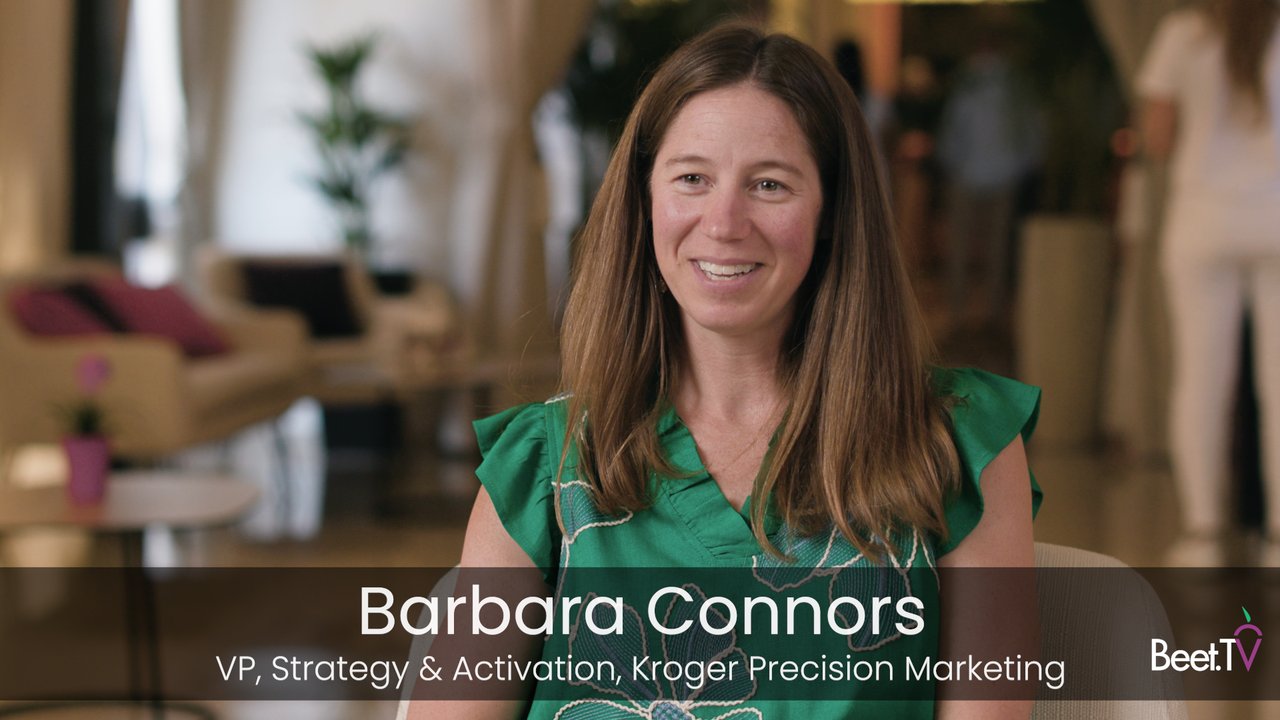
“There is a real opportunity here where brands are missing sales if they don’t drive frequency of messaging and really carry that message through,” said Barbara Connors, vp, strategy and activation, Kroger Precision Marketing, in this video interview with Beet.TV at Cannes Lions 2026.

The discovery-to-purchase problem

Kroger’s internal research paints a picture of both opportunity and leakage. According to Connors:

  • Two-thirds of Kroger shoppers reported purchasing a product they discovered on social media within the past six months.
  • Nearly half said those discoveries have become part of their regular shopping routine.
  • But roughly one-third of shoppers forget the products they encounter on social platforms before ever reaching a store or checkout.

That forgetfulness translates directly into missed revenue for CPG brands investing heavily in creator partnerships.

“Not only that, nearly half of them tell us that a product that they’ve discovered on social media has now become part of their shopping routine,” Connors said. “This is really the power of influencer and creator content. It is the ability to not only drive consideration, but also purchase and even shape long-term behavior change.”

Creator content meets purchase signals

The collaboration announced in June enables brands to activate Kroger’s purchase-based audiences directly within TikTok’s self-serve advertising platform. The integration allows marketers to boost creator-led content with targeting informed by actual grocery transactions rather than inferred interests.

Kroger households that engage with social content spend twice as much in-store as the average shopper, according to KPM’s announcement. That spending differential underscores why connecting social discovery to retail activation matters.

“By enabling our audiences into TikTok’s self-serve advertising platform, we are reducing both friction and complexity in the media buying process,” Connors said. “It’s really important for brands to be able to amplify the messages created by those creators directly with relevant, quality audiences.”

A shifting media landscape

IAB projects U.S. creator ad spend will reach $44 billion in 2026, up from $37 billion in 2025. Meanwhile, Emarketer forecasts that spending on amplified creator content will match creator sponsorship revenues by 2027, then surpass them the following year.

Brands increasingly view creator content not as standalone sponsorship but as raw material for paid media campaigns. Retail media networks like Kroger Precision Marketing are positioning themselves as the connective tissue between inspiration and transaction.

“From nano influencers to celebrities, creators are really reshaping product discovery,” Connors said. “And if we really break that down, it is because of the trust and authenticity that they have with consumers.”

Closing the loop

Kroger has expanded its offsite media capabilities beyond TikTok. Recent additions include self-service activation through Google’s Display & Video 360, YouTube inventory, Snapchat Sponsored Snaps, and Meta Threads. The expansion suggests retail media networks are competing not just on data quality but on platform reach.

For Connors, the formula comes down to pairing the right audiences with content that resonates. Retail signals identify who to reach; creator authenticity determines whether they listen.

“Brands now have the ability to not just reach the right audiences, but to reach the right audiences with content that really resonates,” Connors said.

Posted in Uncategorized

Amazon’s Julie Haleluk: Live Commerce Is Still in Its Infancy. Brands Should Move Now Anyway

CANNES, France — Live commerce’s mix of real-time streaming video viewing and online shopping hasn’t quite reached mainstream adoption in the U.S. But that early-stage status is precisely what makes it strategically valuable for brands willing to move before the format becomes crowded.

“Live shopping on Amazon is a very interesting creative advertising format. It is social shopping, meets shoppable carousel, meets an always-on content engine,” Julie Haleluk, global head of growth for Amazon Shopping Video, told Beet.TV contributor David Kaplan at Cannes Lions. “It functions as an incredibly performant asset that drives campaign performance overall. It’s an amplifier.”

The numbers behind that amplification effect are striking. Haleluk noted that while over 50% of product discovery happens on social media, 94% of influencer-inspired purchases ultimately happen on Amazon. Live commerce is uniquely positioned to bridge, she contended.

Social starts the journey

Rather than treating social marketing and live commerce as separate campaign elements, brands finding the most success think about them as complementary parts of a single storytelling arc.

“There’s this opportunity to see how they complement each other and build that storytelling. It may start on social or in a standard media ad, but once the customer lands to see that Amazon Live content, they are now engaged. They are now super high-intent,” Haleluk said.

When brands combine standard campaign assets with Amazon Live, the halo effect drives measurable upside across purchase rates and branded search — outcomes that neither element consistently delivers alone.

Live content earns authenticity

Something shifts when a creator knows the camera is rolling and there’s no second take. That constraint, paradoxically, is what drives viewer engagement and purchase behavior.

“When the camera starts rolling and you know you’re live, if you say the wrong thing, you’ve got to keep going. It encourages this natural flow that customers really feel on the other side,” Haleluk said. “There’s something about those candid moments that we see drives impact.”

Critically, the live moment doesn’t disappear after broadcast. Content continues replaying, creating remarketing opportunities for viewers who didn’t convert immediately and extending the investment well beyond the original air time.

Preparation drives live performance

Successful live commerce requires deep product knowledge and creator-brand fit — not scripted talking points that viewers immediately see through.

“The ability to prepare and know what you’re talking about — customers who are watching, they can immediately see if it’s not the right fit, someone doesn’t know what they’re talking about, they’re not excited about it, doesn’t feel natural,” Haleluk said.

The format spans product demonstrations, unboxings, get-ready-with-me content, and highly produced brand storytelling — flexible enough to serve both awareness and immediate conversion objectives within the same stream.

Breaking silos unlocks full-funnel potential

The brands finding the most success with live commerce are those dismantling channel-specific planning in favor of approaches that meet consumers wherever they are in the purchase journey.

“Thinking about everything from a full funnel approach and really breaking down those silos, thinking about meeting the customer where they are and enabling them to progress that content journey on their terms in a natural way — that’s where things are going,” Haleluk said. “Those are really the brands that are finding success.”

AI Can Speed Up Creativity Without Evicting Humans: TikTok’s Moritz Bartsch

CANNES, France – For marketers trying to catch a TikTok trend, timing can be unforgiving. By the time a conventional campaign makes it through meetings, approvals and production, the internet may have moved on to a dancing capybara or another cultural milestone.

TikTok is using artificial intelligence to help marketers move faster while preserving the human ideas that make content worth watching, says Moritz Bartsch, global head of creative operations at TikTok.

In an interview with Beet.TV contributor David Kaplan at the Cannes Lions International Festival of Creativity, Bartsch discussed the launch of Symphony Agent. The AI tool is designed to help marketers research trends and create TikTok-native advertising in minutes instead of weeks.

AI puts creative production on fast-forward

Producing short-form video traditionally requires marketers to identify trends, study audience interests and figure out how a brand can join the conversation. Then they still have to make the content, presumably before the trend qualifies for a historical marker.

“That used to take weeks and then to produce the creative used to take more weeks,” Bartsch said.

Symphony Agent automates parts of that process. It analyzes what people are watching and helps marketers develop advertising tailored to TikTok.

“We’re effectively bringing down a process that took a long time to within minutes,” Bartsch said.

The speed could help brands respond while a trend is still recognizable to people under 30. It also lowers the operational burden of producing the steady stream of content that social platforms require.

Automation meets authenticity

Kaplan asked how TikTok balances automation with authenticity on a platform built around creator culture. Bartsch said TikTok views AI as a way to extend human creativity rather than manufacture a substitute for it.

“We think of the AI tools we’re developing as an amplifier of all the human creativity, of all the creator-led content on our platform,” he said.

Bartsch pointed to a creator he met during a business trip to Argentina. The creator had used Symphony’s dubbing and translation capabilities to convert Spanish-language videos into English and other languages.

The translated videos found audiences in additional countries and created more opportunities for brand partnerships. In this case, AI didn’t invent the creator’s personality. It merely helped the personality clear customs.

Bartsch called the technology “really life changing for the creator economy.”

Creators bridge the marketing funnel

TikTok sees creator content as valuable throughout the marketing funnel, from awareness to conversion. Bartsch said it can be especially effective in the consideration stage, where brands often struggle to move consumers from recognizing a product to seriously considering it.

“What we’ve always said is for both actually upper funnel and lower funnel advertising, creator content works best,” Bartsch said.

Creators can generate comments, likes and shares while inspiring viewers to make their own content. That participation can deepen people’s connection with a brand and eventually lead to purchases.

“That creates brand love, which then translates into purchases later,” Bartsch said.

Brand love may sound difficult to enter on a quarterly earnings statement. Marketers generally prefer it to brand indifference, brand irritation or brand muted notifications.

Humans keep the ideas

AI’s biggest role in creative operations may be handling repetitive work, Bartsch said. That would give people more time to develop original concepts instead of spending their afternoons resizing videos and wondering which folder contains the final-final-revised version.

“Humans can actually spend more time on what they do best, which is to think creatively, think of new ideas,” he said.

The tools may accelerate research, production and adaptation. Bartsch nevertheless expects people to remain responsible for the ideas that make branded or creator content distinctive.

“The original idea that makes the content unique, that makes the creator content unique or that makes your own brand content unique, there’s gonna be humans that are still doing that,” he said.

That distinction is central to TikTok’s pitch. AI can make the production machinery faster, but it still needs a person to decide what ought to come out the other end. Otherwise, marketers could produce an unprecedented amount of content that nobody particularly wanted.

Uber Advertising’s Corey Rados: Brands Talk About Moments, But Consumers Actually Experience Them

CANNES, France — Marketers obsess over moments. Uber’s head of Global Creative Studio thinks that framing misses something essential about how consumers actually move through the world and ultimately decide to connect with ads.

“We talk a lot about moments as marketers, but consumers don’t live moments. They don’t live the trip to the airport. They don’t live the global soccer tournament. They don’t live a concert. They experience them,” Corey Rados, head of global creative studio at Uber Advertising, told Beet.TV contributor David Kaplan at Cannes Lions. “With Uber, brands are given a unique opportunity to take advantage of that signal.”

There are 40 million daily Uber trips every day around the world, Rados said, noting that it amounts to 1.7 trips every second. The sheer scale of the real-world intent data Uber collects makes Uber something broader than a retail media platform, Rados contends..

Commerce media, not just retail media

Uber’s mobility side generates consumer intent signals as strong as those on the Uber Eats delivery platform, creating full-funnel opportunities that brands often overlook when categorizing Uber within the retail media ecosystem.

“Sometimes we forget that beyond a retail media ecosystem, Uber is actually a commerce media ecosystem. There’s a whole mobility side of the house that consumers interact with every single day,” Rados said. “That intent and signal is just as strong as on the retail media side of the house.”

A spring Molson Coors partnership spanning Miller, Coors, Topo Chico, and Blue Moon illustrates the approach — combining in-app media with in-real-life activations around stadiums and events to create measurable brand impact across the funnel.

Signals connect physical and digital

Uber’s Creative Studio sits at the intersection of advertising and what Rados calls the broader “Uber-verse.” The term encompasses operational frameworks spanning mobility, consumer marketing, public relations, and communications that enable brands to connect in-app experiences with real-world consumer moments.

“My team is very effective at mining those signals and putting them into the brief in a way that not only pays out against the media component, but also creates an additive and measurable experience for consumers in the real world,” Rados said.

Solving consumer fatigue

As fragmentation and overstimulation drive consumers to actively seek control over their media environments, brands that add value to platform experiences rather than interrupting them will earn attention that pure audience-buying cannot replicate.

“We are all exhausted and overstimulated by this fragmented and unpredictable world. Consumers are actively looking to regain control,” Rados said. “[Practically everyone] talks so much about ‘buying audience.’ But [no one] really focuses in on why that audience comes to their platform.”

By identifying the clear consumer benefit — the reason someone opens Uber in the first place — is where Rados sees the real advertising opportunity. Whether it’s through in-app custom integrations or live onsite experiences that extend campaign value into the physical world, Uber’s goal is to close the loop around all those touchpoints that keep consumers coming back to its services and its platform.

“We’re able to meet that consumer demand and drive that benefit in a way that feels additive, that extends the value of the media campaign and brings the consumer a magical experience to real life,” Rados said.

From Ad Tech to Senegal: tvScientific Executive Heeds the Call to Build Schools Abroad

AMENIA, NY – Thirty years after a college term abroad planted a seed in his mind, Jay Sears founded a school-building charity. Now, one of his former colleagues is finally ready to pick up a shovel.

Heather Carver, chief customer officer at tvScientific by Pinterest, has been quietly supporting Team Dayā, which fights poverty and illiteracy by funding the construction of primary schools in the developing world, for years through donations. This November, she is taking the next step: flying to Senegal for a week to help pour foundations, dig, and paint alongside local masons and community members. Her message to others in the industry who feel the pull of philanthropy but haven’t acted on it is blunt: just do it.

“There’s always a reason not to do something,” said Carver, speaking with Beet.TV at Beet Retreat. “I find that it’s just better if you’re really motivated by something to actually take the time and just go for it.”

The roots of Team Dayā

The foundation was started by Jay Sears, whom Carver worked alongside for five years at Rubicon Project. Sears had spent a term abroad in Nepal during college and, by her account, always intended to return and give back to the community. Three decades later, he made good on that intention, establishing Team Dayā in 2018 and opening his first school in 2019.

The name itself carries weight. “Dayā in Nepali actually means kindness, which I think is so incredibly fitting,” Carver said. The foundation has since built 11 schools across Malawi, Nicaragua, and Senegal, with two more currently under construction.

Carver said she learned about the foundation gradually, donating money over several years while waiting for the right moment to participate more directly. With her children a little older, she decided the moment had arrived. “I signed up. I didn’t really think too much about the logistics behind it and just booked my plane ticket,” she said.

What a week in Senegal will look like

The Senegal trip will be Carver’s first school build, and she acknowledged she isn’t entirely sure what to expect beyond hard physical work. The volunteer group will work beside local masons, pouring the foundation, digging, and painting, contributing labor rather than just funds.

But the experience, she suggested, is about more than construction. “A big portion of it too is getting involved with the community and participating in their local events,” she said. “Really being integrated into their day-to-day life.” She described the prospect of spending time with the children the school will serve as “very, very meaningful,” and said she hopes to understand the long-term impact the building will have on their lives.

She added that she hopes to eventually bring her own children on a future build, should Team Dayā continue its work in the years ahead.

Advice for the philanthropically hesitant

Carver had counsel to colleagues who feel drawn to community service but haven’t found their way in. Start where you are: find something that resonates, talk to people already involved, and let those conversations build momentum. She credited conversations with Team Dayā participants for pushing her from passive supporter to active volunteer.

“People are busy with their lives and children and work and traveling,” she acknowledged. “I think it’s first finding something that speaks to you that you’re passionate about.” The financial entry point, she noted, doesn’t have to be dramatic. Her own involvement began with modest donations before escalating to a transatlantic flight and a week of manual labor.

For Carver, the motivation is partly a sense of professional obligation. “Especially in this industry, a lot of people have had very successful exits or have been successful in their careers, and I feel like it’s partially my responsibility to give back,” she said. “To be able to have the opportunity to give a future, build a school for others, is such a great opportunity.”

Posted in Uncategorized

For Brands in an Agentic AI World, It’s Time to Choose a Role

CANNES, France – Agentic AI is collapsing what remains of the purchase funnel, and brands that haven’t decided what part they want to play risk being written out of the script entirely.

That’s the core argument from Karin Timpone, veteran CMO of the MLB and Marriott. For her, the question isn’t whether AI will mediate consumer decisions – it’s whether a brand will show up as an advisor, an assistant, or an operator. Getting that wrong, she argues, is where the real vulnerability lies.

“I think it’s important to understand what role you’re going to play – and that’s one of the first things marketers should really be considering as they’re planning how to use AI,” said Timpone, CEO and founder of ClearPrompt, in a video interview with Beet.TV recorded at the Beet.TV Leadership Sessions at Cannes Lions, presented by DaVinci Commerce Accenture.

Three levels of agentic involvement

Timpone laid out a spectrum of how agentic AI can function in the consumer journey, and the distinctions matter for how brands position themselves.

  • At the lightest touch, AI acts as an advisor – surfacing information to sharpen a decision the consumer has already largely made.
  • In the middle sits the full assistant model, where AI gathers and sorts options while the consumer retains some agency.
  • At the far end, the AI operates autonomously: collecting, evaluating, and transacting on the consumer’s behalf.

Each of those modes, she argued, demands a different brand posture and a different content strategy – because the moment of consideration, and who controls it, shifts dramatically across the three.

The stakes are rising fast. Gartner projects that spending on supply chain management software incorporating agentic AI will climb from under $2 billion in 2025 to $53 billion by 2030, while separately forecasting that 40% of enterprise applications will feature task-specific AI agents by 2026, up from less than 5% today. Brands that haven’t mapped their role in that landscape are already behind.

PR’s unexpected comeback

One of Timpone’s more counterintuitive recommendations is that the AI era may rehabilitate an often-undervalued discipline: communications and public relations. As large language models increasingly draw on recent, publicly indexed information to form recommendations, the brands that generate a steady stream of credible, current coverage stand to benefit disproportionately.

“LLMs, particularly those that are really biased for recency, really rely on current news – and there’s really no function like comms to kind of gather the story,” she said. From a consultant who has built content marketing units inside major organizations and spent time inside two Hollywood studios, that observation carries some weight.

Timpone went further, arguing that corporate communications needs to be elevated to an organizing principle across marketing functions, with the CEO treated as a primary brand asset. “The CEO now is one of the best brand ambassadors of your business,” she said. “It’s really important for comms to be a part of the organizing principle across all of this work.”

Challengers may have the edge

When asked where brands are most vulnerable in agentic commerce, Timpone said one company’s vulnerability is another’s opening. Larger incumbents carrying legacy system debt may find themselves outmaneuvered by leaner challengers that are, in her phrase, “native to the system.”

“Larger companies don’t necessarily have an advantage and have to really go quickly,” she said. “But I go back to my recommendation about a very clear perspective on what role the brand wants to play.” The advisor, assistant, and operator framework, she argued, is a practical tool for aligning cross-functional teams around something executable.

“The consumer, ultimately, will be the final arbiter. “

Measure What Actually Matters to Your Brand: Mutinex’s Mike Finnerty

CANNES, France – Marketing measurement has become very good at producing numbers. Whether those numbers explain what happened is another matter.

Mike Finnerty, president of Mutinex’s U.S. region, says advertisers need to make measurement part of the planning process instead of scrambling for answers after a campaign has been “dead and buried.”

In an interview with Beet.TV contributor David Kaplan at the Cannes Lions International Festival of Creativity, Finnerty said marketers should focus on incremental growth rather than metrics that look impressive in presentations but leave the finance department unmoved.

“Everything else is a nice-to-have. It’s a proxy,” Finnerty said. “It doesn’t actually speak to the language of finance or actually growing the P&L for the business.”

Start measuring before the campaign ends

The best measurement programs begin with the campaign brief, Finnerty said. Brands and agencies should decide what they will execute, which data they will collect and how they will determine whether the investment moved the business forward.

That sounds obvious. So does checking the weather before holding an outdoor event. Yet both appear to remain occasional surprises at Cannes.

“When you think of measurement at major enterprises, it can’t be an afterthought,” Finnerty said.

Measurement should help marketers answer two basic questions: Did the campaign work? If not, what needs to change? Waiting until the campaign is over can turn measurement into an expensive exercise in explaining yesterday’s decisions.

AI accelerates the measurement race

Artificial intelligence is making campaign buying and optimization faster. Measurement now needs to keep pace without simply producing questionable answers at higher speed.

Finnerty sees analytical control shifting from media sellers toward buyers. Major publishers and platforms have built powerful targeting and measurement systems, but brands increasingly want an independent view of whether their spending generated incremental growth.

“I need to take more control of measurement myself,” Finnerty said, describing the attitude among advertisers.

Mutinex seeks to provide that independent assessment through an agentic approach. Its technology gives advertisers a view of incrementality that can be fed back into buying platforms to improve campaigns in real time.

The goal is to connect rapid automated buying with business outcomes, rather than letting an algorithm enthusiastically optimize a campaign toward a metric nobody remembers choosing.

More data can mean more disagreement

Kaplan noted that brands have more data than ever but often have less clarity about what it means. Finnerty agreed that it is a “huge problem,” though he argued that the problem isn’t necessarily a shortage of information.

“More data right now for most advertisers means more conflicting results,” Finnerty said.

Platforms may each offer their own return-on-investment calculations. Marketers then must decide which result is credible, which measurement method fits a particular situation and how any of it relates to the company’s actual performance.

Mutinex aims to serve as a single source of truth for advertisers hearing rosy assessments from Google, Meta and other platforms. A platform might report a return of five, six or eight times the investment. If the brand’s business results don’t support that claim, Finnerty said, it isn’t a defensible answer to take to the rest of the organization.

Digital media isn’t necessarily easiest to measure

Finnerty divided media into three measurement categories. Broad-reach channels can be comparatively easy to evaluate because their delivery data provides variation for models to examine. Linear television is one example.

Out-of-home advertising and sponsorships are more complicated. Their exposure can change with traffic patterns, attendance and event viewership. The industry needs better ways to express the media delivery or equivalent value of those executions, he said.

Digital performance media presents a different problem. It produces enormous amounts of data and offers highly refined targeting based on intent signals. Those strengths can make it difficult to determine whether an ad caused a purchase or merely found somebody who was already reaching for a credit card.

“You might just be finding people that are going to show up and buy anyway,” Finnerty said.

The challenge is separating an effective targeting algorithm from the incremental influence of the media, message and creative. An ad that locates an inevitable customer deserves some credit, perhaps, but not necessarily a parade.

Advertising ultimately has one job

Kaplan asked whether good measurement and business outcomes are always connected. Finnerty said they should be.

Publishers are becoming more interested in understanding advertisers’ goals and connecting platform activity with those goals, he said. That closer relationship can help media companies deliver advertising that creates value without becoming intrusive.

“At the end of the day, advertising is to grow businesses,” Finnerty said. “We want to sell ****, right?”

It may not be the most delicate description of marketing’s purpose. It is, however, admirably measurable.

Croud’s Kyle Christie: TV’s Awareness Role Grows as AI Shrinks the Ad-Supported Shopping Journey

CANNES, France — Artificial intelligence has been not-so-quietly reshaping all business activities and that includes the way television advertising is created, bought, sold, and measured.

Discovery is one of the areas most impacted within the context of TV campaigns. But as AI introduces new challenges, these tools also offer solutions.

“People are avoiding search more and more. Search is still a huge channel, but it’s seen declines because people are going right to these LLMs,” Kyle Christie, vp of strategy and planning at Croud, told Beet.TV contributor David Kaplan at Cannes Lions. “The benefit for brands is leaning into top of mind awareness, having these awareness channels live so that when a consumer goes to one of those LLMs, you’re in the consideration set already.”

With fewer ad-supported touchpoints inside the AI-driven shopping journey, the window for breaking through to consumers is narrowing — making sustained TV presence a strategic necessity rather than a legacy habit.

Fragmentation’s story turns positive

The cord-cutting era sent audiences toward non-ad-supported environments, threatening TV’s advertising value. What’s emerged instead is a growing network of ad-supported CTV destinations that has actually expanded opportunity.

“The fragmentation is still ongoing, still continuing, but what’s been created are these networks of ad-supported CTV locations. Overall, the channel is exploding,” Christie said. “TV has become less of a left behind and more of just integrated into a kind of digital/traditional world.”

Tentpoles and attention remain TV’s edge

Social delivers efficient reach, but television’s unskippable, leaned-in environments give brands something harder to replicate — the ability to embed in cultural moments at scale.

“TV’s role is to break through. The ability for a message, and a longer form message especially, is kind of unparalleled on these unskippable channels,” Christie said. “TV is what allows a brand to integrate into those tentpoles in a way that is impactful. It’s the one that people remember and what gets that massive reach.”

Full-funnel attribution changes planning

The biggest evolution in TV strategy is connecting linear exposure to lower-funnel outcomes, moving beyond GRP goals and awareness metrics toward commerce attribution that satisfies performance-oriented clients.

“When I first started planning TV, reach and frequency was it. You were hitting a GRP goal. Now there’s a lot of different platforms out there that can help us attribute someone seeing a TV ad to a lower funnel dynamic,” Christie said. “These brands that want full funnel performance are not only satisfied anymore with just seeing an awareness increase. More and more, we have to prove out that media has an outcome that we can plan to.”

Splashy plans aren’t enough anymore

Brands that treat television purely as a reach vehicle will fall behind those building plans that tie cultural relevance and tentpole alignment directly to measurable business results.

“When TV is a channel that can break through, you have to think of it as more than just a reach driver. It needs to be closely tied to what’s going to resonate with the audience and tied to the lower funnel and what actual metric and business success it’s driving to,” Christie said. “The days of just having a really splashy media plan and getting your shareholders excited. That’s still exciting. But you need to do a little bit more than that.”

Criteo’s Todd Parsons: Search Is Not Dead, Just Different

CANNES, France — Performance marketing has always chased consumer intent. Among the promises that artificial intelligence is making right now involves something potentially something more valuable; namely the opportunity to juice intent before the consumer discovery process even forms.

“You don’t always go with the concept of asking for a comparison between the best dog foods for your dog. You might ask GPT, ‘What do I do if my dog’s sick and throws up almost every time it eats?’” Todd Parsons, chief product officer and president of Performance Media at Criteo, told Beet.TV contributor David Kaplan at Cannes Lions. “That’s a great opportunity for a seller of dog food that is doing something that might solve the problem to get in that conversation. That’s discovery.”

Criteo announced recently that it has onboarded 2,000 advertisers to OpenAI’s platform through a four-month API-level partnership that goes beyond demand generation into co-developing how OpenAI advertising actually works.

How search works now

Rather than compressing the consumer journey into zero-click commerce, AI discovery environments are delivering incremental audiences that traditional performance channels rarely reach. In Parson’s view the sense that searchers are simply looking to AI generated answers, as opposed to search results of infinite blue links, is a false dichotomy. Search still works to send people to websites. It just works differently now. 

“We’re seeing 80% of traffic from OpenAI landing on our retail partners as being net new to brand. If you’re looking at a surface where a conversation’s happening and you’re getting 80% new people to a brand, that is a super powerful signal,” Parsons said.

Retailer experiences continue thriving alongside AI discovery, with loyalty, convenience, and selection keeping established purchase destinations relevant rather than obsolete.

Two objectives, one conversation

The conventional separation between upper-funnel brand advertising and lower-funnel performance marketing dissolves in conversational AI environments where a single multi-turn exchange can move a consumer from unawareness through consideration to purchase.

“AI is going to be a stronger machine for brand advertising. Because of the conversation, you can reveal these things in a very natural way, high up in the funnel,” Parsons said. “Because we’re able to see those signals and follow them all the way through to the point of purchase, they sort of become one routine where in the end you’re just selling more product or bringing new attention to a brand — all in one shot.”

Measurement’s organic-to-paid path

Criteo’s 17,000 commerce customers provide a large enough base to observe how organic and paid AI traffic flow differently to points of purchase, building the measurement foundation that will eventually make discovery a standard performance routine.

“We see how organic traffic is going to our points of purchase and now we get to observe how paid traffic is coming to those points of purchase. Seeing those two things together and measuring them — we are already seeing the path for how to monetize better for every one of our sellers,” Parsons said.

MCP opens commerce intelligence to partners

Criteo is opening its commerce assets, which include product discovery intelligence and point-of-purchase behavioral data, through model context protocols (MCP) that allow enterprise and small-to-medium business partners to consume that intelligence in whatever format fits their existing workflows.

“We’re opening up all of our assets for commerce, the intelligence behind what products are being discovered, what behaviors happen on the point of purchase, in the way that those partners can consume the easiest,” Parsons said. “Depending on the product that’s coming in, it can be experienced the way our partner wants to experience what we have to offer.”

AI Has Power to Fix Adtech’s Broken Pipes: Permutive’s Joe Root

AMENIA, NY – The advertising industry has spent years building increasingly sophisticated technology to move money, data and impressions around the internet. Unfortunately, much of that technology now appears to have the plumbing efficiency of a country house built during the Coolidge administration.

Joe Root, co-founder and chief executive of advertising technology company Permutive, said agencies are rapidly rebuilding their operations around artificial intelligence. The next challenge is connecting those systems to publishers without losing most of the audience along the way.

“We’re seeing the agency operating system evolve very quickly right now,” Root told Beet.TV contributor David Kaplan during an interview at the Beet Retreat Berkshires.

AI enters the agency workflow

Root said agencies have moved quickly to embed AI throughout their workflows while strengthening the data foundations beneath them.

The systems can combine data owned by an agency or advertiser with information obtained from outside partners. Agencies are then using that foundation to automate work, improve efficiency and guide media spending.

The problem comes when they try to activate those carefully assembled assets across the open internet.

“A lot of the pipes in adtech are broken and not necessarily helping them achieve that long-term goal,” Root said.

Publishers have also created data systems and AI-powered workflows. However, the agency and publisher systems often remain isolated from each other. Everyone has built an impressive machine, but nobody remembered to agree on the shape of the plug.

“The question is how do we break those operating systems out of their silos and get them into the open internet and really achieving their potential?” Root said.

Most inventory vanishes into the pipes

Kaplan noted that Permutive sits between agencies, publishers and technology platforms. He asked Root what was specifically broken in the way agencies operate.

Root pointed first to the programmatic connections between agencies and publishers. Demand-side platforms have received far more impressions as supply-side platforms have multiplied. Processing all those opportunities became costly, so platforms began asking suppliers to send only the inventory most likely to attract a bid.

The trouble is that everyone tends to select the same inventory, particularly impressions tied to a cookie or another identifier.

“Everyone sends the same 20% of inventory through the pipes, which collapses reach, drives prices up, brings performance down,” Root said.

That concentration means advertisers compete for a limited pool of recognizable consumers while much of the available audience remains unseen. It is a bit like opening a restaurant with 100 tables, seating customers at 20 of them and then wondering why reservations are so competitive.

Addressability loses its address

A second problem is the decline of online identifiers. Root said nearly every consumer could be addressed through an ID five or six years ago. Privacy changes from Apple, government regulation and the growth of channels without conventional identifiers have sharply reduced that pool.

“Right now, about 30% of consumers have an ID, but 70% are no longer addressable,” Root said.

Platforms such as Meta rebuilt their advertising systems using signals from their own supply, Root said. The open internet has not completed the same transition.

That makes closer cooperation between agencies and publishers increasingly important. Publishers can see signals across their audiences that may not survive the trip through the conventional programmatic supply chain.

Agencies therefore need technology that lets them work more directly with publishers, make decisions closer to the source and coordinate campaigns across multiple media owners.

Too many toll collectors

Kaplan asked how Permutive can help simplify agency technology without sacrificing capability.

Root said agency systems typically combine homegrown tools with outsourced services. At the same time, pressure on agency-of-record fees has pushed agencies to make more money from the media budgets they manage.

That has forced them to examine how much advertiser spending actually reaches a publisher.

“A dollar goes in, 30, 40 cents makes its way over to the publisher on the other side,” Root said, referring to findings about supply-chain costs.

Agencies increasingly want to establish more direct connections with publishers and reduce the number of intermediaries taking a nibble from each advertising dollar. In adtech, even the crumbs apparently employ consultants.

Agents may make direct deals scalable

Direct transactions historically required requests for proposals, long email exchanges and data passed around in CSV files. Root described the process as slow, difficult and complicated compared with buying through a walled garden.

AI agents could change that calculation by handling more of the transaction automatically.

“Agents really change what’s possible here,” Root said.

Agentic technology could help agencies transact directly with publishers while still operating at programmatic scale. It may also allow them to use publisher signals without depending on the identifiers that once powered much of digital advertising.

Root sees two trends coming together: deeper connections between agencies and publishers, and AI systems capable of coordinating those relationships.

“Agentic effectively allows that direct transaction to happen in a much more scalable manner,” he said.

If it works, the open internet may finally get smarter pipes. At the very least, fewer advertising dollars should disappear mysteriously between the faucet and the publisher.

Posted in Uncategorized

Brands Must Prepare for Era of Post-Google Discovery: Future’s Mike Peralta

CANNES, France – Perhaps somewhere inside a chatbot near you, artificial intelligence is changing how consumers discover brands.

The traditional shopping journey once moved neatly from awareness to consideration to purchase. It was a tidy little funnel that looked lovely in PowerPoint. Now AI platforms have wedged a new discovery stage into the process and nobody is entirely sure where consumers will turn next.

“As you’ve probably seen, AI has been a consistent topic and theme throughout Cannes,” Mike Peralta, chief revenue officer of publisher Future, told Beet.TV contributor David Kaplan at the Cannes Lions International Festival of Creativity.

The funnel gets another layer

Search engines have long served as a primary starting point for product research. Peralta said brands can no longer assume that Google will control that introduction.

“It’s not confirmed that brands are going to be discovered through Google anymore,” he said. “There’s a variety of different ways and I think brands are challenged trying to figure that out.”

Kaplan asked how Future is preparing for a possible “Google Zero” world, where audience discovery no longer depends on somebody clicking a search result.

Peralta said Future’s greatest advantage is the trust and authority accumulated by its publications. The company has been operating since 1985, while some of its titles have much deeper roots. Horse & Hound dates to 1884, an era when artificial intelligence meant remembering where you had left your horse.

Future’s portfolio also includes Tom’s Guide and Who What Wear, which is celebrating its 20th anniversary. Those brands have built long-term relationships with readers and expertise in their subject areas.

“We’ve got many years of trust with our readers and authority around our topics,” Peralta said, describing two signals that large language models consider when generating answers.

Publishers try to avoid becoming invisible

Future is developing AI products while expanding businesses that do not depend solely on search traffic. Those areas include branded content, experiential marketing, events, email and video intellectual property.

“We’re extremely optimistic about what the future entails,” Peralta said.

Kaplan promptly noted the apparent Future pun. With a company name like that, optimism about the future is either inspired corporate messaging or an unavoidable occupational hazard.

The broader concern for publishers is that AI systems can answer a user’s question without sending that person to the original source. A recommendation may still draw upon a publisher’s reporting or product expertise, but the familiar click could go missing.

That means publishers and advertisers must find ways to remain visible inside AI-generated responses, not merely on search-results pages.

Future Optic looks through the AI lens

Peralta described Future Optic as the publisher’s answer engine optimization and generative engine optimization offering. The product examines brand mentions and citations inside AI-driven discovery environments.

It then combines those insights with the trust and authority of Future’s content to help brands improve their chances of being found.

“It’s our AEO/GEO solution that looks at brand mentions and citations and combines that with our trust and authority across all of the content that we drive,” Peralta said.

The need is becoming more urgent as consumers adopt conversational AI tools. Instead of entering a few keywords into a search box, people can describe their circumstances, preferences and needs in considerable detail. Occasionally, they may tell the chatbot enough to qualify it as a close relative.

Brands want the whole funnel

Beyond AI search, advertisers are asking media partners to connect brand-building with measurable business results.

Peralta said marketers could once concentrate mainly on broad awareness through television or focus heavily on performance channels such as paid search and affiliate marketing. Today, they are expected to do both.

“It’s super important to combine the top of the funnel with the bottom of the funnel,” he said.

That pressure is leading brands to demand evidence that their investments produced an outcome. Media partners must offer solutions that move from awareness through purchase, rather than presenting a collection of impressive metrics that become shy when revenue enters the room.

“The combined aggregate of all those solutions needs to drive outcomes for the brands,” Peralta said.

AI makes search more personal

Peralta sees an opportunity for advertisers to build deeper relationships with consumers as product discovery becomes more conversational.

A conventional Google search might consist of two or three words, such as “best iPhone.” An AI prompt can include a person’s age, location, family situation and intended use. That additional context can help a system deliver a more personalized recommendation.

Peralta said this development could revive the promise of one-to-one marketing, a concept popularized in the 1990s but constrained by the technology available at the time.

“I think there’s an opportunity to go back to one-to-one marketing,” he said.

AI, greater computing power and extensive consumer data could finally make that vision practical. For advertisers, the opportunity is to understand what an individual wants at the moment of discovery and offer a relevant response.

The challenge is making sure the AI remembers to mention the brand. Otherwise, the consumer may receive a wonderfully personal recommendation for somebody else’s product.

Posted in Uncategorized

Advertisers Must Stop Treating Gaming Like a Teenage Boy’s Basement: IAB’s Michael Arzt

Gaming has become a sprawling entertainment universe with millions of U.S. players. Yet some advertisers still approach it like a mysterious arcade cabinet that might eat their quarters.

Michael Arzt, director of the Experience Center at the Interactive Advertising Bureau, wants marketers to stop staring nervously at the controls and start playing.

In an interview with Beet.TV contributor David Kaplan, Arzt said IAB PlayFronts on Sept. 17 will give brands a chance to experience gaming platforms, publishers and creators in person. They can also meet the people who turn marketing ambitions into actual campaigns.

Grandma may be gaming while you read this

The first misconception advertisers need to abandon is that gamers belong to one narrow demographic.

“Gaming is not one particular audience,” Arzt said. “It’s not necessarily who you think it is. Gaming is everyone.”

More than 212 million Americans play games, according to Arzt. About 80% of people age 45 or younger identify as gamers. That makes gaming rather difficult to dismiss as a hobby for adolescent boys surviving on energy drinks and the occasional cheese puff.

“The audience is there and it’s there at scale,” Arzt said.

Its reach is comparable to connected television, he added, but advertising investment has not kept pace. Some marketers remain uncertain about measurement and others simply do not understand how to enter gaming without stomping through the scenery like an intoxicated ogre.

Do not barge in waving a banner ad

Gamers are receptive to advertising when brands contribute something worthwhile, Arzt said. Rewards, benefits and other enhancements can strengthen the experience. Interruptions that arrive with all the subtlety of a leaf blower during a wedding ceremony are less welcome.

“It has to be something that adds value to the experience, but also is not interruptive,” Arzt said. “It’s got to be something that is authentic to the experience.”

That requires marketers to understand what players are doing and why. Gaming includes consoles, PCs, mobile devices, esports, conventions and collectibles. Players also create content, communicate with friends and gather around shared passions.

“Gaming is not just one thing,” Arzt said. “Gaming is an ecosystem.”

Successful brands begin by identifying the audience, studying its behavior and determining how they can improve the experience. Only then should they ask where to place the ad. In other words, perhaps do not arrive in the enchanted kingdom and immediately erect a billboard for laxatives.

AI can handle the bolts but not the feelings

Artificial intelligence is helping advertisers evaluate opportunities, develop plans and select placements more quickly. It can perform many of the nuts-and-bolts tasks that once consumed human time and possibly several pots of coffee.

Still, Arzt warned against asking AI to understand the passions of gaming fans all by itself.

“What it can’t do is replicate sort of that human experience,” he said.

Gaming communities are shaped by emotion and fandom. Marketers therefore still need people who understand why players care deeply about a character, competition or virtual object that may look to outsiders like a purple hat with lightning bolts.

“You have to keep that human element in the mix,” Arzt said.

IAB takes a sledgehammer to the silos

This year, IAB is placing Creator Fronts, Podcast Upfront and PlayFronts into one consolidated series from Sept. 15 through Sept. 17.

The schedule reflects how consumers actually behave. A person might watch a stream, chat with friends on Discord, play a game and then watch videos about playing the game. Somewhere in there, the person may even eat lunch.

The three events will help marketers understand how creators, podcasts and gaming intersect rather than treating them as separate territories guarded by rival media barons.

“I hate that word silo because you don’t wanna operate in silos,” Arzt said. “You wanna operate the way people operate.”

By presenting the events sequentially, IAB aims to give brands and agencies something a report or webinar cannot: a living view of the people, platforms and creative communities connecting these channels.

It also gives marketers the opportunity to network face to face, which remains one human experience AI has not yet replaced. At least not until the chatbot learns to wear a conference badge, hover near the shrimp platter and promise to follow up next week.


Posted in Uncategorized

Retail Media’s Fragmentation Problem Is Finally Getting Fixed, WunderKIND Says

The walls around retail data are starting to come down – and the timing could hardly be better. With U.S. omnichannel retail media ad spending projected to reach $71.67 billion in 2026, according to an eMarketer forecast, the pressure on the industry to make that inventory more accessible and scalable is pretty great.

But recent moves suggest the pipes are being laid. Walmart Connect audiences becoming available in DV360, and The Trade Desk aggregating data from commerce media partners in the travel sector, both point to a market quietly reorganizing itself around interoperability rather than exclusivity.

For Helen Boram, senior director of operations at WunderKIND Ads, these are signals of a structural shift, she said in a video interview with Beet.TV at Cannes Lions 2026.

Breaking down the walled gardens

Boram has spent 11 years at WunderKIND, moving from its e-commerce SaaS roots to the advertising product side in 2017, and now focuses on platform partnerships and new product development. That vantage point gives her a long view on how advertisers have struggled to access the audience data they actually want.

“Advertisers want access to unique audience segments that are performance-driven and going to supplement their strategy,” she said. “But historically, a lot of the most scalable segments have been limited to the walled gardens, and then some of the more transactional or behavioral-based segments from individual retailers can be hard to activate particularly at scale.”

The result, she argued, has been a kind of forced improvisation. “Advertisers have been left to take a mix of what’s available and figure out what’s going to work best for their individual strategies,” Boram said – a suboptimal arrangement that the industry’s latest consolidation moves are beginning to address.

CTV and shoppable formats take center stage

WunderKIND built its reputation on high-impact, behaviorally triggered ad formats for publishers, and has been expanding into connected TV with what it describes as advanced formats focused on measurement and outcomes.

A campaign with Ulta Beauty offers an early proof point: a programmatic CTV pause ad campaign during the holiday season that the company says delivered a 79% decrease in cost per store visit and a 54% higher conversion rate for store visits compared to benchmarks. The results point to what Boram described as a “good reception” for the outcomes-focused approach WunderKIND is pursuing in the CTV space.

“I’m excited to see how the shopping experience continues to evolve,” Boram said, citing shoppable CTV as an area of particular interest. “We’re doing a lot with advanced formats right now with a focus on measurement and outcomes.”

Agentic commerce: opportunity in the unknown

Beyond the near-term mechanics of retail media consolidation and CTV formats, Boram flagged a more speculative but potentially consequential development on the horizon: agentic commerce, in which AI agents make purchasing decisions on behalf of consumers.

The concept – still nascent and undefined in terms of how it will reach mass adoption – raises significant questions for advertisers about where and how brand messages will land when a bot, not a human, is doing the browsing and buying.

“I don’t know if anyone knows exactly what that’s going to look like at full adoption,” Boram acknowledged, “but I’m sure that there are challenges that are going to arise.”

She expressed confidence that WunderKIND’s positioning in the data layer of the advertising stack could prove useful as those challenges crystallize. “We hope to be helpful to our buyers and in a position, due to the place where we sit in the industry, to help advertisers – particularly from a data perspective – address some of those,” she said.

Ro’s Will Flaherty: Healthcare Marketing Needs ‘Real Human Stories’

CANNES, France — Ro, the direct-to-patient marketing company, is trying to change the perception of healthcare advertising. The vertical has long suffered a reputation for being boring and formulaic (add your own “side effects include” litany of bizarre possibilities).

On a basic level, healthcare ads often seem detached from the real human experiences that drive patients to seek care. 

Ro is deliberately working to dismantle those associations through creative storytelling and influencer partnerships spanning everyday people to Serena Williams.

“Consumers have a model of healthcare advertising as boring, staid, formulaic, structured, and we try to flip that,” Will Flaherty, svp of growth at Ro, told Beet.TV contributor David Kaplan at Cannes Lions. “Every patient is a human. Every patient has real human motivations and reasons why they seek care, reasons why they’re looking for help or looking to make a change in their health journey.”

Trust remains the defining variable that separates healthcare marketing from virtually every other consumer category — requiring consistency, creative thoughtfulness, and time that impulse-driven CPG categories simply don’t demand.

Influencers convey human stories

Ro’s weight management, sexual health, dermatology, and fertility categories each address conditions affecting tens of millions of Americans, creating a natural breadth of relatable storytelling opportunities across all levels of public visibility.

“Our thought is it’s our way to tell really thoughtful brand stories across these personas — across someone who’s an influencer all the way up to someone like Serena Williams, who we partner with for our weight management vertical,” Flaherty said. “The human thread of the challenges they’re trying to solve for — trying to lose weight after having kids, overcoming an injury, seeking help for a longstanding skincare issue — all these things are relatable at all strata of fame.”

Search shifts toward AI and video

Consumer health discovery is evolving along two tracks — traditional and AI-powered search for condition education and symptom research, alongside vertical video consumption on mobile for product and service discovery.

“Search is an incredibly important part of the journey. Consumers are asking Google or now increasingly AI engines, ‘Tell me more about this symptom, how can I treat this condition?’“ Flaherty said. “But we also realize a lot of that search behavior is shifting even to video and vertical video. So we’re thinking about both of those planes simultaneously.”

Linking brand and performance

Ro rejects the internal separation of brand and performance marketing budgets, instead treating all marketing investment as contributing to business growth on different time horizons rather than through fundamentally different mechanisms.

“We don’t internally view any difference between brand and performance marketing. We think that even performance channels can have brand elements,” Flaherty said. “We might want to make an investment, something that changes the perception of our business or the broad awareness of it. That may not lead to someone purchasing in that moment, but that’s still a valuable exercise.”

This unified view avoids the measurement dissonance that emerges when separate teams optimize toward separate goals, instead pursuing the blend of tactics that builds the business over the long run.

“Instead of putting them in different camps, look at it as one, understand how they work together, and really pursue the best blend of tactics in the long run and build the business,” Flaherty said.

Nextdoor’s CRO Says Self-Serve Ads Are Stickier Than They Look

AMENIA, NY — When a small business owner wakes up and logs into an ad platform before their morning coffee, the platform has become infrastructure, more than just a marketing tool.

That’s a shift Nextdoor is banking on as it pushes deeper into self-serve advertising. The neighborhood social network now sees tens of thousands of businesses accessing its ads platform daily, building their operations around it in ways that create what the company calls “customer stickiness.”

“When you have a business building its daily operations onto your ads platform, it’s a sign that they’ve come to rely on you as a tool to help them run their business,” said Michael Kiernan, CRO of Nextdoor, in a video interview with Beet.TV at the Beet Retreat Berkshires. “Stronger customer stickiness, stronger retention is leading to a healthier, more durable revenue foundation across our advertising base.”

Record engagement fuels the ad engine

The advertising momentum comes alongside what Kiernan described as record user engagement. Nextdoor delivered its highest-ever weekly active users, a metric that continues to climb.

Kiernan broke down user engagement into two dimensions:

  • Frequency: How often people open the app.
  • Depth: Time spent per session.

Both matter for advertisers hunting for attention.

“Having more active, verified neighbors using the product every day leads to more content landing on the product,” Kiernan said. “It leads to stronger intent and interest signal for advertisers. And ultimately, it leads to compounding growth for the platform.”

Serving the corner shop and the global chain

Nextdoor occupies an unusual position in the advertising landscape, catering simultaneously to owner-operated businesses and multinational brands. The challenge lies in serving both ends without diluting the platform’s hyperlocal appeal.

  • For small businesses, the platform offers a way to compete with the marketing sophistication of larger rivals.
  • For national chains, it provides something arguably more valuable: authenticity. Big brands often struggle to appear genuinely local, and Nextdoor thinks its neighborhood-centric model offers a shortcut to community credibility.

“We’re helping large brands appear to be more authentic and more a part of the neighborhood community, which is something they can struggle with, given who they are,” Kiernan said. “Serving both ends, it broadens the revenue base. It creates a stronger platform for neighbors to ultimately find what they want.”

AI tools and new formats expand the pitch

The company has been investing in its advertising technology stack to support this dual-market strategy. In November 2025, Nextdoor introduced AI-driven ad performance optimization and new video ad formats within its Nextdoor Advertising Manager platform.

These tools use artificial intelligence to optimize click-through rates and conversions, while flexible video formats give advertisers more creative options.

According to Forrester Research, the global self-serve advertising market is projected to reach $85 billion by 2027, growing at a compound annual growth rate of 12%. Platforms offering robust self-serve capabilities and AI-powered optimization are positioned to capture a significant share of that growth, the analyst firm said.

Profitability without sacrificing growth

Nextdoor reached adjusted EBITDA profitability this year, a milestone that Kiernan said has changed how the company thinks about investment. Rather than viewing profitability and growth as opposing forces, he framed them as complementary.

The improved operating leverage has given the company more confidence in its spending decisions. Investments are flowing into features and experiences designed to boost usage, retention, and satisfaction among both users and advertisers.

“That remains our North Star as a business to continue to execute on that plan,” Kiernan said.

How Attention is Reshaping CTV – Viant, Mastercard & TVision on Attention Economics

CANNES, France – Impatience with legacy measurement is driving a broader rethink of how CTV advertising is planned, bought, and evaluated. Attention data, once a niche academic curiosity, is increasingly being positioned as the connective tissue between media and creative, between impressions delivered and outcomes actually achieved. And for Mastercard, it has already started to reshape how the brand allocates spend and briefs agencies.

The conversation took place at the Beet.TV Leadership Sessions at Cannes Lions, where three executives sat down to discuss what happens when you replace gut instinct with second-by-second human engagement data:

– Jay Altschuler, SVP, Global Media & Agency Relations, Mastercard
– Tim Vanderhook, CEO, Viant
– Yan Liu, CEO, TVision

They were hosted by Beet.TV correspondent Pooja Midha.

The problem with proxies

Liu founded TVision in 2015 while a graduate student at MIT, built around a deceptively simple premise: use a camera and AI to passively measure whether people are actually watching TV, rather than asking them to press a button. The company was acquired by Viant in a deal that closed in May 2026 for $40 million, combining TVision’s attention measurement with Viant’s AI-powered programmatic platform.

“On CTV, have you ever seen a 50% viewable ad?” Liu said. “It doesn’t really happen. So you have to get audience attention from the true human. That’s what we do.” The viewability standard, borrowed from digital display a decade ago, was always a proxy for attention rather than a measure of it. On a television screen filling a living room wall, the concept barely applies.

Altschuler said the gap between theoretical and actual reach is larger than most planners assume. “Once you start looking at attention metrics, you realize there is sometimes a delta of actual attentive reach to opportunity to reach of sometimes 30 to 40 basis points,” he said. “Those wonderful flowcharts that you get from the agency, all the modeling that we do, that you need to hit 70% reach over 12 weeks, X amount of frequency, is all theoretical until you start to layer on attention data. And then it becomes real.”

Creative is the variable nobody was measuring

One of the more striking findings to emerge from TVision’s dataset is how dramatically attention scores shift not just by placement, but by creative. The same show, the same slot, a different ad, and the numbers can move substantially. Vanderhook described seeing brands with five to seven pieces of creative in market simultaneously, where the heaviest-weighted execution was not the best-performing one by attention.

“Creative A has much better attention and human engagement, but it only received 5% of the impressions. Creative B had maybe a 15-point difference in attention, but it received 70% of the impressions,” Vanderhook said. “I think it’s replacing gut instinct on the creative side with actual hard data on consumer engagement.”

Liu said TVision’s data spans linear TV, YouTube, walled gardens, and the open web, allowing the company to model which programming environments best amplify specific creative messages. Travel advertising, he said, indexes unusually well against country music programming. Food advertising, perhaps counterintuitively, performs strongly adjacent to crime content.

“If you sell food, if that gets people excited and want to engage with your show, maybe it’s not too bad,” Liu said. With more than 700 contextual segments defined by the IAB, the practical value of data-driven context matching is considerable.

Attention as organizational glue

For Altschuler, the operational implication has been as significant as the measurement insight. Media and creative have functioned as separate disciplines with separate agencies and separate lead times for years. Attention data, he argued, is pulling them back together.

“Somehow attention is this connective tissue to bridge these two conversations that were originally together 30 years ago, and then unbundled itself and became two separate processes,” he said. “Now I think attention is bringing it back together.”

At Mastercard, that has meant integrated agency teams planning holistically, with attention scores used to pre-evaluate creative before it runs, and media placements selected to maximize contextual fit.

There was also an unexpected sustainability dividend. “When you start to optimize based on attention, you happen to be in the most brand-safe places. And when you’re in the most brand-safe places and optimizing for attention, you need fewer impressions. When you’re running fewer impressions, less carbon,” Altschuler said.

That observation prompted agreement from Vanderhook: “When you optimize to attention, you’re really moving into the quality side of the inventory.”

AI Is Shortening Path From Wanting to Buying: PayPal Ads’ Jenna Griffith

Artificial intelligence may eventually write novels, diagnose diseases and decide what everyone should have for dinner. For advertisers, Jenna Griffith is focused on something considerably more immediate: figuring out when consumers are actually ready to buy.

“AI is changing the way people shop,” Jenna Griffith, vice president of operations at PayPal Ads, told Beet.TV contributor David Kaplan. “We’re really seeing the biggest difference in the shortening of the time between somebody wanting to buy something and actually making the purchase.”

That shrinking gap could have major implications for advertisers. PayPal sits unusually close to the moment when browsing turns into spending, giving its advertising business a view into transaction behavior across roughly 400 million consumers.

“At PayPal, we can see all of this transaction data across 400 million consumers,” Griffith said. That lets the company distinguish between people gathering information and those who appear ready to open their digital wallets.

Transactions tell a different story

Kaplan asked Griffith how PayPal’s proximity to the point of transaction affects its approach to AI-powered personalization and the customer experience.

The answer starts with what PayPal Ads calls its “transaction graph,” which draws on commerce activity to help advertisers personalize campaigns.

The distinction matters because much of digital advertising has historically relied on signals such as clicks, browsing behavior and models predicting what consumers might do. PayPal has another piece of evidence available: what people actually bought.

Advertisers can “personalize off of the transaction and not just modeling off of some clicks or perceived behavior on what somebody may or may not want to purchase,” Griffith said.

For marketers accustomed to divining consumer intent from a trail of clicks, transactions provide the rather inconveniently concrete evidence of whether someone ultimately spent money.

Griffith said AI also can make that data easier for advertisers to interrogate instead of requiring them to navigate complicated datasets.

“I get really excited when advertisers are able to actually speak with the data now,” she said. “We want them to have a conversation with it.”

Advertisers could ask what they’re trying to achieve, what kind of personalization they want or what campaign they’re looking to drive. AI can then help translate PayPal’s transaction information into something marketers can put to work.

Keep the humans in the loop

Of course, giving AI access to increasingly sophisticated commerce data raises the small matter of consumer trust.

Kaplan asked how PayPal balances automation with the expectations people have of a financial technology brand.

“Trust is central to PayPal,” Griffith said. “It really is central to how the company grew up and evolved.”

That principle extends to PayPal Ads’ use of AI agents internally. Griffith said her operations group seeks to keep teams small and use agents for automation where appropriate, while retaining human oversight.

Her operating philosophy can be summed up rather neatly: “Automate when possible, keep humans in the loop.”

In other words, the robots can help with the workload. They haven’t been handed the office keys just yet.

Attribution gets closer to the cash register

Kaplan then put Griffith on the spot: What AI application is already creating measurable value for advertisers rather than merely adding another entry to the industry’s rapidly expanding dictionary of AI buzzwords?

“Closed loop attribution is definitely it for us,” Griffith said.

PayPal’s position in the transaction gives it visibility into both ends of an advertising interaction. It can know when an ad was served and determine when that exposure ultimately translates into a transaction.

“On PayPal, we see both sides of that transaction,” Griffith said.

That creates a potentially valuable feedback loop for advertisers. Rather than stopping measurement at impressions, clicks or modeled outcomes, PayPal Ads can connect advertising exposure more directly with purchases.

For an advertising industry that has spent years trying to prove which half of the marketing budget is working, getting closer to the actual transaction isn’t the flashiest application of AI.

It may be one of the more useful ones.

Horizon Next’s Cherie Calingasan: Independent Agencies Can Move at ‘The Speed of Thought’

AMENIA, NY — Horizon Next, the data and performance marketing arm of independent agency Horizon Media, positions itself against its publicly-traded, holding company rivals  by arguing that the biggest players tend to carry layers of legal, compliance, and technology debt that slow decision-making. 

In contrast, says Horizon Next’s Cherie Calingasan,  independent agencies built around entrepreneurial cultures can move from idea to execution within the same conversation.

“We operate at the speed of thought. You have an idea and we make it happen,” Calingasan, president of Horizon Next, told Beet.TV contributor David Kaplan at Beet Retreat Berkshires. “Independence at scale [means] no red tape; that has enabled us to move faster than what I believe our competitors move at.”

Thirteen years at Horizon across a career that began at WPP, Publicis, and Omnicom gives Calingasan a direct comparison point. Her conclusion is that independence isn’t just a cultural value but a structural competitive advantage in an outcomes-driven market.

No skin in the game

Horizon Next’s open ecosystem approach selects technology and media partners exclusively on client merit rather than protecting proprietary platforms or managing technology debt accumulated through holdco-scale investments.

“With every single partner that we select, there’s no skin in the game. We are selecting partners in our client’s best interests. There’s no tech debt. So it all comes from a place of asking, ‘How do we make our clients’ businesses grow effectively?’” Calingasan said.

This partner-agnostic posture enables continuous vetting, piloting, and scaling of new technologies at a pace that holdco infrastructure cannot match.

AI adoption started at the top

Calingasan personally secured Google Gemini’s Agent Space licenses for every Horizon Next employee after experiencing its capabilities firsthand, building the business case on a cross-country flight and winning immediate leadership approval.

“I took a flight from New York to San Francisco and I built a business case for every single employee to get a license. In response to the business case I built that day, [Horizon Media Holdings President] Bob Lord approved it. He said, ‘Approved — get everyone the licenses,’“ Calingasan said.

Rollout followed a deliberate top-down cascade. It went from SVP-level adoption first, then evangelism downward. The process was combined with active listening to junior talent who bring generational fluency with emerging technology.

Business outcomes precede brand metrics

Horizon Next structures every client engagement around next-day sales, customer acquisition cost (CAC) efficiency, and lifetime value rather than leading with brand health metrics, using daily data and analytics reporting to maintain accountability against business results.

“Every single client is focused on next day sales. We care about our brands, we care about the sentiment, all of the brand health stuff we care about, but what we care most about is driving results, driving revenue, driving sales,” Calingasan said.

This outcomes orientation predates the current industry conversation around AI-driven performance measurement — a mindset Calingasan traces back to 2001.

Competitive position requires trust, transparency

Sustained independence at scale depends on maintaining trust, transparency, and interoperability across a continuously evolving technology partner ecosystem that neither smaller independents nor large holdcos can replicate.

“We are continuously vetting the marketplace, introducing pilots. We test, we learn, we scale, or we try something new. Some of the large holdcos either have the tech debt or just can’t move as quickly as we can,” Calingasan said. “Horizon Next, Horizon Proper, Horizon Media, all of our entities are at a competitive vantage where we really, really could win it all.”