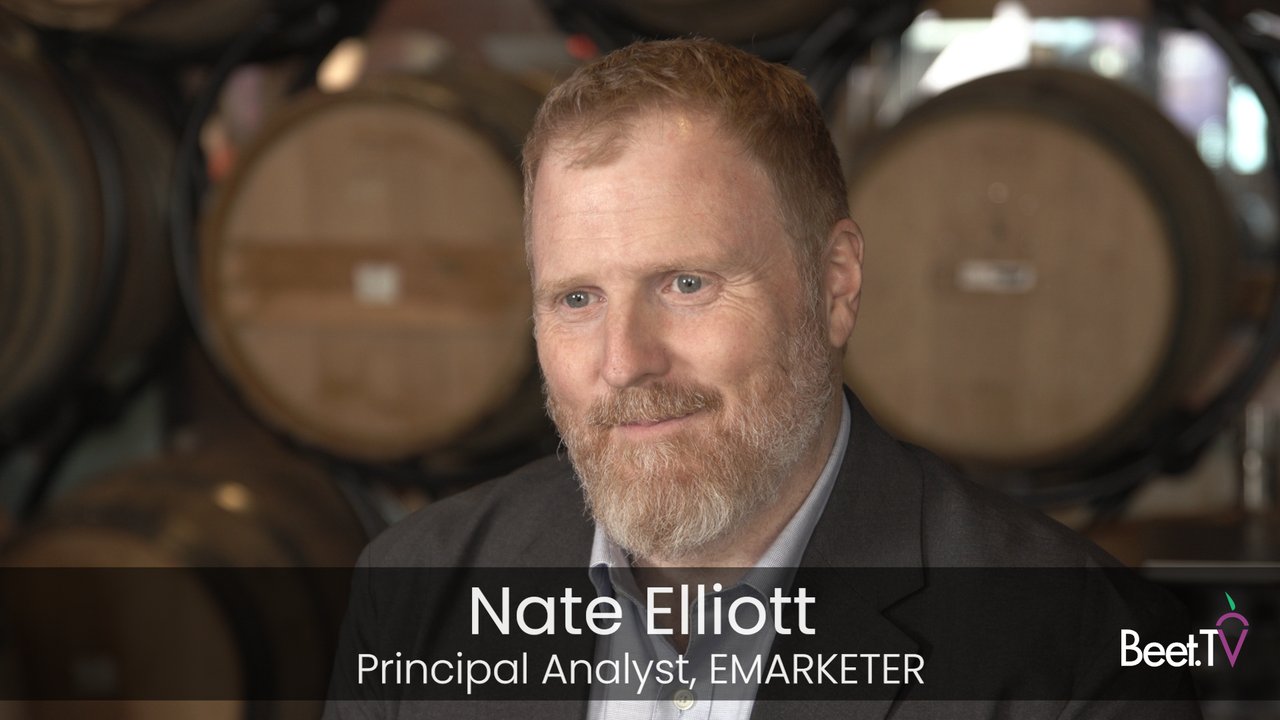
EMARKETER’s Nate Elliott: AI Advertising Will Hit $32 Billion This Year

Most of the conversation about AI in marketing focuses on chatbots and LLM-powered discovery. The money tells a different story.

“This year in the US, AI advertising will generate more than $32 billion in revenue. That’ll more than double to $68 billion by 2030,” Nate Elliott, principal analyst at EMARKETER, told Beet.TV contributor David Kaplan at EMARKETER’s Future of Digital event in New York. “But the vast majority of that money, both now and in 2030, isn’t going to be advertising inside of chatbot conversations. It’s actually just going to be regular paid listings on search results pages that happen to sit next to things like AI overviews.”

Of this year’s $32 billion, only $5.4 billion flows into advertising inside chatbot conversations — a figure that will start to equalize over time, but even by 2030, paid search listings alongside AI overviews remain the dominant revenue source.

Workflow, not channel

Despite the focus on AI as a consumer-facing channel, EMARKETER’s survey of several hundred marketers found that most AI adoption is happening inside the office, not in front of audiences.

“So many companies are playing with GEO, a handful of companies are experimenting with AI advertising, but by far the most common way marketers and agencies say they’re using these tools is to just do their jobs,” Elliott said. “It’s for audience research, it’s for strategy and planning, for creative, for media planning and buying, and for campaign measurement.”

Analytics undervalued

Campaign measurement has ranked as the number one marketer pain point in Elliott’s surveys for decades — not because it lacks importance, but because it’s unglamorous work that few people entered marketing to do.

“I didn’t get into marketing so that I could count more clicks and that’s kind of what campaign measurement is. I’m actually really excited that AI has given us the capability to do this work without having to actually do this work ourselves,” Elliott said. “It’s undervalued as part of what we do as marketers and the fact that we have tools that can do this for us is just fantastic.”

Test everything

AI chatbots didn’t exist four years ago. AI advertisements didn’t exist two years ago. The platforms themselves don’t know what they’ll look like a year from now — which makes sitting on the sidelines a particularly costly form of caution.

“If you’re not testing everything in AI, then you’re going to have a hard time taking advantage of whatever turns out to be the best opportunity,” Elliott said.

For Elliott, that uncertainty is also what makes covering this moment genuinely exciting — not just as an observer, but as a participant in something still being invented.

“Everyone — the platforms, the marketers, the agencies — everyone is literally making this stuff up as we go along. We get to watch this happen, we get to participate in making this happen, and we get to invent the world that’s unfolding in front of us,” Elliott said.

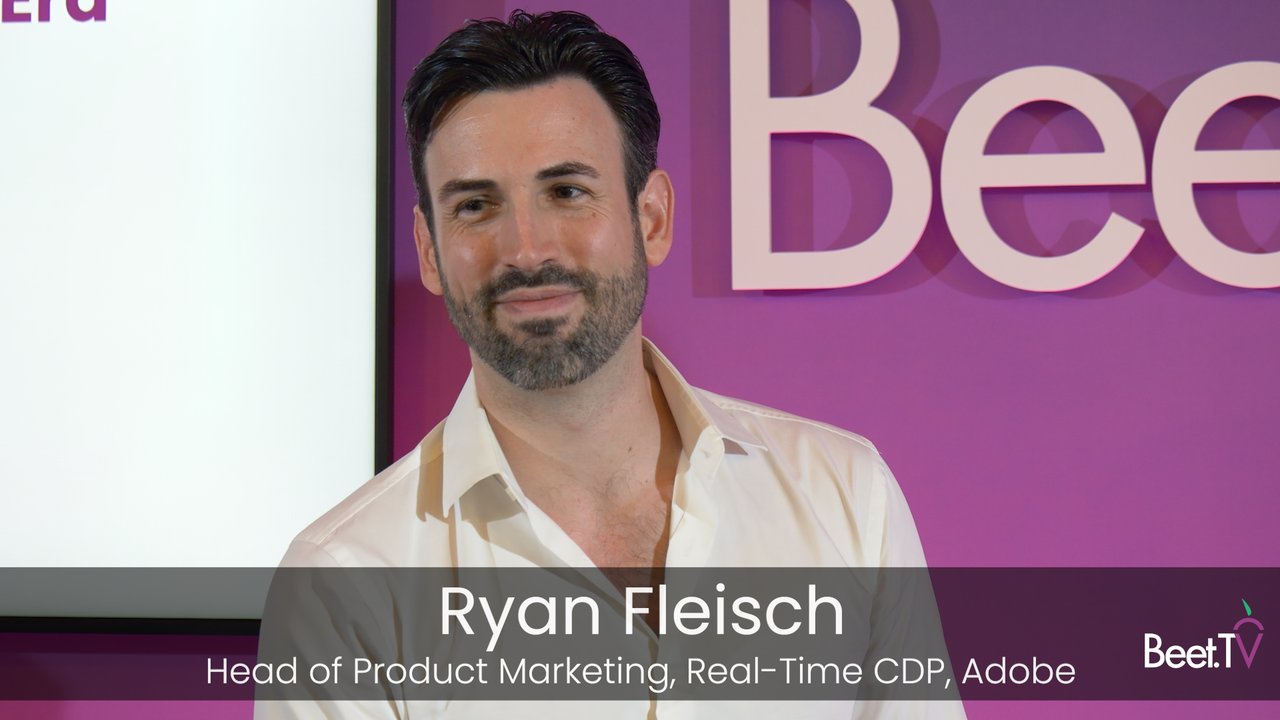
Adobe’s Ryan Fleisch Wants Marketers to Escape the Data Silo Factory

Marketers spent years building first-party data systems to escape their dependence on third-party cookies. Then many discovered that the solution came with its own collection of clean rooms, technology integrations and fresh silos. Apparently, data infrastructure follows the same rule as household storage: The more containers you buy, the more clutter you find.

Ryan Fleisch, head of product marketing and real-time customer data platforms at Adobe, said data collaboration can help brands connect their customer information with publishers, media networks and other companies. He discussed the strategy with Next in Media’s Mike Shields at the Cannes Lions International Festival of Creativity.

Three letters, endless confusion

“The three letters ‘CDP’ are the most confusing letters in the industry,” Fleisch said. Some companies have a customer data platform, others are shopping for one and still others have declared the entire category dead. This being advertising technology, all three positions can probably coexist inside the same company.

Fleisch argued that CDPs are becoming more important as brands prepare for agentic artificial intelligence. However, data collaboration was not originally considered a core CDP function. Brands often responded by adding separate clean rooms, applications and publisher integrations. The technology designed to eliminate silos gradually became another silo.

Adobe decided to incorporate data collaboration directly into its real-time CDP. The goal is to let marketers activate audiences in clean-room environments without repeatedly constructing new integrations. “On average, brands are working with three to five different clean rooms,” Fleisch said. That is less a clean room than a small office park.

Privacy without a permission slip for everything

Adobe’s platform is designed to leave customer data in its original location while allowing participating companies to analyze audience overlaps. Fleisch said personally identifiable information is not exchanged between parties and campaign results are not returned at an individual level.

The controls are meant to give marketers room to operate while reassuring technology departments that nobody has handed the customer database to an intern with a USB drive. The objective, Fleisch said, is to give IT confidence that “I can let some teams loose with my data and they’re not going to misuse it.”

This kind of collaboration can help an advertiser compare its high-value shoppers with a publisher’s audience data, build a seed audience and find similar prospects without relying on third-party cookies. It also can support brand-to-brand partnerships. An airline, for example, could combine insights about travel behavior with a credit-card partner’s knowledge of shopping activity.

AI gets another bumper sticker

No Cannes conversation would be complete without artificial intelligence arriving before the rosé got warm. “Agentic and AI gets slapped onto just about everything like a bumper sticker right now,” Fleisch said.

He sees two practical roles for the technology. AI can make CDP and collaboration tools easier to operate through natural-language instructions. At the same time, clean and current customer data can provide the foundation that AI agents need to respond accurately.

That makes real-time processing more consequential. A customer speaking with an AI agent generates a rapid series of prompts, responses and changes in intent. The system must continually update its understanding of that person. Real time therefore is no longer merely about suppressing an ad before the customer sees it for the 47th time.

“Can I actually keep up with the speed of customer conversations in my agentic strategy at large?” Fleisch asked. For brands, the answer will depend less on how many times they mention AI at Cannes and more on whether their data can keep pace after everyone flies home.

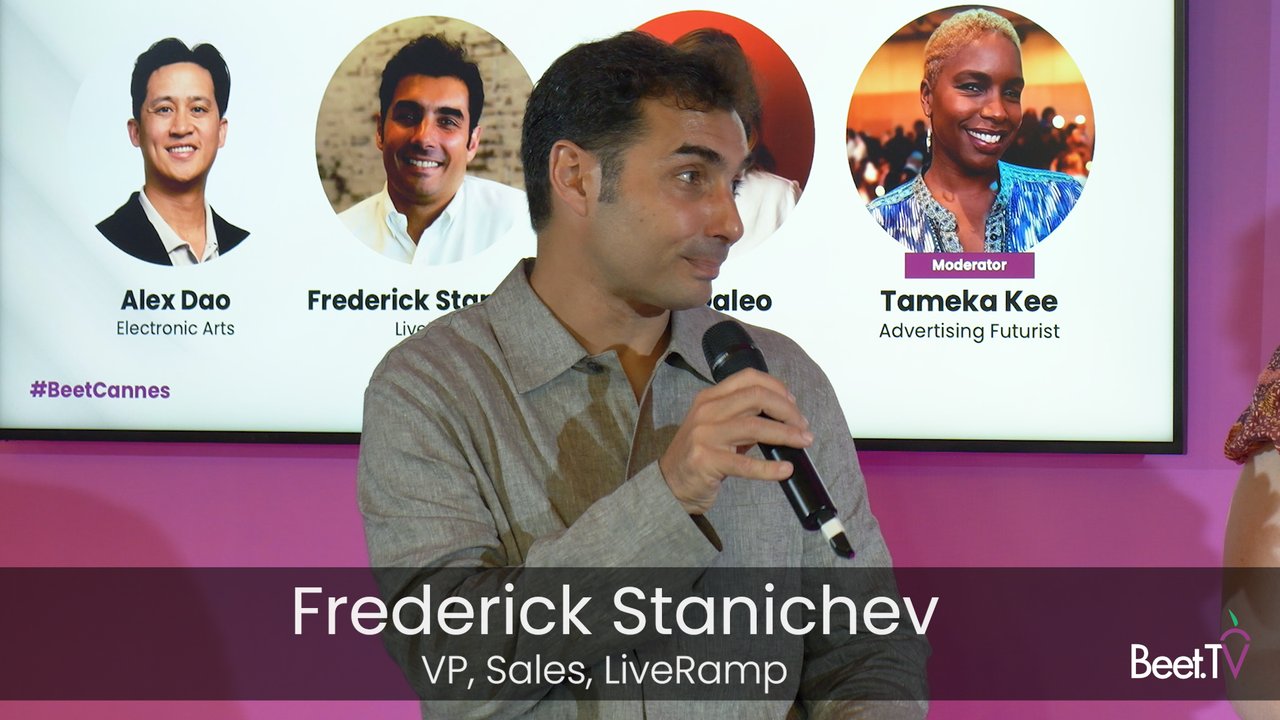
Electronic Arts’ Alex Dao, LiveRamp’s Frederick Stanichev and DoorDash’s Katie Daleo Turn Marketing Into Moments

CANNES, Lions — Consumers increasingly divide their time among video games, delivery apps, live events and the occasional attempt to experience reality without checking a phone. That fragmentation is pushing marketers to look beyond conventional media placements and find moments when people are actively engaged.

Electronic Arts, DoorDash and LiveRamp are helping brands connect those moments with first-party data and measurable outcomes, executives from the companies said during a Beet.TV Leadership Session presented by LiveRamp at the Cannes Lions International Festival of Creativity.

The panel featured Alex Dao, vice president of advertising and sponsorships at Electronic Arts, Frederick Stanichev, vice president of sales at LiveRamp and Katie Daleo, general manager of CPG ads at DoorDash. Beet.TV contributor Tameka Kee moderated the discussion.

Stanichev described experiential media networks as an emerging category that can combine live or digital experiences with advertiser data. Unlike a retail media network, the platform hosting the experience may not control the final transaction. That outcome might instead belong to the advertiser.

The necessary data infrastructure largely exists, he said. The next phase involves making it easier for brands to use at greater scale.

“The infrastructure is already there,” Stanichev said. “It just is now maturing and scaling through all the different functions.”

EA would prefer that advertisers not ruin the game

Gaming presents a particularly valuable environment because players are not merely watching. They are operating the quarterback, building a virtual house or trying to defeat a teenager who seems to have eight thumbs.

Dao said gaming has grown larger than the film and music industries combined. The worldwide gaming audience totals about 3.6 billion people, or almost half the global population.

EA’s portfolio includes franchises such as EA Sports FC, Madden NFL, College Football, Battlefield and The Sims. More than 1 billion matches are played every month in EA Sports FC alone, Dao said.

Players also spend an average of 90 minutes with the game, giving EA something marketers have spent years pursuing through increasingly elaborate charts: sustained attention.

“They’re not dual screening, they’re not distracted, and you have their full attention,” Dao said.

That does not mean EA intends to slap a commercial over the screen while someone is attempting a game-winning pass. Dao said advertisers must understand the game, the audience and the reasons people are playing.

“What you don’t want to do as a marketer is actually get in front of them in a way that disrupts that experience or takes away from what they’re trying to do,” he said.

Visa, for example, sponsored live events and tournaments for EA players. The activation included branded uniforms, stadium advertising and broadcast placements. Coach took a different approach by making virtual products available free to The Sims community.

EA even turns down advertisers when the fit is wrong.

“We do,” Dao said when Kee asked whether EA ever refuses advertising money, a sentence rarely heard on the French Riviera without causing nearby yachts to sound their alarms.

The company looks for brands that already understand the sport or audience surrounding a particular title. Retail and consumer-product advertisers may fit naturally into The Sims, while sports sponsors may work better in Madden or EA Sports FC.

DoorDash finds drama in the delivery bag

DoorDash occupies a different kind of experiential moment. Consumers may spend less time placing an order than playing a video game, but the transaction can carry plenty of emotional weight.

“It could be my daughter has a fever at two in the morning and I need Tylenol delivered,” Daleo said. “What an experience to be able to get that delivered in 20 minutes and not be panicked.”

DoorDash has 56 million monthly active users. The company can help advertisers understand why a consumer visits the platform, what the person needs and how quickly a brand can respond.

Delivery itself is part of the experience, Daleo said. The right product must arrive when promised. It is a basic expectation that becomes rather memorable when dinner is missing, the ice cream has melted or the cough medicine has apparently begun a separate journey of self-discovery.

DoorDash recently worked with Magnum Ice Cream to position ice cream as a snack rather than only an after-dinner treat. The campaign identified frequent snack buyers who were not regular ice cream customers.

Magnum then used DoorDash’s Symbiosys off-platform advertising business to reach consumers through connected television, TikTok and Meta. The campaign directed them to DoorDash, where the sudden ice cream craving could be satisfied within 20 or 30 minutes.

“You see something, you want it, and you’re able to get it immediately,” Daleo said.

First-party data enters the game

EA is working with LiveRamp to let advertisers connect their own first-party information with EA’s player data. The integration is intended to support audience activation, campaign planning, measurement and optimization.

“The key here is that our brands are actually looking for overall connectivity,” Stanichev said.

An advertiser could match its first-party data with an EA identifier, then use that connection to reach relevant audiences and measure the results. LiveRamp is developing similar capabilities with DoorDash.

EA also is working with the Interactive Advertising Bureau to standardize in-game ad formats and with Integral Ad Science on viewability. Console advertising historically has relied on custom sponsorships and one-off integrations that can take six to 12 months to build.

Dao said EA wants to make those campaigns easier to buy, deploy and measure. The company recently introduced a platform and software development kit to bring advertisers into games more quickly.

Sports activity supplies another layer of behavioral data. EA sees player engagement rise before major games, fall while fans watch the live competition and climb again afterward. Players sometimes return to recreate the contest, particularly if the real-world result inflicted emotional damage on their preferred team.

EA calls that behavioral pattern the “W.” Dao called the surrounding signals “marketing gold” for advertisers.

Experiential marketing outgrows the pop-up shop

The panelists acknowledged that the word “experiential” now covers a sprawling collection of activities. These range from hotel-room product placements and food delivery to console games and live entertainment.

Stanichev expects the market to split into more specific subcategories as those businesses develop. A hotel placement, after all, does not necessarily belong in the same bucket as a Madden activation, even if the advertising industry owns a very large supply of buckets.

Daleo argued that experiential marketing was previously defined too narrowly. Brands once associated it mainly with sampling programs, race-day promotions and pop-up stores.

“Experiential marketing is just about making your brand more personal,” she said. “I don’t think it gets diluted. I think it just manifests itself in a different context.”

Dao said the border between physical and digital experiences is already blurring. After Philadelphia Eagles running back Saquon Barkley performed his celebrated reverse hurdle in a real game, EA added the move to Madden within a week.

The company also is bringing its games into physical venues. Its Madden Bowl event at San Francisco’s Chase Center featured musicians Zach Bryan and Teddy Swims alongside gaming, sports and brand activations.

Those efforts give advertisers more opportunities to reach consumers without treating every experience as another rectangular space waiting to be filled with an ad. The challenge is to use data to identify the right moment, then contribute something useful before the consumer reaches for the skip button, closes the app or throws the controller.

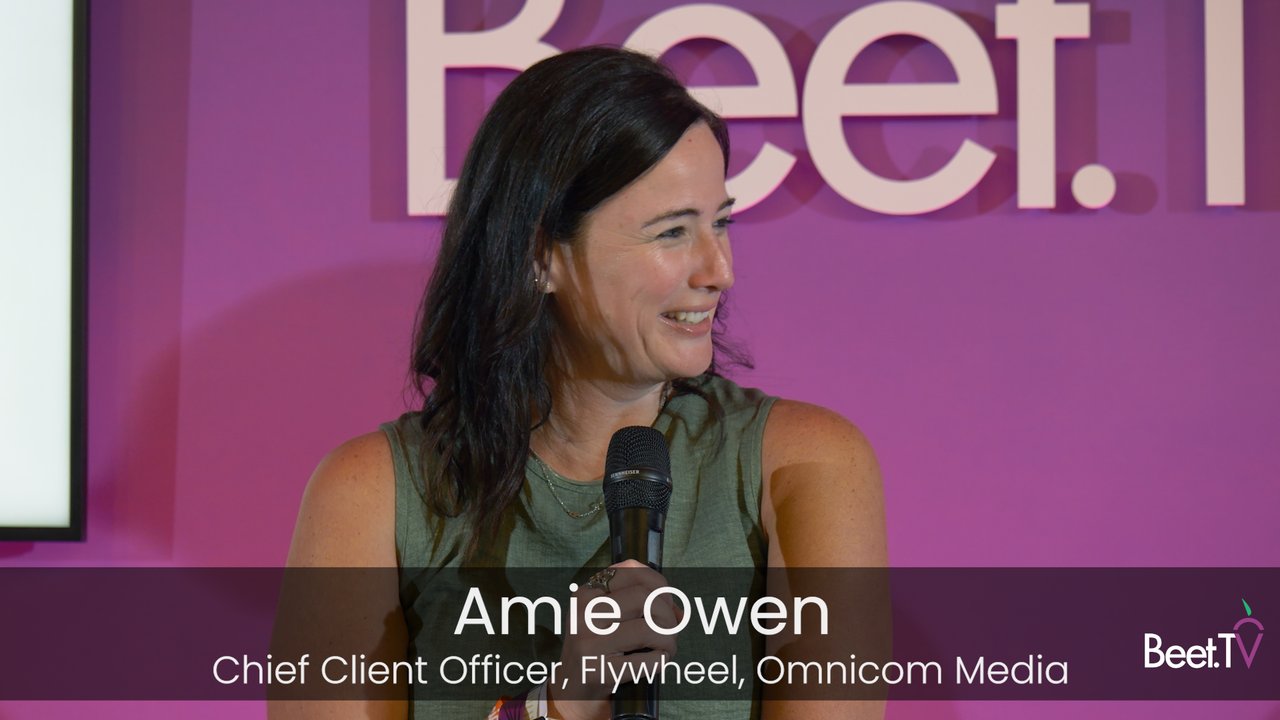
Brands Must Take Holistic Approach to AI: Flywheel’s Amie Owen

CANNES, France – Artificial intelligence may be capable of planning vacations, organizing inboxes and softening emails written in a moment of righteous irritation. Transforming a sprawling marketing organization is another matter.

Companies must prepare for AI across their operations, even if employees, clients and finance chiefs are not entirely comfortable with the cost or consequences, said Amie Owen, chief client officer of Flywheel and Omnicom Media.

“You have to be everywhere when it comes to AI because then you’re going to get left behind,” Owen said in a fireside discussion with Quentin George, partner at McKinsey & Co., at the Cannes Lions International of Creativity.

From fax machines to AI agents

Owen has watched commerce media evolve from an era when insertion orders were prepared in spreadsheets, written by hand and sent by fax. Global campaigns could be delayed by that most formidable of advertising technologies: an empty paper tray.

AI is helping agencies accelerate processes that once depended on manual work. Owen also uses the technology to plan trips, find recipe substitutions and adjust the tone of emails that might otherwise arrive with a little too much cayenne pepper.

“I’ve used it for asking how to rewrite an email because I would come across too harsh in email,” she said.

AI also helps her organize messages from email, Slack and Microsoft Teams into a daily list of priorities. Somewhere, a color-coded spreadsheet is quietly realizing that its best years may be behind it.

Teams are going further by creating AI agents modeled on executives and clients. These digital replicas review presentations and predict what particular people might want to see in quarterly business reviews.

The results can be unsettlingly accurate. They also raise the possibility that future conference panels could feature AI agents, leaving the humans free to enjoy Cannes without having to locate the meeting room.

Transformation is harder than experimentation

The larger challenge is aligning brands, agencies and media partners around AI. Many organizations embrace the technology in theory, Owen said, but retreat to familiar practices when decisions become difficult.

“It’s the behavior change and then the organizational change that is interesting to me,” she said.

Asked whether people are ready for that transformation, Owen offered a blunt assessment.

“I don’t think so, but the reality is, they have to be,” she said.

Companies need to educate employees, internal teams and clients about AI. That preparation may include automating processes, experimenting with agentic shopping and ensuring brands are ready to appear in AI-generated product recommendations.

The problem is that corporate enthusiasm often collides with corporate accounting. George said many chief financial officers are questioning why they should fund another technology overhaul after spending heavily on cloud computing without seeing all the promised productivity gains.

There is also anxiety about employment. Owen said AI will eliminate some jobs, but other roles will emerge as companies redesign how work gets done. Simply distributing an AI tool and telling everyone to use it does not qualify as organizational transformation, although it does satisfy the traditional corporate requirement of sending an upbeat email about innovation.

Companies may need to do two things at once

Executives face a difficult choice between concentrating their AI investments in a high-value business area and making the broader workforce comfortable with AI tools.

Owen argued that companies ultimately need both.

She pointed to one campaign in which an AI-enabled process saved about 600 hours. The company tested the approach before expanding it, giving executives a measurable result rather than another presentation filled with arrows, clouds and the word “synergy.”

At the same time, the usefulness of general-purpose AI tools varies by person and task. Owen described a client who loves Microsoft Copilot. Her own experience has been less rewarding.

“Every single time I tell it to write an email, it takes one word and then moves it back,” Owen said. “And then it’s like, ‘I completed your email.’”

Even artificial intelligence, it appears, has discovered how to look busy.

Product information becomes machine-readable marketing

As AI systems play a greater role in product discovery and purchasing, brands must make sure their online presence is accurate and complete.

“The biggest piece is being retail-ready,” Owen said.

That means updating paid and earned content while connecting media campaigns to product information. AI systems will scan websites and other sources before recommending products to shoppers.

“If you don’t have that updated, you will not be in the top three products that are recommended,” Owen said.

For marketers accustomed to fighting for the first page of search results or a prominent retail shelf, AI introduces another gatekeeper. This one reads everything, never sleeps and probably will not be impressed by a fruit basket.

Integration will separate the winners

Over the next two years, Owen expects successful commerce organizations to integrate brand marketing with commerce, improve how they use data and coordinate go-to-market strategies with retailers and commerce media networks.

“It’s a delicate balance, and it’s all about integration,” she said.

That agenda involves multiple systems, business functions and trading partners. George joked that he hoped someone had written it all down.

Owen suggested dividing the work across the two-year period. The schedule may require some creative arithmetic, but the message was clear: brands cannot wait for AI transformation to become simple, comfortable or inexpensive before they begin.

Basis’ Mike Olson and PHD’s Emily Costello Want Agentic AI to Work, Not Just Look Busy

CANNES, France — Artificial intelligence may be able to create a media plan, generate thousands of ads and summarize a meeting before anyone has found the conference room. That does not mean it always should.

As agencies and brands race to adopt agentic AI, the industry needs to move beyond isolated experiments and build systems that improve actual business outcomes, executives from Basis and PHD said at the Cannes Lions International Festival of Creativity.

Mike Olson, executive vice president of client development at Basis, and Emily Costello, head of integrated investment at PHD, discussed how autonomous AI tools could reshape media planning, activation and measurement. They also warned that the technology needs guardrails, human judgment and clearly defined goals.

The discussion, titled “The Agentic Shift: Scaling AI in Media Strategy,” was moderated by Zach Rodgers of Sensical Consulting.

AI climbs the maturity ladder

Costello described agentic AI adoption as a three-stage maturity model.

The first stage consists of functional agents that handle individual tasks. These may include summarizing briefs or making parts of a workflow more efficient. Connected agents represent the second stage, in which signals begin informing different pieces of the media cycle.

The third and most advanced stage is what Costello called a “horizontal orchestration layer.” At that point, multiple autonomous systems work together across functions instead of waiting for humans to pass work from one department to another.

Most organizations remain somewhere between the first two stages, she said. The larger opportunity will arrive when agencies achieve “true autonomous synergies across workflows.”

In other words, the robots have learned a few useful chores. They have not yet been handed the keys to the agency.

Olson said agencies are moving at different speeds. Major holding companies have sophisticated AI platforms, while independent agencies may lack the data and technology needed to build their own systems.

Basis is seeking to fill that gap with agentic capabilities spanning planning, strategy and activation. The challenge is not simply gathering more information. Agencies must determine what data will help produce the outcome they actually want.

Jurassic Park had an AI strategy

The abundance of potential AI applications has created a familiar technology problem. Companies can build almost anything, but they may not have stopped to ask whether anyone needs it.

“There’s so much going on right now that it’s kind of this ‘Jurassic Park’ model,” Olson said. “They never stop to think if they should just because they could.”

Before deploying an agent, marketers should agree on the goal and the language used to define success, he said. Otherwise, a project can head in several directions without becoming useful to the agency or its clients.

Costello offered a similar warning about creative testing. AI can produce more ads and experiments than human teams could manage on their own. Still, more variations do not automatically produce more insight.

“You need to remain as focused as possible when it comes to creative testing,” she said. The aim should be to identify what moves the needle, not to conduct so many experiments that the results become noise.

Guardrails without an AI hall monitor

PHD wants employees to experiment with AI without feeling that every prompt is being watched by a compliance officer carrying a clipboard.

The agency’s Omni AI platform provides a protected environment with controls already in place. That lets teams test ideas while maintaining safeguards around client data, Costello said.

PHD is not including individual AI usage in employee performance reviews. Costello said that kind of mandate could create fear, especially among workers already wondering whether the efficiency they produce will eventually make their roles redundant.

Instead, the agency is emphasizing how automation can free people to spend more time on strategic work.

“When you start to see capacity release, what that enables is for us to start to invest time,” Costello said.

Basis also describes itself as an AI-first company. Olson said employees are encouraged to build tools while respecting rules governing sensitive information and the large language models they use.

In one example, Basis’ head of revenue operations used Claude to build a dashboard connecting internal tools for business planning. Basis is moving that application into its own technology infrastructure so the company can support it.

That is vibe coding’s corporate graduation ceremony: one day an employee is experimenting with an AI tool and the next day IT has adopted the offspring.

Beware the slop machine

AI can increase productivity, but it also can turn a simple thought into a novella that nobody requested.

Olson described the downside as “all the slop.” A matter that once required a 30-second phone call or a paragraph can become a long document that colleagues must read and verify.

“Unless you can sign your name to it and you know every word it produced, don’t use AI just to produce a bunch of content,” he said.

Costello agreed that agencies need new quality-control systems. Employees must develop the habit of checking AI-generated work to ensure it solves the original problem without creating several exciting new ones.

AI has therefore “created a premium on humans,” she said. People are still needed to review the work, exercise judgment and catch the confident nonsense before it reaches a client.

Rodgers noted another concern. Junior employees traditionally develop judgment by handling lower-level assignments. If AI automates those jobs, agencies will need another way to cultivate future leaders who can oversee the machines.

Olson said Basis encourages employees to share AI tips with colleagues. Younger workers sometimes discover effective techniques but keep them to themselves as a personal advantage. A culture of sharing can spread productivity gains while reducing fear about the technology.

Sustainability waits in the lobby

Agentic AI also carries financial and environmental costs because its models require substantial computing power.

Costello said agencies must balance fiscal responsibility with experimentation. One approach is to build reusable skills rather than constantly creating new agents, reducing repeated token and computing costs.

Olson compared the debate with the advertising industry’s earlier focus on reducing carbon emissions from programmatic media. Agencies and brands asked vendors about sustainability while also demanding more targeting, more inventory and global reach.

“You can’t have both at one time,” he said.

AI capabilities are currently taking priority over environmental concerns, Olson observed. He expects sustainability questions to return as token costs fall and AI tools become more established.

For now, the industry appears to have placed its carbon calculator in a safe location where it cannot interfere with the product roadmap.

Outcomes still pay the bills

For all the enthusiasm around AI, Olson said the basic purpose of advertising has not changed.

“We’re in advertising, right? I mean, brands want outcomes,” he said. “At the end of the day, if I run a furniture store, I wanna sell more furniture.”

AI is worthwhile when it makes agencies more efficient, improves service or helps clients reach their business goals. It becomes less useful when it adds fragmentation and operational headaches.

The technology also may broaden the meaning of creative personalization. Olson pointed to Coframe, a company that can alter a website for each visitor. That approach extends optimization beyond the ad and into the landing-page experience.

Costello said consumers increasingly expect personalized experiences, although marketers must avoid crossing the line from relevant to creepy. AI may create many capabilities that the industry has not considered yet, she said.

Looking ahead, both executives named orchestration as the priority.

Costello expects AI systems to connect strategy, activation, measurement and governance without relying on today’s linear handoffs. Olson said Basis wants that orchestration to extend from planning through billing reconciliation.

“If we can have agentic solutions helping solidify and streamline that to create autonomous processes, that’s what we want,” Olson said.

The machines may soon plan the campaign, activate the media and reconcile the bill. Humans will still be needed to decide whether any of it was a good idea.


AI Can Scale Marketing, but Human Taste Still Sets It Apart

CANNES, France — Artificial intelligence may be able to write an advertisement, analyze an audience and rescue an executive from the inconvenience of forming an original sentence. That does not mean it should run the marketing department.

AI’s proper role is to help people work faster and make better decisions, according to marketing leaders who spoke during a panel at the Cannes Lions International Festival of Creativity. The technology can organize data, sharpen creative briefs and personalize content. Human beings must still supply judgment, imagination and taste.

That was the broad conclusion of Laura Foster, CMO of GumGum, Andrew Swinand, CEO of Inspired Thinking and Lou Paskalis, founder and CEO of AJL Partners. Michelle Denhart, head of brand strategy and content at 1440, moderated the discussion.

The panel was titled “Are We Living Through the Next Renaissance?” If so, the modern equivalent of the printing press apparently comes with a prompt box and an executive demanding 20% greater efficiency by Friday.

AI is a tool, not a strategy

Swinand warned that companies are becoming so fascinated with AI that they mistake owning the tool for having a business plan.

“My thesis on AI is everyone’s so overly enamored with AI that they think it’s a strategy,” he said. “And it’s a tool.”

He compared AI with earlier technologies such as laptops and email. Those inventions changed jobs and accelerated work, but they did not relieve companies of the need to decide what they were trying to accomplish.

AI can help marketers find insights more quickly, Swinand said. It might have helped Procter & Gamble reach the strategic positioning behind Old Spice’s “Smell Like a Man” campaign sooner. It probably would not have invented the campaign’s famously strange image of a shirtless man sitting backward on a horse.

“You still need people, you still need ideas,” Swinand said. “And the value creation is the strategic intent and the creativity that AI enables.”

That distinction matters because AI is trained on enormous amounts of existing material. It is very good at identifying what has worked before. Unfortunately, “something that resembles everything that worked before” is not usually the brief for a breakthrough campaign.

“My belief is AI is good at the average,” Swinand said. “And if you want average, absolutely AI, save your money.”

Everyone gets a press release

Foster said AI has made basic marketing knowledge available to far more people. Employees no longer need years of specialized training to understand common concepts or translate technical ideas into language a client can follow.

That democratization comes with an industrial-sized barrel of beige paint.

“Everybody can write a press release and every press release sounds exactly the same,” Foster said.

She described how executives sometimes put her work into ChatGPT for a second opinion. While using the technology as a check is not necessarily wrong, treating its response as the final judgment creates a bigger problem.

“The reality is, what they are paying me for is to not be AI,” Foster said. “Judging the work through the eyes of a tool is going to make us all sound the same.”

Foster said companies can use AI to produce the straightforward starting point for an idea. Human creatives can then turn it into something memorable. She recalled advice from a former professor: “Say it straight before you say it great.”
AI can handle the straight part. Cannes exists largely because advertisers still need someone to handle the great part, preferably before the rosé runs out.

The machine has taste, but whose?

Denhart asked whether AI itself can have taste. The answer depended partly on how generously one defines the word.

Swinand said AI can produce good material, particularly when a user trains it through prompts and feedback. Foster noted that her AI communicates differently with her because she has taught it to respond in a way that fits her personality.

Paskalis was more skeptical. He described AI as a system that searches many variables and gravitates toward their midpoint.

“If you come away with one idea today, it’s that AI is a bell curve of bell curves,” Paskalis said.

That makes AI useful for spotting patterns and improving a creative brief. It is less likely to discover the strange idea at the edge of culture that later moves into the mainstream.

“The things that break through are the ones that look different,” Paskalis said. “It’s never the mainstream. It’s never the middle.”

Paskalis offered an unsettling example from a conversation with a senior marketer at a former employer. After an executive disliked creative work for a campaign, he asked ChatGPT to produce an alternative. The marketer admitted that the machine’s version was materially better.

That was not the ending Paskalis wanted. He was hoping for reassurance that decades of human craft could still defeat an executive and his chatbot in single combat.

“This is a craft that requires human taste and human judgment and human expertise,” Paskalis said.

Planning isn’t dead, but it may lose its calendar

The speakers also rejected the idea that AI will eliminate strategic planning. It could instead make planning continuous.

In the traditional model, planners studied a brand and audience for months before presenting a campaign. AI can analyze incoming signals much faster, allowing marketers to revise their approach as consumer behavior changes.

“Planning used to be something you would do in advance,” Foster said. “Planning has to happen in real time now.”

AI also can help marketers move beyond crude demographic categories. Foster noted that advertising systems still frequently assume she is the household grocery shopper because she is a woman in a particular age group. Her husband actually shops and cooks. He also believes she chops carrots incorrectly, which may be the most precise piece of household targeting data disclosed at Cannes.

Swinand said AI can sort through thousands of consumer attributes to identify the differences that matter. For a dog-food brand, knowing that someone owns a dog is less useful than knowing whether the animal is large, small, overweight or athletic.

“You need a great idea,” Swinand said. “And then you need AI to ingest all of the data.”

Paskalis said the result could be dynamic segmentation based on what a person is doing and thinking now, rather than a static consulting report that begins aging the moment it leaves the printer.

Don’t measure the Renaissance by Tuesday

In closing, the panelists warned companies against deploying AI merely so executives can say they deployed AI.

Swinand called it a “hammer and nail problem.” Businesses should begin with a customer need or operational obstacle, then decide whether AI can solve it. Starting with the technology often produces demonstrations that are impressive but commercially pointless.

Foster also questioned broad corporate goals such as becoming 20% more efficient through AI. Such targets sound appealing but may be impossible to measure while employees are still experimenting.

“AI is a tool and hopefully it makes us more efficient, but let’s not try to measure the Renaissance before we’re through it,” Foster said.

Her advice was to let marketing teams experiment, accept some disorder and postpone the scorekeeping until people understand what they are learning.

Or, as future historians may record it: First came the printing press. Then came artificial intelligence. Shortly afterward came the meeting to establish its key performance indicators.

Video Podcasts Open New Doors for Advertisers: Omnicom Media’s Maureen Bosetti

CANNES, France – Podcasts were once the place where two people could talk into microphones for three hours and confidently assume nobody needed to see what they were wearing.

That era is ending. Podcasts are rapidly becoming a video medium, giving advertisers new ways to combine the intimacy of host-driven audio with the visual impact of television, Maureen Bosetti, chief investment officer at Omnicom Media, said at the Cannes Lions International Festival of Creativity.

The expansion onto YouTube, streaming services and free ad-supported television channels has turned leading podcasts into full-fledged video properties. Netflix is making podcast deals, while Prime Video has added “The Oprah Podcast.”

“The audiences really want to see that visual medium,” Bosetti said in a fireside chat with Zach Rodgers, principal at Sensical Consulting. “You can’t beat that, right, in terms of seeing the ‘SmartLess’ cast and how they interact with each other. What are they wearing? What are their facial expressions?”

For advertisers, those facial expressions are not merely entertaining. They are additional commercial real estate.

Everybody has a podcast

Podcasting has attracted celebrities, journalists, comedians, reality stars and an untold number of people who recently purchased a microphone.

“Everybody has a podcast,” Bosetti said.

Only some of them develop the loyal audiences needed to interest major advertisers. Shows such as “SmartLess,” “The Joe Rogan Experience” and Alex Cooper’s “Call Her Daddy” have risen to the top, while true-crime programming continues to perform strongly.

The difficulty is keeping listeners and viewers engaged when another show is always waiting in the queue.

“What’s going to keep that person coming back or not skipping and going to the next one?” Bosetti said. “Some of them have done it incredibly well, and then others will just kind of fall off the map.”

Reach remains important for large insurance, wireless and beauty advertisers. Yet Bosetti said smaller podcasts can also be valuable when their audiences show strong engagement.

A specialized business or finance podcast may lack celebrity-sized numbers, but it can offer access to a narrowly defined group of potential customers. That can make it particularly useful for business-to-business and financial-services marketers.

Trust gives host reads their power

Podcast advertising has revived one of media’s oldest selling techniques: Have a trusted personality tell the audience about a product.

Host-read advertisements can sound more credible than conventional commercials because listeners have developed a relationship with the person delivering the message. A gifted host might even persuade an audience that a software subscription has brought profound joy to an otherwise empty life.

“These host reads, they’re incredibly engaging,” Bosetti said. “You believe them, you believe that they’re using these products, you believe in what they’re saying.”

That sense of trust is difficult to reproduce with an ordinary inserted advertisement. It can also encourage people to pay closer attention to the product and its message.

“If it’s done well, it can lend itself to a high degree of trust and engagement that you don’t see everywhere,” Bosetti said.

The catch is that authentic host reads require work. Marketers must adapt the language to the program, the host and the audience. The process can involve more customization and negotiation than distributing the same 30-second television spot across multiple channels.

“The more customized it is, quite honestly, the better it is, the more engaging it is,” Bosetti said. “But it is hard to scale that.”

Measurement is improving, slowly

Direct-to-consumer advertisers have some of the clearest ways to measure podcast performance. They can track visits to a website, assign promotional codes or connect an advertisement with an online purchase.

Brands without a direct sales relationship must rely on tools such as brand-lift studies and marketing mix modeling, or MMM. These models estimate how different forms of advertising contribute to sales and other business results.

Bosetti acknowledged that podcast measurement remains imperfect.

“We’ve got to get the models to be better certainly, so that we can make sure that we can show the ROI on this medium that is continuing to grow,” she said.

Views and downloads still matter, but they do not necessarily show whether people paid attention or took action. After all, the internet has demonstrated a remarkable ability to produce views without producing much of anything else.

“Sure, views are important, but you can kind of get views anywhere,” Bosetti said. “It’s really going to be more about some of these other metrics that we’re looking at.”

Fragmentation complicates the buying process

A podcast may be owned by one company, distributed by another and viewed on several platforms. The same episode can appear through SiriusXM, YouTube, Netflix or other services, creating an organizational chart that may require its own podcast to explain.

For media buyers, this fragmentation makes it harder to transact, measure audiences and understand where advertising is appearing.

Bosetti said the market needs “simplification, better measurement, easier ways to transact.”

Programmatic buying is becoming more widely available, but advertisers still need a more unified system that connects content owners, distributors and platforms.

“How do we help simplify the process, create more of an end-to-end solution?” Bosetti said. “It’s so fragmented in this space and it’s confusing in terms of where everything lives.”

Video opens the aperture for brands

Podcasts can offer audience precision that broad television programming often cannot. Shows tend to develop around specific subjects, personalities and interests, creating communities whose connection goes beyond demographic targeting.

“It’s very passion-driven,” Bosetti said.

That relationship becomes especially appealing when video is added. Advertisers that once hesitated to spend on audio because viewers could not see a logo, product or brand color now have more opportunities for visual integration.

The result is a hybrid format that combines television’s imagery with podcasting’s intimacy and audience loyalty.

“The fact that they’re on video has opened up the aperture for a lot of brands,” Bosetti said. “We’re just seeing a lot more interest, especially in a lot of these talent that we had not seen before.”

For advertisers, video podcasting therefore presents an unusual proposition: the targeting of digital media, the persuasive power of a familiar host and the comforting presence of a logo somewhere in the frame.

Playing It Safe May be a Brand’s Riskiest Move: Amazon’s Lauren Anderson

CANNES, France — Advertisers searching for the next great use of artificial intelligence might want to put down the efficiency spreadsheet for a moment.

For Lauren Anderson, U.S. head of Amazon Ads Brand Innovation Lab, AI is not merely a tool for making ads faster or cheaper. It can help creative teams build customer experiences that previously were not possible, provided humans remain in charge of the creative decisions.

“We really think of it in terms of how do we use it to create things inside of our advertising experiences that haven’t been done before,” Anderson said in an interview with Beet.TV Editorial Director Lisa Granatstein at the Cannes Lions International Festival of Creativity.

Amazon’s Brand Innovation Lab develops custom campaigns across properties including Prime Video, Amazon Music, Twitch and Fire TV. That gives the team a sizable creative canvas, along with enough consumer touchpoints to make the traditional marketing funnel look less like a funnel and more like the plumbing diagram for a luxury yacht.

AI is the paintbrush, not the painter

While much of the advertising industry pitches AI as a way to produce more assets before lunch, Anderson sees a broader opportunity. Her team is exploring how the technology can expand creative possibilities, improve brand experiences and deliver personalization that goes beyond inserting someone’s name into a message.

The goal is to complement the work of creative strategists, executive creative directors and producers, not send them to a quiet corner while the algorithm wins a Cannes Lion.

“It’s a paintbrush. It is not the painter,” Anderson said. Creative teams, she added, are “still in the driver’s seat of creativity.”

That distinction matters as marketers face pressure to automate production without draining campaigns of the judgment and imagination that make them memorable. AI can provide another instrument in the creative toolbox. It does not necessarily know what house should be painted or why anyone would want to live there.

Funnel should feel like one experience

The Brand Innovation Lab also approaches brand building and performance marketing as connected parts of a customer experience.

“This isn’t about separating upper funnel from lower funnel,” Anderson said. “It’s about how is the handoff seamless and smooth?”

Campaigns should make sense as customers move from discovery to consideration and potentially to a purchase. Treating each interaction as a separate assignment can produce a collection of ads that technically belong to the same campaign but behave like distant relatives seated together at a wedding.

“That experience has to cut across the funnel,” Anderson said. “It has to make sense from one point to the next.”

Amazon’s collection of entertainment, streaming and commerce properties gives the lab opportunities to connect those points. The creative challenge is to make the journey feel coherent rather than assembling a series of one-off placements and hoping consumers admire the media plan.

Creators come with communities

Anderson also urged brands to think beyond hiring creators as delivery systems for corporate talking points.

Working with creators “really is about going beyond a line in the media plan,” she said. The old formula of finding an influencer, handing over a message and saying “go forth” misses much of what makes creator marketing valuable.

Creators have built communities with their own tastes, expectations and conversational habits. Brands should identify which creator and audience would naturally engage with the campaign, then develop something tailored to that group.

“For us it’s really about creating community,” Anderson said.

That approach can involve co-creating a campaign with the creator and, in some cases, the community itself. A conventional sponsored message may still have a role. Anderson said Amazon does that work too. The larger opportunity comes from creating a genuine conversation instead of renting someone’s follower count for the afternoon.

Safety can disappear into the noise

Asked what advice she would give CMOs and creative leaders who want to push boundaries but feel pressure to play it safe, Anderson did not offer much comfort to the cautious.

“I think that’s too bad,” she said with a laugh. “If the pressure is to play it safe, I think the reality is that’s maybe the riskiest thing you can do right now.”

Media fragmentation has produced more noise, more clutter and more competition for attention. A campaign engineered to offend nobody may also interest nobody, which is an expensive way to achieve perfect brand safety.

“If you’re playing it safe, you are not gonna be heard in the middle of the noise, of the chaos, of the busyness,” Anderson said.

Innovation has therefore become less of a decorative ambition and more of a requirement for visibility. Brands have to take creative chances to stand out across a crowded media landscape.

“You have to be innovative to cut through,” Anderson said.

For marketers, that means AI, creators and Amazon’s many consumer platforms are not shortcuts around creative thinking. They are tools for making bigger ideas possible. The paintbrush may be getting smarter, but someone still has to decide what belongs on the canvas.

Dick’s, CVS and Fluent Find Commerce Media’s Next Growth Spurts

CANNES, France – Commerce media has reached the awkward stage of its development when simply showing up with shopper data no longer counts as a personality.

During a panel at the Cannes Lions International Festival of Creativity, executives from Dick’s Sporting Goods, CVS Media Exchange and Fluent said the next phase will require retail media networks to differentiate themselves, recruit advertisers from outside their traditional categories and turn physical stores into measurable media channels.

Tameka Kee, a Beet.TV contributor, moderated the discussion, titled “Who’s Actually Building the Next Phase of Commerce Media?”

Retail media enters its toddler years

David Young, vice president of retail media at Dick’s Sporting Goods, described the first generation of retail media as an effort to replicate a familiar marketplace playbook. The second generation is about establishing what makes each network distinctive.

With more than 250 commerce and retail media networks competing for advertising, merely possessing transaction data is no longer enough. Retailers need to explain how their customer relationships can influence purchase behavior.

For Dick’s, that relationship centers on the “athletic family.” The definition is generous.

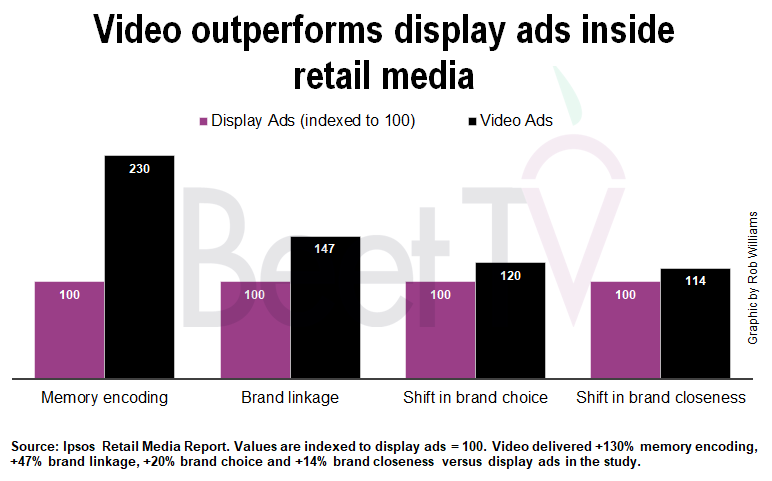
Video outperforms display ads in retail media

“If you shop at Dick’s Sporting Goods, congratulations, you’re an athlete,” Young said, clarifying that he meant customers rather than LeBron James.

Paul Lentz, head of strategic development at CVS Media Exchange, said retail media may have graduated from infancy, although it should not be trusted near an open staircase just yet.

“We’re probably toddlers if you think about life stages of retail media networks,” Lentz said.

CMX builds its offering around CVS’s ExtraCare loyalty program, which has 90 million addressable members. The network combines those customer signals with offsite activation, closed-loop measurement and a growing collection of in-store media surfaces.

Loyalty would like to start paying rent

Tim Lukens, president of commerce media at Fluent, identified loyalty and in-store advertising as two of the industry’s biggest growth opportunities.

A loyalty identifier is more than another audience label, he said. It can connect online and in-store behavior, help advertisers understand downstream purchases and support rewards such as points, cash or coupons.

The commercial goal is to turn loyalty programs from an expense into a source of profit while still giving customers something worthwhile in return. Airlines and credit-card companies have already demonstrated the potential. Retailers are now reaching for the same prize, preferably without converting every reward into a coupon worth 17 cents.

“It’s turning that loyalty from a cost to an actual profit center,” Lukens said.

Lentz said expansion into complementary advertising categories can make loyalty programs more useful than a stack of discounts. That prompted the inevitable discussion of CVS receipts, those celebrated paper scrolls that can make the purchase of toothpaste feel like the signing of an international treaty.

Non-endemic gets a rebrand

The panelists agreed that “non-endemic” is losing favor as a label. Young prefers “complementary,” partly because prospective advertisers do not particularly enjoy being described with a term that sounds like a public-health warning.

At Dick’s, complementary categories can include automobiles, quick-service restaurants, consumer packaged goods, financial services, entertainment and travel. These products fit the lives of families spending weekends driving between games, tournaments and emergency cleat purchases.

Young said the selection process involves “a little science” and “a little art.” Data helps identify promising categories, but any partner must make sense within the retailer’s customer experience.

A whiskey promotion aimed at families shopping for youth sports equipment, for example, received a quick rejection during the discussion.

“Sounds cool, not the right brand,” Young said.

CVS applies a similar filter around health and wellness. Lentz noted that the pharmacy chain stopped selling cigarettes more than a decade ago, making tobacco advertising an obvious nonstarter. Alcohol also falls outside the boundaries CMX is drawing.

Brand compatibility still leaves substantial room for expansion. A hotel offer shown after a parent buys lacrosse cleats, Lukens said, may be highly relevant even though Dick’s does not sell accommodations.

“The customer is the algorithm at the end of the day,” he said.

Stores become media, finally

In-store advertising has generated plenty of conference conversation but less execution. Lentz said the novelty is not advertising inside stores, which has existed for ages. It is the expectation that retailers can bring digital-style targeting and measurement into a physical environment.

That requires upgraded point-of-sale systems, better infrastructure and processes that have moved beyond manual spreadsheets.

“We can’t run stuff in spreadsheets anymore,” Lentz said, delivering the sort of statement that could cause several departments to quietly minimize their screens.

Dick’s has concentrated its early in-store experiments in its House of Sport locations. The stores are about twice the size of a typical Dick’s and may include a football field and batting cages. Young called the concept “an FAO Schwarz for sports.”

One activation, called “lift and learn,” combines RFID-tagged footwear with seven-foot digital displays and magnetized shelving. When a shopper picks up a shoe, the screen changes its video and audio content. Dick’s can measure how long products remain in shoppers’ hands, how many try-on requests follow and whether sales change.

The results are not invariably flattering.

“Advertising doesn’t fix product that doesn’t work,” Young said.

Even an unsuccessful sales result can provide useful product intelligence. If customers repeatedly pick up a shoe but decline to try it on or buy it, the problem may not be a shortage of impressions.

The cash register gets another job

Fluent and CVS are also working to bring complementary advertising into the post-purchase experience. Lukens said CVS was well into the rollout of new point-of-sale systems that can support advertising at checkout.

The companies plan to use loyalty signals and a Databricks clean room to match audiences in a privacy-conscious way, deliver offers and measure subsequent activity.

Lentz said CVS has continually studied customer reaction to ads on checkout screens. More than 67% of the responses have been positive, helped by the relevance of the messages.

CMX also works with Circana to measure sales beyond CVS. A customer identified as being interested in body wash may see an ad through CVS but purchase the product from another retailer. Rest-of-market reporting can help demonstrate that the campaign produced a broader sales lift even when CVS did not ring the final register.

Not every impression needs a tiny courtroom trial

The industry’s fixation on incrementality and return on ad spend also received some pushback.

Young said retail media networks must resist reducing every campaign to immediate incremental sales if they want to compete for brand budgets. Test-and-control studies and sales-lift measurements remain valuable, but some advertising builds awareness or affinity outside a convenient attribution window.

“Not everything is a performance marketing channel and it should not be treated as such,” Young said.

Physical stores can encompass the entire marketing funnel in a single visit, Lentz added. Someone entering CVS to collect a prescription may discover a hydration product through an audio message or endcap display before making an unplanned purchase. Not every influence will submit neatly to one-to-one attribution, no matter how sternly the spreadsheet asks.

The next phase needs fewer clones

Looking toward the next year, Young said commerce media networks must differentiate themselves through their customer identities and insights. Their value lies not only in recording purchases but in understanding the circumstances that shape them.

Lentz hopes more agency and brand money will flow through retail media networks rather than leaving them dependent on traditional shopper-marketing budgets.

Lukens framed the larger choice facing retailers: Are they building another media network or improving the customer experience in a way that creates trust and can eventually be monetized?

The answer may determine which of those 250-plus networks mature into serious advertising businesses and which remain toddlers with excellent first-party data.

Retail Media’s Expansion Beyond the Aisle is Forcing Marketers to Rethink the Entire Funnel

A year ago, retail media meant building e-commerce platforms and optimizing sponsored product listings.

Today, the category has sprawled into connected TV, offsite partnerships, and even live sports apps – anywhere a retailer’s first-party data can follow a consumer. Dick’s Sporting Goods, for instance, now reaches families through its app while they watch their kids play soccer, far from any store shelf.

“It’s certainly well beyond just what’s in the Dick’s Sporting Goods store and retailer, and it’s expanded well beyond that,” said Scott Pawloski, chief revenue officer at GSTV (Gas Station TV), in this video interview with Beet.TV.

Walmart’s TV play signals the new logic

The clearest signal of retail media’s ambitions came when Walmart acquired Vizio in December 2024. A grocery giant buying a television manufacturer seemed odd until you understood the strategy: connect viewing behavior to shopping behavior, then close the loop on attribution.

“You think, why would Walmart buy a TV? But that’s their ability to take and realize the purchases don’t just happen while you’re at the aisle,” Pawloski said. “It’s all through the funnel, and sitting in front of your TV and watching an ad can relate and be able to tie that back to the attribution once you see that person in the actual Walmart aisle.”

According to WARC’s Future of Commerce Media 2026 report, global retail media spend is forecast to reach $223.4 billion in 2027, accounting for 15.2% of total worldwide ad spending. But growth is slowing, and outside Amazon, the category’s expansion rate is expected to fall to 9.8% in 2027 – the lowest since WARC began tracking it.

The gas pump as commerce catalyst

GSTV operates video screens at fuel pumps across the United States, reaching 115 million unique adults monthly at roughly 29,000 locations. The company positions itself not as retail media but as “retail adjacent” – a distinction Pawloski argues matters because of what happens after consumers finish fueling.

“A GSTV consumer spends about five times more in an hour to three hours post fuel-up than the average consumer,” he said. “That’s because it sits right in the heart of the epicenter of retail centers. So you see it in the grocery store parking lot or in the parking lot at Walmart, or it’s across the street from a CVS.”

The pitch is that fueling up is a behavioral signal that predicts imminent spending. “Seeing the last ad on GSTV right before you hit the aisle will, in fact, influence what they grab in that aisle,” Pawloski said. The company recently expanded its retail media ambitions through a September 2025 partnership with Casey’s to support the convenience chain’s retail media network with forecourt video.

AI enters the planning process

In June, GSTV became the first external media company to integrate Stagwell’s Agentic Targeting System, an AI-powered audience planning tool built on Palantir Foundry that draws on behavioral, attitudinal, and mobility signals from an identity graph spanning more than 260 million U.S. consumers.

“AI is changing everything, not just in marketing but in the entire world,” Pawloski said. “Having a consumer who’s always on the go, using that data to understand it to build a stronger plan will certainly help agencies and help GSTV help its partners.”

Conagra Brands was named as the first advertiser to use the system for GSTV campaign planning. The partnership reflects a broader industry trend toward using AI not just for optimization but for audience construction – building dynamic segments from real-time signals rather than static demographic buckets.

Attention without the phone

One argument GSTV makes is that the gas pump represents a rare moment of undivided attention in a fragmented media landscape. Consumers need both hands to operate the pump, which means their phones stay in their pockets.

“It’s probably the one moment of the week that you don’t have a phone in your hand,” Pawloski said. “And it’s also a moment in time where you truly have an attention on a screen that you enjoy. Most people when they look at that GSTV screen, they think to themselves, I’d rather have that than not.”

The company also recently selected Shinka as its mediation layer to improve programmatic connectivity across SSPs and DSPs including Equativ, Madhive, Magnite, Nexxen, and OOH Connect. The move is designed to make GSTV inventory easier to buy through the same systems advertisers already use for CTV and digital video.

“For us, getting a proper marketing message at that time, linked to the fact that we know it’s an indicator that they’re going to spend – to say, ‘Hey, maybe go grab this cheeseburger at a certain QSR as you’re getting hungry,’ or, ‘Don’t forget to grab this when you’re in the aisle’ – I think aligns the right moment at the right place in real life with the right consumer,” Pawloski said.

DoorDash Exec: Brands Should Unify Media and Promo Budgets to Unlock True Incrementality

CANNES, France – The age-old wall between advertising and promotions is crumbling. For decades, consumer packaged goods companies kept their media budgets in one silo and their trade and shopper marketing dollars in another, each measured by different teams with different metrics and different definitions of success.

Now, as retail and commerce media networks mature, there is growing pressure to tear down that wall. Brands want to know whether a coupon amplified by paid media actually grows a category, wins a new buyer, or merely subsidizes a sale that would have happened anyway.

“For a lot of brands and a lot of use cases, media plus promo drives better performance,” said Katie Daleo, GM, CPG Ads, DoorDash, in this video interview with Beet.TV at Cannes Lions 2026. “And so we need to get sharper about when we should bring them together.”

High intent, open to discovery

DoorDash has grown far beyond restaurant delivery. The platform now spans grocery, convenience, and retail, reaching 56 million monthly active users across more than 40 countries. For CPG advertisers, that expansion creates new moments to intercept shoppers who are already primed to buy.

“Most of our consumers open the app with the intention to make a purchase, but they’re open to finding exactly what they are going to buy to satisfy whatever craving or need that they have,” Daleo said. “So discovery is a big piece of it.”

That combination of intent and openness is central to DoorDash’s pitch. Unlike upper-funnel media, where brands pay for attention that may or may not convert, DoorDash argues it offers access to consumers who are already reaching for their wallets.

One platform, many occasions

Daleo highlighted another dimension: the ability to see a single consumer across multiple purchase occasions. A shopper might buy a single-serve ice cream from a convenience store one day, a six-pack from a grocery store the next week, and a bulk case from a club store the week after.

“DoorDash is a platform where consumers actually do all of those occasions, service all of those use cases and trips in one platform,” she said. “The onus is on us to give that data back to our brand partners so that they can understand where to reach the consumer best.”

That cross-occasion visibility matters because traditional retail media networks typically see only their own store’s transactions. DoorDash, by aggregating orders across thousands of merchants and formats, can stitch together a more complete picture of how consumers interact with a brand.

Ibotta partnership deepens

Promotions remain a core lever for CPG marketers, and DoorDash has been building out its promo capabilities through a partnership with Ibotta, the digital promotions and rewards platform. The two companies launched their integration roughly a year ago and are now moving into more ambitious territory.

“Going into back to school, we’re actually kind of co-creating a campaign together,” Daleo said. “We know back to school is a huge consumables moment. DoorDash loves moments. I think it’s number two. Last year we had significant double digit growth.”

The collaboration will produce bespoke promotions that DoorDash will then amplify through media and merchandising on its app. “First time we’re kind of creating something unique or bespoke together,” Daleo said.

MMM Must Plug Directly Into Bidding Systems to Stay Competitive, Mutinex CEO Says

CANNES, France – Within six to 12 months, brands that fail to connect incrementality data directly into their programmatic bidding systems will find themselves at a structural disadvantage, according to the chief executive of a marketing measurement company.

IAB’s 2026 Outlook Study found that 61% of buyers expect to focus more time and resources on marketing mix modeling this year, while 62% plan to increase attention on incrementality measurement.

“I no longer see measurement as competitive advantage,” said Henry Innis, CEO, Mutinex, in this video interview with Beet.TV. “I actually describe choice of measurement vendor as creating measurement disadvantage and competitive disadvantage correspondingly quite a lot.”

Measurement’s sell-side problem

According to Innis, for the last decade, measurement has functioned primarily as a tool for media sellers to justify their value to buyers. Advertisers are now reclaiming control.

“Increasingly, the advertiser is now saying, ‘No, I’d like to take control of my measurement, and I want to control that measurement from the buy side,'” he said. “That’s the principle that Mutinex is trying to enable.”

Mutinex industrializes market mix modeling, spinning up hundreds of models at granular levels – geography, product lines, creative, format – so brands can analyze every dimension of their commercial operations. The company says it has reduced the cost of enterprise MMM programs that historically ran into the millions of dollars with legacy vendors.

Click-based measurement is ‘grossly irresponsible’

AI is accelerating the collapse of deterministic attribution. Large language models now sit in the discovery layer between consumers and brands, and those AI interfaces do not pass through clicks in ways conventional tracking can capture.

“I think actually every single brand will be forced off deterministic measurement,” Innis said. “I don’t think it is possible in the age of AI and every single AI platform being its own walled garden, compounding the effect of walled gardens, for a marketer to rely on deterministic measurement. In fact, I think it’s grossly irresponsible.”

Mutinex addressed that gap in August 2026, launching Signals, a capability inside its GrowthOS platform that measures a brand’s weekly presence across ChatGPT, Claude, Gemini, and Perplexity, then connects AI-answer visibility to marketing mix data.

Scale remains unsolved

Open-source tools like Google’s Meridian and PyMC have democratized the techniques of market mix modeling. But Innis argued the industry is stuck on accuracy and scalability.

“If I run a Meridian model on weekly data, I’ve only really got 152 samples of data over three years. It’s not a lot of data,” he said. “I don’t think most brands have solved how to take the data, run a market mix model quickly, do it across hundreds of products, deliver that at scale back into ad buying platforms, and in a way where an agentic media buying system could pick it up.”

Emarketer’s 2026 report on MMM trends echos that: only 28% of marketers say their organization is very effective at converting MMM insights into action.

Incrementality as bidding signal

The next frontier, Innis argued, is wiring incrementality data into programmatic buying logic so that bids reflect business value rather than just cost efficiency.

“I think it will be exceedingly difficult for brands not to be aligning their bidding strategies across programmatic and digital inventory to incrementality data,” he said. “I think that will reshape the ability of brands to bid on what’s valuable to their growth as opposed to a race to the bottom on CPM.”

Mutinex has piloted that approach with The Hershey Company and The Trade Desk. At Cannes Lions in June 2026, the three companies demonstrated outcome-based media activation designed to optimize toward incremental sales, revenue lift, and customer acquisition outcomes. Hershey’s measurement modernization involved analyzing $2 billion in annual media and trade spend and reducing model cycle times from several months to a few weeks.

AI Enables Creative ‘Magic,’ but Humans Still Make the Call, Says Digitas Chief

CANNES, France — The pressure on creative teams to automate everything is real, but the smarter play is using AI to eliminate the predictable so humans can chase the unexpected. That’s the view from one of the largest agency networks in the business.

Rather than treating generative AI as a replacement for creative talent, Digitas North America is deploying it as a “co-pilot” that handles the expected so strategists and creatives can focus on building emotional connections between consumers and brands. The approach includes synthetic audiences built on Epsilon data that can pressure-test creative concepts before they ever reach a focus group – or a real CMO.

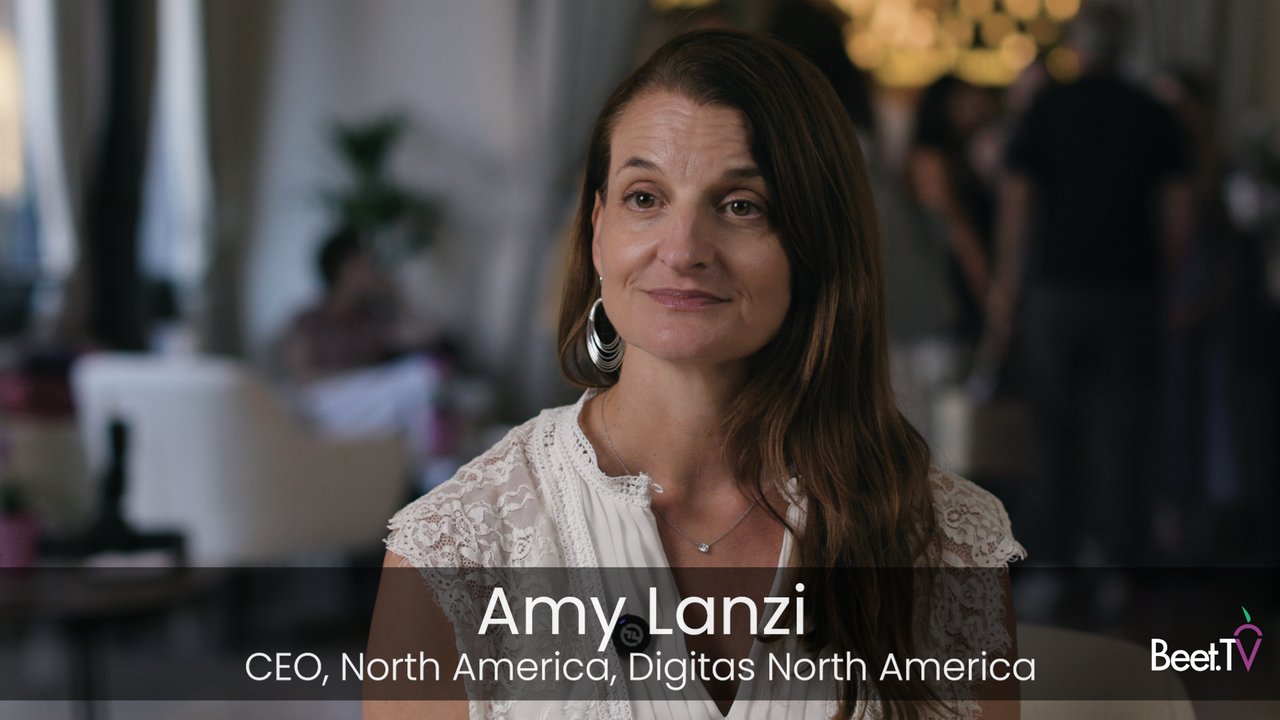
“AI is a wonderful tool for our creatives to find the things that actually might be more expected, so that they can continue to go through the creative process to find the unexpected, because that’s what creates emotional connections between consumers and brands,” said Amy Lanzi, CEO of Digitas North America, in this video interview with Beet.TV at Cannes Lions 2026.

Synthetic audiences as creative sparring partners

The agency has built what it calls a Synthetic Audience Agent, which uses past campaign data and brand guidelines to predict how target consumers might react to creative ideas before production begins. The tool lets teams surface weak concepts early and refine stronger ones without waiting weeks for formal research panels.

“We used to do this when you would wait and you’d get to a focus group and try to find an insight,” Lanzi said. “Of course, it’s not real humans, but it’s a pretty good proxy. And so you can talk about different places to play. You can then look at the creative you’re making and feed the synthetic audience the creative to get them to react.”

The capability sits within a broader AI operating system Digitas calls Digitas AI, which also includes tools for building brand-safe agents and enabling dynamic personalized web experiences. Parent company Publicis Groupe recently agreed to acquire LiveRamp for approximately $2.2 billion, a deal framed as accelerating “data co-creation for smarter agents” by combining LiveRamp’s clean rooms with Epsilon’s identity graph.

Context is king, but now you can actually deliver on it

Marketers have talked about contextual relevance for years, but Lanzi argued the tools now exist to make it operational. The shift requires creatives to think beyond a single brand act and instead design content distribution systems that can react to context while remaining authentic.

“From a creative, I say to creatives, think about a brand and the content distribution system a brand should have so that they can have the right types of creative to connect with the core or growth audience with context,” she said. “You want a brand act that can react to context and still feel authentic at the same time.”

The stakes are rising. Emarketer forecasts US AI ad spending will more than double to $68.25 billion by 2030, with more than 80% of AI advertising in 2026 appearing adjacent to AI content – such as traditional search ads next to Google AI Overviews – rather than inside chatbot conversations. That means brands need creative systems designed for AI-mediated discovery environments, not just human-curated feeds.

Networked experiences and the influence economy

Digitas describes its creative philosophy around “networked experiences” – ideas that live across the full ecosystem where a consumer plays, from content placements to community conversations to their preferred LLM. Lanzi said the definition of a consumer’s network now includes influence, community chat, and AI interfaces.

“When we think about a creative platform, it’s really about building within the network that a consumer plays within,” she said. “That network is really about influence. And that network is not only where you are placing content, it’s also community, what’s happening in the chat, also what their favorite LLM is.”

A Forrester study released with the 4A’s found nine in 10 US marketing agencies now use generative AI, and half use agentic AI for marketing execution. But the research also warned agencies are leaning so heavily toward productivity gains that they risk commoditizing creative output – precisely the trap Lanzi said Digitas is trying to avoid.

Teads’ Stephanie Himoff: Brands Shouldn’t Have to Choose Between Quality and Reach in CTV

CANNES, France — Premium CTV formats command attention that pre-roll inventory simply cannot match. The challenge has always been whether that quality comes at the cost of scale. Teads argues the tradeoff is a false one.

“Brands should not have to make a trade off between quality and reach. Omnichannel is really key to that,” Stephanie Himoff, chief commercial supply officer at Teads, told Beet.TV contributor David Kaplan at Cannes Lions. “Through the omnichannel graph, through Teads’ ad management, we are connecting CTV exposure to the web and mobile through a unified workflow.”

Teads’ own screen placements drive 48% attention rates — significantly higher than standard pre-roll formats like YouTube — a figure the company backs with exclusive measurement access through Lumen, Adelaide, and TVision.

Attention connected to outcomes

Measuring attention is one thing. Connecting it to business results is another. Teads’ CTV Performance suite bridges that gap, linking premium screen exposure to site visits, conversions, store visits, and offline sales.

“We can prove that attention matters. We take it a step forward by bringing performance into it,” Himoff said. “We can connect the CTV experience with outcome — whether it’s site visit, whether it’s conversion, whether it’s store visits or offline sales. It’s really about making this premium screen that was maybe used predominantly for branding into a performance channel.”

Exclusive partnerships underpin premium supply

Teads works with major OEMs including Hisense, Samsung, LG, TCL, and Google TV, with preferred partnerships earned through operational delivery across more than 5,000 campaigns. In Europe and APAC, Teads is LG’s exclusive provider of CTV native high-intent formats.

“Exclusive really comes with preferred partnership and you have to earn your way to those partnerships, not just talk about it, but really make them meaningful,” Himoff said. “Exclusive placement with proof that those work — that makes us very unique.”

Household data crosses screens

Bringing web-based household data into CTV targeting eliminates the reach-quality tradeoff by enabling precise audience delivery without sacrificing scale across the omnichannel graph.

“When you bring your household data that you have on the web into the CTV, you’re making sure that it works and you can really bring those levels of targeting,” Himoff said.

Program-level targeting takes this further, aligning brand messages with specific content and viewer interests rather than relying on broad demographic proxies.

Home screen, dynamic creative define what’s next

The home screen remains an underexplored opportunity, and dynamic creative optimization is enabling location-level personalization that connects CTV exposure directly to physical store visits.

“If you’re a brand and you’ve got multiple stores, you can have a personal message to the user incentivizing them to go to the store just at the point of location,” Himoff said. “The future is not about where the ad is appearing. It’s the fact that you can now serve the right ad at the right time to the right user.”

Creators are Becoming Television’s New Showrunners: WPP Media’s Adam Shlachter

CANNES, France — Creator-led video and traditional television are starting to resemble relatives at a family reunion. They arrived by different routes, insist they have nothing in common and are now sitting on the same living-room sofa.

For advertisers, that convergence is creating new ways to reach audiences that may not consider television to be a particular device, channel or programming format. If a favorite creator appears on the biggest screen in the house, that may be television enough.

“It’s not a sort of either/or. I think it’s an and,” Adam Shlachter, client president at WPP Media, said in a fireside discussion with moderator Zach Rodgers at the Cannes Lions International Festival of Creativity.

Definition of television is getting fuzzier

Older viewers grew up regarding television as the gold standard for professionally produced video. Younger audiences move comfortably among YouTube, Instagram, TikTok, Twitch and connected TV without pausing to classify each experience.

They follow creators for entertainment, information and community. The attachment is often stronger than anything generated by a conventional program guide, which has never inspired much affection beyond reminding viewers that 17 channels are currently showing crime procedurals.

Creator content also is moving onto television screens. Shlachter cited the scale and production quality of MrBeast as an extreme example of how difficult it has become to define TV by its traditional boundaries.

Creator-led programming is “being consumed, built for and consumed on so many different platforms that it’s hard to even say, ‘Well, what is TV to that audience?’” he said.

YouTube’s growing presence on connected television gives creators another outlet for longer-form programming. It also offers advertisers a way to work with personalities who already command loyal audiences instead of trying to manufacture loyalty during a 30-second commercial.

Creators become modern showrunners

Creators increasingly perform several jobs once divided among a small army of television professionals. They develop the concept, produce the content, direct the action and appear on camera.

“They’re both the producer, the director and the talent,” Shlachter said.

Some do all of that live and with a single camera. Somewhere, a television production executive is staring at a budget spreadsheet and wondering why the craft-services bill alone costs more than an entire creator series.

The larger question is whether these personalities can carry their appeal from social platforms into longer programming and bigger screens. Shlachter said the jury is still out, partly because many creators are already highly successful on the platforms where they started.

Television also is adapting to them. Creators are appearing as hosts, commentators and correspondents around live sports, red carpets and alternative broadcasts. Their value comes from an authentic connection with fans who chose to follow them, rather than viewers who merely failed to change the channel quickly enough.

Brands want more than a logo slab

For advertisers, creator partnerships need to offer more than a fleeting appearance beside a recognizable personality. Shlachter said WPP Media wants to develop lasting systems that let brands participate in the relationship between creators and their communities.

“We want to build. We don’t want to buy,” he said. “And if we can build systems and platforms that are long-lasting with these voices who have these really robust communities, we can be a part of that authentic relationship that they have rather than just have another logo slab.”

That approach requires more structure. Brands need assurances about safety, authenticity, exclusivity and competitive separation. A company underwriting a creator’s program generally does not want its largest rival wandering into the same episode like an unexpected dinner guest carrying a larger check.

“There’s got to be some standards,” Shlachter said.

Creators and their representatives are becoming more sophisticated about those expectations. Many now work with talent agents or creator networks that understand the commercial rules established by television. Early partnerships produced some hard lessons on both sides, Shlachter said, but the broader creator business is maturing.

Not every vertical video belongs on a 70-inch screen

Technical formats present another challenge. Social video was often designed for a phone held vertically, while television still favors a horizontal picture.

“I mean, I think the standards are still emerging there,” Shlachter said. “Some stuff just doesn’t look right on, you know, a 42-inch or 70-inch screen.”

Still, the awkwardness can become an advantage. Brands have run commercials during major sports events that resemble TikTok videos or Instagram Reels. Such ads may look slightly out of place on television, but their familiarity to social-media users can help them stand apart from the polished commercials surrounding them.

“It breaks through because it looks and feels different,” Shlachter said. “And it kind of looks and feels a little out of place, but also a little familiar.”

That creative tension may be the most useful part of the convergence. Television offers creators a larger canvas and access to new audiences. Creators give television a format that feels more personal, immediate and connected to culture.

Advertisers, meanwhile, get another chance to secure the resource they have pursued through every technological upheaval since the invention of the remote control.

“Ultimately, that’s what we’re trying to do,” Shlachter said, “get people to pay attention.”

Nift’s Saket Mehta: Brands Must Learn to Thank Consumers for Their Actions

Attention has always been valuable in advertising. What has changed is how hard consumers are making brands work to earn it. It all comes down to what happens when brands get the moment right.

“You can’t just serve the customer an impression, you have to meaningfully engage with them,” Saket Mehta, CRO of Nift, told Beet.TV Editorial Director Lisa Granatstein. “What that means at Nift is that it’s a moment where we allow a business or a publisher to thank a consumer for a specific action.”

That opt-in, action-triggered model is generating conversion rates of 10 to 12% across Nift’s platform, compared to the one to 3% typical of digital advertising. Foot Locker reports that 90% of its customers enjoy their Nift gift.

Relevance earns trust

Harris Poll research commissioned by Nift found that 84% of consumers respond well when brands demonstrate they understand what the customer wants. That expectation has intensified as AI raises the bar for personalization across every channel.

“Customers are expecting brands and publishers to know what they want and what’s relevant to them, especially in this age of AI,” Mehta said. “What’s really important is that marketers are asking not how do I just serve them an impression, but how do I engage the customer in a really effective way?”

Delivery confirmations, loyalty program enrollments, milestone moments, and reservation confirmations all create natural openings where brand appreciation lands as genuinely relevant rather than intrusive.

Three-sided marketplace

Nift operates as a three-sided marketplace connecting publishers, advertisers, and consumers. Publishers thank customers on behalf of their own brand. Advertisers reach new consumers in high-relevance moments. Consumers discover products and services through machine learning that matches offers to demonstrated behavior.

A recent Klarna partnership illustrates the upside when all three sides align. Klarna’s birthday gift campaign generated a 150% increase in revenue alongside a 90% increase in customer favorability.

“Both revenue and customer sentiment can be drawn together and achieved together when done right,” Mehta said.

Intentionality over monetization

Owned customer moments are becoming more valuable than bought media, but Mehta is direct about the risk of over-monetizing them. Nift sends roughly 50 million gifts monthly, and consistent positive consumer experience requires discipline about when and how often to interject.

“The goal is not to over monetize. It’s to be highly intentional about how you’re reaching that customer and their ability to discover new products and services that could be relevant to them,” Mehta said.

Breaking down silos

The brands winning in this environment are those dismantling the separation between monetization, media, and customer experience — treating them as a single unit rather than competing priorities.

“Really making sure the silo between monetization, media, and customer experience all joins together and then operates as a unit so you can drive the appropriate level of customer appreciation and reciprocity,” Mehta said. “When they’re able to really ensure that they’re optimizing for the customer, we consistently see positive customer experience and stronger yield and better advertising performance for the marketer.”

Axonet’s Patrick Raycroft: RMN Aggregation Democratizes Access To Retail Media

CANNES, France — With 250 retail media networks now competing for advertiser budgets, the math of direct relationships is breaking down. Brands and agencies have fixed time, fixed resources, and fixed capacity for RMN partnerships. And that means spending tends to consolidate at the top and the long tail goes unfunded.

“The brands and agencies that are engaging with RMN have limited ability to activate with an increasing number of RMNs. There’s fixed costs, fixed time and resources that have to go into those relationships, and that limits spend going into RMNs down market on the long tail,” Patrick Raycroft, CEO of Axonet, told Beet.TV contributor David Kaplan at Cannes Lions. “We believe it’s democratizing access, not only for the retailers, but also for those brands that may want to activate in some of those retail outlets but don’t have the time, the resources, the people to engage with them.”

Axonet positions itself as a first-party media network. It aggregates retailer data and owned and operated touchpoints into a single layer that national campaigns can activate against while retaining the measurement credibility that makes retail media valuable in the first place.

Retailers keep control

The most common concern Raycroft hears from retailers considering aggregation is loss of control over their data and direct brand relationships. His answer separates two distinct use cases that can coexist.

“We aren’t here to stand in between retailers working directly with brands on particular activations. If a brand wants to do a big bet with a retailer, they can still do that within an aggregated model,” Raycroft said. “They’re still your owned and operated assets.”

Data control is addressed retailer by retailer through legal frameworks built around the principle that retailers controlling their own assets is paramount. From there, aggregation is layered on top as a value exchange rather than a takeover, Raycroft added.

Think national, not “network”

The bigger behavioral shift Raycroft is pushing brands toward is organizational rather than tactical. Most brands currently manage RMN and national budgets in separate teams with separate objectives — a structure that prevents them from unlocking what aggregation actually offers.

“In order to unlock the power of a national first party media network, you need to think about it as that — as a national media network — not necessarily as an RMN. But it brings the RMN bonafides behind it of first party audiences, first party touchpoints, and that trusted and verified measurement,” Raycroft said.

Both, not either/or

Raycroft is careful not to position aggregation as a replacement for direct retailer relationships. Large bets, limited time offers, and deep brand-retailer integrations still belong in direct relationships. Aggregation serves the national layer alongside them.

“I don’t see it as an either or. I see it as an and,” Raycroft said. “That’s where we’re growing and continuing to grow with our retailers on our network, but also our brands and agencies as well.”

CTV’s Awareness-Only Era Is Over: Brands Now Chasing Performance on the Big Screen

The living room’s biggest screen is no longer just a billboard. Marketers once treated connected TV as a blunt awareness tool – the digital successor to the 30-second broadcast spot – but that thinking is increasingly outdated as advertisers demand the same accountability from CTV that they expect from search and social.

U.S. CTV ad spending is forecast to grow 14% to $37.26 billion in 2026, according to Emarketer research, yet nearly 38% of marketers still cite difficulty proving incremental return on ad spend as a top barrier.

“CTV is no longer just super high funnel awareness driver. It also can truly drive people through their experience,” said Dani Cushion, CMO of Teads, in this video interview with Beet.TV at Cannes Lions 2026.

The second-screen reality demands orchestration

Research suggests 50% to 60% of viewers are simultaneously on a phone or tablet, a figure that climbs higher during live sports. That fragmented attention makes CTV a starting point rather than a destination.

Cushion argued that brands should treat CTV as the anchor of a cross-device strategy rather than a standalone buy. “CTV is the first screen that you’re going to see, but figuring out how to get that to connect in an omnichannel way with web, with mobile, and using them together is really important,” she said.

The approach relies on sequential messaging and retargeting across screens. “I as a consumer am going to be watching a show, engaging with an ad, but perhaps getting a similar ad either retargeted sequentially or just being surrounded later by the brand,” Cushion said. “It really is thoughtful about the experience that I’m having with the brand.”

Data remains the sticking point

Omnichannel sounds elegant in a pitch deck but some think it tends to fall apart in execution. The culprit, according to Cushion, is data fragmentation – specifically the difficulty of tying a household on a smart TV to an individual on a mobile device to a browser session on a laptop.

“Unless you can actually have data to be able to tie the thread between knowing who is one person here, one household here, and how are you actually making sure that you’re targeting the same people with the right kind of messages – the data is a lot of what stands in the way of that,” she said.

Teads positions its omnichannel graph, built on direct CTV integrations and relationships with more than 10,000 open-web publishers, as the connective tissue. “You don’t have to worry about patching it together. You have it all in one place and you can make sure that you have this sort of symphonic connection of reaching your consumers effectively,” Cushion said.

From attention to attribution

CTV’s attention advantage is well documented – Teads claims its HomeScreen video ads achieve a 48% attention rate and outperform skippable pre-roll by 16% – but attention alone does not satisfy CFOs. The company recently launched CTV Ensemble, a suite that includes what it calls CTV Performance, designed to connect big-screen impressions to lower-funnel outcomes.

The product emerged from a beta spanning roughly 40 campaigns across 14 countries. “We’re actually able to help brands show that it’s not just high funnel, but that you can drive performance campaigns from CTV and drive actual measurable outcomes,” Cushion said.

One example she cited was Citroën, which used CTV Performance to drive test-drive bookings. A Teads case study reports the campaign generated a 94% video completion rate, more than 13,000 site visits, and 5,000 online conversions tied to vehicle configuration and dealership searches. “We were able to measure the impact from CTV to those online conversions that drove that,” Cushion said.

How Brands Engineer Impulse Buying: Axonet’s Patrick Raycroft and Mars United’s Amy Andrews

CANNES, France – The convenience-store impulse buy may feel spontaneous. In reality, an impressive collection of data, advertising technology and loyalty programs could be helping that energy drink leap into a shopper’s hand.

Axonet co-founder and CEO Patrick Raycroft and Mars United Commerce president Amy Andrews examined the science behind those quick purchases during a panel moderated by McKinsey & Co. partner Quentin George at the Cannes Lions International Festival of Creativity.

Axonet operates a retail media network for convenience stores and fuel retailers. Mars United is a commerce marketing company that helps brands influence shoppers across stores, digital platforms and retail media networks. Publicis Groupe acquired Mars United in 2024.

The discussion covered everything from three-minute shopping trips to artificial intelligence agents that may someday order products before consumers know they want them. Apparently, even robots will understand the medicinal importance of a gas-station snack.

Impulse trips are partly planned

Andrews distinguished between an impulse purchase and an “impulse trip,” such as an unplanned stop made while traveling somewhere else.

“We are absolutely still in an impulse era,” she said. “There’s the impulse purchase, but then also the impulse trip.”

Raycroft said the word “impulse” doesn’t fully describe the 160 million transactions that take place each day at U.S. convenience stores. Many visits are inevitable even if shoppers haven’t decided when or where they will stop.

People need fuel, food, caffeine or products involving what Raycroft diplomatically called “vices.” The trip is coming. The precise location remains up for grabs.

“Once I make that stop, that’s the moment that we have to influence the impulse buy,” he said.

For brands, that creates a narrow opening between a practical need and a sudden craving. The shopper may have planned to buy gasoline. The neon-blue beverage and family-sized bag of cheese dust were more of a late roster addition.

Three minutes leave little time for Hamlet

Convenience-store shoppers are typically in and out in less than three minutes. Raycroft’s advice for advertisers was characteristically restrained: “Hit them a lot and hit them in really short bursts.”

That can mean reaching consumers at fuel dispensers, on screens inside the store, through audio messages or with advertising delivered before they arrive. It also can involve customer relationship management programs and loyalty data.

The creative must fit the setting. A 30-second television commercial has little chance against a shopper moving toward the register with the speed and determination of someone who left a child waiting in the car.

“The eight, 10, 12-second range” tends to be most effective, Raycroft said. Those shorter formats also can work across social media, off-site advertising and other digital channels.

Andrews said artificial intelligence and automation can help advertisers produce variations of creative for different audiences and moments.

“AI is not replacing creativity,” she said. “But in terms of scaling content, there’s a lot of automation technology that we can use now.”

Loyalty data follows the shopper around town

A typical consumer regularly visits five to seven convenience-store brands, according to Raycroft. That makes it important to connect shopping activity across different retailers.

“It’s all about the connectivity in the convenience-store customer,” he said.

The goal is to understand what one shopper does across BP, Marathon and other chains rather than treating every stop as the work of a newly discovered human being.

Consumers help by entering their phone numbers into loyalty programs, usually in exchange for discounts. Andrews described that bargain as a value exchange. People are more willing to identify themselves when the resulting offer provides a meaningful benefit over time.

Marketers then face another problem: separating useful buying signals from the enormous warehouse of digital clutter they have spent years proudly collecting.

“We have so much data now,” Andrews said. “We’re all struggling with what are the right signals.”

More complete data can help agencies examine purchases across retailers and sales channels. That allows them to identify the behaviors most relevant to a client’s objectives.

Selling another unit is still the assignment

For all the elaborate technology and discussion of omnichannel consumer journeys, Raycroft said convenience-store advertising eventually comes down to a fairly uncomplicated measurement.

“At the end of the day, it’s unit velocity,” he said. “That’s just the name of the game.”

Unit velocity measures how quickly products sell. Advertisers also want to know whether a campaign brought in new customers or generated purchases that would not otherwise have occurred.

Andrews warned that moving a planned purchase from tomorrow to today does not necessarily create incremental sales. It may simply change the date on the receipt.

Challenger brands have a particular opportunity in convenience stores. Consumers may hesitate to buy a 12-pack of an unfamiliar beverage at a supermarket. They are more likely to gamble on one can during a quick stop.

“You gain brand loyalty through the single-unit purchase, not through the multipack purchase at the grocery store,” Raycroft said.

That makes convenience stores a proving ground for new brands. It also gives established companies one more thing to worry about before breakfast.

Timing prevents advertising overkill

Convenience stores place shoppers within 20 to 30 feet of many advertised products. Retailers can synchronize video and in-store messages to reach consumers when an item is almost literally within arm’s length.

Timing matters. Raycroft noted that promoting energy drinks at 1 a.m. on a Thursday is unlikely to be especially productive. Presumably, the truly dedicated Thursday-night energy-drink customer has already made arrangements.

Loyalty data can help advertisers estimate when commuters and professional drivers are likely to shop. Brands can then concentrate their messages before, during and after the expected visit.

That prompted George to ask whether consumers need protection from a marketing barrage that follows them to the pump, through the store, past the register and back into the car.

“That feels like a lot,” Andrews conceded.

She recommended using different messages across the day and the shopping journey. The aim is to create a coherent experience without making customers feel pursued by a can of soda carrying a search warrant.

Fragmentation complicates national campaigns

Convenience retail remains divided among chains, franchisees and independent operators. A national advertiser might have to deal with dozens or even hundreds of retail media networks.

Raycroft said aggregation can simplify that buying process, provided retailers retain the qualities that make their businesses distinctive.

“It makes it really difficult when you have to navigate 10, 20, 30, 200 retail media networks in the C-store space,” he said.

Axonet seeks to give advertisers access to first-party retail data at a national scale while allowing retailers to preserve their direct relationships with suppliers and manufacturers.

Mars United takes a wider view of the shopper. Andrews said Publicis puts identity at the center of its strategy, examining purchases across convenience stores, grocery outlets and other sales channels. Agencies can then determine whether the convenience channel should support a product launch or help turn a one-can experiment into a six-pack commitment.

AI may automate temptation

George closed by asking whether agentic AI could eliminate impulse purchases by automatically ordering household staples and optimizing shopping lists.

Both panelists said no.

Raycroft suggested that autonomous vehicles could have a bigger effect by changing when and why consumers visit fuel stations. Until then, the convenience-store impulse buy appears safe.

Andrews went further, predicting that AI could become an entirely new source of temptation.

“True agentic commerce could be the ultimate surprise and delight,” she said.

An AI agent might introduce consumers to products they did not know they needed. That would preserve the impulse purchase while removing the inefficient step in which the shopper personally develops the impulse.

For marketers, it is a tantalizing prospect: a machine that knows what consumers want before they do and is always willing to stop for snacks.axonet

Healthcare Marketers Seek to Close the Loop from Ad Impressions to Patient Outcomes

CANNES, France – Healthcare marketers have been promising to “close the loop” between advertising and patient outcomes for years. Unfortunately, that loop has often resembled a circle drawn by someone riding in the back of an ambulance.

Connecting an ad impression to a real health outcome is unusually difficult. Patient journeys are complicated, medical data is highly sensitive and the healthcare system does not exactly glide along with the efficiency of a Cannes hotel bar tab.

Christine Grammier, vice president of global measurement products at LiveRamp, Scott Mackay, head of sales at CVS Media Exchange, or CMX, and Frank Lin, vice president and general manager at IQVIA Digital, discussed how marketers are getting closer to making those connections in a panel moderated by Beet.TV contributor Tameka Kee at the Cannes Lions International Festival of Creativity.

Pharma ads attempt a reputation transplant

Pharmaceutical advertising may inspire eye rolls, especially when a commercial’s list of possible side effects seems longer than the program it interrupted. Lin argued that relevant health information can still help patients begin conversations they might otherwise avoid.

“Pharma ads get a bad rep,” Lin said. Yet for a patient or caregiver dealing with a condition, a well-placed message can provide useful information before a doctor’s appointment.

Advertising has also helped reduce the stigma surrounding sensitive categories such as erectile dysfunction, women’s health and mental health, he said. The first step toward closing the loop is understanding whom an impression reaches and whether it encourages a meaningful conversation.

CMX occupies a particularly useful position because CVS operates across retail, pharmacy and patient care. That gives the media network signals that a typical retailer cannot collect between the breakfast cereal and the laundry detergent.

“Most RMNs, retail media networks, they’re looking at actual transactions, where we’re actually looking at health journeys,” Mackay said.

Seven out of 10 visits to CVS are motivated by healthcare needs, according to Mackay. CMX can connect advertising exposure with store engagement, conversations with pharmacists and actions such as prescription fills or refills.

The important question is no longer limited to whether someone saw an ad. Marketers can begin asking whether that person took a step toward better health.

Patient journey refuses to behave like a funnel

The traditional marketing funnel looks reassuringly orderly on a PowerPoint slide. The American healthcare system apparently has declined to participate.

“I wish the loop is this perfect circle that we’d all draw on the whiteboard,” Lin said. “It’s a non-linear journey that we all take.”

IQVIA follows medicines from clinical trials through commercialization and their use among patients in the real world. That broader view helps marketers assess more than whether an advertisement led to a prescription.

“The definition of patient outcome doesn’t stop at that script lift,” Lin said. “It’s really about the continuance of, is this patient getting better?”

That process can include the physician, nurse practitioner, pharmacist, insurer, caregiver and patient. In other words, the healthcare journey has a cast large enough for prestige television, but considerably more paperwork.

Data gets connected without revealing the patient

Bringing these signals together requires technology that protects a person’s identity. Healthcare data cannot simply be passed among companies like a beach-party invitation.

Grammier said healthcare companies use methods including tokenization and expert determination to de-identify information and prevent it from being traced back to an individual.

“The fundamental idea is that your data is de-identified in an expert way, ensured that it cannot be re-identified to you as a consumer,” Grammier said.

LiveRamp provides a clean-room framework that lets companies compare exposure and outcome data without directly transferring sensitive information. Platforms such as TikTok, Snap and Meta can provide advertising exposure data that partners use to determine whether messages reached the intended audiences. YouTube remains “a little tricky,” Grammier said, proving that even sophisticated data architecture must occasionally confront the digital equivalent of a locked medicine cabinet.

The analysis can show whether a person in an appropriate audience saw an ad, visited a doctor, received a diagnosis, filled a prescription and remained on the treatment.

“That whole journey is possible today in our ecosystem,” Grammier said, provided companies take additional steps to protect patient data.

Closed loop runs through drugstores

Mackay offered a practical example of how the process can work. A consumer might see an ad away from CVS, encounter the message again on a screen inside the store and then speak with a pharmacist.

That conversation could lead to the purchase of an over-the-counter product, a prescription fill or a follow-up with a doctor. The campaign crosses several channels while its effectiveness can be measured through connected signals.

CVS can also combine information from the front and back of the store to develop a more complete view of the customer’s healthcare journey. The company must do this without making shoppers suspect that the moisturizer aisle has developed surveillance capabilities.

“Trust is everything,” Mackay said. “That’s really our foundation.”

Consent is also critical. Mackay said CMX can avoid sending vaccination messages to someone who has already received the vaccine. It also seeks to avoid bombarding unvaccinated consumers with the same appeal until they begin hiding from the pharmacy app.

“It’s finding that direct balance,” he said, between educating patients and “not overstepping our boundaries.”

Precision doesn’t belong everywhere

Healthcare marketers may have access to highly precise information, but Grammier said they do not need to apply that precision at every stage of a campaign.

Detailed data can be valuable for measurement while consumer targeting can rely on broader audience models. That distinction lets companies assess whether a campaign worked without delivering an ad so specific that the recipient wonders whether their dermatologist has joined the media plan.

LiveRamp, IQVIA and CVS all maintain data ethics or privacy teams. Lin said IQVIA Digital also uses an ethics board to examine campaigns.

“It’s not just, ‘Hey, can we do this,’ but, ‘Is it ethical to do this?’” Lin said.

The goal is to give patients useful knowledge rather than merely drive prescriptions. Companies working with healthcare information must earn trust through standards that may exceed the minimum requirements of the broader advertising industry, he added.

Dashboard receives grim diagnosis

As healthcare measurement improves, Lin expects marketers to shift their attention from reporting results to acting on them.

“We also believe that dashboards are dead,” he said.

Brands have reached the “so what” stage of measurement, Lin added. A dashboard can report what happened, but marketers increasingly want to know how they should adjust placements, audiences and spending.

IQVIA is therefore moving from measurement toward optimization, working with media partners to shorten the time between gathering results and changing a campaign.

Grammier said optimization does not require telling a media platform that a particular consumer received a prescription. Marketers can use broader signals showing that certain placements or audiences performed better than others.

The future of healthcare measurement may involve less cumbersome planning, faster optimization and stronger privacy protections. It could even produce the rare pharmaceutical campaign that reaches the right patient, encourages useful care and stops showing ads once its work is finished.

For an industry still trying to close a stubbornly broken loop, that would qualify as a healthy outcome.