How Brands Engineer Impulse Buying: Axonet’s Patrick Raycroft and Mars United’s Amy Andrews
CANNES, France – The convenience-store impulse buy may feel spontaneous. In reality, an impressive collection of data, advertising technology and loyalty programs could be helping that energy drink leap into a shopper’s hand.
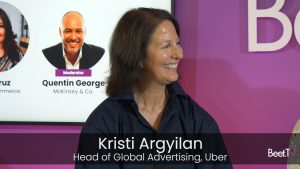
Axonet co-founder and CEO Patrick Raycroft and Mars United Commerce president Amy Andrews examined the science behind those quick purchases during a panel moderated by McKinsey & Co. partner Quentin George at the Cannes Lions International Festival of Creativity.
Axonet operates a retail media network for convenience stores and fuel retailers. Mars United is a commerce marketing company that helps brands influence shoppers across stores, digital platforms and retail media networks. Publicis Groupe acquired Mars United in 2024.
The discussion covered everything from three-minute shopping trips to artificial intelligence agents that may someday order products before consumers know they want them. Apparently, even robots will understand the medicinal importance of a gas-station snack.
Impulse trips are partly planned
Andrews distinguished between an impulse purchase and an “impulse trip,” such as an unplanned stop made while traveling somewhere else.
“We are absolutely still in an impulse era,” she said. “There’s the impulse purchase, but then also the impulse trip.”
Raycroft said the word “impulse” doesn’t fully describe the 160 million transactions that take place each day at U.S. convenience stores. Many visits are inevitable even if shoppers haven’t decided when or where they will stop.
People need fuel, food, caffeine or products involving what Raycroft diplomatically called “vices.” The trip is coming. The precise location remains up for grabs.
“Once I make that stop, that’s the moment that we have to influence the impulse buy,” he said.
For brands, that creates a narrow opening between a practical need and a sudden craving. The shopper may have planned to buy gasoline. The neon-blue beverage and family-sized bag of cheese dust were more of a late roster addition.
Three minutes leave little time for Hamlet
Convenience-store shoppers are typically in and out in less than three minutes. Raycroft’s advice for advertisers was characteristically restrained: “Hit them a lot and hit them in really short bursts.”
That can mean reaching consumers at fuel dispensers, on screens inside the store, through audio messages or with advertising delivered before they arrive. It also can involve customer relationship management programs and loyalty data.
The creative must fit the setting. A 30-second television commercial has little chance against a shopper moving toward the register with the speed and determination of someone who left a child waiting in the car.
“The eight, 10, 12-second range” tends to be most effective, Raycroft said. Those shorter formats also can work across social media, off-site advertising and other digital channels.
Andrews said artificial intelligence and automation can help advertisers produce variations of creative for different audiences and moments.
“AI is not replacing creativity,” she said. “But in terms of scaling content, there’s a lot of automation technology that we can use now.”
Loyalty data follows the shopper around town
A typical consumer regularly visits five to seven convenience-store brands, according to Raycroft. That makes it important to connect shopping activity across different retailers.
“It’s all about the connectivity in the convenience-store customer,” he said.
The goal is to understand what one shopper does across BP, Marathon and other chains rather than treating every stop as the work of a newly discovered human being.
Consumers help by entering their phone numbers into loyalty programs, usually in exchange for discounts. Andrews described that bargain as a value exchange. People are more willing to identify themselves when the resulting offer provides a meaningful benefit over time.
Marketers then face another problem: separating useful buying signals from the enormous warehouse of digital clutter they have spent years proudly collecting.
“We have so much data now,” Andrews said. “We’re all struggling with what are the right signals.”
More complete data can help agencies examine purchases across retailers and sales channels. That allows them to identify the behaviors most relevant to a client’s objectives.
Selling another unit is still the assignment
For all the elaborate technology and discussion of omnichannel consumer journeys, Raycroft said convenience-store advertising eventually comes down to a fairly uncomplicated measurement.
“At the end of the day, it’s unit velocity,” he said. “That’s just the name of the game.”
Unit velocity measures how quickly products sell. Advertisers also want to know whether a campaign brought in new customers or generated purchases that would not otherwise have occurred.
Andrews warned that moving a planned purchase from tomorrow to today does not necessarily create incremental sales. It may simply change the date on the receipt.
Challenger brands have a particular opportunity in convenience stores. Consumers may hesitate to buy a 12-pack of an unfamiliar beverage at a supermarket. They are more likely to gamble on one can during a quick stop.
“You gain brand loyalty through the single-unit purchase, not through the multipack purchase at the grocery store,” Raycroft said.
That makes convenience stores a proving ground for new brands. It also gives established companies one more thing to worry about before breakfast.
Timing prevents advertising overkill
Convenience stores place shoppers within 20 to 30 feet of many advertised products. Retailers can synchronize video and in-store messages to reach consumers when an item is almost literally within arm’s length.
Timing matters. Raycroft noted that promoting energy drinks at 1 a.m. on a Thursday is unlikely to be especially productive. Presumably, the truly dedicated Thursday-night energy-drink customer has already made arrangements.
Loyalty data can help advertisers estimate when commuters and professional drivers are likely to shop. Brands can then concentrate their messages before, during and after the expected visit.
That prompted George to ask whether consumers need protection from a marketing barrage that follows them to the pump, through the store, past the register and back into the car.
“That feels like a lot,” Andrews conceded.
She recommended using different messages across the day and the shopping journey. The aim is to create a coherent experience without making customers feel pursued by a can of soda carrying a search warrant.
Fragmentation complicates national campaigns
Convenience retail remains divided among chains, franchisees and independent operators. A national advertiser might have to deal with dozens or even hundreds of retail media networks.
Raycroft said aggregation can simplify that buying process, provided retailers retain the qualities that make their businesses distinctive.
“It makes it really difficult when you have to navigate 10, 20, 30, 200 retail media networks in the C-store space,” he said.
Axonet seeks to give advertisers access to first-party retail data at a national scale while allowing retailers to preserve their direct relationships with suppliers and manufacturers.
Mars United takes a wider view of the shopper. Andrews said Publicis puts identity at the center of its strategy, examining purchases across convenience stores, grocery outlets and other sales channels. Agencies can then determine whether the convenience channel should support a product launch or help turn a one-can experiment into a six-pack commitment.
AI may automate temptation
George closed by asking whether agentic AI could eliminate impulse purchases by automatically ordering household staples and optimizing shopping lists.
Both panelists said no.
Raycroft suggested that autonomous vehicles could have a bigger effect by changing when and why consumers visit fuel stations. Until then, the convenience-store impulse buy appears safe.
Andrews went further, predicting that AI could become an entirely new source of temptation.
“True agentic commerce could be the ultimate surprise and delight,” she said.
An AI agent might introduce consumers to products they did not know they needed. That would preserve the impulse purchase while removing the inefficient step in which the shopper personally develops the impulse.
For marketers, it is a tantalizing prospect: a machine that knows what consumers want before they do and is always willing to stop for snacks.axonet
You’re watching The Beet.TV Leadership Sessions at Cannes Lions 2026, presented by Axonet and Uber Advertising. For more videos from this series, please visit this page. You can find all of our coverage from Cannes Lions 2026 here.


CANNES, France – The convenience-store impulse buy may feel spontaneous. In reality, an impressive collection of data, advertising technology and loyalty programs could be helping that energy drink leap into a shopper’s hand.
Axonet co-founder and CEO Patrick Raycroft and Mars United Commerce president Amy Andrews examined the science behind those quick purchases during a panel moderated by McKinsey & Co. partner Quentin George at the Cannes Lions International Festival of Creativity.
Axonet operates a retail media network for convenience stores and fuel retailers. Mars United is a commerce marketing company that helps brands influence shoppers across stores, digital platforms and retail media networks. Publicis Groupe acquired Mars United in 2024.
The discussion covered everything from three-minute shopping trips to artificial intelligence agents that may someday order products before consumers know they want them. Apparently, even robots will understand the medicinal importance of a gas-station snack.
Impulse trips are partly planned
Andrews distinguished between an impulse purchase and an “impulse trip,” such as an unplanned stop made while traveling somewhere else.
“We are absolutely still in an impulse era,” she said. “There’s the impulse purchase, but then also the impulse trip.”
Raycroft said the word “impulse” doesn’t fully describe the 160 million transactions that take place each day at U.S. convenience stores. Many visits are inevitable even if shoppers haven’t decided when or where they will stop.
People need fuel, food, caffeine or products involving what Raycroft diplomatically called “vices.” The trip is coming. The precise location remains up for grabs.
“Once I make that stop, that’s the moment that we have to influence the impulse buy,” he said.
For brands, that creates a narrow opening between a practical need and a sudden craving. The shopper may have planned to buy gasoline. The neon-blue beverage and family-sized bag of cheese dust were more of a late roster addition.
Three minutes leave little time for Hamlet
Convenience-store shoppers are typically in and out in less than three minutes. Raycroft’s advice for advertisers was characteristically restrained: “Hit them a lot and hit them in really short bursts.”
That can mean reaching consumers at fuel dispensers, on screens inside the store, through audio messages or with advertising delivered before they arrive. It also can involve customer relationship management programs and loyalty data.
The creative must fit the setting. A 30-second television commercial has little chance against a shopper moving toward the register with the speed and determination of someone who left a child waiting in the car.
“The eight, 10, 12-second range” tends to be most effective, Raycroft said. Those shorter formats also can work across social media, off-site advertising and other digital channels.
Andrews said artificial intelligence and automation can help advertisers produce variations of creative for different audiences and moments.
“AI is not replacing creativity,” she said. “But in terms of scaling content, there’s a lot of automation technology that we can use now.”
Loyalty data follows the shopper around town
A typical consumer regularly visits five to seven convenience-store brands, according to Raycroft. That makes it important to connect shopping activity across different retailers.
“It’s all about the connectivity in the convenience-store customer,” he said.
The goal is to understand what one shopper does across BP, Marathon and other chains rather than treating every stop as the work of a newly discovered human being.
Consumers help by entering their phone numbers into loyalty programs, usually in exchange for discounts. Andrews described that bargain as a value exchange. People are more willing to identify themselves when the resulting offer provides a meaningful benefit over time.
Marketers then face another problem: separating useful buying signals from the enormous warehouse of digital clutter they have spent years proudly collecting.
“We have so much data now,” Andrews said. “We’re all struggling with what are the right signals.”
More complete data can help agencies examine purchases across retailers and sales channels. That allows them to identify the behaviors most relevant to a client’s objectives.
Selling another unit is still the assignment
For all the elaborate technology and discussion of omnichannel consumer journeys, Raycroft said convenience-store advertising eventually comes down to a fairly uncomplicated measurement.
“At the end of the day, it’s unit velocity,” he said. “That’s just the name of the game.”
Unit velocity measures how quickly products sell. Advertisers also want to know whether a campaign brought in new customers or generated purchases that would not otherwise have occurred.
Andrews warned that moving a planned purchase from tomorrow to today does not necessarily create incremental sales. It may simply change the date on the receipt.
Challenger brands have a particular opportunity in convenience stores. Consumers may hesitate to buy a 12-pack of an unfamiliar beverage at a supermarket. They are more likely to gamble on one can during a quick stop.
“You gain brand loyalty through the single-unit purchase, not through the multipack purchase at the grocery store,” Raycroft said.
That makes convenience stores a proving ground for new brands. It also gives established companies one more thing to worry about before breakfast.
Timing prevents advertising overkill
Convenience stores place shoppers within 20 to 30 feet of many advertised products. Retailers can synchronize video and in-store messages to reach consumers when an item is almost literally within arm’s length.
Timing matters. Raycroft noted that promoting energy drinks at 1 a.m. on a Thursday is unlikely to be especially productive. Presumably, the truly dedicated Thursday-night energy-drink customer has already made arrangements.
Loyalty data can help advertisers estimate when commuters and professional drivers are likely to shop. Brands can then concentrate their messages before, during and after the expected visit.
That prompted George to ask whether consumers need protection from a marketing barrage that follows them to the pump, through the store, past the register and back into the car.
“That feels like a lot,” Andrews conceded.
She recommended using different messages across the day and the shopping journey. The aim is to create a coherent experience without making customers feel pursued by a can of soda carrying a search warrant.
Fragmentation complicates national campaigns
Convenience retail remains divided among chains, franchisees and independent operators. A national advertiser might have to deal with dozens or even hundreds of retail media networks.
Raycroft said aggregation can simplify that buying process, provided retailers retain the qualities that make their businesses distinctive.
“It makes it really difficult when you have to navigate 10, 20, 30, 200 retail media networks in the C-store space,” he said.
Axonet seeks to give advertisers access to first-party retail data at a national scale while allowing retailers to preserve their direct relationships with suppliers and manufacturers.
Mars United takes a wider view of the shopper. Andrews said Publicis puts identity at the center of its strategy, examining purchases across convenience stores, grocery outlets and other sales channels. Agencies can then determine whether the convenience channel should support a product launch or help turn a one-can experiment into a six-pack commitment.
AI may automate temptation
George closed by asking whether agentic AI could eliminate impulse purchases by automatically ordering household staples and optimizing shopping lists.
Both panelists said no.
Raycroft suggested that autonomous vehicles could have a bigger effect by changing when and why consumers visit fuel stations. Until then, the convenience-store impulse buy appears safe.
Andrews went further, predicting that AI could become an entirely new source of temptation.
“True agentic commerce could be the ultimate surprise and delight,” she said.
An AI agent might introduce consumers to products they did not know they needed. That would preserve the impulse purchase while removing the inefficient step in which the shopper personally develops the impulse.
For marketers, it is a tantalizing prospect: a machine that knows what consumers want before they do and is always willing to stop for snacks.axonet
You’re watching The Beet.TV Leadership Sessions at Cannes Lions 2026, presented by Axonet and Uber Advertising. For more videos from this series, please visit this page. You can find all of our coverage from Cannes Lions 2026 here.

Series Videos