

Electronic Arts’ Alex Dao, LiveRamp’s Frederick Stanichev and DoorDash’s Katie Daleo Turn Marketing Into Moments
CANNES, Lions — Consumers increasingly divide their time among video games, delivery apps, live events and the occasional attempt to experience reality without checking a phone. That fragmentation is pushing marketers to look beyond conventional media placements and find moments when people are actively engaged.
Electronic Arts, DoorDash and LiveRamp are helping brands connect those moments with first-party data and measurable outcomes, executives from the companies said during a Beet.TV Leadership Session presented by LiveRamp at the Cannes Lions International Festival of Creativity.
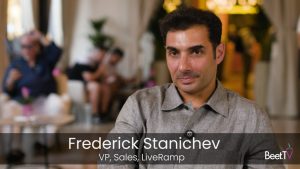
The panel featured Alex Dao, vice president of advertising and sponsorships at Electronic Arts, Frederick Stanichev, vice president of sales at LiveRamp and Katie Daleo, general manager of CPG ads at DoorDash. Beet.TV contributor Tameka Kee moderated the discussion.
Stanichev described experiential media networks as an emerging category that can combine live or digital experiences with advertiser data. Unlike a retail media network, the platform hosting the experience may not control the final transaction. That outcome might instead belong to the advertiser.
The necessary data infrastructure largely exists, he said. The next phase involves making it easier for brands to use at greater scale.
“The infrastructure is already there,” Stanichev said. “It just is now maturing and scaling through all the different functions.”
EA would prefer that advertisers not ruin the game
Gaming presents a particularly valuable environment because players are not merely watching. They are operating the quarterback, building a virtual house or trying to defeat a teenager who seems to have eight thumbs.
Dao said gaming has grown larger than the film and music industries combined. The worldwide gaming audience totals about 3.6 billion people, or almost half the global population.
EA’s portfolio includes franchises such as EA Sports FC, Madden NFL, College Football, Battlefield and The Sims. More than 1 billion matches are played every month in EA Sports FC alone, Dao said.
Players also spend an average of 90 minutes with the game, giving EA something marketers have spent years pursuing through increasingly elaborate charts: sustained attention.
“They’re not dual screening, they’re not distracted, and you have their full attention,” Dao said.
That does not mean EA intends to slap a commercial over the screen while someone is attempting a game-winning pass. Dao said advertisers must understand the game, the audience and the reasons people are playing.
“What you don’t want to do as a marketer is actually get in front of them in a way that disrupts that experience or takes away from what they’re trying to do,” he said.
Visa, for example, sponsored live events and tournaments for EA players. The activation included branded uniforms, stadium advertising and broadcast placements. Coach took a different approach by making virtual products available free to The Sims community.
EA even turns down advertisers when the fit is wrong.
“We do,” Dao said when Kee asked whether EA ever refuses advertising money, a sentence rarely heard on the French Riviera without causing nearby yachts to sound their alarms.
The company looks for brands that already understand the sport or audience surrounding a particular title. Retail and consumer-product advertisers may fit naturally into The Sims, while sports sponsors may work better in Madden or EA Sports FC.
DoorDash finds drama in the delivery bag
DoorDash occupies a different kind of experiential moment. Consumers may spend less time placing an order than playing a video game, but the transaction can carry plenty of emotional weight.
“It could be my daughter has a fever at two in the morning and I need Tylenol delivered,” Daleo said. “What an experience to be able to get that delivered in 20 minutes and not be panicked.”
DoorDash has 56 million monthly active users. The company can help advertisers understand why a consumer visits the platform, what the person needs and how quickly a brand can respond.
Delivery itself is part of the experience, Daleo said. The right product must arrive when promised. It is a basic expectation that becomes rather memorable when dinner is missing, the ice cream has melted or the cough medicine has apparently begun a separate journey of self-discovery.
DoorDash recently worked with Magnum Ice Cream to position ice cream as a snack rather than only an after-dinner treat. The campaign identified frequent snack buyers who were not regular ice cream customers.
Magnum then used DoorDash’s Symbiosys off-platform advertising business to reach consumers through connected television, TikTok and Meta. The campaign directed them to DoorDash, where the sudden ice cream craving could be satisfied within 20 or 30 minutes.
“You see something, you want it, and you’re able to get it immediately,” Daleo said.
First-party data enters the game
EA is working with LiveRamp to let advertisers connect their own first-party information with EA’s player data. The integration is intended to support audience activation, campaign planning, measurement and optimization.
“The key here is that our brands are actually looking for overall connectivity,” Stanichev said.
An advertiser could match its first-party data with an EA identifier, then use that connection to reach relevant audiences and measure the results. LiveRamp is developing similar capabilities with DoorDash.
EA also is working with the Interactive Advertising Bureau to standardize in-game ad formats and with Integral Ad Science on viewability. Console advertising historically has relied on custom sponsorships and one-off integrations that can take six to 12 months to build.
Dao said EA wants to make those campaigns easier to buy, deploy and measure. The company recently introduced a platform and software development kit to bring advertisers into games more quickly.
Sports activity supplies another layer of behavioral data. EA sees player engagement rise before major games, fall while fans watch the live competition and climb again afterward. Players sometimes return to recreate the contest, particularly if the real-world result inflicted emotional damage on their preferred team.
EA calls that behavioral pattern the “W.” Dao called the surrounding signals “marketing gold” for advertisers.
Experiential marketing outgrows the pop-up shop
The panelists acknowledged that the word “experiential” now covers a sprawling collection of activities. These range from hotel-room product placements and food delivery to console games and live entertainment.
Stanichev expects the market to split into more specific subcategories as those businesses develop. A hotel placement, after all, does not necessarily belong in the same bucket as a Madden activation, even if the advertising industry owns a very large supply of buckets.
Daleo argued that experiential marketing was previously defined too narrowly. Brands once associated it mainly with sampling programs, race-day promotions and pop-up stores.
“Experiential marketing is just about making your brand more personal,” she said. “I don’t think it gets diluted. I think it just manifests itself in a different context.”
Dao said the border between physical and digital experiences is already blurring. After Philadelphia Eagles running back Saquon Barkley performed his celebrated reverse hurdle in a real game, EA added the move to Madden within a week.
The company also is bringing its games into physical venues. Its Madden Bowl event at San Francisco’s Chase Center featured musicians Zach Bryan and Teddy Swims alongside gaming, sports and brand activations.
Those efforts give advertisers more opportunities to reach consumers without treating every experience as another rectangular space waiting to be filled with an ad. The challenge is to use data to identify the right moment, then contribute something useful before the consumer reaches for the skip button, closes the app or throws the controller.
You’re watching The Beet.TV Leadership Sessions at Cannes Lions 2026, presented by LiveRamp. For more videos from this series, please visit this page. You can find all of our coverage from Cannes Lions 2026 here.


CANNES, Lions — Consumers increasingly divide their time among video games, delivery apps, live events and the occasional attempt to experience reality without checking a phone. That fragmentation is pushing marketers to look beyond conventional media placements and find moments when people are actively engaged.
Electronic Arts, DoorDash and LiveRamp are helping brands connect those moments with first-party data and measurable outcomes, executives from the companies said during a Beet.TV Leadership Session presented by LiveRamp at the Cannes Lions International Festival of Creativity.
The panel featured Alex Dao, vice president of advertising and sponsorships at Electronic Arts, Frederick Stanichev, vice president of sales at LiveRamp and Katie Daleo, general manager of CPG ads at DoorDash. Beet.TV contributor Tameka Kee moderated the discussion.
Stanichev described experiential media networks as an emerging category that can combine live or digital experiences with advertiser data. Unlike a retail media network, the platform hosting the experience may not control the final transaction. That outcome might instead belong to the advertiser.
The necessary data infrastructure largely exists, he said. The next phase involves making it easier for brands to use at greater scale.
“The infrastructure is already there,” Stanichev said. “It just is now maturing and scaling through all the different functions.”
EA would prefer that advertisers not ruin the game
Gaming presents a particularly valuable environment because players are not merely watching. They are operating the quarterback, building a virtual house or trying to defeat a teenager who seems to have eight thumbs.
Dao said gaming has grown larger than the film and music industries combined. The worldwide gaming audience totals about 3.6 billion people, or almost half the global population.
EA’s portfolio includes franchises such as EA Sports FC, Madden NFL, College Football, Battlefield and The Sims. More than 1 billion matches are played every month in EA Sports FC alone, Dao said.
Players also spend an average of 90 minutes with the game, giving EA something marketers have spent years pursuing through increasingly elaborate charts: sustained attention.
“They’re not dual screening, they’re not distracted, and you have their full attention,” Dao said.
That does not mean EA intends to slap a commercial over the screen while someone is attempting a game-winning pass. Dao said advertisers must understand the game, the audience and the reasons people are playing.
“What you don’t want to do as a marketer is actually get in front of them in a way that disrupts that experience or takes away from what they’re trying to do,” he said.
Visa, for example, sponsored live events and tournaments for EA players. The activation included branded uniforms, stadium advertising and broadcast placements. Coach took a different approach by making virtual products available free to The Sims community.
EA even turns down advertisers when the fit is wrong.
“We do,” Dao said when Kee asked whether EA ever refuses advertising money, a sentence rarely heard on the French Riviera without causing nearby yachts to sound their alarms.
The company looks for brands that already understand the sport or audience surrounding a particular title. Retail and consumer-product advertisers may fit naturally into The Sims, while sports sponsors may work better in Madden or EA Sports FC.
DoorDash finds drama in the delivery bag
DoorDash occupies a different kind of experiential moment. Consumers may spend less time placing an order than playing a video game, but the transaction can carry plenty of emotional weight.
“It could be my daughter has a fever at two in the morning and I need Tylenol delivered,” Daleo said. “What an experience to be able to get that delivered in 20 minutes and not be panicked.”
DoorDash has 56 million monthly active users. The company can help advertisers understand why a consumer visits the platform, what the person needs and how quickly a brand can respond.
Delivery itself is part of the experience, Daleo said. The right product must arrive when promised. It is a basic expectation that becomes rather memorable when dinner is missing, the ice cream has melted or the cough medicine has apparently begun a separate journey of self-discovery.
DoorDash recently worked with Magnum Ice Cream to position ice cream as a snack rather than only an after-dinner treat. The campaign identified frequent snack buyers who were not regular ice cream customers.
Magnum then used DoorDash’s Symbiosys off-platform advertising business to reach consumers through connected television, TikTok and Meta. The campaign directed them to DoorDash, where the sudden ice cream craving could be satisfied within 20 or 30 minutes.
“You see something, you want it, and you’re able to get it immediately,” Daleo said.
First-party data enters the game
EA is working with LiveRamp to let advertisers connect their own first-party information with EA’s player data. The integration is intended to support audience activation, campaign planning, measurement and optimization.
“The key here is that our brands are actually looking for overall connectivity,” Stanichev said.
An advertiser could match its first-party data with an EA identifier, then use that connection to reach relevant audiences and measure the results. LiveRamp is developing similar capabilities with DoorDash.
EA also is working with the Interactive Advertising Bureau to standardize in-game ad formats and with Integral Ad Science on viewability. Console advertising historically has relied on custom sponsorships and one-off integrations that can take six to 12 months to build.
Dao said EA wants to make those campaigns easier to buy, deploy and measure. The company recently introduced a platform and software development kit to bring advertisers into games more quickly.
Sports activity supplies another layer of behavioral data. EA sees player engagement rise before major games, fall while fans watch the live competition and climb again afterward. Players sometimes return to recreate the contest, particularly if the real-world result inflicted emotional damage on their preferred team.
EA calls that behavioral pattern the “W.” Dao called the surrounding signals “marketing gold” for advertisers.
Experiential marketing outgrows the pop-up shop
The panelists acknowledged that the word “experiential” now covers a sprawling collection of activities. These range from hotel-room product placements and food delivery to console games and live entertainment.
Stanichev expects the market to split into more specific subcategories as those businesses develop. A hotel placement, after all, does not necessarily belong in the same bucket as a Madden activation, even if the advertising industry owns a very large supply of buckets.
Daleo argued that experiential marketing was previously defined too narrowly. Brands once associated it mainly with sampling programs, race-day promotions and pop-up stores.
“Experiential marketing is just about making your brand more personal,” she said. “I don’t think it gets diluted. I think it just manifests itself in a different context.”
Dao said the border between physical and digital experiences is already blurring. After Philadelphia Eagles running back Saquon Barkley performed his celebrated reverse hurdle in a real game, EA added the move to Madden within a week.
The company also is bringing its games into physical venues. Its Madden Bowl event at San Francisco’s Chase Center featured musicians Zach Bryan and Teddy Swims alongside gaming, sports and brand activations.
Those efforts give advertisers more opportunities to reach consumers without treating every experience as another rectangular space waiting to be filled with an ad. The challenge is to use data to identify the right moment, then contribute something useful before the consumer reaches for the skip button, closes the app or throws the controller.
You’re watching The Beet.TV Leadership Sessions at Cannes Lions 2026, presented by LiveRamp. For more videos from this series, please visit this page. You can find all of our coverage from Cannes Lions 2026 here.