


Tomorrow’s Leaders will Connect People, AI and Ideas: Chief CEO Alison Moore
CANNES, France – By the middle of the Cannes Lions International Festival of Creativity, executives had settled into a familiar rhythm: praise AI, praise creativity, praise the Mediterranean and repeat as necessary.
Alison Moore happily checked the first box.
“If I didn’t say AI, there would be something wrong with me, right?” she joked in this interview with Tameka Kee for Beet.TV and the New York Stock Exchange.
But as the CEO of executive leadership network Chief, Moore wasn’t interested in delivering another sermon on artificial intelligence. Her real message was about leadership and why companies risk overlooking the human side of the AI revolution.
Across discussions about commerce, creativity and technology at Cannes Lions, Moore said another theme kept surfacing: “the concern for the humanity of it all.”
The real question isn’t whether AI will transform business. It already has. The challenge, she said, is whether companies will redesign their organizations and leadership models as quickly as they adopt the technology.
Speed is great, panic is overrated
Corporate executives have rarely been accused of moving too slowly when the latest technology arrives. Moore is urging something that almost feels rebellious in 2026: think first.
“We have to move at record’s pace,” she said. “It’s mind blowing, but can we have some contemplation and consideration first? I think the two can be had at the same time.”
Rather than blindly chasing speed, Moore wants leaders to rethink how AI fits into organizations, how people collaborate with intelligent agents and what uniquely human skills deserve protecting.
That conversation, she said, is finally beginning to happen.
The org chart is getting flatter
Chief works with thousands of senior women leaders, giving Moore a front row seat to how leadership is evolving.
Today’s workplace spans four generations, from baby boomers to Gen Z, while AI arrives as an entirely new kind of colleague. Instead of treating that as organizational chaos, Moore sees an opportunity.
Young employees often arrive with native AI skills. Veteran executives contribute experience, judgment and strategic thinking. Neither group can succeed without the other.
“The hierarchy is sort of collapsing,” Moore said. “They have to talk differently together. And the best organizations are going to be the ones that acknowledge that.”
Future executives, she suggested, may spend less time acting as command-and-control managers and more time connecting expertise across people, AI systems and business functions.
Women aren’t waiting for permission
Moore also pushed back on the narrative that women are cautiously standing on the AI sidelines.
Research conducted by Chief with The Harris Poll found that 80% of senior women leaders already play an active role in AI strategy, governance or implementation inside their companies. They’re participating enthusiastically while also asking harder questions about long-term consequences.
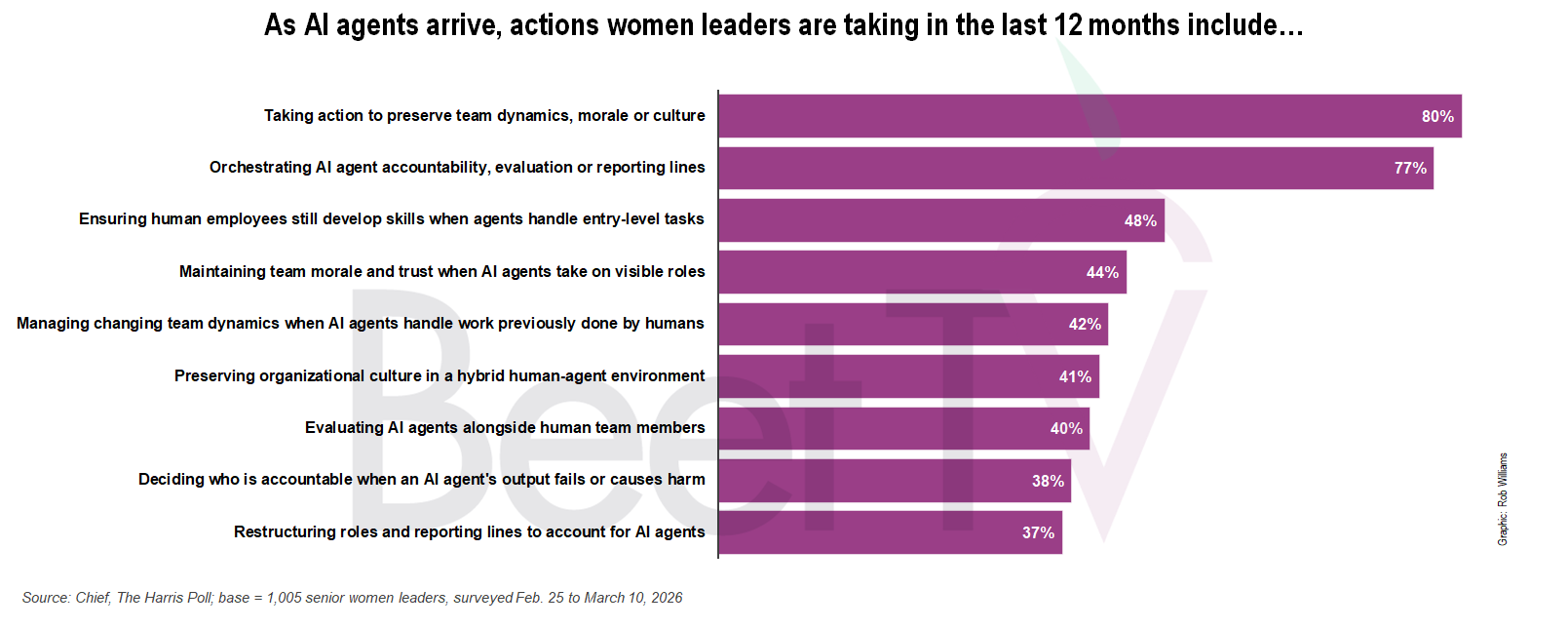
According to Moore, many are concerned that organizations are prioritizing speed over thoughtful adoption.
Among their biggest worries is the erosion of critical thinking as employees become increasingly dependent on AI tools.
“I am going to be thinking about the human impact,” Moore said, describing the mindset she sees among many leaders. “Protecting critical thinking, protecting integrity, intelligence, all the things that are uniquely human.”
She describes the goal as balancing artificial intelligence with what she calls “HI,” or human intelligence.
Curiosity is becoming a leadership skill
Asked what women leaders should take home from Cannes, Moore’s advice was refreshingly direct.
“Gear up.”
She acknowledged that women have historically faced barriers to accessing emerging technologies, making it even more important to experiment with AI both professionally and personally.
Her prescription sounds less like a technology roadmap than a lifelong learning plan: stay curious, keep experimenting and repeatedly upskill and reskill.
“The mindset needs to change,” Moore said. “Agile, constant learner, skill, upskill, reskill, repeat.”
Optimism survives the hype cycle
For someone who spent much of the interview discussing disruption, Moore ended on an unexpectedly hopeful note.
She sees women inside Chief launching businesses, reinventing careers and embracing AI as a tool for building entirely new chapters rather than simply preserving old ones.
In a conference overflowing with predictions about machines replacing work, Moore offered a different vision.
Technology may reshape organizations, flatten hierarchies and automate countless tasks. Leadership, however, still depends on curiosity, judgment and the very human ability to connect people who think differently.
Those qualities remain refreshingly difficult to automate.


CANNES, France – By the middle of the Cannes Lions International Festival of Creativity, executives had settled into a familiar rhythm: praise AI, praise creativity, praise the Mediterranean and repeat as necessary.
Alison Moore happily checked the first box.
“If I didn’t say AI, there would be something wrong with me, right?” she joked in this interview with Tameka Kee for Beet.TV and the New York Stock Exchange.
But as the CEO of executive leadership network Chief, Moore wasn’t interested in delivering another sermon on artificial intelligence. Her real message was about leadership and why companies risk overlooking the human side of the AI revolution.
Across discussions about commerce, creativity and technology at Cannes Lions, Moore said another theme kept surfacing: “the concern for the humanity of it all.”
The real question isn’t whether AI will transform business. It already has. The challenge, she said, is whether companies will redesign their organizations and leadership models as quickly as they adopt the technology.
Speed is great, panic is overrated
Corporate executives have rarely been accused of moving too slowly when the latest technology arrives. Moore is urging something that almost feels rebellious in 2026: think first.
“We have to move at record’s pace,” she said. “It’s mind blowing, but can we have some contemplation and consideration first? I think the two can be had at the same time.”
Rather than blindly chasing speed, Moore wants leaders to rethink how AI fits into organizations, how people collaborate with intelligent agents and what uniquely human skills deserve protecting.
That conversation, she said, is finally beginning to happen.
The org chart is getting flatter
Chief works with thousands of senior women leaders, giving Moore a front row seat to how leadership is evolving.
Today’s workplace spans four generations, from baby boomers to Gen Z, while AI arrives as an entirely new kind of colleague. Instead of treating that as organizational chaos, Moore sees an opportunity.
Young employees often arrive with native AI skills. Veteran executives contribute experience, judgment and strategic thinking. Neither group can succeed without the other.
“The hierarchy is sort of collapsing,” Moore said. “They have to talk differently together. And the best organizations are going to be the ones that acknowledge that.”
Future executives, she suggested, may spend less time acting as command-and-control managers and more time connecting expertise across people, AI systems and business functions.
Women aren’t waiting for permission
Moore also pushed back on the narrative that women are cautiously standing on the AI sidelines.
Research conducted by Chief with The Harris Poll found that 80% of senior women leaders already play an active role in AI strategy, governance or implementation inside their companies. They’re participating enthusiastically while also asking harder questions about long-term consequences.
According to Moore, many are concerned that organizations are prioritizing speed over thoughtful adoption.
Among their biggest worries is the erosion of critical thinking as employees become increasingly dependent on AI tools.
“I am going to be thinking about the human impact,” Moore said, describing the mindset she sees among many leaders. “Protecting critical thinking, protecting integrity, intelligence, all the things that are uniquely human.”
She describes the goal as balancing artificial intelligence with what she calls “HI,” or human intelligence.
Curiosity is becoming a leadership skill
Asked what women leaders should take home from Cannes, Moore’s advice was refreshingly direct.
“Gear up.”
She acknowledged that women have historically faced barriers to accessing emerging technologies, making it even more important to experiment with AI both professionally and personally.
Her prescription sounds less like a technology roadmap than a lifelong learning plan: stay curious, keep experimenting and repeatedly upskill and reskill.
“The mindset needs to change,” Moore said. “Agile, constant learner, skill, upskill, reskill, repeat.”
Optimism survives the hype cycle
For someone who spent much of the interview discussing disruption, Moore ended on an unexpectedly hopeful note.
She sees women inside Chief launching businesses, reinventing careers and embracing AI as a tool for building entirely new chapters rather than simply preserving old ones.
In a conference overflowing with predictions about machines replacing work, Moore offered a different vision.
Technology may reshape organizations, flatten hierarchies and automate countless tasks. Leadership, however, still depends on curiosity, judgment and the very human ability to connect people who think differently.
Those qualities remain refreshingly difficult to automate.