

Wunderkind’s Adam Gendelman: Pause Ads Drive Twice The Attention Of Standard 60-Second Spots
CANNES, France — When a viewer pauses a TV show they’re streaming, they’re still in the room. They’re still looking at the screen, still mentally engaged. That moment, it turns out, is far more valuable to advertisers than the traditional commercial break viewers routinely use to check their phones or go to the fridge.
“Pause ads when shown versus a 60-second in-stream ad drove two times higher attention and three times more presence,” Adam Gendelman, General Manager of Wunderkind Ads, told Beet.TV contributor David Kaplan at Cannes Lions. “When the in-stream ad goes on or that commercial break, you usually pick up your phone or you walk out of the room. And that’s exactly what the data showed.”
The findings come from a TVision-measured study spanning 40 advertisers across 15 verticals, establishing the first serious attention benchmarks for pause ads against traditional in-stream formats.
All verticals, not just auto, outperforms
Automotive registered the most dramatic results — 3X to 4X attention lift, according to Gendelman. The lift was driven by the format’s full-page creative canvas that suits longer purchase cycles requiring deeper product research, he noted.
“Context is really king there. When you think about someone getting served an automotive ad, they want to research the product more and that’s what that creative canvas can provide,” Gendelman said. “Whether it’s a carousel or has a QR code, we do see typically an automotive ad perform better, or even a retail or travel ad where a user has to do a little bit more research.”
Notably, every vertical in the study outperformed expectations, suggesting the attention advantage is structural to the format rather than category-specific.
Programmatic solves standardization problems
Pause ads have historically required one-to-one direct deals with each app and OEM, creating operational friction that limited buyer access. Wunderkind’s programmatic approach delivers the format across all apps and OEMs through a single deal ID and single creative.
“What we’re doing is providing scale across any app and OEM in a uniform way. All users or buyers have to do is traffic it,” Gendelman said.
The backend technology effectively creates standardization where none exists in the broader ecosystem, giving media buyers programmatic access to inventory that previously demanded bespoke direct relationships.
Premium inventory, programmatic efficiency
The study ran across Plex, Philo, and DISH — household name streaming environments that counter the common perception that programmatic inventory means lower quality placements.
“The common misconception of programmatic is that buyers think they’re getting less quality inventory. But what the study showed is that programmatic inventory and the access we’re giving to all these apps and OEMs are the same value as going to these apps directly on a one-to-one basis,” Gendelman said.
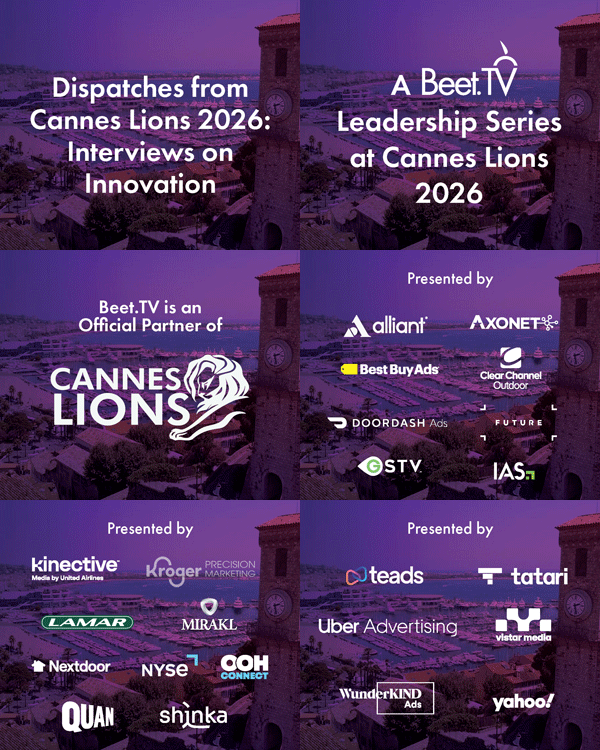
You’re watching “Dispatches from Cannes Lions 2026: Interviews on Innovation”, a Beet.TV Leadership Series at Cannes Lions 2026, presented by Alliant, Axonet, Clear Channel, DoorDash Ads, Future, GSTV, IAS, Kroger Precision Marketing, Lamar, Mirakl, Nextdoor, OOH Connect, Quan, Shinka, Teads, Tatari, Uber Advertising, Vistar Media, WunderKIND Ads, and Yahoo. For more videos from this series, visit this page. You can find all of our coverage from Cannes Lions 2026 here.
CANNES, France — When a viewer pauses a TV show they’re streaming, they’re still in the room. They’re still looking at the screen, still mentally engaged. That moment, it turns out, is far more valuable to advertisers than the traditional commercial break viewers routinely use to check their phones or go to the fridge.
“Pause ads when shown versus a 60-second in-stream ad drove two times higher attention and three times more presence,” Adam Gendelman, General Manager of Wunderkind Ads, told Beet.TV contributor David Kaplan at Cannes Lions. “When the in-stream ad goes on or that commercial break, you usually pick up your phone or you walk out of the room. And that’s exactly what the data showed.”
The findings come from a TVision-measured study spanning 40 advertisers across 15 verticals, establishing the first serious attention benchmarks for pause ads against traditional in-stream formats.
All verticals, not just auto, outperforms
Automotive registered the most dramatic results — 3X to 4X attention lift, according to Gendelman. The lift was driven by the format’s full-page creative canvas that suits longer purchase cycles requiring deeper product research, he noted.
“Context is really king there. When you think about someone getting served an automotive ad, they want to research the product more and that’s what that creative canvas can provide,” Gendelman said. “Whether it’s a carousel or has a QR code, we do see typically an automotive ad perform better, or even a retail or travel ad where a user has to do a little bit more research.”
Notably, every vertical in the study outperformed expectations, suggesting the attention advantage is structural to the format rather than category-specific.
Programmatic solves standardization problems
Pause ads have historically required one-to-one direct deals with each app and OEM, creating operational friction that limited buyer access. Wunderkind’s programmatic approach delivers the format across all apps and OEMs through a single deal ID and single creative.
“What we’re doing is providing scale across any app and OEM in a uniform way. All users or buyers have to do is traffic it,” Gendelman said.
The backend technology effectively creates standardization where none exists in the broader ecosystem, giving media buyers programmatic access to inventory that previously demanded bespoke direct relationships.
Premium inventory, programmatic efficiency
The study ran across Plex, Philo, and DISH — household name streaming environments that counter the common perception that programmatic inventory means lower quality placements.
“The common misconception of programmatic is that buyers think they’re getting less quality inventory. But what the study showed is that programmatic inventory and the access we’re giving to all these apps and OEMs are the same value as going to these apps directly on a one-to-one basis,” Gendelman said.
You’re watching “Dispatches from Cannes Lions 2026: Interviews on Innovation”, a Beet.TV Leadership Series at Cannes Lions 2026, presented by Alliant, Axonet, Clear Channel, DoorDash Ads, Future, GSTV, IAS, Kroger Precision Marketing, Lamar, Mirakl, Nextdoor, OOH Connect, Quan, Shinka, Teads, Tatari, Uber Advertising, Vistar Media, WunderKIND Ads, and Yahoo. For more videos from this series, visit this page. You can find all of our coverage from Cannes Lions 2026 here.