AI Won’t Kill Agencies, but Programmatic Advertising Might: Taboola’s Adam Singolda
CANNES, France — If you expected artificial intelligence to wipe out advertising agencies, Adam Singolda, founder and chief executive of Taboola, has other ideas. The bigger threat, he argues, is that the traditional programmatic advertising business could end up getting replaced by software agents that negotiate directly with each other while humans are still debating the agenda for the next status meeting.
Speaking with Beet.TV contributor David Kaplan at the Cannes Lions International Festival of Creativity, Singolda painted a future where agencies survive, publishers adapt and AI handles much of the tedious plumbing that has defined digital advertising for years. The catch is that everyone has to move a lot faster.
“I’m very optimistic,” Singolda said when asked whether agencies still have a future.
That optimism comes with conditions. Agencies, he said, should invest heavily in first-party data and build AI agents capable of negotiating directly with platforms on behalf of clients.
“I’m bullish on agencies that will lean in” by owning first-party data and developing internal AI agents that can negotiate with major platforms, Singolda said.
His prediction for today’s programmatic ecosystem was considerably less charitable.
“Buying programmatically is archaic, not sophisticated, old school and will be gone,” he said, adding that he expects it to be replaced by “agent-to-agent negotiation” built on Model Context Protocols and other AI standards.
AI agents could become advertising’s new media buyers
Rather than relying on layers of ad tech vendors, Singolda envisions agencies using AI agents that can strike deals directly with Google, Meta, connected TV platforms and companies across the open web, including Taboola.
That approach, he said, could reduce costs while producing better results for advertisers.
“I think those agencies create more value to the client, keep more money, which is always good,” Singolda said.
He pointed to industry consolidation and investments in identity platforms as evidence that major holding companies already recognize the growing importance of proprietary customer data.
Advertisers want proof, not pretty PowerPoint charts
Singolda said advertisers are becoming far less interested in proxy metrics and much more focused on measurable business outcomes.
“We’re seeing an increase and a desire of clients to understand an outcome,” he said, rather than relying on studies or indirect measurements.
At the same time, he doesn’t believe AI eliminates the importance of branding. Quite the opposite.
As consumers increasingly rely on AI assistants to recommend products, emotional connections with brands may become even more valuable. Singolda compared that loyalty to the way sports fans remain fiercely attached to their favorite teams regardless of the standings. The algorithms may be making recommendations but people still buy with their hearts.
Publishers have a traffic problem, but also an opportunity
Singolda acknowledged that AI search is already reducing traffic flowing to publishers.
“We’re seeing around 20%” declines in search traffic at various publishers, he said, largely because of Google’s AI-powered search experiences.
Instead of fighting that trend, Taboola is betting publishers should embrace conversational AI through its DeeperDive platform.
Describing DeeperDive as an ad-supported answer engine for publisher websites, Singolda said it allows readers to ask follow-up questions while staying inside a trusted publisher’s environment instead of disappearing into a general-purpose chatbot.
The early engagement numbers have surprised him.
“I’ve never seen numbers like that,” he said, referring to click-through rates of 15% to 25% generated through conversational interactions.
Singolda said the platform already processes roughly one-third of a million questions every day and gives publishers something they have rarely possessed before: detailed first-party curiosity data showing exactly what readers want to know.
That data, he argued, could become one of publishers’ most valuable assets as AI agents increasingly negotiate advertising opportunities automatically.
Connected TV gets smarter when someone measures it
Singolda also expects connected television to continue evolving from a branding channel into a measurable performance platform.
Television remains essential for building emotional connections with consumers, he said, but advertisers increasingly expect proof that campaigns actually produce business results.
“It’s just not good enough,” Singolda said of relying solely on brand lift studies and proxy measurements.
He expects more television companies to combine branding with outcome-based measurement, creating experiences that resemble the full-funnel capabilities already offered by companies such as Amazon.
AI advertising may become the industry’s next growth engine
While AI advertising remains in its infancy, Singolda believes it could become one of digital marketing’s fastest-growing channels.
“The number one conversion rate comes from LLM,” he said, referring to performance data generated through DeeperDive.
Because AI assistants are expanding rapidly across apps and services, he believes the available advertising inventory will grow much faster than connected TV inventory.
“LLM monetization… might be the next CTV,” Singolda said.
For an industry that has spent years squeezing marginal improvements out of increasingly complicated ad tech stacks, Singolda’s message was refreshingly simple. The future may belong less to whoever has the fanciest demand-side platform and more to whoever builds the smartest AI negotiator. Somewhere, an overworked media buyer just felt both relieved and slightly unemployed.
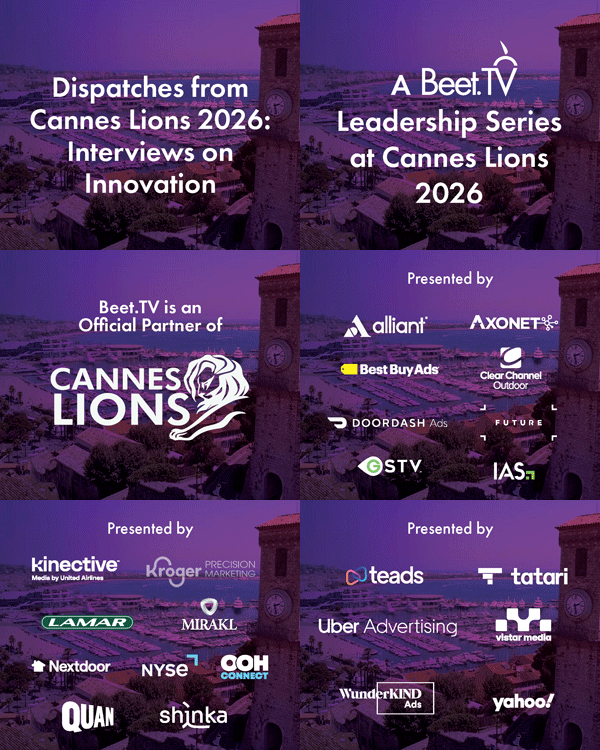
You’re watching “Dispatches from Cannes Lions 2026: Interviews on Innovation”, a Beet.TV Leadership Series at Cannes Lions 2026, presented by Alliant, Axonet, Clear Channel, DoorDash Ads, Future, GSTV, IAS, Kroger Precision Marketing, Lamar, Mirakl, Nextdoor, OOH Connect, Quan, Shinka, Teads, Tatari, Uber Advertising, Vistar Media, WunderKIND Ads, and Yahoo. For more videos from this series, visit this page. You can find all of our coverage from Cannes Lions 2026 here.
CANNES, France — If you expected artificial intelligence to wipe out advertising agencies, Adam Singolda, founder and chief executive of Taboola, has other ideas. The bigger threat, he argues, is that the traditional programmatic advertising business could end up getting replaced by software agents that negotiate directly with each other while humans are still debating the agenda for the next status meeting.
Speaking with Beet.TV contributor David Kaplan at the Cannes Lions International Festival of Creativity, Singolda painted a future where agencies survive, publishers adapt and AI handles much of the tedious plumbing that has defined digital advertising for years. The catch is that everyone has to move a lot faster.
“I’m very optimistic,” Singolda said when asked whether agencies still have a future.
That optimism comes with conditions. Agencies, he said, should invest heavily in first-party data and build AI agents capable of negotiating directly with platforms on behalf of clients.
“I’m bullish on agencies that will lean in” by owning first-party data and developing internal AI agents that can negotiate with major platforms, Singolda said.
His prediction for today’s programmatic ecosystem was considerably less charitable.
“Buying programmatically is archaic, not sophisticated, old school and will be gone,” he said, adding that he expects it to be replaced by “agent-to-agent negotiation” built on Model Context Protocols and other AI standards.
AI agents could become advertising’s new media buyers
Rather than relying on layers of ad tech vendors, Singolda envisions agencies using AI agents that can strike deals directly with Google, Meta, connected TV platforms and companies across the open web, including Taboola.
That approach, he said, could reduce costs while producing better results for advertisers.
“I think those agencies create more value to the client, keep more money, which is always good,” Singolda said.
He pointed to industry consolidation and investments in identity platforms as evidence that major holding companies already recognize the growing importance of proprietary customer data.
Advertisers want proof, not pretty PowerPoint charts
Singolda said advertisers are becoming far less interested in proxy metrics and much more focused on measurable business outcomes.
“We’re seeing an increase and a desire of clients to understand an outcome,” he said, rather than relying on studies or indirect measurements.
At the same time, he doesn’t believe AI eliminates the importance of branding. Quite the opposite.
As consumers increasingly rely on AI assistants to recommend products, emotional connections with brands may become even more valuable. Singolda compared that loyalty to the way sports fans remain fiercely attached to their favorite teams regardless of the standings. The algorithms may be making recommendations but people still buy with their hearts.
Publishers have a traffic problem, but also an opportunity
Singolda acknowledged that AI search is already reducing traffic flowing to publishers.
“We’re seeing around 20%” declines in search traffic at various publishers, he said, largely because of Google’s AI-powered search experiences.
Instead of fighting that trend, Taboola is betting publishers should embrace conversational AI through its DeeperDive platform.
Describing DeeperDive as an ad-supported answer engine for publisher websites, Singolda said it allows readers to ask follow-up questions while staying inside a trusted publisher’s environment instead of disappearing into a general-purpose chatbot.
The early engagement numbers have surprised him.
“I’ve never seen numbers like that,” he said, referring to click-through rates of 15% to 25% generated through conversational interactions.
Singolda said the platform already processes roughly one-third of a million questions every day and gives publishers something they have rarely possessed before: detailed first-party curiosity data showing exactly what readers want to know.
That data, he argued, could become one of publishers’ most valuable assets as AI agents increasingly negotiate advertising opportunities automatically.
Connected TV gets smarter when someone measures it
Singolda also expects connected television to continue evolving from a branding channel into a measurable performance platform.
Television remains essential for building emotional connections with consumers, he said, but advertisers increasingly expect proof that campaigns actually produce business results.
“It’s just not good enough,” Singolda said of relying solely on brand lift studies and proxy measurements.
He expects more television companies to combine branding with outcome-based measurement, creating experiences that resemble the full-funnel capabilities already offered by companies such as Amazon.
AI advertising may become the industry’s next growth engine
While AI advertising remains in its infancy, Singolda believes it could become one of digital marketing’s fastest-growing channels.
“The number one conversion rate comes from LLM,” he said, referring to performance data generated through DeeperDive.
Because AI assistants are expanding rapidly across apps and services, he believes the available advertising inventory will grow much faster than connected TV inventory.
“LLM monetization… might be the next CTV,” Singolda said.
For an industry that has spent years squeezing marginal improvements out of increasingly complicated ad tech stacks, Singolda’s message was refreshingly simple. The future may belong less to whoever has the fanciest demand-side platform and more to whoever builds the smartest AI negotiator. Somewhere, an overworked media buyer just felt both relieved and slightly unemployed.
You’re watching “Dispatches from Cannes Lions 2026: Interviews on Innovation”, a Beet.TV Leadership Series at Cannes Lions 2026, presented by Alliant, Axonet, Clear Channel, DoorDash Ads, Future, GSTV, IAS, Kroger Precision Marketing, Lamar, Mirakl, Nextdoor, OOH Connect, Quan, Shinka, Teads, Tatari, Uber Advertising, Vistar Media, WunderKIND Ads, and Yahoo. For more videos from this series, visit this page. You can find all of our coverage from Cannes Lions 2026 here.

Series Videos