


Marketing’s Proxy Problem: Can AI Finally Connect Media Investment to Real Business Outcomes?
CANNES, France — Marketing mix models have long been the industry’s best attempt at accountability. They have also been slow, backward-looking, and riddled with the biases of whoever commissioned them. A panel at the Beet.TV Leadership Sessions at Cannes Lions made the case that AI is changing all three of those conditions simultaneously — and that the implications run deeper than measurement.
“MMMs have been criticized. All of us have been painfully aware about how slow they tend to be,” said Jill Kelly, CEO of Assembly Global. “What I’m most excited about is a comprehensive view of all the different data insights that large language models can process at a different level of speed than we’ve ever seen before.”
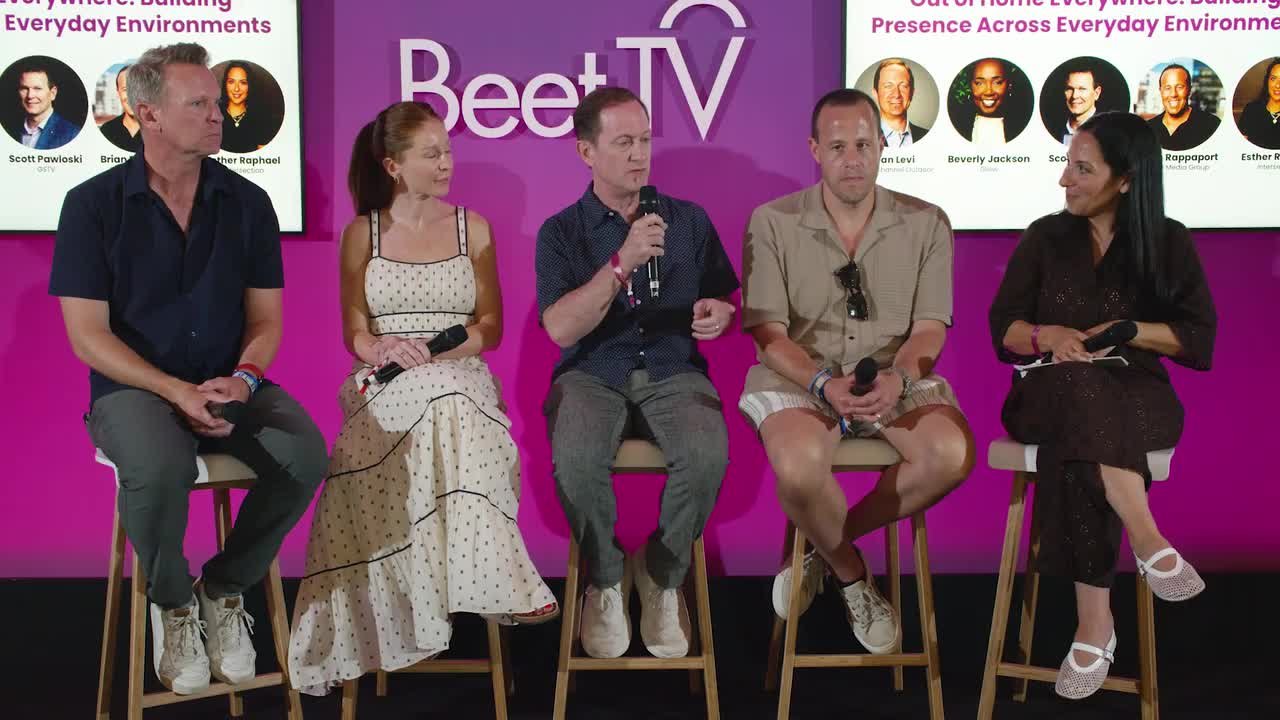
The session, moderated by Pooja Midha, executive in residence at LUMA Partners, brought together Kelly, Jay Altschuler, svp, global media & agency relations at Mastercard, and Mike Finnerty, U.S. president of Mutinex, to examine what it actually takes to move from proxy metrics to genuine business outcomes and what stands in the way.
The proxy problem
The core tension the panel kept returning to is structural. Marketers optimize toward what they can measure quickly — clicks, form fills, site visits — because the things they actually care about, incremental sales, long-term brand strength, revenue growth, take too long to surface in traditional models.
“By the time you get to that done MMM, it’s already stale,” Kelly said. “What I find really exciting is that the new approach is a continuum — it ties yesterday to today to tomorrow.”
Altschuler, whose Mastercard portfolio includes sales cycles running three to four years, was candid about the limits of that aspiration. “I have to figure out the right model to get there. I’m still in the proxy world and we’re going to have to be okay with that for a little bit.”
Agentic buying needs an outcome to aim at
Finnerty framed the measurement evolution as the essential companion to agentic media buying. Without it, automated optimization systems have no meaningful target.
“You have agentic buying increasingly taking over the knobs and pulling within human guardrails, and measurement is giving it the direction to optimize toward growth of a specific business — not toward reach, not toward an efficient CPM, but truly incremental sales and incremental growth,” Finnerty said. “That’s a huge unlock.”
On the operational side, AI is already dissolving two longstanding bottlenecks. Pulling data programmatically from platforms like Meta, Google, and TikTok has become dramatically easier. And taxonomizing that data by classifying campaigns by type, objective, and business unit in ways models can use is the task AI handles most powerfully, Finnerty said.
“That contextual overlay of the data has always been a huge problem. That’s what we’re solving very quickly through the agentic pipeline,” Finnerty said.
Guardrails, not autopilot
None of the panelists were willing to describe agentic optimization as a set-it-and-forget-it proposition. Altschuler’s framing was direct.
“Our job is to constantly refine the settings to ensure that the agent doing your bidding is doing it against the right KPIs. We have to constantly understand the data coming back, match it to outcomes, and constantly refine the dials,” Altschuler said. “That’s the job moving forward.”
Kelly described the practical model as establishing foundational guardrails and agreed-upon rules about when to shift budget, caps on spend by channel, within which, agents can move quickly without requiring human approval on every decision.
“The higher the risk, the more human intervention is going to be required,” Kelly said. “But if there’s a way to better automate the decision making process from a foundational perspective, that’s a fantastic way to automate a lift.”
Speaking CFO
The panel’s most pointed observation was about organizational politics as much as technology. Marketers have spent years defending budgets using metrics that finance teams don’t recognize as real.
“If you tell a CFO, ‘I want to invest more into brand media and I’m going to demonstrate why through clicks,’ there’s no faster way to a no,” Kelly said. “CFOs are addicted to incrementality and sales. Rightfully so.”
The promise of always-on, outcome-linked measurement is that it translates marketing’s work into finance’s language and aims to put marketing at the center of growth conversations rather than defending its existence in them.
“We’ve missed that translation layer for quite some time,” Finnerty said. “We’re at the precipice of that being much more standard.”
Creative remains the unmeasured lever
The panel’s most striking blind spot acknowledgment was around creative. Despite being, as Altschuler put it, the biggest driver of marketing performance, creative has been largely absent from measurement frameworks that focus on media allocation.
“Time and time again, the creative strength is the number one lever a brand has to drive up marketing performance. And it’s one that is largely absent from a lot of currency,” Finnerty said.
One table, one model
Altschuler closed with a vision that reframes what measurement could ultimately accomplish. It’s not just accountability for marketing, but organizational alignment across functions that currently operate in silos.
“A fully comprehensive model that actually starts to be the connective tissue in the organization — getting product, marketing, and finance all sitting around the same table, looking at the same models, working off the same data, having the same conversations,” Altschuler said. “That allows us to move much quicker as organizations, all aligned around the same objectives.”
You’re watching The Beet.TV Leadership Sessions at Cannes Lions 2026, presented by Mutinex. For more videos from this series, please visit this page. You can find all of our coverage from Cannes Lions 2026 here.

CANNES, France — Marketing mix models have long been the industry’s best attempt at accountability. They have also been slow, backward-looking, and riddled with the biases of whoever commissioned them. A panel at the Beet.TV Leadership Sessions at Cannes Lions made the case that AI is changing all three of those conditions simultaneously — and that the implications run deeper than measurement.
“MMMs have been criticized. All of us have been painfully aware about how slow they tend to be,” said Jill Kelly, CEO of Assembly Global. “What I’m most excited about is a comprehensive view of all the different data insights that large language models can process at a different level of speed than we’ve ever seen before.”
The session, moderated by Pooja Midha, executive in residence at LUMA Partners, brought together Kelly, Jay Altschuler, svp, global media & agency relations at Mastercard, and Mike Finnerty, U.S. president of Mutinex, to examine what it actually takes to move from proxy metrics to genuine business outcomes and what stands in the way.
The proxy problem
The core tension the panel kept returning to is structural. Marketers optimize toward what they can measure quickly — clicks, form fills, site visits — because the things they actually care about, incremental sales, long-term brand strength, revenue growth, take too long to surface in traditional models.
“By the time you get to that done MMM, it’s already stale,” Kelly said. “What I find really exciting is that the new approach is a continuum — it ties yesterday to today to tomorrow.”
Altschuler, whose Mastercard portfolio includes sales cycles running three to four years, was candid about the limits of that aspiration. “I have to figure out the right model to get there. I’m still in the proxy world and we’re going to have to be okay with that for a little bit.”
Agentic buying needs an outcome to aim at
Finnerty framed the measurement evolution as the essential companion to agentic media buying. Without it, automated optimization systems have no meaningful target.
“You have agentic buying increasingly taking over the knobs and pulling within human guardrails, and measurement is giving it the direction to optimize toward growth of a specific business — not toward reach, not toward an efficient CPM, but truly incremental sales and incremental growth,” Finnerty said. “That’s a huge unlock.”
On the operational side, AI is already dissolving two longstanding bottlenecks. Pulling data programmatically from platforms like Meta, Google, and TikTok has become dramatically easier. And taxonomizing that data by classifying campaigns by type, objective, and business unit in ways models can use is the task AI handles most powerfully, Finnerty said.
“That contextual overlay of the data has always been a huge problem. That’s what we’re solving very quickly through the agentic pipeline,” Finnerty said.
Guardrails, not autopilot
None of the panelists were willing to describe agentic optimization as a set-it-and-forget-it proposition. Altschuler’s framing was direct.
“Our job is to constantly refine the settings to ensure that the agent doing your bidding is doing it against the right KPIs. We have to constantly understand the data coming back, match it to outcomes, and constantly refine the dials,” Altschuler said. “That’s the job moving forward.”
Kelly described the practical model as establishing foundational guardrails and agreed-upon rules about when to shift budget, caps on spend by channel, within which, agents can move quickly without requiring human approval on every decision.
“The higher the risk, the more human intervention is going to be required,” Kelly said. “But if there’s a way to better automate the decision making process from a foundational perspective, that’s a fantastic way to automate a lift.”
Speaking CFO
The panel’s most pointed observation was about organizational politics as much as technology. Marketers have spent years defending budgets using metrics that finance teams don’t recognize as real.
“If you tell a CFO, ‘I want to invest more into brand media and I’m going to demonstrate why through clicks,’ there’s no faster way to a no,” Kelly said. “CFOs are addicted to incrementality and sales. Rightfully so.”
The promise of always-on, outcome-linked measurement is that it translates marketing’s work into finance’s language and aims to put marketing at the center of growth conversations rather than defending its existence in them.
“We’ve missed that translation layer for quite some time,” Finnerty said. “We’re at the precipice of that being much more standard.”
Creative remains the unmeasured lever
The panel’s most striking blind spot acknowledgment was around creative. Despite being, as Altschuler put it, the biggest driver of marketing performance, creative has been largely absent from measurement frameworks that focus on media allocation.
“Time and time again, the creative strength is the number one lever a brand has to drive up marketing performance. And it’s one that is largely absent from a lot of currency,” Finnerty said.
One table, one model
Altschuler closed with a vision that reframes what measurement could ultimately accomplish. It’s not just accountability for marketing, but organizational alignment across functions that currently operate in silos.
“A fully comprehensive model that actually starts to be the connective tissue in the organization — getting product, marketing, and finance all sitting around the same table, looking at the same models, working off the same data, having the same conversations,” Altschuler said. “That allows us to move much quicker as organizations, all aligned around the same objectives.”
You’re watching The Beet.TV Leadership Sessions at Cannes Lions 2026, presented by Mutinex. For more videos from this series, please visit this page. You can find all of our coverage from Cannes Lions 2026 here.