

Retail Media Confronts Its Grading-Your-Own-Homework Problem
CANNES, France — Retail media has spent the past few years multiplying at a pace normally associated with rabbits, streaming subscriptions and Cannes invitations.
Now comes the less glamorous phase: proving that all those networks, promotions and data partnerships actually sell something.
“Most of our conversations are centered around proof,” Chris Riedy, chief revenue officer of Ibotta, said during a Beet.TV leadership session presented by the company. “Every brand is happy to test something, but to keep going, you got to find the proof.”
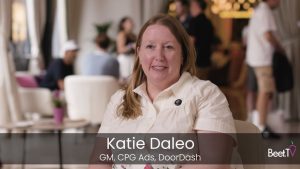
Riedy joined Catherine Berger, vice president of marketing transformation and services at Bimbo Bakeries, and Katie Daleo, general manager of CPG ads at DoorDash. Beet.TV contributor Tameka Kee moderated the discussion.
The panel examined how more than $200 billion in annual U.S. consumer packaged goods trade spending can converge with retail media. The goal is to transform promotions from a murky expense into something measurable, targetable and adjustable in something close to real time.
That would represent progress from the traditional trade-spending model, which could occasionally resemble sending a large check into a cave and waiting for sales to emerge.
Brands want receipts
Riedy said the industry is moving beyond its infatuation with retail media’s potential and asking harder questions about actual results.
“We’re past that kind of the Kool-Aid phase, if you will,” he said.
That means determining whether reported sales are based on verified transactions or statistical estimates. Through a partner such as DoorDash, Ibotta can track how many units were sold rather than merely build a model of what may have happened.
“It’s not a model. We’re not guessing. It is actually how many units,” Riedy said. “I think partners are asking for deterministic outcomes.”
Brands also want independent verification. Platforms inevitably measure their own performance so they can optimize campaigns. Increasingly, however, advertisers want the underlying information shared with finance teams or outside measurement companies such as Circana.
Otherwise, the platform is grading its own homework, a practice that usually produces an impressive report card and surprisingly few calls from the principal.
Riedy said the questions now are whether the data provide a deterministic, closed-loop view of sales and whether partners will share those data. That allows marketing, sales and finance to have what he called “one honest and open conversation.”
Trade spending meets the bottom line
Berger said Bimbo Bakeries has been identifying “unproductive trade” spending that moves products without generating sufficient profit.
“Yes, we’re moving product, but we are not making money,” she said. “And we do like making money and that is important.”
Once Bimbo identifies spending that isn’t producing incremental profit, it can redirect those dollars toward more effective programs. That requires connecting sales and marketing teams that historically operated with different budgets, incentives and definitions of success.
Berger said large CPG businesses need to become more agnostic about where dollars originate. Smaller emerging brands already tend to treat money as a common resource rather than a collection of departmental fiefdoms guarded by stern budget owners.
The alternative is for a century-old food company to discover that a fashionable soda brand has sprinted past it while everyone internally was still determining which team owned the spreadsheet.
DoorDash brings purchase intent into the equation
Daleo said DoorDash offers access to 56 million monthly active users who arrive with strong purchase intent but remain open to influence.
The platform can show brands how shoppers move toward a purchase, how one brand performs against competitors and whether a promotion attracted new customers. However, media exposure is only part of the picture. Out-of-stock products, distribution problems and merchandising decisions can also affect campaign performance.
If a promotion disappoints, the advertisement itself may not be the culprit. Occasionally, the brilliant marketing strategy has encountered an ancient retail obstacle known as “there was nothing on the shelf.”
Daleo said retail media platforms need to connect commercial data with media results. They also need to measure combinations such as sponsored product advertising paired with a promotion, rather than judging each tactic in isolation.
Incrementality needs a control group
Riedy said Ibotta and its partners are developing privacy-safe methods to measure whether promotions generate sales that wouldn’t have occurred otherwise. Clean rooms can be used to share data and compare exposed consumers with control groups.
“You have to serve promotions to some and not to others so that you can actually measure the delta between those two groups,” he said.
The purpose isn’t simply to help a platform charge more. It is to demonstrate that the program delivered value to the advertiser.
“If we’re not delivering profitability, I think it’s gonna be really hard for us to scale and to be the business that we want to be,” Riedy said.
Bimbo also has consolidated its media buying, including e-commerce, to create a more unified view of the marketing funnel. Berger called that change a “massive unlock.” The company is connecting media performance and consumer signals with information such as out-of-stock levels and direct sales.
Old trade model needs an off switch
The promise of combining retail investment with digital media is not merely better reporting. It is the ability to respond while a campaign is still running.
Riedy said brands should set a profitability goal, measure performance against it and react when results change. A campaign may falter because inventory ran out or a delivery was delayed. In either case, the advertiser should be able to pause spending quickly.
That flexibility contrasts with traditional trade programs that were committed well in advance and difficult to change.
“The old world of trade” was essentially, “It’s on and it’s not turning off,” Riedy said.
His prescription was refreshingly free of mysticism: “When it’s working, you keep doing it. When it’s not working, you pause and ask why didn’t it work?”
For an industry that has spent years constructing increasingly elaborate funnels, networks and measurement frameworks, the next breakthrough may be something unexpectedly radical: finding out whether the promotion made money.
You’re watching The Beet.TV Leadership Sessions at Cannes Lions 2026, presented by Ibotta. For more videos from this series, please visit this page. You can find all of our coverage from Cannes Lions 2026 here.

CANNES, France — Retail media has spent the past few years multiplying at a pace normally associated with rabbits, streaming subscriptions and Cannes invitations.
Now comes the less glamorous phase: proving that all those networks, promotions and data partnerships actually sell something.
“Most of our conversations are centered around proof,” Chris Riedy, chief revenue officer of Ibotta, said during a Beet.TV leadership session presented by the company. “Every brand is happy to test something, but to keep going, you got to find the proof.”
Riedy joined Catherine Berger, vice president of marketing transformation and services at Bimbo Bakeries, and Katie Daleo, general manager of CPG ads at DoorDash. Beet.TV contributor Tameka Kee moderated the discussion.
The panel examined how more than $200 billion in annual U.S. consumer packaged goods trade spending can converge with retail media. The goal is to transform promotions from a murky expense into something measurable, targetable and adjustable in something close to real time.
That would represent progress from the traditional trade-spending model, which could occasionally resemble sending a large check into a cave and waiting for sales to emerge.
Brands want receipts
Riedy said the industry is moving beyond its infatuation with retail media’s potential and asking harder questions about actual results.
“We’re past that kind of the Kool-Aid phase, if you will,” he said.
That means determining whether reported sales are based on verified transactions or statistical estimates. Through a partner such as DoorDash, Ibotta can track how many units were sold rather than merely build a model of what may have happened.
“It’s not a model. We’re not guessing. It is actually how many units,” Riedy said. “I think partners are asking for deterministic outcomes.”
Brands also want independent verification. Platforms inevitably measure their own performance so they can optimize campaigns. Increasingly, however, advertisers want the underlying information shared with finance teams or outside measurement companies such as Circana.
Otherwise, the platform is grading its own homework, a practice that usually produces an impressive report card and surprisingly few calls from the principal.
Riedy said the questions now are whether the data provide a deterministic, closed-loop view of sales and whether partners will share those data. That allows marketing, sales and finance to have what he called “one honest and open conversation.”
Trade spending meets the bottom line
Berger said Bimbo Bakeries has been identifying “unproductive trade” spending that moves products without generating sufficient profit.
“Yes, we’re moving product, but we are not making money,” she said. “And we do like making money and that is important.”
Once Bimbo identifies spending that isn’t producing incremental profit, it can redirect those dollars toward more effective programs. That requires connecting sales and marketing teams that historically operated with different budgets, incentives and definitions of success.
Berger said large CPG businesses need to become more agnostic about where dollars originate. Smaller emerging brands already tend to treat money as a common resource rather than a collection of departmental fiefdoms guarded by stern budget owners.
The alternative is for a century-old food company to discover that a fashionable soda brand has sprinted past it while everyone internally was still determining which team owned the spreadsheet.
DoorDash brings purchase intent into the equation
Daleo said DoorDash offers access to 56 million monthly active users who arrive with strong purchase intent but remain open to influence.
The platform can show brands how shoppers move toward a purchase, how one brand performs against competitors and whether a promotion attracted new customers. However, media exposure is only part of the picture. Out-of-stock products, distribution problems and merchandising decisions can also affect campaign performance.
If a promotion disappoints, the advertisement itself may not be the culprit. Occasionally, the brilliant marketing strategy has encountered an ancient retail obstacle known as “there was nothing on the shelf.”
Daleo said retail media platforms need to connect commercial data with media results. They also need to measure combinations such as sponsored product advertising paired with a promotion, rather than judging each tactic in isolation.
Incrementality needs a control group
Riedy said Ibotta and its partners are developing privacy-safe methods to measure whether promotions generate sales that wouldn’t have occurred otherwise. Clean rooms can be used to share data and compare exposed consumers with control groups.
“You have to serve promotions to some and not to others so that you can actually measure the delta between those two groups,” he said.
The purpose isn’t simply to help a platform charge more. It is to demonstrate that the program delivered value to the advertiser.
“If we’re not delivering profitability, I think it’s gonna be really hard for us to scale and to be the business that we want to be,” Riedy said.
Bimbo also has consolidated its media buying, including e-commerce, to create a more unified view of the marketing funnel. Berger called that change a “massive unlock.” The company is connecting media performance and consumer signals with information such as out-of-stock levels and direct sales.
Old trade model needs an off switch
The promise of combining retail investment with digital media is not merely better reporting. It is the ability to respond while a campaign is still running.
Riedy said brands should set a profitability goal, measure performance against it and react when results change. A campaign may falter because inventory ran out or a delivery was delayed. In either case, the advertiser should be able to pause spending quickly.
That flexibility contrasts with traditional trade programs that were committed well in advance and difficult to change.
“The old world of trade” was essentially, “It’s on and it’s not turning off,” Riedy said.
His prescription was refreshingly free of mysticism: “When it’s working, you keep doing it. When it’s not working, you pause and ask why didn’t it work?”
For an industry that has spent years constructing increasingly elaborate funnels, networks and measurement frameworks, the next breakthrough may be something unexpectedly radical: finding out whether the promotion made money.
You’re watching The Beet.TV Leadership Sessions at Cannes Lions 2026, presented by Ibotta. For more videos from this series, please visit this page. You can find all of our coverage from Cannes Lions 2026 here.