

Agentic Commerce Demands a Full Consumer Experience, Not Just a Smarter Checkout
CANNES, France — Digital commerce has a problem that predates artificial intelligence and anything this agentic moment might finally solve: Most consumers abandon their shopping carts after making a product selection. It’s not because they don’t want to buy. Rather, it’s because the friction between selection and purchase defeats them.
“Our analysis suggests that almost 85% of customers actually abandoned their cart after having made the selection. The fundamental premise of agentic commerce is that it is an unmet need for the customer. And so therefore it is more likely to be successful,” said Rajat Agarwal, global commerce lead at Accenture Song, speaking at the Beet.TV Leadership Sessions at Cannes Lions.
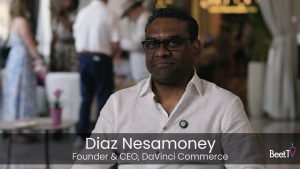
Agarwal was joined by Karin Timpone, CEO of ClearPrompt, and Diaz Nesamoney, founder, President, and CEO of DaVinci Commerce, in a panel moderated by Beet.TV correspondent and advertising futurist Tameka Kee. The session explored what it will actually take for brands to succeed in an agentic commerce environment. The answers went well beyond technology.
Two types of agents will emerge
Agarwal drew a distinction that the panel returned to repeatedly: horizontal agents like ChatGPT, Gemini, and Amazon Alexa will strip friction from the search-browse-checkout process, while vertical agents built by brands with deep category expertise can create experiences that are genuinely interesting rather than merely efficient.
The strategic question every brand must answer, in Agarwal’s framing, is whether to be the choice of agent — discoverable within dominant platforms — or the agent of choice, owning the consumer experience directly.
“Horizontal agents will make it very efficient, but not interesting. That’s the opportunity for brands which have deep categories to become the agent of choice for their categories,” Agarwal said.
First movers’ advantages
Unlike search engine optimization, where late entrants could climb rankings through paid placement or algorithmic catch-up, AI learning platforms compound their understanding of brands over time. Nesamoney argued this makes early investment structurally different from previous platform transitions.
“What’s different about these AI platforms is they’re learning platforms. They’re learning about your brand and they’re also learning about consumers choosing your brand. First movers inherently have an advantage,” Nesamoney said. “Back then it was like, oh, just wait and see. That’s not true here.”
The implication for brands is significant: the window for establishing relevance within AI commerce environments may close faster than it did with search or social.
Don’t send the AI clones
The panel’s sharpest warning was against brands simply porting existing ecommerce models into agentic environments. Kee’s example of an Instacart agent buying four loaves of bread when one was unavailable illustrated what happens when AI replicates human checkout logic without genuine intelligence behind it.
“Don’t clone your retail site into a ChatGPT experience. Make it conversational,” Nesamoney said. “Brands who think about this conversational model and employ AI to make it intelligent — have a conversation like they would have with the sales associate — can win this in a very significant way.”
Data infrastructure precedes everything
Timpone, who has served as CMO at Marriott, Major League Baseball, and Yahoo, framed the entire agentic commerce opportunity as dependent on first-party data discipline that most brands haven’t yet achieved. Marriott’s Ask Bonvoy agent, she noted, was only possible because of years of data investment that came before it.
The storytelling dimension matters too. As LLMs develop a bias for recency, brands that maintain consistent, well-crafted narratives across communications will shape what agents know and say about them.
“When you think about LLMs that have a bias for recency, you want your brand to be showing up in this way. I really strongly encourage human touch all along the process, but also the storytelling craft to optimize where agentic commerce will go,” Timpone said.
Trust, not tech, determines adoption
The panel converged on trust as the variable that will ultimately determine how quickly agentic commerce scales. Parallels were drawn to early digital commerce, when consumers were reluctant to share credit card details online until enough brands demonstrated reliability over time.
“When companies are launching these agents, they have to be agents that give the trust. They need to make sure that the agents are not just a gimmick, but that they can be trustworthy,” Agarwal said. “Brands should make sure that they are investing in developing that trust.”
You’re watching The Beet.TV Leadership Sessions at Cannes Lions 2026, presented by DaVinci Commerce. For more videos from this series, please visit this page. You can find all of our coverage from Cannes Lions 2026 here.



CANNES, France — Digital commerce has a problem that predates artificial intelligence and anything this agentic moment might finally solve: Most consumers abandon their shopping carts after making a product selection. It’s not because they don’t want to buy. Rather, it’s because the friction between selection and purchase defeats them.
“Our analysis suggests that almost 85% of customers actually abandoned their cart after having made the selection. The fundamental premise of agentic commerce is that it is an unmet need for the customer. And so therefore it is more likely to be successful,” said Rajat Agarwal, global commerce lead at Accenture Song, speaking at the Beet.TV Leadership Sessions at Cannes Lions.
Agarwal was joined by Karin Timpone, CEO of ClearPrompt, and Diaz Nesamoney, founder, President, and CEO of DaVinci Commerce, in a panel moderated by Beet.TV correspondent and advertising futurist Tameka Kee. The session explored what it will actually take for brands to succeed in an agentic commerce environment. The answers went well beyond technology.
Two types of agents will emerge
Agarwal drew a distinction that the panel returned to repeatedly: horizontal agents like ChatGPT, Gemini, and Amazon Alexa will strip friction from the search-browse-checkout process, while vertical agents built by brands with deep category expertise can create experiences that are genuinely interesting rather than merely efficient.
The strategic question every brand must answer, in Agarwal’s framing, is whether to be the choice of agent — discoverable within dominant platforms — or the agent of choice, owning the consumer experience directly.
“Horizontal agents will make it very efficient, but not interesting. That’s the opportunity for brands which have deep categories to become the agent of choice for their categories,” Agarwal said.
First movers’ advantages
Unlike search engine optimization, where late entrants could climb rankings through paid placement or algorithmic catch-up, AI learning platforms compound their understanding of brands over time. Nesamoney argued this makes early investment structurally different from previous platform transitions.
“What’s different about these AI platforms is they’re learning platforms. They’re learning about your brand and they’re also learning about consumers choosing your brand. First movers inherently have an advantage,” Nesamoney said. “Back then it was like, oh, just wait and see. That’s not true here.”
The implication for brands is significant: the window for establishing relevance within AI commerce environments may close faster than it did with search or social.
Don’t send the AI clones
The panel’s sharpest warning was against brands simply porting existing ecommerce models into agentic environments. Kee’s example of an Instacart agent buying four loaves of bread when one was unavailable illustrated what happens when AI replicates human checkout logic without genuine intelligence behind it.
“Don’t clone your retail site into a ChatGPT experience. Make it conversational,” Nesamoney said. “Brands who think about this conversational model and employ AI to make it intelligent — have a conversation like they would have with the sales associate — can win this in a very significant way.”
Data infrastructure precedes everything
Timpone, who has served as CMO at Marriott, Major League Baseball, and Yahoo, framed the entire agentic commerce opportunity as dependent on first-party data discipline that most brands haven’t yet achieved. Marriott’s Ask Bonvoy agent, she noted, was only possible because of years of data investment that came before it.
The storytelling dimension matters too. As LLMs develop a bias for recency, brands that maintain consistent, well-crafted narratives across communications will shape what agents know and say about them.
“When you think about LLMs that have a bias for recency, you want your brand to be showing up in this way. I really strongly encourage human touch all along the process, but also the storytelling craft to optimize where agentic commerce will go,” Timpone said.
Trust, not tech, determines adoption
The panel converged on trust as the variable that will ultimately determine how quickly agentic commerce scales. Parallels were drawn to early digital commerce, when consumers were reluctant to share credit card details online until enough brands demonstrated reliability over time.
“When companies are launching these agents, they have to be agents that give the trust. They need to make sure that the agents are not just a gimmick, but that they can be trustworthy,” Agarwal said. “Brands should make sure that they are investing in developing that trust.”
You’re watching The Beet.TV Leadership Sessions at Cannes Lions 2026, presented by DaVinci Commerce. For more videos from this series, please visit this page. You can find all of our coverage from Cannes Lions 2026 here.

Series Videos