

Beyond the First-Party Data Rush, the Real Work Is Making It Smart
CANNES – The scramble for first-party data may have been a necessary reaction to signal loss, but it has left many brands with a new problem: a trove of information they don’t fully know how to use.
For many, the promise of a unified customer view remains fractured by internal technology silos and a lack of the specific expertise needed to turn raw signals into commercially impactful insights.
That is the view of a panel of executives who believe the industry must now move beyond simple data collection and toward sophisticated enrichment and collaboration.
- Richard Nunn, CEO, United Airlines MileagePlus
- Jeremy Cornfeldt, President, Tinuiti
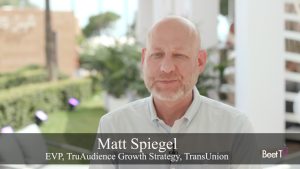
- Matt Spiegel, EVP, TruAudience Growth Strategy, TransUnion
Building the foundation correctly
For United Airlines, which flew 174 million people last year, getting the data architecture right from the start was paramount. The airline is at the “tail end” of building out its identity spine and graph, a foundational step many in the industry have tried to bypass in their haste, according to Nunn.
“It’s pretty critical to get that right before you work with a TransUnion or anybody, because that has to be foundationally right,” Nunn said. He noted that the company captures a multitude of signals, from seating preference to pet ownership, but believes many companies “rush to kind of enrich before they … build the foundations of the house correctly.”
That challenge is compounded by fragmented technology. Marketers at large companies use an average of 16 different marketing technology stacks that silo their data, according to research from TransUnion. “I don’t know that people appreciated just how hard it was,” Spiegel said. “I think what has happened in industry, we did adopt a little too much of the, ‘Well, just my own data and I’m good.’”
The enrichment imperative
While first-party data is a critical asset, some think relying on it exclusively limits a company’s ability to find new customers. The key, the executives argued, is to use that owned data as a foundation for intelligent enrichment through trusted partners to uncover new insights and identify expansion audiences.
“Maximize your use of the data you have, but if you stop there, you’re going to limit your ability to grow outside of what is your known customer set,” Spiegel said. “The reality is, there is signal out there that you will want that you don’t sit on.” This focus on deriving deeper meaning aligns with broader industry trends, as a Salesforce survey found 84% of global marketers now depend on first-party data to generate audience insights.
Nunn provided an example from United’s MileagePlus program. Previously, the airline treated all “gold” status members as a single cohort. Through data enrichment, however, it discovered multiple distinct sub-segments within that tier, enabling hyper-personalization. In another instance, a partnership with TelevisaUnivision to promote its streaming platform saw United achieve a 4.5 times higher index for identifying Spanish-speaking travelers than it could have alone. “There’s no way we would have seen those insights without that,” he added.
Navigating the hype and complexity
While tools like data clean rooms generated significant excitement, their practical application has sometimes lagged behind the hype, Spiegel suggested. He argued that the underlying principle of data collaboration is sound and will continue to grow, even if the industry gets distracted by labels.
“We do, in this industry, seem to fall for hype because we really like buzzwords,” Spiegel said. “I just think the hype curve got a little ahead of the sphere there. But I don’t think the idea that we are not headed towards a world of more data collaboration doesn’t make any sense.” The goal, he noted, is to get past the “sausage making” and focus on delivering more relevant marketing.
Ultimately, the advice for marketers is to focus on fundamentals: build a solid data foundation, invest in the right talent, and don’t be afraid to lean on trusted partners to connect disparate systems and unlock new value. “If you keep your data siloed, and you can’t actually access it in a way that’s useful, then you are limiting your opportunity,” Spiegel concluded.
You’re watching “The Beet.TV Leadership Sessions at Cannes Lions 2025, presented by TransUnion” For more videos from this series, please visit this page.
You’re watching The Beet.TV Leadership Sessions at Cannes Lions 2025, presented by TransUnion. For more videos from this series, please visit this page. You can find all of our coverage from Cannes Lions 2025 here.

CANNES – The scramble for first-party data may have been a necessary reaction to signal loss, but it has left many brands with a new problem: a trove of information they don’t fully know how to use.
For many, the promise of a unified customer view remains fractured by internal technology silos and a lack of the specific expertise needed to turn raw signals into commercially impactful insights.
That is the view of a panel of executives who believe the industry must now move beyond simple data collection and toward sophisticated enrichment and collaboration.
- Richard Nunn, CEO, United Airlines MileagePlus
- Jeremy Cornfeldt, President, Tinuiti
- Matt Spiegel, EVP, TruAudience Growth Strategy, TransUnion
Building the foundation correctly
For United Airlines, which flew 174 million people last year, getting the data architecture right from the start was paramount. The airline is at the “tail end” of building out its identity spine and graph, a foundational step many in the industry have tried to bypass in their haste, according to Nunn.
“It’s pretty critical to get that right before you work with a TransUnion or anybody, because that has to be foundationally right,” Nunn said. He noted that the company captures a multitude of signals, from seating preference to pet ownership, but believes many companies “rush to kind of enrich before they … build the foundations of the house correctly.”
That challenge is compounded by fragmented technology. Marketers at large companies use an average of 16 different marketing technology stacks that silo their data, according to research from TransUnion. “I don’t know that people appreciated just how hard it was,” Spiegel said. “I think what has happened in industry, we did adopt a little too much of the, ‘Well, just my own data and I’m good.’”
The enrichment imperative
While first-party data is a critical asset, some think relying on it exclusively limits a company’s ability to find new customers. The key, the executives argued, is to use that owned data as a foundation for intelligent enrichment through trusted partners to uncover new insights and identify expansion audiences.
“Maximize your use of the data you have, but if you stop there, you’re going to limit your ability to grow outside of what is your known customer set,” Spiegel said. “The reality is, there is signal out there that you will want that you don’t sit on.” This focus on deriving deeper meaning aligns with broader industry trends, as a Salesforce survey found 84% of global marketers now depend on first-party data to generate audience insights.
Nunn provided an example from United’s MileagePlus program. Previously, the airline treated all “gold” status members as a single cohort. Through data enrichment, however, it discovered multiple distinct sub-segments within that tier, enabling hyper-personalization. In another instance, a partnership with TelevisaUnivision to promote its streaming platform saw United achieve a 4.5 times higher index for identifying Spanish-speaking travelers than it could have alone. “There’s no way we would have seen those insights without that,” he added.
Navigating the hype and complexity
While tools like data clean rooms generated significant excitement, their practical application has sometimes lagged behind the hype, Spiegel suggested. He argued that the underlying principle of data collaboration is sound and will continue to grow, even if the industry gets distracted by labels.
“We do, in this industry, seem to fall for hype because we really like buzzwords,” Spiegel said. “I just think the hype curve got a little ahead of the sphere there. But I don’t think the idea that we are not headed towards a world of more data collaboration doesn’t make any sense.” The goal, he noted, is to get past the “sausage making” and focus on delivering more relevant marketing.
Ultimately, the advice for marketers is to focus on fundamentals: build a solid data foundation, invest in the right talent, and don’t be afraid to lean on trusted partners to connect disparate systems and unlock new value. “If you keep your data siloed, and you can’t actually access it in a way that’s useful, then you are limiting your opportunity,” Spiegel concluded.
You’re watching “The Beet.TV Leadership Sessions at Cannes Lions 2025, presented by TransUnion” For more videos from this series, please visit this page.
You’re watching The Beet.TV Leadership Sessions at Cannes Lions 2025, presented by TransUnion. For more videos from this series, please visit this page. You can find all of our coverage from Cannes Lions 2025 here.