Commerce GO, Agent-Ready APIs Help to Tackle Ad Fragmentation: Criteo’s Todd Parsons
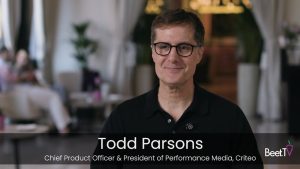
LAS VEGAS – Media fragmentation is reshaping performance marketing in two ways, said Todd Parsons, Chief Product Officer and President of Performance Media at Criteo. Consumers move fluidly across discovery, consideration and purchase channels, while marketing organizations still operate in channel silos.
Speaking with Beet.TV Editorial Director Lisa Granatstein at CES 2026, Parsons said the performance stack now needs to be redesigned around how people actually shop, not how teams are structured.
Following consumers forces rebuild of performance stack
Parsons argued that marketers can no longer assume a linear funnel or a single dominant channel. People discover products in one place, evaluate them elsewhere and buy wherever it feels easiest. That behavior makes channel-first planning less useful and it raises the bar for cross-channel execution. He said the future of performance marketing depends on changing internal operating habits so teams can follow consumers across touchpoints and treat them in ways that match their expectations.
Commerce GO aims to unify planning, activation, measurement
Criteo is leaning into a more self-service model with a product centerpiece it calls Commerce GO. Parsons described it as a single workflow that spans planning, activation, optimization and measurement. The system is AI augmented, not fully automated, with controls for buyers but automation for the tedious parts of campaign setup, activation and results tracking.
He said Criteo has already been using the product internally within managed services and has run roughly 5,000 campaigns through it. Parsons claimed results have been consistently positive, citing higher return on ad spend, more organic spend growth and more incremental product sales.
Generative AI cuts creative timelines from weeks to minutes
Creative production remains the biggest pain point in a consolidated workflow, Parsons said, because it eats time and slows speed to market. He pointed to generative tools such as text to image and image to video as a major shift. In the Commerce GO context, AI can generate dynamic creative and traffic it while maintaining brand standards and voice.
Parsons said what used to take days or weeks, often slowed by approvals, can now happen in minutes. The goal is to reduce the friction of creative iteration while keeping compliance with brand principles.
Model Context Protocol is how Criteo plans to serve agents
Granatstein asked about Criteo’s Model Context Protocol and Parsons framed it as a standard rather than a breakthrough on its own. Its value, he said, is that it lets agents talk to APIs in a consistent way. Criteo has long provided buy-side and sell-side partners access through APIs, but Parsons said the company has not previously been able to serve the agents those partners are now building.
With Model Context Protocol, Criteo plans to expose key parts of workflows so partner-built agents can respond and act on them. Parsons positioned this as a practical step toward helping teams remove operational pain points as they experiment with AI to increase efficiency.
Cross-channel measurement enables real-time budget shifts
Parsons said the most important change ahead is dynamic decision-making across the workflow. He argued that reallocating budget toward outcomes across channels such as CTV, social and retail has been difficult to do in a unified way. Criteo’s pitch is that it can make these adjustments during campaign runtime rather than in a backward-looking optimization cycle.
He tied that capability to Criteo’s commerce data scale, describing it as one of the world’s largest commerce data sets. The implication is a shift from measuring performance after the fact to making outcome-driven changes while a campaign is live, including budget movement and creative adjustments without waiting for a reporting window to close.
You’re watching “Beyond the Buy. Making every shopping moment smarter, a Beet.TV Leadership Series, presented by Criteo ” For more videos from this summit, please visit this page.

LAS VEGAS – Media fragmentation is reshaping performance marketing in two ways, said Todd Parsons, Chief Product Officer and President of Performance Media at Criteo. Consumers move fluidly across discovery, consideration and purchase channels, while marketing organizations still operate in channel silos.
Speaking with Beet.TV Editorial Director Lisa Granatstein at CES 2026, Parsons said the performance stack now needs to be redesigned around how people actually shop, not how teams are structured.
Following consumers forces rebuild of performance stack
Parsons argued that marketers can no longer assume a linear funnel or a single dominant channel. People discover products in one place, evaluate them elsewhere and buy wherever it feels easiest. That behavior makes channel-first planning less useful and it raises the bar for cross-channel execution. He said the future of performance marketing depends on changing internal operating habits so teams can follow consumers across touchpoints and treat them in ways that match their expectations.
Commerce GO aims to unify planning, activation, measurement
Criteo is leaning into a more self-service model with a product centerpiece it calls Commerce GO. Parsons described it as a single workflow that spans planning, activation, optimization and measurement. The system is AI augmented, not fully automated, with controls for buyers but automation for the tedious parts of campaign setup, activation and results tracking.
He said Criteo has already been using the product internally within managed services and has run roughly 5,000 campaigns through it. Parsons claimed results have been consistently positive, citing higher return on ad spend, more organic spend growth and more incremental product sales.
Generative AI cuts creative timelines from weeks to minutes
Creative production remains the biggest pain point in a consolidated workflow, Parsons said, because it eats time and slows speed to market. He pointed to generative tools such as text to image and image to video as a major shift. In the Commerce GO context, AI can generate dynamic creative and traffic it while maintaining brand standards and voice.
Parsons said what used to take days or weeks, often slowed by approvals, can now happen in minutes. The goal is to reduce the friction of creative iteration while keeping compliance with brand principles.
Model Context Protocol is how Criteo plans to serve agents
Granatstein asked about Criteo’s Model Context Protocol and Parsons framed it as a standard rather than a breakthrough on its own. Its value, he said, is that it lets agents talk to APIs in a consistent way. Criteo has long provided buy-side and sell-side partners access through APIs, but Parsons said the company has not previously been able to serve the agents those partners are now building.
With Model Context Protocol, Criteo plans to expose key parts of workflows so partner-built agents can respond and act on them. Parsons positioned this as a practical step toward helping teams remove operational pain points as they experiment with AI to increase efficiency.
Cross-channel measurement enables real-time budget shifts
Parsons said the most important change ahead is dynamic decision-making across the workflow. He argued that reallocating budget toward outcomes across channels such as CTV, social and retail has been difficult to do in a unified way. Criteo’s pitch is that it can make these adjustments during campaign runtime rather than in a backward-looking optimization cycle.
He tied that capability to Criteo’s commerce data scale, describing it as one of the world’s largest commerce data sets. The implication is a shift from measuring performance after the fact to making outcome-driven changes while a campaign is live, including budget movement and creative adjustments without waiting for a reporting window to close.
You’re watching “Beyond the Buy. Making every shopping moment smarter, a Beet.TV Leadership Series, presented by Criteo ” For more videos from this summit, please visit this page.

Series Videos