


Gen AI Ads: Consumers More Bearish Than Ad Execs, and the Gap Is Widening
PALM SPRINGS, CALIF. – The advertising industry’s rush to embrace AI-generated creative may be outpacing its understanding of how audiences actually receive it. New research suggests ad executives are misreading their own consumers – and the misalignment is getting worse, not better.
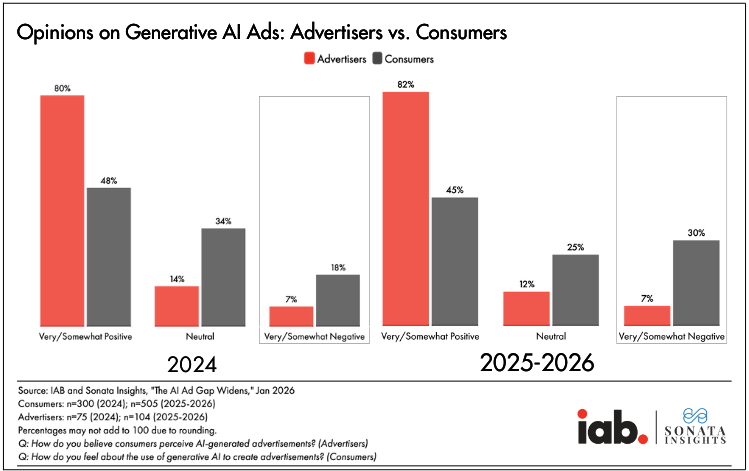
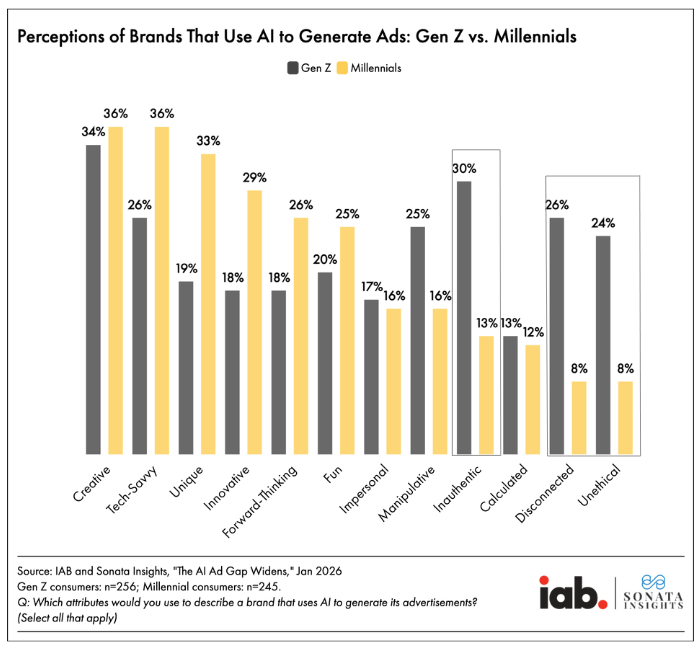
A study conducted by Sonata Insights in partnership with the IAB found that young consumers remain considerably less hostile toward AI-generated advertising than the executives making those ads assume. What’s more, the gap between actual consumer sentiment and executive perception has widened since the same study was conducted a year earlier.
“We actually thought that maybe things would improve,” said Debra Aho Williamson, founder and chief analyst of Sonata Insights, in this video interview with Beet.TV at IAB ALM 2026. “With more exposure, we thought young people would have a better impression of advertising that’s generated with AI – but. in fact, the gap widened.”
Gen Z’s finely tuned fakeness detector
The findings carry particular weight given the pace at which AI is infiltrating ad production. According to eMarketer, 22% of video ad creatives were built or enhanced using generative AI in 2024, a figure projected to reach 39% by 2026. The tools are proliferating across every major platform – Meta, TikTok, YouTube, and Amazon have all expanded AI-assisted creative capabilities in the past year.
Yet the assumption that younger audiences will simply absorb whatever content lands in their feeds may be misplaced. Williamson argued that Gen Z has developed a sophisticated instinct for spotting AI-generated imagery – one that goes well beyond the telltale signs of distorted hands or extra fingers.
“They really have a sense where something doesn’t look right to them,” she said. “And because they’re so used to using social media, they’re very quick to go onto social media and complain about it. And so advertisers may not be aware of this.”
That social amplification effect matters. A single poorly received AI ad can generate backlash that far outstrips the original media buy.
The broader trend supports this concern: consumer enthusiasm for AI-generated content has dropped sharply, from 60% in 2023 to 26% in 2025, according to eMarketer research on what it has termed “AI slop” – generic, unlabeled, algorithmically produced material that audiences are increasingly learning to resent.
The disclosure dilemma
If AI in advertising is now essentially unavoidable (Williamson noted that the topic dominated discussion throughout the IAB event), then the more pressing question becomes how the industry handles transparency. Her research pointed toward disclosure as a practical middle ground, though the details are complicated.
“There’s so many different ways that AI can be used,” she said. “You can use AI to generate text, you can use AI to create video, create digital characters or avatars – the entire concept of your ad can be generated with AI. Maybe it’s just as simple as a background.”
The research found that young consumers generally favor disclosure, particularly for video, AI-generated imagery, and fully AI-produced ads. Encouragingly, ad executives surveyed largely agreed. “We do see kind of an industry support for the idea of making it more clear to consumers when AI is being used,” Williamson said.
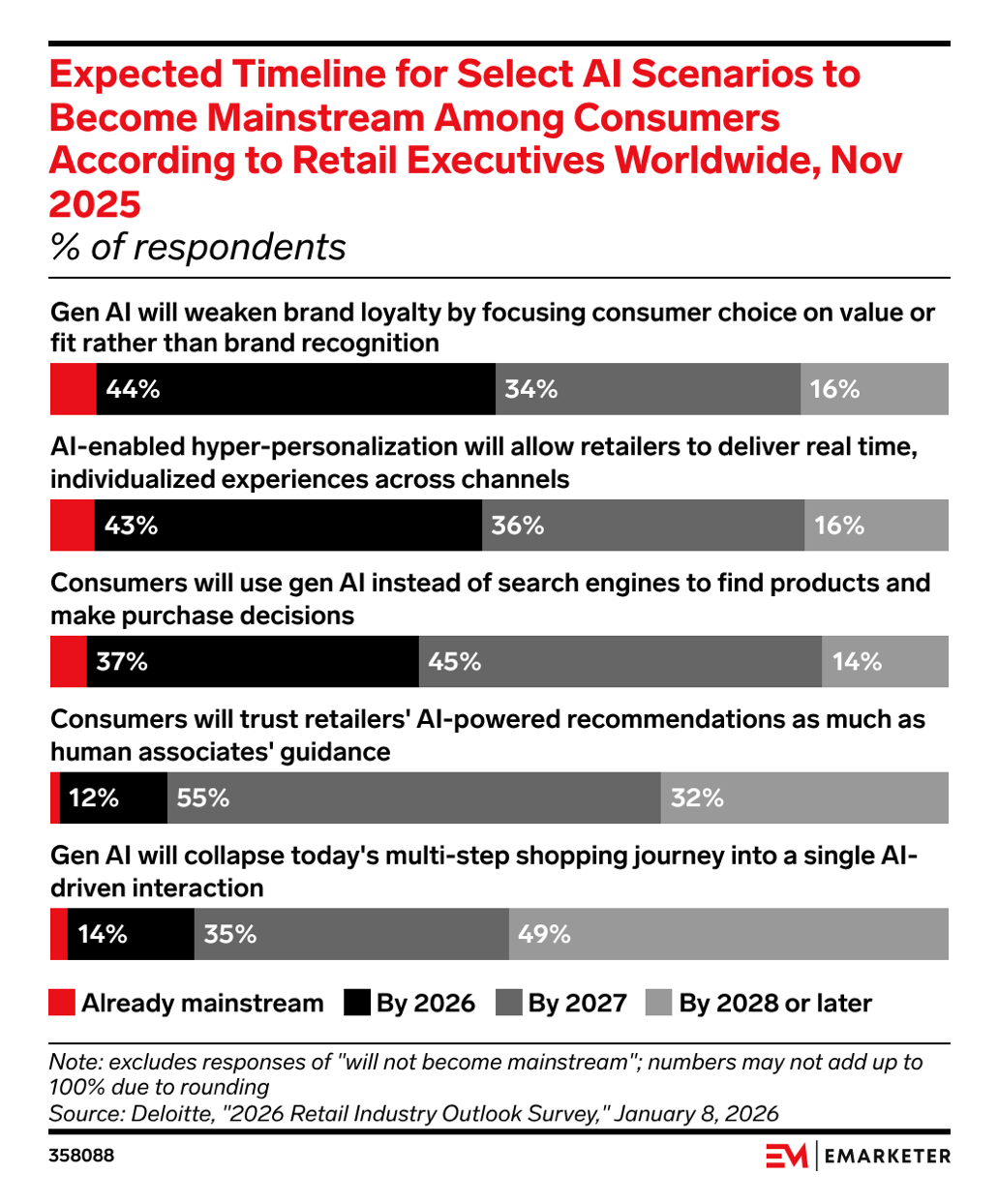
Aside from issues of trust, however, new research from Deloitte, cited by eMarketer, shows the majority of retail executives fearing generative AI will weaken brand loyalty.
You’re watching Beet.TV coverage from IAB ALM 2026. For more videos from this series, please visit this page.

PALM SPRINGS, CALIF. – The advertising industry’s rush to embrace AI-generated creative may be outpacing its understanding of how audiences actually receive it. New research suggests ad executives are misreading their own consumers – and the misalignment is getting worse, not better.
A study conducted by Sonata Insights in partnership with the IAB found that young consumers remain considerably less hostile toward AI-generated advertising than the executives making those ads assume. What’s more, the gap between actual consumer sentiment and executive perception has widened since the same study was conducted a year earlier.
“We actually thought that maybe things would improve,” said Debra Aho Williamson, founder and chief analyst of Sonata Insights, in this video interview with Beet.TV at IAB ALM 2026. “With more exposure, we thought young people would have a better impression of advertising that’s generated with AI – but. in fact, the gap widened.”
Gen Z’s finely tuned fakeness detector
The findings carry particular weight given the pace at which AI is infiltrating ad production. According to eMarketer, 22% of video ad creatives were built or enhanced using generative AI in 2024, a figure projected to reach 39% by 2026. The tools are proliferating across every major platform – Meta, TikTok, YouTube, and Amazon have all expanded AI-assisted creative capabilities in the past year.
Yet the assumption that younger audiences will simply absorb whatever content lands in their feeds may be misplaced. Williamson argued that Gen Z has developed a sophisticated instinct for spotting AI-generated imagery – one that goes well beyond the telltale signs of distorted hands or extra fingers.
“They really have a sense where something doesn’t look right to them,” she said. “And because they’re so used to using social media, they’re very quick to go onto social media and complain about it. And so advertisers may not be aware of this.”
That social amplification effect matters. A single poorly received AI ad can generate backlash that far outstrips the original media buy.
The broader trend supports this concern: consumer enthusiasm for AI-generated content has dropped sharply, from 60% in 2023 to 26% in 2025, according to eMarketer research on what it has termed “AI slop” – generic, unlabeled, algorithmically produced material that audiences are increasingly learning to resent.
The disclosure dilemma
If AI in advertising is now essentially unavoidable (Williamson noted that the topic dominated discussion throughout the IAB event), then the more pressing question becomes how the industry handles transparency. Her research pointed toward disclosure as a practical middle ground, though the details are complicated.
“There’s so many different ways that AI can be used,” she said. “You can use AI to generate text, you can use AI to create video, create digital characters or avatars – the entire concept of your ad can be generated with AI. Maybe it’s just as simple as a background.”
The research found that young consumers generally favor disclosure, particularly for video, AI-generated imagery, and fully AI-produced ads. Encouragingly, ad executives surveyed largely agreed. “We do see kind of an industry support for the idea of making it more clear to consumers when AI is being used,” Williamson said.
Aside from issues of trust, however, new research from Deloitte, cited by eMarketer, shows the majority of retail executives fearing generative AI will weaken brand loyalty.
You’re watching Beet.TV coverage from IAB ALM 2026. For more videos from this series, please visit this page.