


Lower Costs Fuel In-Store Media Growth: Stratacache’s Ben Reynolds
The retail industry has seen rapid change over the past year, particularly around in-store media, as falling technology costs and margin pressure elsewhere push retailers to rethink where growth comes from, according to Ben Reynolds, vice president of business development at Stratacache.
Speaking with Beet.TV contributor David Kaplan, Reynolds said lower hardware and installation costs have removed a major barrier to adoption.
“The cost of technology has come down, so the cost of implementation isn’t as big as it used to be,” he said. “The capex isn’t as scary.”
Why in-store media is gaining momentum
Reynolds said many retailers in North America have already tapped out their higher-margin digital inventory online.
“A lot of retailers have exhausted their inventory for onsite and search and product ads,” he said, adding that offsite retail media has not delivered the margins some expected.
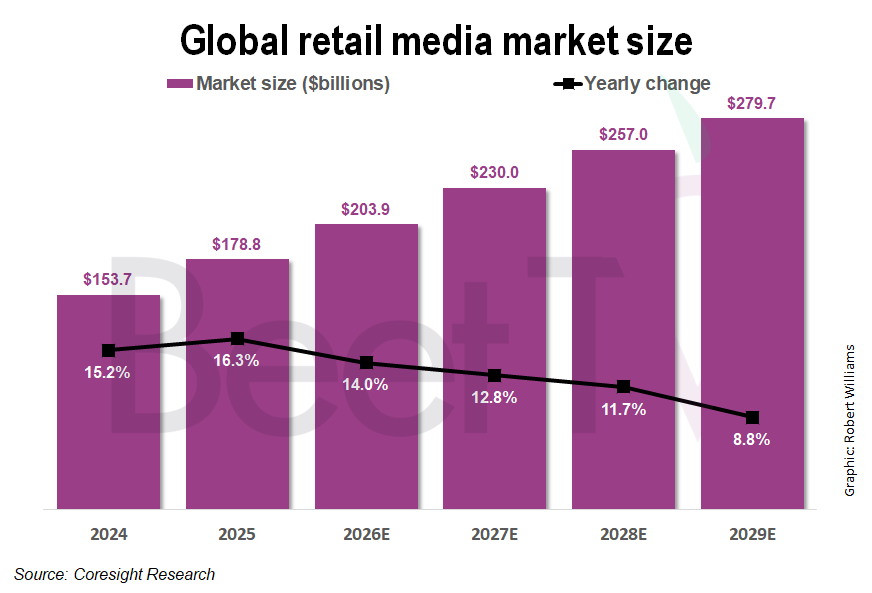
By contrast, in-store media sits on owned property and can deliver stronger economics.
“The factor of higher margins in store, because it’s an owned property, coupled with the cost of installation coming down, is a huge opportunity,” Reynolds said. Those dynamics, he added, have driven a surge in adoption over the past 12 months.
Cutting through the noise at the shelf
With screens now common throughout stores, Reynolds warned against overwhelming shoppers.
“You don’t want to think about the stores like Times Square,” he said. Instead, he argued that relevance and context are critical to influencing purchases.
Digital screens allow retailers to tailor messages based on where shoppers are in their journey.
“It’s really important to understand contextually where are they in their shopping journey,” Reynolds said.
Factors such as dwell time, department location, time of day, day of week and even weather can shape what content appears. Done well, he said, this approach “creates a more frictionless journey.”
Making in-store performance measurable
Measurement has also improved, Reynolds said, as the industry finds ways to capture behavioral and location signals in a privacy-friendly way.
“The ability to capture those signals in a privacy-friendly way and be able to have them be incredibly accurate, yet very actionable, has really changed,” he said.
He pointed to industry efforts to better define what constitutes an in-store impression, including whether a shopper had a real opportunity to view a screen. Tying anonymous dwell and location data back to specific ad units, Reynolds said, allows in-store media to be measured like other digital channels.
Personalization without one-to-one targeting
Personalization in physical stores looks different than online, Reynolds said, and typically operates at the cohort level rather than individual identification.
“In the store, it’s more synonymous,” he said, describing how content can be curated based on how groups of shoppers behave in specific areas.
“It’s not going to say, ‘Hey, Ben, welcome back again,’” Reynolds said. “It just might be based on how I’m behaving and maybe my past shopping trips, but it’s at the cohort or audience level, not necessarily a one-to-one.”
What to watch this year
Looking ahead, Reynolds expects 2026 to be a pivotal year for adoption and standardization. “This year is going to be a huge year of adoption for in-store retail media and certainly measurement,” he said.
A key focus, he added, is aligning in-store metrics with the rest of the digital ecosystem.
“How do we fit into that ecosystem so that we’re not creating something new,” Reynolds said, “but we’re making the in-store part of the omnichannel look like all the others and make it actionable.”
You’re watching “Scaling In-Store, Demystified: How Retail Media Is Reinventing the Aisle,” a Beet.TV Leadership Series, presented by Stratacache. For more videos from this series, please visit this page.




The retail industry has seen rapid change over the past year, particularly around in-store media, as falling technology costs and margin pressure elsewhere push retailers to rethink where growth comes from, according to Ben Reynolds, vice president of business development at Stratacache.
Speaking with Beet.TV contributor David Kaplan, Reynolds said lower hardware and installation costs have removed a major barrier to adoption.
“The cost of technology has come down, so the cost of implementation isn’t as big as it used to be,” he said. “The capex isn’t as scary.”
Why in-store media is gaining momentum
Reynolds said many retailers in North America have already tapped out their higher-margin digital inventory online.
“A lot of retailers have exhausted their inventory for onsite and search and product ads,” he said, adding that offsite retail media has not delivered the margins some expected.
By contrast, in-store media sits on owned property and can deliver stronger economics.
“The factor of higher margins in store, because it’s an owned property, coupled with the cost of installation coming down, is a huge opportunity,” Reynolds said. Those dynamics, he added, have driven a surge in adoption over the past 12 months.
Cutting through the noise at the shelf
With screens now common throughout stores, Reynolds warned against overwhelming shoppers.
“You don’t want to think about the stores like Times Square,” he said. Instead, he argued that relevance and context are critical to influencing purchases.
Digital screens allow retailers to tailor messages based on where shoppers are in their journey.
“It’s really important to understand contextually where are they in their shopping journey,” Reynolds said.
Factors such as dwell time, department location, time of day, day of week and even weather can shape what content appears. Done well, he said, this approach “creates a more frictionless journey.”
Making in-store performance measurable
Measurement has also improved, Reynolds said, as the industry finds ways to capture behavioral and location signals in a privacy-friendly way.
“The ability to capture those signals in a privacy-friendly way and be able to have them be incredibly accurate, yet very actionable, has really changed,” he said.
He pointed to industry efforts to better define what constitutes an in-store impression, including whether a shopper had a real opportunity to view a screen. Tying anonymous dwell and location data back to specific ad units, Reynolds said, allows in-store media to be measured like other digital channels.
Personalization without one-to-one targeting
Personalization in physical stores looks different than online, Reynolds said, and typically operates at the cohort level rather than individual identification.
“In the store, it’s more synonymous,” he said, describing how content can be curated based on how groups of shoppers behave in specific areas.
“It’s not going to say, ‘Hey, Ben, welcome back again,’” Reynolds said. “It just might be based on how I’m behaving and maybe my past shopping trips, but it’s at the cohort or audience level, not necessarily a one-to-one.”
What to watch this year
Looking ahead, Reynolds expects 2026 to be a pivotal year for adoption and standardization. “This year is going to be a huge year of adoption for in-store retail media and certainly measurement,” he said.
A key focus, he added, is aligning in-store metrics with the rest of the digital ecosystem.
“How do we fit into that ecosystem so that we’re not creating something new,” Reynolds said, “but we’re making the in-store part of the omnichannel look like all the others and make it actionable.”
You’re watching “Scaling In-Store, Demystified: How Retail Media Is Reinventing the Aisle,” a Beet.TV Leadership Series, presented by Stratacache. For more videos from this series, please visit this page.