

TV’s ‘Front Door’ Now Comes With Deterministic Data and a Side of AI: Roku’s Lauren Benedict
MIAMI – At the Possible conference for marketers, Lauren Benedict, vice president of global ad sales and partnerships at streaming pioneer Roku, delivered a message that probably made half the adtech ecosystem nod thoughtfully while the other half quietly updated their pitch decks to include the phrase “front door to the viewer experience.”
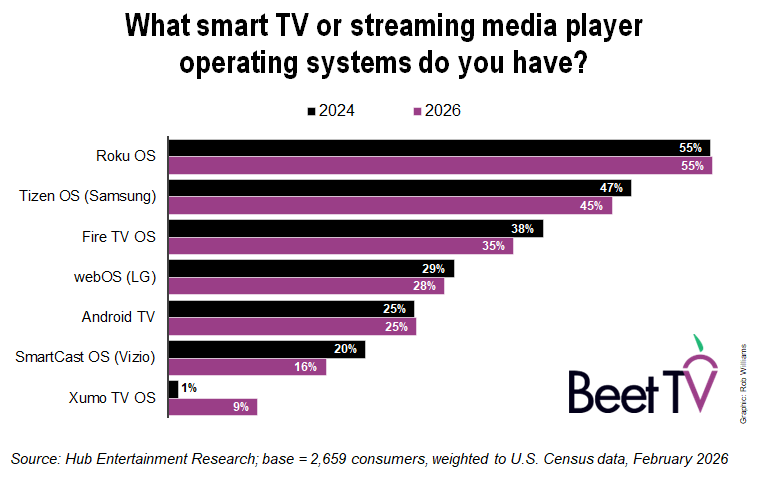
Roku, whose advertising revenue jumped 27% from a year earlier to about $613 million in the first quarter, is making a strong case that the streaming wars aren’t any longer just about content libraries and celebrity cameos. They’re increasingly about who owns the first screen viewers see before they settle into three straight hours of sitcom nostalgia and prestige murder dramas.
“The linear and streaming TV worlds are really starting to come together,” Benedict told Beet.TV contributor Rob Williams. “The beautiful part about Roku is we are the front door to the viewer experience.”
That “front door” now sees massive traffic. Benedict said 50% of all streaming happens on Roku’s platform, with 125 million people a day coming through its interface to find something to watch, or more realistically, spend 18 minutes debating what to watch.
Hits, habits and the eternal search for attention
Benedict described Roku’s strategy as balancing the giant cultural moments with everyday viewing rituals.
“All those big media moments that attract audiences at scale, we love those moments,” she said. “But it’s also that everyday viewing behavior and habits.”
In other words, Roku wants advertisers to know it can deliver both the season finale everyone tweets about and the Tuesday-night comfort-comedy binge that nobody admits they’re still watching.
For marketers trying to balance brand storytelling with measurable performance, Benedict argued Roku sits in a uniquely powerful spot because it sees what viewers are actually doing across streaming environments.
“We’ve got a ton of data that we sit on at Roku,” she said, noting the company recently surpassed 100 million homes globally.
That milestone matters because, unlike the old days of television measurement, Roku says its audience data comes from authenticated viewers and deterministic signals instead of statistical guesswork, séance rituals or media buyers staring at Nielsen spreadsheets while whispering “please let the CPMs stabilize.”
Retail media crashes the streaming party
Naturally, no advertising interview in 2026 would be complete without retail media entering the conversation like an overcaffeinated keynote speaker who just discovered APIs.
Benedict highlighted Roku Curate, a new offering combining Roku’s first-party data with retail media partners including Instacart, Best Buy, Kroger and Fandango.
“It really does allow for brands to access these audiences at scale,” she said. “It’s not only about precision in terms of who they’re reaching but essentially building business outcomes and really moving CTV into a performance platform.”
In other words, connected TV isn’t satisfied any longer with being the glamorous awareness machine sitting at the grown-ups’ table. It now wants credit for actual purchases, too.
The industry’s latest obsession with “full funnel” advertising was everywhere at Possible, where nearly every booth, panel and cocktail conversation eventually circled back to proving outcomes. Roku appears eager to position itself as both Hollywood and math class.
AI arrives to make everybody a TV producer
Then came the mandatory AI portion of the interview, though to Benedict’s credit, it sounded less like a science-fiction trailer and more like a practical explanation of how smaller advertisers might finally afford polished TV creative.
“The part that I get so excited about is really how AI is showing up in creative,” she said.
Benedict pointed to Roku Ads Manager and its partnership with Spaceback, which helps small and midsize businesses turn existing assets into 15- and 30-second TV spots.
That means the local mattress store that once produced commercials resembling a hostage video can now generate reasonably slick connected-TV ads with AI assistance and real-time optimization.
“We’re also able to use AI to optimize and test and understand what offers are resonating and optimize in real time,” Benedict said.
Somewhere, a regional furniture chain just became a performance marketer.
The ‘one, two, threes’ of modern TV
Asked what a modern TV buy actually looks like, Benedict broke Roku’s vision into what she called the “one, two, threes of modern TV.”
The first piece is the Roku operating system itself, which she described as “that front door to TV where we capture consumer attention.”
Second is the Roku Channel, which she said ranks as the No. 2 ad-supported streaming platform by viewing time.
Third is Roku’s broader ecosystem of data, identity and interoperability with outside partners.
“It really is bringing together all the data and the signal, and being an open and interoperable partner in this space,” Benedict said.
That may not sound quite as romantic as the golden age of television, but in today’s media business, interoperability is apparently the new prestige drama.
CTV Emerges as Performance Channel Amid Shift to Lower-Funnel Ad Buying: Roku
You’re watching “The New TV Equation”, a Beet.TV Leadership Series at POSSIBLE 2026, presented by Tatari. For more videos from this series, please visit this page.

MIAMI – At the Possible conference for marketers, Lauren Benedict, vice president of global ad sales and partnerships at streaming pioneer Roku, delivered a message that probably made half the adtech ecosystem nod thoughtfully while the other half quietly updated their pitch decks to include the phrase “front door to the viewer experience.”
Roku, whose advertising revenue jumped 27% from a year earlier to about $613 million in the first quarter, is making a strong case that the streaming wars aren’t any longer just about content libraries and celebrity cameos. They’re increasingly about who owns the first screen viewers see before they settle into three straight hours of sitcom nostalgia and prestige murder dramas.
“The linear and streaming TV worlds are really starting to come together,” Benedict told Beet.TV contributor Rob Williams. “The beautiful part about Roku is we are the front door to the viewer experience.”
That “front door” now sees massive traffic. Benedict said 50% of all streaming happens on Roku’s platform, with 125 million people a day coming through its interface to find something to watch, or more realistically, spend 18 minutes debating what to watch.
Hits, habits and the eternal search for attention
Benedict described Roku’s strategy as balancing the giant cultural moments with everyday viewing rituals.
“All those big media moments that attract audiences at scale, we love those moments,” she said. “But it’s also that everyday viewing behavior and habits.”
In other words, Roku wants advertisers to know it can deliver both the season finale everyone tweets about and the Tuesday-night comfort-comedy binge that nobody admits they’re still watching.
For marketers trying to balance brand storytelling with measurable performance, Benedict argued Roku sits in a uniquely powerful spot because it sees what viewers are actually doing across streaming environments.
“We’ve got a ton of data that we sit on at Roku,” she said, noting the company recently surpassed 100 million homes globally.
That milestone matters because, unlike the old days of television measurement, Roku says its audience data comes from authenticated viewers and deterministic signals instead of statistical guesswork, séance rituals or media buyers staring at Nielsen spreadsheets while whispering “please let the CPMs stabilize.”
Retail media crashes the streaming party
Naturally, no advertising interview in 2026 would be complete without retail media entering the conversation like an overcaffeinated keynote speaker who just discovered APIs.
Benedict highlighted Roku Curate, a new offering combining Roku’s first-party data with retail media partners including Instacart, Best Buy, Kroger and Fandango.
“It really does allow for brands to access these audiences at scale,” she said. “It’s not only about precision in terms of who they’re reaching but essentially building business outcomes and really moving CTV into a performance platform.”
In other words, connected TV isn’t satisfied any longer with being the glamorous awareness machine sitting at the grown-ups’ table. It now wants credit for actual purchases, too.
The industry’s latest obsession with “full funnel” advertising was everywhere at Possible, where nearly every booth, panel and cocktail conversation eventually circled back to proving outcomes. Roku appears eager to position itself as both Hollywood and math class.
AI arrives to make everybody a TV producer
Then came the mandatory AI portion of the interview, though to Benedict’s credit, it sounded less like a science-fiction trailer and more like a practical explanation of how smaller advertisers might finally afford polished TV creative.
“The part that I get so excited about is really how AI is showing up in creative,” she said.
Benedict pointed to Roku Ads Manager and its partnership with Spaceback, which helps small and midsize businesses turn existing assets into 15- and 30-second TV spots.
That means the local mattress store that once produced commercials resembling a hostage video can now generate reasonably slick connected-TV ads with AI assistance and real-time optimization.
“We’re also able to use AI to optimize and test and understand what offers are resonating and optimize in real time,” Benedict said.
Somewhere, a regional furniture chain just became a performance marketer.
The ‘one, two, threes’ of modern TV
Asked what a modern TV buy actually looks like, Benedict broke Roku’s vision into what she called the “one, two, threes of modern TV.”
The first piece is the Roku operating system itself, which she described as “that front door to TV where we capture consumer attention.”
Second is the Roku Channel, which she said ranks as the No. 2 ad-supported streaming platform by viewing time.
Third is Roku’s broader ecosystem of data, identity and interoperability with outside partners.
“It really is bringing together all the data and the signal, and being an open and interoperable partner in this space,” Benedict said.
That may not sound quite as romantic as the golden age of television, but in today’s media business, interoperability is apparently the new prestige drama.
CTV Emerges as Performance Channel Amid Shift to Lower-Funnel Ad Buying: Roku
You’re watching “The New TV Equation”, a Beet.TV Leadership Series at POSSIBLE 2026, presented by Tatari. For more videos from this series, please visit this page.

Series Videos