


By Thomas Albright
San Francisco Chronicle/Examiner
Sunday, April 18, 1976
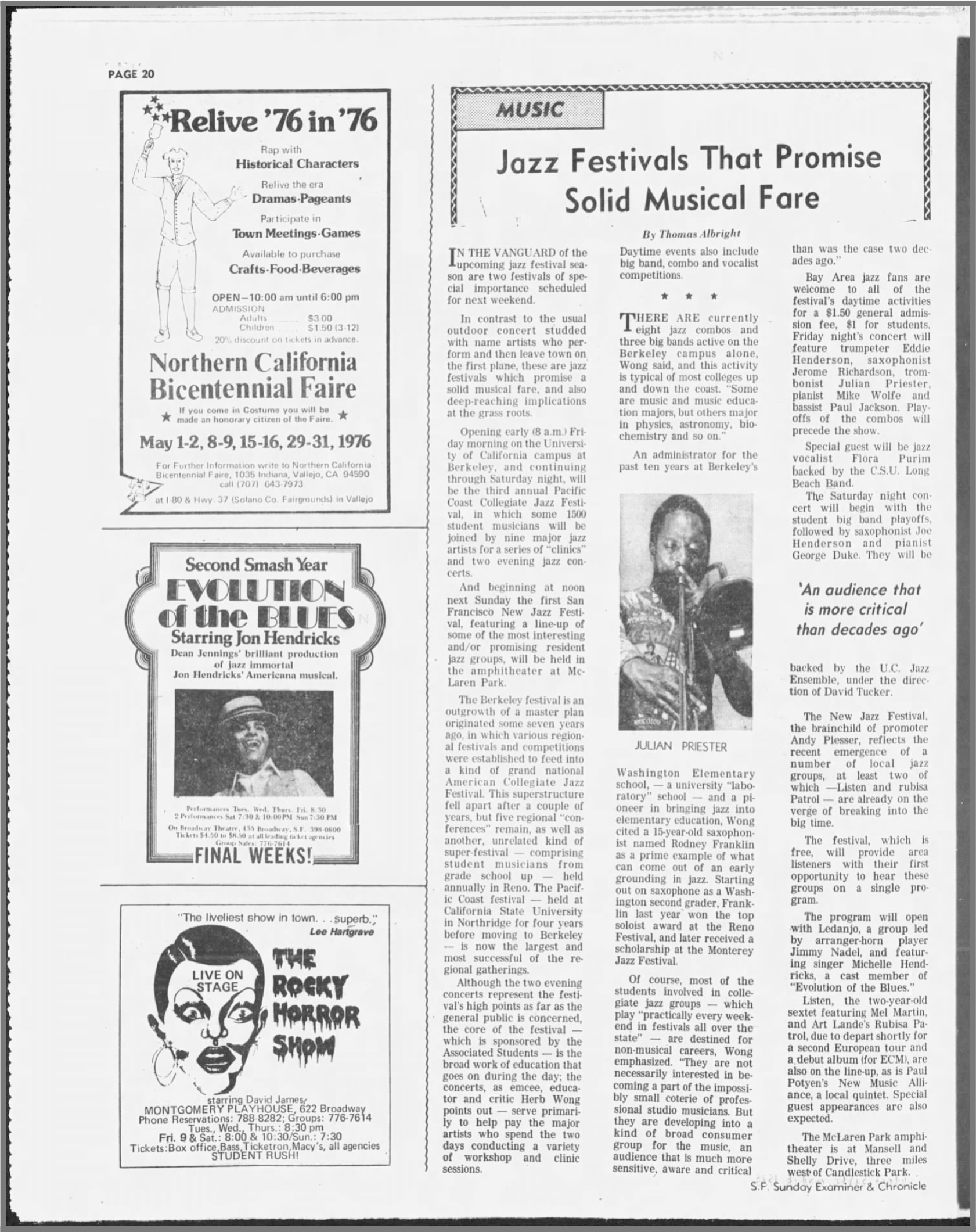 In the vanguard of the upcoming jazz festival season are two festivals of special importance scheduled for next weekend.
In contrast to the usual outdoor concert studded with name artists who perform and then leave town on the first plane, these are jazz festivals which promise a solid musical fare. and also deep-reaching implications at the grass roots.
Opening early (8 a.m.) Friday morning on the University of California campus at Berkeley. and continuing through Saturday night, will be the third annual Pacific Coast Collegiate Jazz Festival, in which some 1500 student musicians will be joined by nine major jazz artists for a series of “clinics” and two-evening jazz concerts.
And beginning at noon next Sunday the first San Francisco New Jazz Fest’. sal, featuring a lineup of some of the mm) interesting and/or promising resident jazz groups, will be held in the amphitheater at Mc. Laren Park.
The Berkeley festival is an outgrowth of a master plan originated some seven years ago. in which various region• at festivals and competitions were established to feed into a kind of grand national American Collegiate Jazz Festival. This superstructure fell apart after a couple of years, but five regional “conferences” remain, as well as another, unrelated kind of super-festival — comprising student musicians from grade school up — held annually in Reno. The Pacific Coast festival — held at California State University in Northridge for four years before moving to Berkeley — is now the largest and most successful of the regional gatherings.
Although the two evening concerts represent the festival’s high points as far as the general public in concerned, the core of the festival —which is sponsored by the Associated Students — is the broad work of education that goes on during the day; the concerts, as emcee, educator and critic Herb Wong points out — serve primarily to help pay the major artists who spend the two days conducting a variety of workshop and clinic sessions.
Daytime events also include big hand, combo and vocalist competitions.
There are currently eight jazz combos and three big bands active on the Berkeley campus alone, Wong said, and this activity is typical of most colleges up and down the coast. “Some are music and music education majors, but others major In physics, astronomy, biochemistry and so on.”
An administrator for the past ten years at Berkeley’s Washington Elementary school, — a university “laboratory” school — and a pioneer in bringing jazz into elementary education, Wong cited a 15-year-old saxophonist named Rodney Franklin as a prime example of what can come out of an early grounding in jazz. Starting out on saxophone as a Washington second grader, Franklin last year son the top soloist award at the Reno Festival, and later received a scholarship at the Monterey Jazz Festival.
Of course, most of the students involved in collegiate Jazz groups — which play “practically every weekend in festivals all over the state” — are destined for non-musical careers, Wong emphasized. “They are not necessarily interested in becoming a part of the impossibly small coterie of professional studio musicians. But they are developing into a kind of broad consumer group for the music, an audience that is much more sensitive, aware and critical than was the case two decades ago.”
Bay Area jazz fans are welcome to all of the festival’s daytime activities for a 81.50 general admission fee, 91 for students. Friday night’s concert will feature trumpeter Eddie Henderson, saxophonist Jerome Richardson, trombonist Julian Priester, pianist Mike Wolfe and bassist Paul Jackson. Playoffs of the combos will precede the show.
Special guest will be Jazz vocalist Flora Purim backed by the C.S.U. Long Reach Band.
The Saturday night concert will begin with the student big band playoffs, followed by saxophonist Joe Henderson and pianist George Duke. They will be backed by the U.C. Jazz Ensemble, under the dire, lion of David Tucker.
The New Jazz Festival, the brainchild of promoter Andy Plesser, reflects the recent emergence of a number of local jazz groups, at least two of which —Listen and Rubisa Patrol — arc already on the verge of breaking into the big time.
The festival, which is free, will provide area listeners with their first opportunity to hear these groups on a single program.
The program Will open with Ledanjo, a group led by arranger-horn player Jimmy Nadel, and featuring singer Michelle Hendricks, a cast member of “Evolution of the Blues.”
Listen, the two-year-old sextet featuring Mel Martin, and Art Lande’s Rubisa Patrol, due to depart shortly for a second European tour and a debut album ‘for ECM’, are also on the line-up, as is Paul Potyen’s New Music Alliance, a local quintet. Special guest appearances are also expected.
The McLaren Park amphitheater is at Mansell and Shelly Drive, three miles west. of Candlestick Park. Sunday Examiner & Chronicle